Algorithms: Geometry Basics
Radians and Degrees
Each time when dealing with angles, pay attention if the value is provided in Radians or Degrees. Some examples of operations are:
| Operation | Unit |
|---|---|
| state.angle | Degrees |
| state.gun.angle | Degrees |
| Math.cos(x) | Radians |
| Math.atan2(y, x) | Radians |
The conversion is pretty simple, knowing that 180 degrees is equal to PI
radianValue = degreeValue * (Math.PI/180);…or…
degreeValue = radianValue * (180/Math.PI);Such operations are used pretty often so Math object in JsBattle was extended by Math.deg2rad(degreeValue) and Math.rad2deg(radianValue) functions. See Extended Math Object for more helper functions.
Normalize angle
Operations on angles can be tricky. Consider the following sum:
30° + 200° + 150° = 380°It is over 360° so we made a full circle plus an additional 20°. In practice, there is not much difference between 380° and 20°. If you rotate the tank by 380° or by 20°, it will be heading at exactly the same direction. However, for your code 20 and 380 are definitely not the same numbers since 380 == 20 is false.
To make your life easier, all angles in JsBattle are normalized to be in range of -180° to 180° (or between -PI and PI if you are using radians).
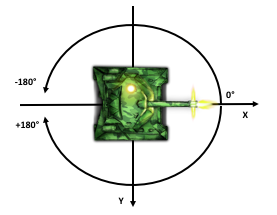
If you need to normalize angles during your calculations you can use Math.rad.normalize(value) or Math.deg.normalize(value) Extended Math Object. For example:
Math.deg.normalize(380) == 20The same logic applies to the calculation of a difference between two angles. Let's assume that you need to calculate the difference between -170° and 150°. Both angles are already normalized but not the result:
-170° - 150° = -320°After normalization, the result is 40° and this is the actual difference between those two angles.
Angles in aiming algorithms
Calculate the angle knowing coordinates
Let's say that you know coordinates of your target (x2, y2), coordinates of your own tank (x1, y1) and you need to calculate the angle where your tank should aim to: angle.
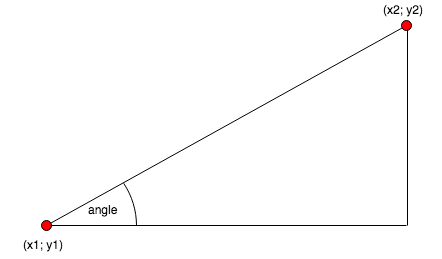
The easiest way to do it is by arctangents function. Extended Math Object provides two implementations of that function for both radians and degrees (Math.rad.atan2(y, x) and Math.deg.atan2(y, x)). Following code will calculate the angle in degrees:
angle = Math.deg.atan2(y2 - y1, x2 - x1);For radians calculations you can use both: the native implementation (Math.atan2(y, x)) or the Extended Math Object (Math.rad.atan2(y, x))
Calculate coordinates knowing the angle
Now let's consider a different situation. You know the position of your tank (x1, y1), and the angle where it is heading (angle). You need to find coordinates of the location where the tank will be (x2, y2) after travelling a defined distance in the current direction.
Such math can be done using sine and cosine functions:
x2 = x1 + Math.cos(angle) * distance;
y2 = y1 + Math.sin(angle) * distance;
Please keep in mind that the angle must be provided in radians