
English · 中文 ·
Architecture
---
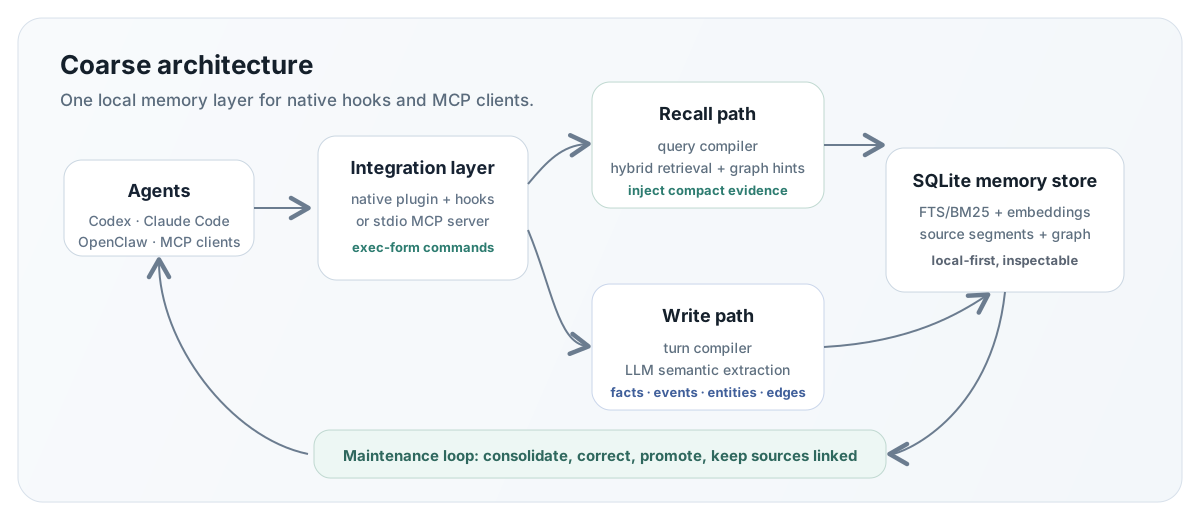
memX turns completed work into structured, searchable, self-maintained memory, then injects only the evidence an agent needs for the current query.
It connects natively to Codex, Claude Code, and OpenClaw, and reaches any MCP-compatible client through the same local memory layer.
## Benchmarks
| Suite |
Scope |
R@3 success rate |
| LongMemEval-S |
Long-context memory retrieval |
94.2% |
| Real engineering cases |
30 cases, each with 20+ turns |
100% |
## Architecture
## Agent support
 |
Codex |
native hooks, MCP hidden by default |
 |
Claude Code |
native hooks, MCP hidden by default |
 |
OpenClaw |
native + hooks |
| MCP |
MCP clients |
any MCP-compatible client |
## Quick start
Requirements: Node.js 22.14+ or Node 24. OpenClaw installs require OpenClaw 2026.3.25+. Python 3 is
needed only for the default local embedding runtime.
The README commands use the GitHub package spec. A fresh run pulls current GitHub code, so installs
do not wait for an npm publish. To use the npm release channel later, replace
`github:NeoLi00/memX` with `@neoli00/memx`.
Fill in these values before running a command:
- `--llm-provider`: the provider adapter memX should call. Choose one of `openai-compatible`,
`anthropic`, `google`, or `ollama`.
- `--llm-base-url`: the base URL for that provider. Examples: `https://api.openai.com/v1`,
`https://api.anthropic.com/v1`, `https://generativelanguage.googleapis.com/v1beta`, or
`http://127.0.0.1:11434` for Ollama.
- `--llm-model`: the model memX uses for memory compilation, recall planning, and maintenance.
Pick a fast, low-cost model with reliable JSON output.
- `--llm-api-key`: the API key for the provider. Use `--llm-api-key-env PROVIDER_API_KEY` if you
want the config to reference an environment variable instead of storing plaintext. For local
Ollama, omit the key.
The default embedding setup is local `sentence-transformers-local` with
`intfloat/multilingual-e5-small`. Add `--embedding-provider` and `--embedding-model` only when you
want to override that default. Use `--dry-run` to preview the files and exec-form commands before
writing anything.
For Codex and Claude Code, native hooks are the default lifecycle path for automatic recall and
turn capture. Quickstart installs the native plugin, writes the shared memX config, starts or
refreshes the managed local memX service, and keeps MCP memory tools hidden with `--mcp-tools none`
by default. This prevents duplicate recall/write and prevents the agent from reading audit data as a
side channel. Use `--mcp-tools full` only when you intentionally want the agent to see the complete
MCP tool set. Generic MCP quickstart stays `full` by default because it has no native lifecycle
hooks. Default native memories are also host-scoped, so Codex and Claude Code do not share the same
local database unless you deliberately override the database path and actor settings.
If `http://127.0.0.1:3878` is already used by an unmanaged memX-compatible service, quickstart stops
instead of silently reusing it. Stop the old service or pass a free local URL, for example
`--memx-url http://127.0.0.1:3888`.
### Claude Code
This installs the shared memX config, a local Claude Code plugin marketplace, native lifecycle
hooks, and the managed local memX service in one run.
```bash
npx -y -p github:NeoLi00/memX memx quickstart claude-code \
--llm-provider openai-compatible \
--llm-base-url https://llm.example.com/v1 \
--llm-model fast-memory-model \
--llm-api-key sk-your-provider-key
```
### Codex
This installs the shared memX config, a local Codex plugin marketplace, native lifecycle hooks, and
the managed local memX service in one run.
```bash
npx -y -p github:NeoLi00/memX memx quickstart codex \
--llm-provider openai-compatible \
--llm-base-url https://llm.example.com/v1 \
--llm-model fast-memory-model \
--llm-api-key sk-your-provider-key
```
### OpenClaw
```bash
npx -y -p github:NeoLi00/memX memx quickstart openclaw \
--llm-provider openai-compatible \
--llm-base-url https://llm.example.com/v1 \
--llm-model fast-memory-model \
--llm-api-key sk-your-provider-key
```
### Generic MCP
Use this path for MCP clients that do not have a native memX lifecycle adapter. Quickstart writes the
shared memX config, starts the managed local memX service, and prints a ready-to-copy MCP server
config.
```bash
npx -y -p github:NeoLi00/memX memx quickstart mcp \
--llm-provider openai-compatible \
--llm-base-url https://llm.example.com/v1 \
--llm-model fast-memory-model \
--llm-api-key sk-your-provider-key
```
### Service management
```bash
npx -y -p github:NeoLi00/memX memx service status
npx -y -p github:NeoLi00/memX memx service restart
npx -y -p github:NeoLi00/memX memx service stop
```
Use the same `--home`, `--memx-url`, and `--memx-secret` values that you used during quickstart when
you manage a non-default install.
## Clean uninstall
Each uninstall command backs up the target config first, then removes only memX-owned entries.
Claude Code and Codex cleanup also stop the managed local service, uninstall the native plugin,
remove the local marketplace, and delete the generated marketplace snapshot.
OpenClaw cleanup also removes stale `memx` / `memory-memx` slot, allow, and entry references, then
best-effort uninstalls both current and legacy plugin files if OpenClaw can still see them.
```bash
npx -y -p github:NeoLi00/memX memx uninstall openclaw
npx -y -p github:NeoLi00/memX memx uninstall codex
npx -y -p github:NeoLi00/memX memx uninstall claude-code
```
Add `--dry-run` to preview, or `--config /path/to/config` when using a non-default config path.
## What memX can do
- **Remember work over time**: project decisions, user preferences, task status, long source
segments, and raw evidence stay linked to the original turn.
- **Connect related things**: projects, repos, tools, files, resources, blockers, and outcomes can
be represented as entities and graph edges.
- **Learn collaboration patterns**: repeated evidence can become reusable guidance without losing
its supporting sources.
- **Maintain itself**: corrections can supersede older facts, stable evidence can be promoted, and
stale task state stops competing with current state.
- **Recall compact evidence**: facts, events, state, chunks, relationships, resources, and learned
patterns are searched together, then injected as small evidence lines.