ztrack
Done is earned, not declared. A verification gate for AI coding agents — every “done” backed by a real commit and proof, or it doesn’t pass.






Setup ·
Usage ·
Guide ·
Support ·
Startup Pilot
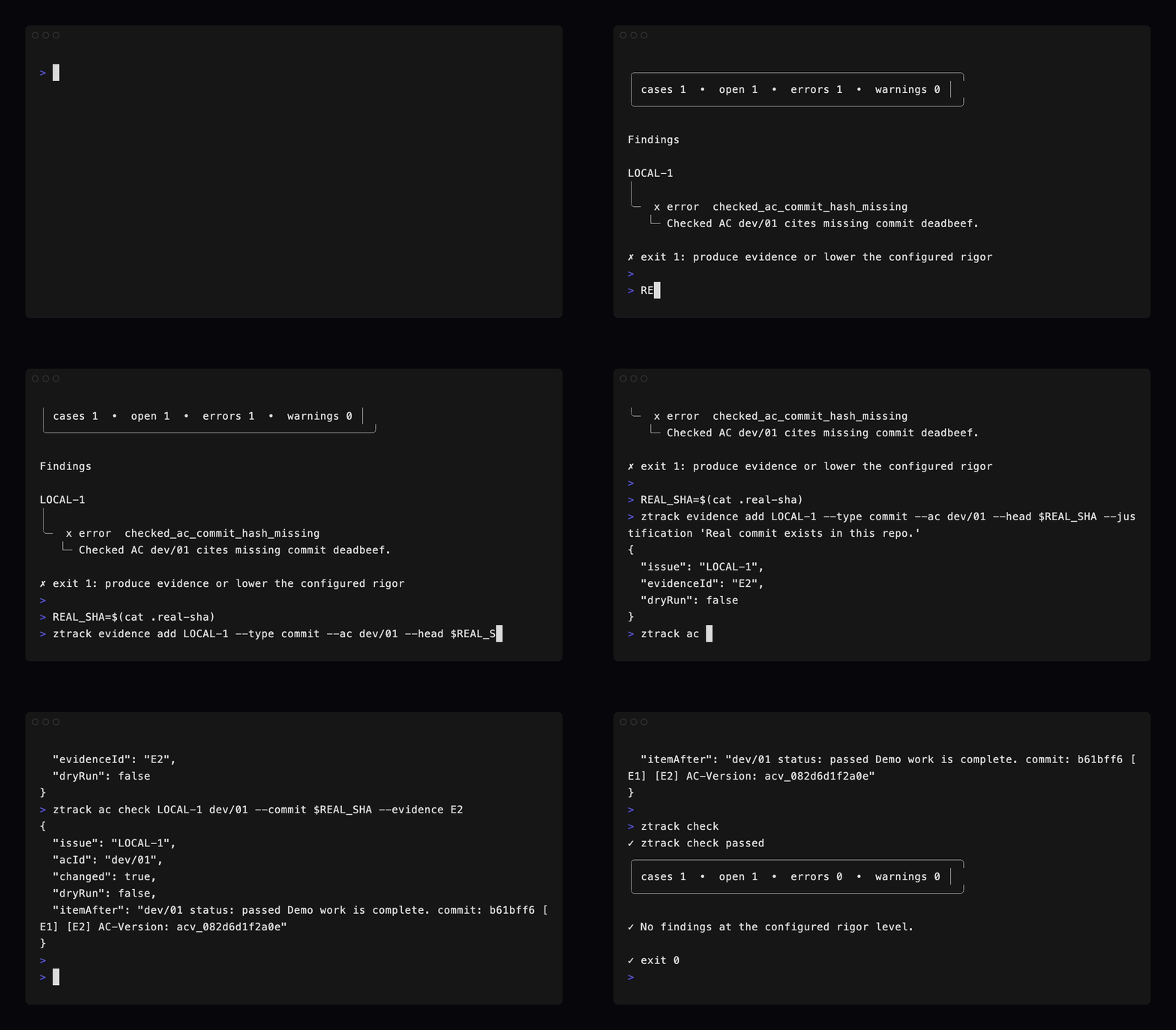
AI coding agents close tickets on prose. "All tests pass, feature complete" — and the
commit it cited never existed. Your tracker stored the claim with perfect fidelity and
verified nothing.
**ztrack is a typechecker for your issue tracker.** A checked acceptance criterion must cite a
commit SHA that exists in git, plus the evidence and proof the preset requires. You use it **two
ways**, over the same work:
- **`ztrack check`** — verify on demand (CI, pre-merge, a spot check). Pass or exit non-zero.
- **`ztrack loop`** — a *ralph loop*: Stop/SubagentStop hooks hold your agent's turn (and any
subagent's) until the work is actually green. **Recommended while developing** — the agent
can't call it done until it is.
`check` is the oracle; `loop` runs that oracle on every turn until the agent earns "done."
## What ztrack catches
| Claim in the tracker | What ztrack verifies |
|---|---|
| "Implemented in commit `a1b2c3d`" | the SHA exists in the local git object database |
| "This acceptance criterion is passed" | it cites evidence captured at a real commit, against the current AC version |
| "This evidence proves it" | the AC carries a `proof:` that names the evidence it relies on |
| "This ticket is ready/done" | the installed preset's lifecycle gates hold — every AC passed (and, on a PR-based preset, the PR exists/merged) |
Lint errors are fixed by editing text. Type errors are fixed by producing evidence.
**What it does _not_ verify** (be honest with your team): the `simple-sdlc` preset checks that the
cited commit **exists** and — if you cite an image — that the image is committed at that commit (a
fabricated screenshot path fails). By default it does not check *relevance* — a real, unrelated commit
with a real screenshot still passes — but an AC can opt in to a `paths:` **relevance anchor** (or the
repo can require one on every passed AC) so a claimed commit must at least touch the area it claims;
see [Relevance](#relevance) below. Full semantic judgment ("is this commit really the right fix for
the right reason") is still the irreducible thing a deterministic checker can't make. It raises the
floor from "prose can lie" to "the proof must exist, be real, and land in the claimed area"; encode
stricter, project-specific grounding in the editable `preset.mts`.
---
# Setup
> **Prerequisites:** Node ≥ 22.18 (the installed preset is `.mts`, loaded via native type
> stripping, on by default from Node 22.18 / 23.6 / 24) and `git`. No database, no Python. The
> `ztrack visualizer` additionally needs [Bun](https://bun.sh). Verified under npm, pnpm, yarn
> (classic + Berry + PnP), and bun.
ztrack is a project dev-dependency — the installed preset imports the mechanism from it, exactly
like an eslint config imports its plugins (a global or one-off `npx` install is not enough):
```bash
npm install -D ztrack # add ztrack to the project (the preset imports it)
npx ztrack init # installs .volter/tracker/validation/preset.mts — real, editable rules
```
That's the whole setup for local verification. Three things you choose here:
**1. Local or linked.** The default is a **local tracker** — issues live as markdown in your repo,
committed alongside the code. To make your issues *be* GitHub Issues, synced both ways:
```bash
npx ztrack init --sync github --repo owner/name # links + pulls existing issues; check/loop stay synced
```
**2. Your preset (the ruleset).** `ztrack init` installs the recommended **`simple-sdlc`** baseline.
See all presets with `ztrack init --list`; choose one with `--preset `. The installed
`preset.mts` is real, editable code — open it and change the rules. (Reference: [Presets](docs/PRESETS.md).)
**3. The loop gate** — only needed for `ztrack loop` usage. Install the Stop/SubagentStop-hook
plugin once; it's **dormant unless a loop is armed**, so it's safe to leave enabled globally:
```bash
/plugin marketplace add volter-ai/ztrack # in Claude Code
/plugin install ztrack@ztrack
```
Not using Claude Code plugins? Wire the Stop and SubagentStop hooks yourself — see the
[Guide → drive an agent to green](docs/GUIDE.md#3-usage-drive-an-agent-to-green).
### Optional machine-local project hooks
Independent tools can subscribe to ztrack's `project:invoke` event without becoming a ztrack dependency:
```sh
ztrack hooks add --event project:invoke --id my-tool --timeout-ms 10000 -- /absolute/path/to/tool arg1
ztrack hooks list --json
ztrack hooks remove my-tool
```
The versioned `ztrack.project-hooks.v1` registry lives at `/ztrack/hooks.json`, so it is
local to one clone, shared by its worktrees, and cannot be enabled by committed repository files. Commands
are stored as an absolute executable plus a literal argv vector and run without a shell. Each hook is
bounded to 15 seconds and failures warn without changing the ztrack command's result. ztrack supplies
`ZTRACK_HOOK_EVENT`, `ZTRACK_PROJECT_ROOT`, and `ZTRACK_COMMAND_JSON` to the child. Help, version,
completions, hook management, initialization, migration, unrecognized commands, and standalone-file checks
do not invoke project hooks.
---
# Usage
**First decide where your work lives, then how you'll drive it** — two choices each, four doors:
| You have… | Do |
|---|---|
| **GitHub Issues already** | `npx ztrack init --sync github --repo owner/name` — your issues pull in and GitHub stays the source of truth ([linked sync](docs/GUIDE.md#how-linked-sync-works)) |
| **a pile of tasks, no tracker** | `npx ztrack init`, write the tasks down as you naturally would, then `npx ztrack import notes/tasks.md --register` materializes them into issues (or `issue create` one by one) ([importing](docs/GUIDE.md#importing-a-freeform-backlog)) |
| **one issue to finish** | `ztrack loop start --until done` — the Stop-hook gate holds your agent's turn until the work is genuinely done ([drive to green](#drive-to-green--ztrack-loop)) |
| **a whole backlog to burn down** | groom → order → dispatch one loop-armed subagent per `issue list --actionable` row, wave by wave ([orchestrating a backlog](docs/GUIDE.md#orchestrating-a-whole-backlog-one-long-lived-session-many-issues)) |
Two patterns, **the same targets**. Pick by the job:
| | **`ztrack check`** | **`ztrack loop start`** |
|---|---|---|
| **does** | verifies once, exits `0`/`1` | a ralph loop — Stop/SubagentStop hooks hold every turn in the root (main agent and subagents alike) until the target is green, then disarm |
| **use for** | CI gate, pre-merge, a manual "is this real?" | driving an agent to actually finish — **recommended during development** |
| **bounds** | one run | capped iterations, with honest escapes; cooperative, not a sandbox |
Both take the same target — nothing, an id, a file, or the current branch's issue:
```bash
ztrack check # (nothing) the whole tracker
ztrack check LOCAL-1 # one issue
ztrack check ./body.md # a markdown file (document grammar checks every issue in it)
ztrack check # (in a worktree named for an issue) → that issue, automatically
ztrack loop start LOCAL-1 # loop takes the exact same target grammar
```
A `` in **document grammar** (id-bearing headings like `## APP-1 — title`, the same
grammar a registered `format: "document"` source uses) is checked as the multi-issue document it
is — every issue in the file, intra-file relations included — and a stderr note says whether the
file is a **registered source** (i.e. whether the tracker itself can see these issues), offering
`ztrack import --register` when it is not. Anything else is one loose issue, checked for
**structure + evidence** (the core promise); lifecycle/PR gates (ready/in-review/done) apply only
to **stored** issues, so a loose file is treated as a draft.
### Verify once — `ztrack check`
Install, init, author an acceptance criterion that claims done but cites a **fabricated** commit,
and watch ztrack catch it:
```bash
cat > body.md <<'EOF'
Assignee: me
Status: ready
## Acceptance Criteria
- [x] dev/01 v1 GET /health returns 200
- status: passed
- evidence ev1: commit=deadbeef acv=1
- proof: "screenshot shows a 200 response" -> ev1
EOF
npx ztrack issue create --title "Add /health" --label type:case --state ready --assignee me --body-file body.md
npx ztrack check # ✗ the cited commit isn't in git
```
```text
✗ ztrack check failed issues 1 • errors 1 • warnings 0
LOCAL-1
╰─ ✗ error evidence_commit_not_found
└─ Evidence ev1 cites commit deadbeef, which does not exist.
✗ exit 1 — the checkbox says done. the commit doesn't exist.
```
Now make it real — commit the work, cite a SHA that exists, re-import the body (the issue is stored
independently, so editing `body.md` alone isn't enough), and re-check:
```bash
git add -A && git commit -m "add /health endpoint"
SHA=$(git rev-parse HEAD)
sed "s/deadbeef/$SHA/" body.md > body.fixed.md # cite a SHA that exists
npx ztrack issue edit LOCAL-1 --body-file body.fixed.md # re-import the corrected body
npx ztrack check # ✓ now it passes
```
That's the whole idea: a checked acceptance criterion must cite proof that actually exists.
### Drive to green — `ztrack loop`
The recommended development flow, in three steps:
**1. Install the gate once** — dormant unless a loop is armed, so it's safe to leave enabled (Claude
Code; non-plugin wiring is in the [Guide](docs/GUIDE.md#3-usage-drive-an-agent-to-green)):
```bash
/plugin marketplace add volter-ai/ztrack
/plugin install ztrack@ztrack
```
**2. Arm a loop** on the issue you're working — two modes, same `start`:
```bash
ztrack loop start LOCAL-1 # validate-current-stage: hold until LOCAL-1's CURRENT status passes check
ztrack loop start LOCAL-1 --until done # drive-to-stage: hold until LOCAL-1's status reaches "done" (or later) AND passes check there
```
`--until ` is for driving an issue somewhere it isn't yet — the stage is any value in the
active preset's status vocabulary (e.g. `ready`, `in-review`, `done`), validated at arm time (an
unknown stage fails loud, naming the real vocabulary). It's the difference between "is the current
stage real?" and "get this all the way to done" — without pre-flipping the issue to a stage that
isn't true yet just to make the oracle look at it. Flipping the status early doesn't cheat this:
that stage's own lifecycle gates (e.g. every AC passed before `in-review`) still have to pass for
real, so an early `--state done` with unpassed ACs stays red on its own. `--until` only makes
sense for a single issue (an id, or the bare/auto-resolved worktree issue) — a file or the whole
tracker has no one status to drive.
**3. Point your agent at the issue** — hand it the id (its working rules are in the
[agent playbook](docs/AGENT-PLAYBOOK.md)). When the agent — or a subagent it delegates to — tries
to stop, the Stop/SubagentStop hook runs `ztrack check`; if the issue is still red — or, under
`--until`, its status hasn't reached the target stage yet — the turn is held and the agent keeps
working — until the work is genuinely green (then the loop disarms), or it hits the iteration cap.
It's **cooperative**, not a sandbox: the agent can disarm (`ztrack loop stop`), self-exempt for a
session, or an authority can [waive](docs/PRESETS.md#waivers) a finding it knowingly accepts — so it
never grinds forever on something it can't satisfy honestly.
```bash
ztrack loop status # is a loop armed? capped?
ztrack loop stop # disarm
```
You set the target; the loop holds the standard.
**Driving a whole backlog** (not just one issue) is the same loop, dispatched wave by wave:
`ztrack issue list --actionable` names every not-done, unblocked issue — the dispatch frontier — and
`--blocked` names what's stalling the rest. See [Guide → Orchestrating a whole
backlog](docs/GUIDE.md#orchestrating-a-whole-backlog-one-long-lived-session-many-issues) for the full
intake → groom → order → dispatch flow.
## When the checker is wrong
`ztrack check` is deterministic, but deterministic isn't the same as always right for your repo — a
legacy AC that predates evidence discipline, or a finding that genuinely doesn't apply. The sanctioned
override is a **waiver**, signed by a human (or an agent acting under one), not editing the check's
output or disabling a rule globally:
```bash
ztrack waiver sign --code [--ac ] [--ref ] --reason "..."
ztrack waiver status
ztrack waiver clear [--code ]
```
A waiver lives in the issue body's `## Waivers` section, one line per waiver — pinned to the single
offending occurrence, `// eslint-disable-next-line` style:
```
- code: evidence_commit_not_found ac: dev/01 ref: cafebabe… reason: repo predates the import by: Jane Doe (jane@co.com)
```
`sign` downgrades the matching finding from `error` to `acknowledged` — `check` still reports it, but
exits `0`. The `ref:` pin (auto-captured by `sign` when the finding is unambiguous; pass `--ref
` yourself when it isn't) scopes the waiver to ONE occurrence — the offending value, e.g. a
commit SHA — so it self-expires the moment that occurrence changes instead of silencing the rule
forever. Sign-off is captured automatically from your git identity (`git config user.name` /
`user.email`); you can't waive anonymously. Hygiene is enforced in every direction: an unreasoned or
unsigned waiver is itself an error (`waiver_missing_reason`, `waiver_missing_signoff`); an unpinned
waiver that could pin is flagged `waiver_overbroad` (`ztrack waiver migrate` rewrites legacy broad
rows into per-occurrence pins); and a waiver that stops matching anything is flagged `waiver_unused`
(a warning, not blocking) so a stale waiver doesn't silently keep suppressing forever.
Prefer fixing the issue; waive only a finding you knowingly accept. Full grammar in
[Presets → Waivers](docs/PRESETS.md#waivers).
## Relevance
By default `ztrack check` verifies that cited evidence *exists and is real* — not that it's *about*
the claimed work. An acceptance criterion can opt in to a **relevance anchor**: a `paths:` glob
declaring the repo area it concerns. Once declared, a passed AC's cited commit(s) must touch at least
one of those paths, or the claim is rejected:
```markdown
- [x] dev/01 v1 GET /health returns 200
- status: passed
- paths: src/**
- evidence ev1: commit= acv=1
- proof: "the commit adds the health endpoint" -> ev1
```
A commit that only touches `docs/` here fails with `evidence_commit_unrelated`; one that touches a
`src/` file passes. `paths:` accepts globs (`*` within a segment, `**` across segments, literal
files/dirs, comma-separated lists) and is satisfied by ANY cited commit touching ANY declared path.
`paths:` is opt-in — a passed AC that omits it is never relevance-checked (existing repos are
unaffected). Set `"relevance": "required"` in `.volter/tracker-config.json` to make it mandatory:
every passed AC must then declare `paths:`, or `passed_ac_missing_paths` fires. This is still not full
semantic judgment (a commit that touches the right files for the wrong reason still passes) — it's a
deterministic floor: the cited proof must at least be **in** the area it claims to fix.
---
## How it works
ztrack is a verification layer, not a new tracker. It reads tasks from your work system (or a
committed validated root), parses them into one strict multi-issue root through a Zod schema,
gathers git/world facts into a typed context, and runs pure rules over it — exiting non-zero when a
checked claim isn't backed by real proof. CI, MCP, or an agent Stop hook can block on that exit.
Keep **Linear**, **Jira**, or **GitHub Issues** as the human surface; ztrack sits next to them and
validates the claims agents or humans make there. Two-way sync with GitHub Issues is built in (a
synced issue *is* the GitHub issue) — see the [Guide → linked sync](docs/GUIDE.md#how-linked-sync-works).
## One document, many issues
Your existing plan or backlog markdown can *be* the tracker. Declare it as a `document` source and
every heading whose text starts with an id (`APP-1 — Add the /health endpoint`) becomes an issue —
no reformatting, no separate store to keep in sync:
```bash
cat > PLAN.md <<'EOF'
## APP-1 — Add the /health endpoint
status: ready
assignee: me
### Acceptance Criteria
- [ ] dev/01 v1 GET /health returns 200
- status: pending
EOF
```
```jsonc
// .volter/tracker-config.json
{ "sources": [{ "path": ".volter/tracker/markdown" }, { "path": "PLAN.md", "format": "document" }] }
```
```bash
npx ztrack issue list --json identifier,title # -> APP-1 Add the /health endpoint
npx ztrack check # reads PLAN.md like any other store
```
`ac patch`/`issue edit` splice a verified change straight back into the doc at the heading's
recorded span — patching `dev/01` above changes only its checkbox and status/evidence/proof lines;
every other byte in `PLAN.md` is untouched. State, assignee, and anything wider than title/body
still fail closed, naming the file to edit directly instead. With 2+ declared sources,
`--source ` scopes `issue list` and `check` to one or more of them (repeatable AND
comma-separated, on both commands). Grammar, the write model, scoping, and diagnostics:
[Sources](docs/SOURCES.md).
Already have a messier backlog — headings, prose, checkboxes, no id tokens? `ztrack import` (accepts
a file, a directory, or a quoted glob) materializes it into that same grammar **in place**,
idempotently: `ztrack import notes/backlog.md --dry-run` previews the plan, plain `ztrack import`
writes it, `--register` declares the result as a source. Pre-checked `[x]` items import unchecked
with a preserved-claim marker (a checked-but-unproven claim is exactly what `check` rejects); an
`Acceptance Criteria` or `Waivers` section is recognized document-source structure and is never
turned into an issue, so waiver rows survive untouched — see
[Sources → Importing a freeform backlog](docs/SOURCES.md#importing-a-freeform-backlog).
And a file that tracks work in a repo's **own** idiom — `### KQ1` sections with
`- **Status**: 🟢/🟡/🔴` bullets, or `- [x] **WS-A: title**` checkbox rosters — needs no rewrite at
all: `ztrack check ` auto-detects the shape (a **dialect**) and checks every issue through a
read-only lens, printing the one command that adopts it. Registering the lens is config-only (the
file is never modified); its issues appear in `issue list`/`check` with their own ids and true
statuses, reported but never gating. Materializing later (`ztrack import --register`)
is the opt-in upgrade to the full grammar, with any id renames recorded as aliases so old
spellings keep resolving — see [Sources → Dialect lenses](docs/SOURCES.md#dialect-lenses-read-a-repos-own-idiom).
## Agent workflows
ztrack is built to be an AI agent's **completion oracle** — three ways to wire it, smallest to most
autonomous:
- **CI gate:** the `volter-ai/ztrack@v1` Action over a committed validated root (or `npx ztrack check --phase gate`) — full recipe, including linked mode, in the [Guide → gate it in CI](docs/GUIDE.md#gate-it-in-ci).
- **MCP:** `claude mcp add ztrack -- npx ztrack mcp serve` — the agent calls `tracker_check` before finishing.
- **Autonomy loop:** the [`ztrack loop`](#drive-to-green--ztrack-loop) Stop-hook gate above — the recommended development flow.
Full setup (MCP tools, the loop, the Stop-hook `settings.json`) is in the
[Guide → drive an agent to green](docs/GUIDE.md#3-usage-drive-an-agent-to-green); the copy-paste agent
adoption prompt is in the [agent playbook](docs/AGENT-PLAYBOOK.md).
## Presets
`ztrack init --preset ` installs one editable, **standalone** preset — its own schema, parser,
and rules, importing only `ztrack/preset-kit`:
| Preset | Use when |
|---|---|
| `simple-sdlc` | a dev lifecycle (draft→ready→in-progress→in-review→done) with commit+proof evidence — **PR-free**, runs locally. The recommended baseline; `default` is an alias for it |
| `simple-gh-sdlc` | the same, **plus** a GitHub PR at in-review and a merged PR for done |
| `spec` | issue bodies are specs whose ACs cite commit-backed evidence |
| `speckit` | GitHub Spec Kit style feature records (user stories, tasks, phases) |
`ztrack init --list` shows every preset; [Presets](docs/PRESETS.md) documents the exact gates and how
to add your own rule.
## Visualize
For a read-only web view of the tracker — issues, acceptance-criteria progress, findings, and
audit-derived timestamps — run the visualizer (requires [Bun](https://bun.sh)):
```bash
ztrack visualizer # the active preset, http://localhost:3300
ztrack viz --preset speckit --port 4000
```
It validates the live tracker on each request through the same core as `check`, so the board never
drifts from what CI enforces.
The board is yours to mod — its vocabulary, theme, and panels are repo-owned code and data, like the
preset. See [docs/VISUALIZER.md](docs/VISUALIZER.md) for theming it, teaching it a new status, and
adding custom panels.
### Embed Project Work
Hosts can render the same validated board without an iframe or a second parser:
```tsx
import { ZtrackVisualizer } from 'ztrack/visualizer-react';
import 'ztrack/visualizer-react/styles.css';
```
`ztrack/visualizer-node` supplies the configured payload plus confined theme
and extension loaders for a trusted local server. The React surface is
browser-safe, rooted under `.ztrack-root`, and styled through `--ztrack-*`
variables. Use `variant="compact"` for a chat-side summary, `"embedded"` for
a host-owned work document, and `"standalone"` for ztrack's complete app.
All three variants render ztrack's real list, board, and detail components;
there is no separate simplified component set. `ztrack/supercode` is the
optional read-only integration seam: it
resolves exact work-item context or ambient branch/worktree signals, reports
conflicts and stale references, and projects Supercode task activity without
writing either tracker issues or transcripts.
## Why believe it
ztrack runs our own autonomous agent fleet in production — it's what we use to ship real code. Every
release re-proves in CI that a fabricated commit SHA fails the check.
**Stability & dependencies (be honest before adopting).** Since 1.0.0 ztrack follows semver
proper: the CLI flag surface, the package-root API, and the bundled preset contracts break only at
a **major** version — minor and patch releases are safe to take. Still read the
[CHANGELOG](CHANGELOG.md) before upgrading across a major. The deterministic **local** core
(check, evidence, presets) depends only on the markdown store and git, and needs nothing beyond
`ztrack` itself. **GitHub two-way sync** and **world-backed evidence** route through `@volter-ai-dev/twin` (same publisher) — since 0.38.0 that's an **optional
peer dependency**, not a regular one: adopt only local verification and nothing extra installs or
runs; adopt sync and you must `npm install -D @volter-ai-dev/twin @volter-ai-dev/twin-github`
yourself, and run the sync command under **bun** (not npx/node) — see the [canonical
recipe](docs/GUIDE.md#github-sync-since-038-install-the-peers-run-under-bun).
## How it compares
| | Records claim | Validates structure | Verifies evidence of "done" |
|---|:---:|:---:|:---:|
| Linear / Jira | ✓ | shape only | — |
| Beads / Backlog.md | ✓ | partial | — |
| spec-kit / OpenSpec | ✓ | ✓ (prose shape) | — |
| Eval / observability | ephemeral | — | scores outputs |
| **ztrack** | ✓ | ✓ | ✓ |
## Managed setup
The open-source core is free to self-host and run locally. Teams that want help wiring ztrack into an
existing tracker, CI, MCP, and the agent Stop-hook loop can apply for
[Startup Pilot](https://ztrack.dev/startup-pilot.html). No payment is collected until we confirm a
good fit.
## Community and support
- Questions and bugs: open a GitHub issue with the matching template.
- Feature ideas: include the workflow problem and the evidence you want ztrack to verify.
- Managed setup: use the [Startup Pilot](https://ztrack.dev/startup-pilot.html) form.
- Security reports: use GitHub Security Advisories; do not open public security issues.
## Documentation
The README is the front door; these go deep:
- **[Guide](docs/GUIDE.md)** — setup, the two usage patterns, CI gate, agent enforcement, visualize.
- **[Presets](docs/PRESETS.md)** — choose and customize the ruleset; the grammar; add a rule; build your own preset; `preset upgrade`.
- **[Sources](docs/SOURCES.md)** — declare where issues live; the document format (one file, many issues); write-back and diagnostics.
- **[Evidence](docs/EVIDENCE.md)** — cite, store, and verify proof; in-toto + DSSE attestation.
- **[Agent playbook](docs/AGENT-PLAYBOOK.md)** — the copy-paste prompt for an agent adopting and driving ztrack.
- **[Programmatic API](docs/API.md)** · **[Architecture](ARCHITECTURE.md)** · **[Visualizer](visualizer/README.md)** ([extending it](docs/VISUALIZER.md))
- **[Roadmap](ROADMAP.md)** · **[Contributing](CONTRIBUTING.md)** · **[Security](SECURITY.md)** · **[Changelog](CHANGELOG.md)**
## License
[Apache-2.0](LICENSE)