YAGL
====
[](https://www.travis-ci.org/samvv/YAGL)
YAGL is Yet Another Graph Library™ for storing and manipulating mathematical
graphs. It can be used in a wide range of applications, from package managers
that need to find the correct dependencies to network analysis.
⚠ Some components haven't thoroughly been tested yet. You are invited to try
out this library and report any bugs in the [issue tracker][1].
[1]: https://github.com/samvv/YAGL/issues
### Features
- **Fully typed graph algorithms** including a toplogical sort and a cycle detector
- **Algorithms in this library can be paused** to only provide part of the
result
- **Generic graph interface** allowing you to define your own graph on which the
algorithms will work
- **Support for asynchronous iteration protocol**, allowing data to be fetched
as the algorithm continues.
## Examples
### Sorting a list of dependencies
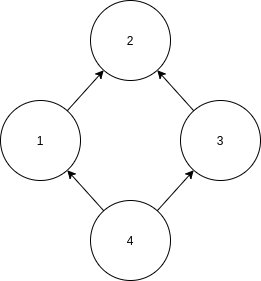
The following is an example of a simple graph with vertices numbered from 1 to 4.
 ```typescript
import { DirectedHashGraph } from "yagl"
const g = new DirectedHashGraph([[1, 2], [3, 2], [4, 1], [4, 3]]);
```
If we want to know which node goes before the next, we can use this library
to perform a _toplogical sort_. Note that in the image below all the arrows are
now from right to left.
```typescript
import { DirectedHashGraph } from "yagl"
const g = new DirectedHashGraph([[1, 2], [3, 2], [4, 1], [4, 3]]);
```
If we want to know which node goes before the next, we can use this library
to perform a _toplogical sort_. Note that in the image below all the arrows are
now from right to left.
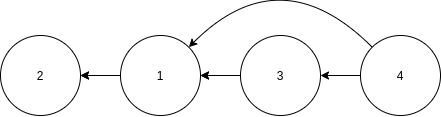 This library can lazily calculate the first element that is guaranteed to have
no outgoing edges. This can be done like so:
```typescript
import { toposort } from "yagl"
const ordered = toposort(g);
console.log(ordered.next().value); // outputs 2
// the rest of the items will not be calculated
```
If you want to force calculating all elements upfront you can make use of the
spread operator:
```typescript
console.log([...toposort(g)]) // [2, 1, 3, 4];
```
### Using the asynchronus API
The following example demonstrates how to use the asynchronous version of the
library to count how many people in a database are connected to one another
either directly or indirectly:
```typescript
import { AsyncGraph, strongconnectAsync } from "yagl"
class MyGraphFromDB implements AsyncGraph {
public getTargetVertices(person): Iterable {
return db.findFriendsOfPerson(person.id);
}
// ...
}
async function printConnectedPeople(person): void {
const people = new MyGraphFromDB();
for await (const scc of strongconnectAsync(people)) {
console.log(`${scc.length} persons are connected to one another.`);
}
}
```
## Graph Types
There are many different graph types possible, each with their own advantages
and disadvantages. YAGL comes bundled with a few implementations that are most
regularly used. Use the graph type that gives you the best perfomance for your
specific application.
| Name | Edge type | Labeled | Edge check | Add edge | Remove edge | Incoming | Outgoing |
|--------------------------|-----------|---------|------------|----------|-------------|----------|----------|
| DirectedHashGraph | Directed | No | O(1) | O(1) | O(1) | O(1) | O(1) |
| LabeledDirectedHashGraph | Directed | Yes | O(1) | O(1) | O(1) | O(1) | O(1) |
## Graph API
### Graph.vertexCount
A read-only property that indicates the total amount of vertices that are
stored within this graph.
### Graph.edgeCount
A read-only property that indicates the total amount of edges that are stored
within this graph.
### Graph.addEdge(from, to)
Adds a new edge from vertex `from` to vertex `to` to the graph. When the vertex
is not present, it will be automatically added to the list of vertices in the
graph.
### Graph.addVertex(vertex)
Adds a new vertex to the graph. Note that this is not strictly necessary, as
new vertices are automatically added when calling `addEdge`.
### Graph.getTargetVertices(vertex)
Get all the vertices that flow outward from the given vertex.
```typescript
const g = new DirectedHashGraph([[2, 1], [3, 1]]);
// this will print '[1]'
console.log([...g.getTargetVertices(3)])
```
### Graph.getSourceVertices(vertex)
Get all the vertices that lead to the provided vertex, if any.
```typescript
const g = new DirectedHashGraph([[2, 1], [3, 1]]);
// this will print '[1, 3]'
console.log([...g.getSourceVertices(1)])
```
### Graph.deleteVertex(vertex)
Delete the given vertex and all associated edges from the graph.
## Algorithms
The algorithms are written using ES6 generators, which means that they
**incrementally perform calculations on-demand**. This can be extremely useful
if you e.g. only need the first strongly connected component in a graph, or
only want to calculate the next task if the previous task has finished.
### preorder(graph)
Performs a depth-first graph traversal starting at the given node. The nodes
are traversed in _pre-order_, meaning that first the node itself is returned,
and then its children are visited. Returns an [Iterable][2] that generates the
next node that has been visited.
### preorderAsync(graph)
Performs a depth-first asynchronous graph traversal starting at the given node.
The nodes are traversed in _pre-order_, meaning that first the node itself is
returned, and then its children are visited. Returns an [AsyncIterable][3] that
generates the next node that has been visited.
### strongconnect(graph)
Finds all _strongly connected components_ in a graph by going through all nodes
and edges. Takes `O(|E| + |V|)` time. Returns an [Iterable][2] that generates
lists of nodes that are strongly connected to one another.
### strongconnectAsync(graph)
Finds all _strongly connected components_ in an asynchronous graph by going
through all nodes and edges. Takes `O(|E| + |V|)` time. Returns an
[AsyncIterable][3] that generates lists of nodes that are strongly connected to
one another.
### hasCycle(graph)
Quickly detect whether a given graph has cycles. In the worst case, this method
takes `O(|E| + |V|)` time, but it might return faster if there is a cycle.
### hasCycleAsync(graph)
Quickly detect whether a given asynchronous graph has cycles. In the worst
case, this method takes `O(|E| + |V|)` time, but it might return faster if
there is a cycle.
### toposort(graph)
Performs a _topological sort_ on the graph. Also takes `O(|E| + |V|)` time.
Throws an error if the graph contains one or more cycles. Returns an
[Iterable][2] that generates the next dependency in reverse order.
### toposortAsync(graph)
Performs a _topological sort_ on an asynchronous graph. Also takes `O(|E| +
|V|)` time. Throws an error if the graph contains one or more cycles. Returns
an [AsyncIterable][3] that generates the next dependency in reverse order.
[2]: https://developer.mozilla.org/en-US/docs/Web/JavaScript/Reference/Iteration_protocols#The_iterable_protocol
[3]: https://github.com/tc39/proposal-async-iteration
## License
This software is licensed under the MIT license.
This library can lazily calculate the first element that is guaranteed to have
no outgoing edges. This can be done like so:
```typescript
import { toposort } from "yagl"
const ordered = toposort(g);
console.log(ordered.next().value); // outputs 2
// the rest of the items will not be calculated
```
If you want to force calculating all elements upfront you can make use of the
spread operator:
```typescript
console.log([...toposort(g)]) // [2, 1, 3, 4];
```
### Using the asynchronus API
The following example demonstrates how to use the asynchronous version of the
library to count how many people in a database are connected to one another
either directly or indirectly:
```typescript
import { AsyncGraph, strongconnectAsync } from "yagl"
class MyGraphFromDB implements AsyncGraph {
public getTargetVertices(person): Iterable {
return db.findFriendsOfPerson(person.id);
}
// ...
}
async function printConnectedPeople(person): void {
const people = new MyGraphFromDB();
for await (const scc of strongconnectAsync(people)) {
console.log(`${scc.length} persons are connected to one another.`);
}
}
```
## Graph Types
There are many different graph types possible, each with their own advantages
and disadvantages. YAGL comes bundled with a few implementations that are most
regularly used. Use the graph type that gives you the best perfomance for your
specific application.
| Name | Edge type | Labeled | Edge check | Add edge | Remove edge | Incoming | Outgoing |
|--------------------------|-----------|---------|------------|----------|-------------|----------|----------|
| DirectedHashGraph | Directed | No | O(1) | O(1) | O(1) | O(1) | O(1) |
| LabeledDirectedHashGraph | Directed | Yes | O(1) | O(1) | O(1) | O(1) | O(1) |
## Graph API
### Graph.vertexCount
A read-only property that indicates the total amount of vertices that are
stored within this graph.
### Graph.edgeCount
A read-only property that indicates the total amount of edges that are stored
within this graph.
### Graph.addEdge(from, to)
Adds a new edge from vertex `from` to vertex `to` to the graph. When the vertex
is not present, it will be automatically added to the list of vertices in the
graph.
### Graph.addVertex(vertex)
Adds a new vertex to the graph. Note that this is not strictly necessary, as
new vertices are automatically added when calling `addEdge`.
### Graph.getTargetVertices(vertex)
Get all the vertices that flow outward from the given vertex.
```typescript
const g = new DirectedHashGraph([[2, 1], [3, 1]]);
// this will print '[1]'
console.log([...g.getTargetVertices(3)])
```
### Graph.getSourceVertices(vertex)
Get all the vertices that lead to the provided vertex, if any.
```typescript
const g = new DirectedHashGraph([[2, 1], [3, 1]]);
// this will print '[1, 3]'
console.log([...g.getSourceVertices(1)])
```
### Graph.deleteVertex(vertex)
Delete the given vertex and all associated edges from the graph.
## Algorithms
The algorithms are written using ES6 generators, which means that they
**incrementally perform calculations on-demand**. This can be extremely useful
if you e.g. only need the first strongly connected component in a graph, or
only want to calculate the next task if the previous task has finished.
### preorder(graph)
Performs a depth-first graph traversal starting at the given node. The nodes
are traversed in _pre-order_, meaning that first the node itself is returned,
and then its children are visited. Returns an [Iterable][2] that generates the
next node that has been visited.
### preorderAsync(graph)
Performs a depth-first asynchronous graph traversal starting at the given node.
The nodes are traversed in _pre-order_, meaning that first the node itself is
returned, and then its children are visited. Returns an [AsyncIterable][3] that
generates the next node that has been visited.
### strongconnect(graph)
Finds all _strongly connected components_ in a graph by going through all nodes
and edges. Takes `O(|E| + |V|)` time. Returns an [Iterable][2] that generates
lists of nodes that are strongly connected to one another.
### strongconnectAsync(graph)
Finds all _strongly connected components_ in an asynchronous graph by going
through all nodes and edges. Takes `O(|E| + |V|)` time. Returns an
[AsyncIterable][3] that generates lists of nodes that are strongly connected to
one another.
### hasCycle(graph)
Quickly detect whether a given graph has cycles. In the worst case, this method
takes `O(|E| + |V|)` time, but it might return faster if there is a cycle.
### hasCycleAsync(graph)
Quickly detect whether a given asynchronous graph has cycles. In the worst
case, this method takes `O(|E| + |V|)` time, but it might return faster if
there is a cycle.
### toposort(graph)
Performs a _topological sort_ on the graph. Also takes `O(|E| + |V|)` time.
Throws an error if the graph contains one or more cycles. Returns an
[Iterable][2] that generates the next dependency in reverse order.
### toposortAsync(graph)
Performs a _topological sort_ on an asynchronous graph. Also takes `O(|E| +
|V|)` time. Throws an error if the graph contains one or more cycles. Returns
an [AsyncIterable][3] that generates the next dependency in reverse order.
[2]: https://developer.mozilla.org/en-US/docs/Web/JavaScript/Reference/Iteration_protocols#The_iterable_protocol
[3]: https://github.com/tc39/proposal-async-iteration
## License
This software is licensed under the MIT license.