<div align="center">

# vitest-auto-spy

**Auto-generate fully-typed test spies from a class — across any Vitest-compatible runtime and framework.**

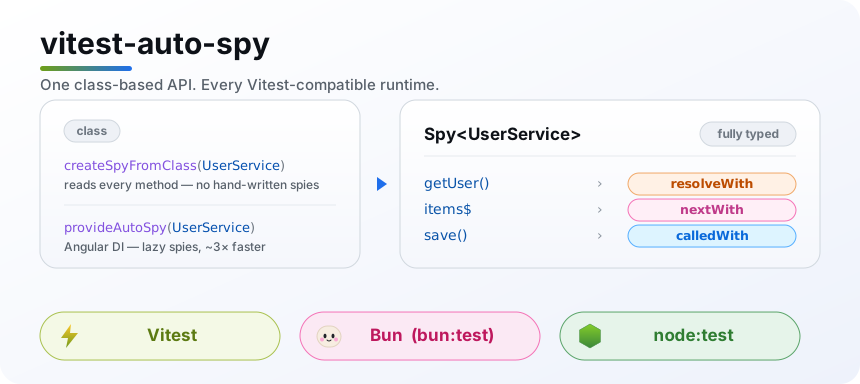
The only auto-spy library that reads a **class** and gives a **fully-typed** spy of every method
with **return-type-aware** helpers — `resolveWith` / `rejectWith` for `Promise`s, `nextWith` /
`throwWith` for RxJS `Observable`s, and `calledWith` / `mustBeCalledWith` for argument matching. Or
skip the class entirely and mock straight from a **type or interface** with `createAutoMock<T>()` and
recursive `mockDeep<T>()`. Runs on **Vitest**, **Bun** (`bun:test`), **`node:test`** and **Rstest** behind one
identical API, with **RxJS** spies and **Angular / NestJS / React / Vue·Pinia / Svelte** recipes
([availability](#availability)). A drop-in replacement for
[`jest-auto-spies`](https://www.npmjs.com/package/jest-auto-spies) — same API, and roughly 1.5x
faster at suite scale ([benchmarks](#benchmarks)) — and for
[`jasmine-auto-spies`](https://www.npmjs.com/package/jasmine-auto-spies) through
[`vitest-auto-spy/jasmine`](#migrating-from-jasmine-auto-spies), which keeps `.and`, `.calls` and
`.withArgs` working while you land the suite green.

[![npm version](https://img.shields.io/npm/v/vitest-auto-spy?color=brightgreen&logo=npm)](https://www.npmjs.com/package/vitest-auto-spy)
[![downloads per day](https://img.shields.io/badge/dynamic/json?url=https%3A%2F%2Fapi.npmjs.org%2Fdownloads%2Fpoint%2Flast-day%2Fvitest-auto-spy&query=%24.downloads&color=brightgreen&logo=npm&label=downloads%2Fday)](https://www.npmjs.com/package/vitest-auto-spy)

[![downloads per week](https://img.shields.io/badge/dynamic/json?url=https%3A%2F%2Fapi.npmjs.org%2Fdownloads%2Fpoint%2Flast-week%2Fvitest-auto-spy&query=%24.downloads&color=brightgreen&logo=npm&label=downloads%2Fweek)](https://www.npmjs.com/package/vitest-auto-spy)

[![downloads per month](https://img.shields.io/badge/dynamic/json?url=https%3A%2F%2Fapi.npmjs.org%2Fdownloads%2Fpoint%2Flast-month%2Fvitest-auto-spy&query=%24.downloads&color=brightgreen&logo=npm&label=downloads%2Fmonth)](https://www.npmjs.com/package/vitest-auto-spy)

[![downloads over 18 months](https://img.shields.io/badge/dynamic/json?url=https%3A%2F%2Fapi.npmjs.org%2Fdownloads%2Fpoint%2F2026-06-21%3A2030-01-01%2Fvitest-auto-spy&query=%24.downloads&color=brightgreen&logo=npm&label=downloads%2F18mo)](https://www.npmjs.com/package/vitest-auto-spy)

[![CI](https://github.com/ASDAlexey/vitest-auto-spy/actions/workflows/ci.yml/badge.svg)](https://github.com/ASDAlexey/vitest-auto-spy/actions/workflows/ci.yml)
[![minzipped size](https://img.shields.io/badge/minzip-22.6%20kB-brightgreen)](#install)
[![types](https://img.shields.io/npm/types/vitest-auto-spy?logo=typescript&logoColor=white)](https://www.npmjs.com/package/vitest-auto-spy)
[![coverage](https://img.shields.io/badge/coverage-100%25-brightgreen)](https://github.com/ASDAlexey/vitest-auto-spy/actions/workflows/ci.yml)

[![license](https://img.shields.io/npm/l/vitest-auto-spy?color=blue)](./LICENSE)

[![Vitest](https://img.shields.io/badge/Vitest-✓-6E9F18?logo=vitest&logoColor=white)](#runtimes)
[![Bun](https://img.shields.io/badge/Bun%201.4-✓-6E9F18?logo=bun&logoColor=white)](#availability)
[![Angular on Bun](https://img.shields.io/badge/Angular%20on%20Bun-✓-6E9F18?logo=angular&logoColor=white)](#angular-on-bun-buntest)
[![node:test](https://img.shields.io/badge/node%3Atest-✓-6E9F18?logo=node.js&logoColor=white)](#availability)
[![runtime deps](https://img.shields.io/badge/runtime%20deps-0-brightgreen)](#install)

📚 [**Documentation**](https://asdalexey.github.io/vitest-auto-spy/) · 🧭 [**Spec patterns**](https://asdalexey.github.io/vitest-auto-spy/recipes) · 📦 [**npm**](https://www.npmjs.com/package/vitest-auto-spy) · 🐙 [**GitHub**](https://github.com/ASDAlexey/vitest-auto-spy) · 🔖 [**Changelog**](./CHANGELOG.md)

🤖 [**AGENTS.md**](./AGENTS.md) · 🔤 [**llms.txt**](https://asdalexey.github.io/vitest-auto-spy/llms.txt) · 📄 [**llms-full.txt**](https://asdalexey.github.io/vitest-auto-spy/llms-full.txt) — works with [Claude Code, OpenAI Codex, GLM, Cursor, Copilot, Gemini CLI and the rest](#which-file-your-agent-reads)
<br/>

<img src="./assets/one-api-three-runtimes.svg" alt="One class-based API — createSpyFromClass, or provideAutoSpy for Angular DI — across three Vitest-compatible runtimes: Vitest, Bun and node:test" width="720" />

</div>

---

- 🧪 Reads a class and generates a typed spy for **every** method — no hand-written `vi.fn()` lists
- 🧬 Or mock from a **type/interface** alone — `createAutoMock<T>()`, no class required; `mockDeep<T>()` for a whole tree, arrays included (`api.page.items[0].title = 'x'` makes a real `Array` of deep mocks), and `{ fallbackMockImplementation }` makes a call nobody configured throw instead of answering `undefined`
- 🪛 Or patch the object you already hold, in place — `createSpyFromInstance(client)` spies a real instance without replacing it, so a closure or a DI container that captured it first sees the spies; `restoreSpiedInstance` puts it back. With `{ passthrough: true }` the real methods keep running and are recorded until the test configures one — `createSpyFromInstance(TestBed.inject(CartService), { passthrough: true })` keeps the DI graph, the signals and `ngOnDestroy` real
- 🌐 One `MockAdapter` core — **Vitest**, **Bun** and **`node:test`**, identical API on each
- 🧩 Framework recipes: **Angular**, **NestJS**, **React**, **Vue/Pinia** and **Svelte**
- 🎯 Return-type-aware helpers — sync, `Promise`, and `Observable` all get the right API
- 🔀 `calledWith` / `mustBeCalledWith` argument dispatch — and `explainSpy(spy)` prints every configured list next to every recorded call, before anything has failed
- 📡 First-class RxJS `Observable` spying (`nextWith`, `nextWithValues`, `throwWith`, …)
- ⚙️ Getter / setter spies via `accessorSpies` — **including on Bun**, where `bun:test`'s own `spyOn(obj, 'prop', 'get')` throws _"does not support accessor properties yet"_ (verified on Bun 1.4.0); no library that generates a double from a class or a type has accessor spies on any runner
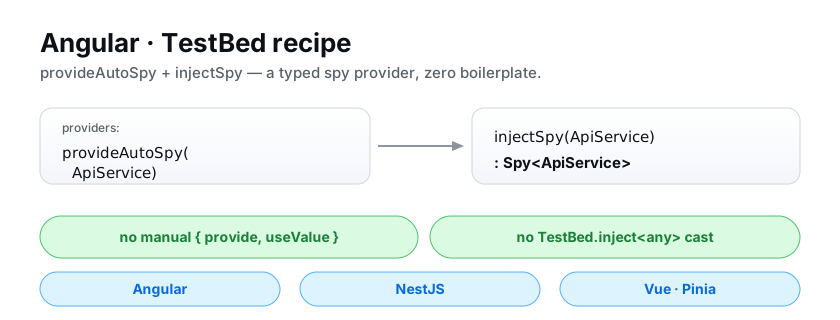
- 🧰 DI & mocking utilities — `provideAutoSpy` / `injectSpy` (Angular, NestJS, Vue), `createFunctionSpy`, `adoptMock` (typed `calledWith` / `resolveWith` on a `vi.mock` factory's `vi.fn()`, same object, history kept), `mockReadonlyProp` for signals
- ⚡ Angular speed & zoneless helpers — [`renderShallow`](#shallow-component-rendering), which brings a component up through the real `TestBed` without its child subtree, `createWithAutoSpies`, `stable` / `flushEffects`, `settleResource` for `httpResource()`, `toHaveSignalValue`, per-file `TestBed` timings
- **`node:test` stops retaining every spy.** Node's built-in runner keeps every `mock.fn()` in one
  process-wide `MockTracker` and has no way to drop a single entry, so a long suite accumulates every
  spy it ever made along with every argument they recorded. `trackNodeMocks()` gives this library a
  tracker of its own and replaces it after each test — 124.5 MB retained down to 5.9 MB on 20 000
  spies of a 10-method class (Node v24.19.0, `--expose-gc`, 5.4 MB baseline). It never calls
  `mock.reset()`, so a `mock.fn()` your spec made by hand is untouched.
- 🌐 `httpResource()` and `HttpClient` in two lines — `provideHttpTesting()` + `await expectRequest(url).flush(body)` does the tick, the controller, the `expectOne`, the flush **and the settling**, so `resource.value()` reads on the next line; `@angular/common` stays an optional peer, confined to the `/angular-http` entry
- 🧭 An `ActivatedRoute` that cannot disagree with itself — `provideActivatedRoute({ params, queryParams, data })` provides Angular's own route, its streams, `paramMap`s and snapshot built from one record, and `injectActivatedRoute().setParams(…)` moves them together the way a navigation does; `@angular/router` stays an optional peer, confined to the `/angular-router` entry
- 🧱 The providers every suite hand-rolls, provided once — `provideRouterDouble({ url })` for a `Router` that derives `url`, `routerState`, `events` and `currentNavigation()` from one URL rather than four guesses; `provideWindowDouble(WINDOW, { screen })` and `provideDocumentDouble({ … })`, which merge what the spec names **over** the real jsdom object, so the member nobody thought of still answers; `provideMatDialogData(MAT_DIALOG_DATA, data)` and `provideMatDialogRef(MatDialogRef)` for the Material dialog trio, with Material itself staying out of this package's dependencies
- 🧪 A signal graph you can assert on — `mockSignalProp` writes **through** a member that is already a `signal()`, `model()` or `linkedSignal()` instead of replacing it, so a computed, an effect or a template that read it first is still connected; `setInputs(fixture, { … })` changes an input mid-test; `trackRecomputations` / `trackEffectRuns` count what actually re-ran; `runEffect` runs the previous cleanup first, the way Angular's own scheduler does
- 🪆 NestJS units from their own DI metadata — `createNestUnit(Target, { expose, providers })`, the solitary / sociable model of `@suites/unit` with the real prototype behind every spy and no `@nestjs` dependency
- 🧱 The providers a testing module cannot reach — `overrideComponentProvider` (which verifies the override actually applied), `provideAutoSpyForToken`, `assertNgModuleScopes`, `assertComponentDefIntact`, `createDirectiveHost`, and `createComponentStub` for a child whose selector and inputs are read off the real one, so the stub cannot drift
- 🚨 Failures that used to be silence — `enableAngularDiagnostics()` for dead NgModule imports, dead `schemas`, an unspied provider and unflushed HTTP requests; `trackInjections` for which collaborators the code actually asked for. `injectSpy` already warns once per token when DI handed back a real instance, naming the token and the missing `provideAutoSpy` — where Spectator's `inject<T>(token): SpyObject<T>` types **every** token as a spy whether it was mocked or not, so the compiler hides the same mistake
- 🐢 Which test is slow, and why — [`npx vitest-auto-spy perf --gate`](#perf--where-the-cpu-time-actually-goes) fails CI over a file whose tests each cost many times the median test of the same run, so a laptop and a runner nine times slower agree; it re-measures every suspect on its own first, and a confirmed one comes with a CPU profile card: the slowest tests, hooks against bodies, the time by package and in your own code, and a likely cause. Vitest 5.0 marks a test over a fixed `slowTestThreshold` of 300 ms and says nothing about where the time went
- 🔒 [Strict doubles](#strict-doubles--fail-on-a-method-nobody-configured) — `strict: true` / `onUnstubbedCall` fail on a method nobody configured, naming the class, the method and the arguments instead of answering `undefined`; `unconfiguredReads` reports the getter and the stream nobody configured once the test is over
- ♻️ `using spy = createSpyFromClass(X)` — every double carries `[Symbol.dispose]`, so the `afterEach` that only reset one spy can go
- 📡 Observable assertions that fail on silence — `expectEmission` / `expectEmissions` / `expectNoEmission` / `expectCompletion` / `expectError`, no rxjs required, Angular `output()` included
- 🏗️ Doubles for what the code builds itself — `mockConstructor` / `stubConstructor` for `new`, plus `stubMediaElement`, `stubAbortController`, `stubWebStorage` and the observer stubs; `stubResponse({ body })` for a real `Response` a stubbed `fetch` answers with, no `as Response`
- ⏳ Waiting that is not a guess — `flushEventLoop`, `settleDynamicImport`, `flushEventLoopUntil`, and a clock that survives fake timers (`mockSystemTime`, `useCountingClock`)
- 🌀 `fakeAsync` / `waitForAsync` on Vitest — one import of `vitest-auto-spy/zone`; zone.js stays out of every other entry
- 🧩 Module mocks that prove they applied — `assertMocked`, `moduleNamespace`, for a `vi.mock()` a bundler quietly ignored; `moduleNamespace(await importOriginal(), { passthrough: true })` is Vitest's `{ spy: true }` with `calledWith` on top, on any runner
- 🧾 Fixtures without casts — deep-partial `createMock`, `createFixture` / `createFixtureFactory`, `narrow()`, `withOverrides()`, `asInstances()`, `captureArg()`
- 🚚 A migration you can verify — `vitest-auto-spy/diagnostics`: `compareTestRuns` on the two JSON reports, `summarizeTestRun` / `formatTestRunComparison` to read the answer, `diffByField` for the assertion the reporter collapses, `explainSpy` for a double that answered something you did not configure
- 📏 Lint rules and one-line test-run hygiene — forty rules in `vitest-auto-spy/eslint-plugin` (four `--fix`, thirteen suggestions, four of them for a suite mid-migration off jasmine), `setupAutoSpy()` — with `preset: 'strict'` for every guard at its strictest grade
- 🩺 [Editor diagnostics](#editor-diagnostics--webstorm--vs-code) — the same anti-patterns underlined while you type: native ESLint inspections in **WebStorm** and the other JetBrains IDEs, the ESLint extension in **VS Code**, no extra plugin either way
- 🔎 [`npx vitest-auto-spy doctor`](#the-cli--doctor-perf-codemod-and-init) — suite-level defects **that never fail a run**: a `tsconfig` `include` matching no file, a production module importing a spec, a `@jest-environment` pragma the runner never reads, config left behind for a runner that is gone. Read-only, no config, exits 1 in CI
- ⏱️ [`npx vitest-auto-spy perf`](#perf--where-the-cpu-time-actually-goes) — where a suite's CPU time actually goes, phase by phase, and which spec files to act on: the ones that reach no DOM and could run under `node`, the ones that import a barrel. Runs Vitest once with a reporter this package ships, reads `TestModule.diagnostic()`, names files, states the rule behind each finding
- 🚚 [`npx vitest-auto-spy codemod`](#codemod--migrating-a-suite-off-jest-auto-spies) — thirteen transforms that move a suite off `jest-auto-spies` and Jest, or off `jasmine-auto-spies` and jasmine (`--from jasmine`), dry-run by default, with a `--verify` pass that also checks a file somebody edited by hand
- 🔇 Console spies — `import { consoleInfoSpy } from 'vitest-auto-spy/console'` silences `console` and asserts its calls; [`setupAutoSpy({ strayConsole: 'throw' })`](#how-to-mock-the-console) fails any test whose console output nothing absorbed
- 🧭 [**Spec patterns**](https://asdalexey.github.io/vitest-auto-spy/recipes) — the shapes a ~370-file Angular suite converged on, and the traps that only surface at scale; task recipes for [mocking classes](https://asdalexey.github.io/vitest-auto-spy/guides/mocking-classes), [`localStorage`](https://asdalexey.github.io/vitest-auto-spy/guides/mocking-local-storage), [Prisma Client](https://asdalexey.github.io/vitest-auto-spy/guides/mocking-prisma) and [Storybook stories (Angular)](https://asdalexey.github.io/vitest-auto-spy/guides/storybook-angular)
- 🤖 Built for AI agents too — one `npx vitest-auto-spy init` writes the pointer into the files your agents actually read and specialises it for this repository, backed by an offline [`AGENTS.md`](#using-this-library-with-an-ai-agent) inside the package, a [per-agent map](#which-file-your-agent-reads) for **Claude Code**, **OpenAI Codex**, **GLM/z.ai**, **Cursor**, **Copilot**, **Gemini CLI** and the rest, `llms.txt` on the docs site, a Claude Code skill, and errors that name their own fix
- 🟢 100% test coverage, **zero runtime dependencies** (in-tree arg serializer, no `javascript-stringify`)

## New in 5

A major that changes **no helper, no option and no runtime behaviour**. What it changes is what the
package claims to run on, because both old peer ranges were claims the code could not keep — the
full list, with what to do about each, is in
[Upgrading to 5.0](https://asdalexey.github.io/vitest-auto-spy/upgrading-5).

| What you get                                                                                                                                                                                                                        | Verified                                                                                                                            |
| ----------------------------------------------------------------------------------------------------------------------------------------------------------------------------------------------------------------------------------- | ----------------------------------------------------------------------------------------------------------------------------------- |
| **The Angular range stops being false.** `>=16.0.0` admitted four majors on which an entry point cannot link at all: `ɵSIGNAL` is a value import and arrived in 18, `provideZonelessChangeDetection` in 20. The floor is now `>=20` | Angular 16 through 22 downloaded, their real `export { … }` lists parsed out of `fesm2022/*.mjs`; Angular 19 went EOL on 2026-05-19 |
| **`@angular/platform-browser` is a declared peer.** `/angular` has always imported `By` from it as a value, and under pnpm's isolated layout that never resolved                                                                    | undeclared → optional peer on the same `>=20` range                                                                                 |
| **The rxjs range stops promising rxjs 8.** Six operators came from `rxjs/operators`, a path rxjs 8 removes; they now come from the root entry, where rxjs re-exported them in 7.2, and the floor moved with the specifier           | read out of rxjs 7.2.0's own `dist/types/index.d.ts`; every Angular major from 16 to 22 already peers above it                      |
| **`flushEffects()` is one line.** The `ApplicationRef.tick()` fallback and the spec that deleted `TestBed.tick` at runtime to cover it are both gone                                                                                | `TestBed.tick()` direct; coverage still 100 %                                                                                       |

For almost everyone the whole upgrade is a version number: every Angular still supported by Angular
satisfies the new floor, and only a project pinning `rxjs@7.0` or `7.1` on purpose has to move.

## New in 4

A major with **one job**: take out of your project the weight this library was making it carry.
Nothing was removed or renamed and no runtime behaviour changed — the whole cost is two import
specifiers, listed with their fix in
[Upgrading to 4.0](https://asdalexey.github.io/vitest-auto-spy/upgrading-4).

| What you get                                                                                                                                                                                                                                                        | Measured                                                                                                                                                        |
| ------------------------------------------------------------------------------------------------------------------------------------------------------------------------------------------------------------------------------------------------------------------- | --------------------------------------------------------------------------------------------------------------------------------------------------------------- |
| **rxjs is out of your TypeScript program.** The declarations named `Observable` and `Subject`, so every consumer loaded rxjs whether the project used it or not. `import type` does not fix that — TypeScript resolves it the same way — so the reference had to go | consumer program **303 → 114 files**, of which **189 → 0** are rxjs; `TS2307` inside a shipped `.d.ts` under `skipLibCheck: false` with no rxjs installed: gone |
| **Every spec file gets time back.** The DOM stubs and the run diagnostics moved to `vitest-auto-spy/dom-stubs` and `…/diagnostics`, so a spec that never touches a DOM global stops evaluating 27 kB to reach `createSpyFromClass`                                  | **−0.159 ms per spec file** that does not import them, +0.155 ms in the files that do; root entry **15.5 → 12.9 kB** min+gzip                                   |
| **A second copy of rxjs stops breaking detection.** Observable detection is structural now, so an `Observable` from a duplicated rxjs earns the observable helpers instead of failing with `nextWith is not a function`                                             | —                                                                                                                                                               |
| **The lint rules stop deciding how much you care.** All nineteen ship as `error`; which findings block a merge is one line of config, documented per rule                                                                                                           | —                                                                                                                                                               |

If you use the observable helpers, keep `import 'vitest-auto-spy/rxjs'` somewhere your `tsconfig`
includes — that one import is what keeps `returnSubject()` typed as rxjs's own `Subject<T>`.

## Table of contents

- [Install](#install)
  - [Requirements](#requirements)
  - [Peer dependencies](#peer-dependencies)
- [The CLI — `doctor`, `perf`, `codemod` and `init`](#the-cli--doctor-perf-codemod-and-init)
  - [`doctor` — defects that never fail](#doctor--defects-that-never-fail)
  - [`perf` — where the CPU time actually goes](#perf--where-the-cpu-time-actually-goes)
  - [`codemod` — migrating a suite off `jest-auto-spies`](#codemod--migrating-a-suite-off-jest-auto-spies)
  - [`init` — the pointer an agent reads](#init--the-pointer-an-agent-reads)
- [Using this library with an AI agent](#using-this-library-with-an-ai-agent)
  - [Point your agent at it once](#point-your-agent-at-it-once)
  - [Which file your agent reads](#which-file-your-agent-reads)
  - [Install it in your agent](#install-it-in-your-agent)
  - [OpenAI Codex](#openai-codex)
  - [GLM (z.ai), Kimi K2 and other Claude-compatible models](#glm-zai-kimi-k2-and-other-claude-compatible-models)
  - [Gemini CLI](#gemini-cli)
  - [Claude Code plugin](#claude-code-plugin)
- [Availability](#availability)
- [Quick start](#quick-start)
- [How to mock](#how-to-mock)
  - [A service behind Angular DI](#how-to-mock-a-service-behind-angular-di)
  - [A service without DI](#how-to-mock-a-service-without-di)
  - [An object the test already holds](#how-to-mock-an-object-the-test-already-holds)
  - [Reading a spy back from DI](#how-to-mock-reading-a-spy-back-from-di)
  - [A whole class's dependencies at once](#how-to-mock-a-whole-classs-dependencies-at-once)
  - [A readonly property or a signal](#how-to-mock-a-readonly-property-or-a-signal)
  - [An Observable](#how-to-mock-an-observable)
  - [An overloaded method](#how-to-mock-an-overloaded-method)
  - [A promise a test forgets to await](#how-to-mock-a-promise-a-test-forgets-to-await)
  - [A component's children](#how-to-mock-a-components-children)
  - [A child the template still binds](#how-to-mock-a-child-the-template-still-binds)
  - [A class the code under test builds with `new`](#how-to-mock-a-class-the-code-under-test-builds-with-new)
  - [A double more than one spec uses](#how-to-mock-a-double-more-than-one-spec-uses)
  - [A pipe](#how-to-mock-a-pipe)
  - [`localStorage` and `sessionStorage`](#how-to-mock-localstorage-and-sessionstorage)
  - [`fetch` and other globals](#how-to-mock-fetch-and-other-globals)
  - [The console](#how-to-mock-the-console)
  - [A jasmine suite mid-migration](#how-to-mock-a-jasmine-suite-mid-migration)
- [Why](#why)
- [How it works (and what it won't spy)](#how-it-works-and-what-it-wont-spy)
- [Entry points & runtimes](#entry-points--runtimes)
  - [Runtimes](#runtimes)
- [Angular on Bun (`bun:test`)](#angular-on-bun-buntest)
- [Comparison](#comparison)
  - [@testing-library/angular /vitest-utils](#testing-libraryangular-vitest-utils)
- [Benchmarks](#benchmarks)
  - [Reproducing the numbers](#reproducing-the-numbers)
- [Migrating from jest-auto-spies](#migrating-from-jest-auto-spies)
- [Migrating from jasmine-auto-spies](#migrating-from-jasmine-auto-spies)
- [Migrating from @ngneat/spectator](https://asdalexey.github.io/vitest-auto-spy/migrating-spectator)
- [Migrating from @testing-library/angular](https://asdalexey.github.io/vitest-auto-spy/migrating-testing-library-angular)
- [Configuration](#configuration)
  - [Spying instance-assigned callables (`signal()`, arrow props, `signalStore()`)](#spying-instance-assigned-callables-signal-arrow-props-signalstore)
  - [Strict doubles — fail on a method nobody configured](#strict-doubles--fail-on-a-method-nobody-configured)
- [Auto-mock by type (no class needed)](#auto-mock-by-type-no-class-needed)
- [Synchronous methods](#synchronous-methods)
- [Promise-returning methods](#promise-returning-methods)
- [Observable methods & properties](#observable-returning-methods--observable-properties)
  - [Standalone observable builder](#standalone-observable-builder)
- [Getters & setters](#getters--setters)
- [Resetting — `using`, `resetAutoSpy`, `clearAutoSpy`](#resetting--using-resetautospy-clearautospy)
- [Framework adapters](#framework-adapters)
  - [Angular](#angular)
    - [Signal / readonly property mocking (bonus)](#signal--readonly-property-mocking-bonus)
    - [Shallow component rendering](#shallow-component-rendering)
    - [Building a class with auto-spied dependencies](#building-a-class-with-auto-spied-dependencies)
    - [Zoneless waiting](#zoneless-waiting)
    - [Settling a `resource()` or `httpResource()`](#settling-a-resource-or-httpresource)
    - [Asserting a signal's value](#asserting-a-signals-value)
    - [Where a spec spends its time](#where-a-spec-spends-its-time)
    - [A provider the component declares for itself](#a-provider-the-component-declares-for-itself)
    - [Diagnostics — five silent failures made loud](#diagnostics--five-silent-failures-made-loud)
    - [Which collaborators the code asked for](#which-collaborators-the-code-asked-for)
    - [An `ActivatedRoute` whose halves agree](#an-activatedroute-whose-halves-agree--vitest-auto-spyangular-router)
  - [NestJS](#nestjs)
  - [React (Testing Library)](#react-testing-library)
  - [Vue / Pinia](#vue--pinia)
  - [Svelte](#svelte)
  - [Which factory, and what it costs](#which-factory-and-what-it-costs)
- [Utilities](#utilities)
  - [Console spies — `vitest-auto-spy/console`](#console-spies--vitest-auto-spyconsole)
  - [Taking hold of an argument — `captureArg`](#taking-hold-of-an-argument--capturearg)
  - [Why a spy answered what it did — `explainSpy`](#why-a-spy-answered-what-it-did--explainspy)
- [Observable assertions](#observable-assertions)
- [Test-run hygiene](#test-run-hygiene)
- [Fake timers](#fake-timers)
- [Observer stubs](#observer-stubs)
- [ESLint plugin](#eslint-plugin)
- [Editor diagnostics — WebStorm & VS Code](#editor-diagnostics--webstorm--vs-code)
  - [WebStorm and the other JetBrains IDEs](#webstorm-and-the-other-jetbrains-ides)
  - [VS Code, Cursor, Windsurf, VSCodium](#vs-code-cursor-windsurf-vscodium)
- [Bridging `Spy<T>` and `T`](#bridging-spyt-and-t)
- [API reference](#api-reference)
- [FAQ & troubleshooting](#faq--troubleshooting)
- [Versioning](#versioning)
- [Contributing](#contributing)
- [Acknowledgements](#acknowledgements)
- [License](#license)

## Install

```bash
npm i -D vitest-auto-spy
```

> The plural name — [`vitest-auto-spies`](https://www.npmjs.com/package/vitest-auto-spies) — is an
> alias package that re-exports this one, entry point for entry point, so a typo resolves to the
> same code. Prefer the singular; the alias only follows it.

### Requirements

| Tool       | Minimum                                                                                                           |
| ---------- | ----------------------------------------------------------------------------------------------------------------- |
| Node.js    | ≥ 22 — 18 and 20 are EOL; CI exercises 22, 24 and 26                                                              |
| Vitest     | ≥ 2.1 (required peer) — one install covers 2.1 through 5.x                                                        |
| Angular    | ≥ 20 for the Angular entry points, ≥ 22 for `vitest-auto-spy/signal-forms` — optional peer, nothing else needs it |
| Bun        | ≥ 1.4 for `vitest-auto-spy/bun-angular`; any recent Bun for `vitest-auto-spy/bun`                                 |
| TypeScript | ≥ 4.7 for the typed helpers (plain JS works too, just untyped)                                                    |

Vitest **≥ 2.1** because the typed `spy.method.mock.settledResults` surface is Vitest's own `Mock`
type, and `@vitest/spy` only grew `settledResults` in 2.0 — 2.1 is where the 2.x line actually sits.
The runtime helpers themselves still run on older Vitest (the library polyfills `settledResults` for
`bun:test` and `node:test` regardless), but the types no longer line up there, so the range stops
claiming it.

**Vitest 5 needs nothing from you.** The same install covers it — no second major of this package,
no version-split types, no `@next` tag, no change to an import. Two changes in Vitest 5 would
otherwise have broken quietly, and both are handled here: its `clearAllMocks()` now visits only the
mocks that were called, so a spy engine that is not `vi.fn()` had to make itself reachable to the
sweep; and the `Matchers` interface grew a second type parameter, so the bundled matchers declare
themselves on Chai's `Assertion` instead and keep typing on 4 and 5 alike. The one thing Vitest 5
can still break is its own doing: `clearMocks` is on by default there, so a spec asserting on a call
recorded by an _earlier_ test now reads zero. Record it in a counter, not in the spy.

One feature of this package does need a line changed. `setupAutoSpy({ pruneMockRegistry: true })`
finds long-lived mocks by walking the runner's own registry, and Vitest 5 no longer exposes it — so
on Vitest 5 the automatic half does nothing and a mock that must survive `vi.resetAllMocks()` has to
say so: `keepMockRegistered(vi.fn().mockReturnThis())`. Everything after that mark behaves as before.

Measured 2026-09-06 on 40 spec files, 800 tests, 400 spied methods per file, v8 coverage on,
Node v24.19.0, median of five runs: the same suite takes **1383 ms on Vitest 4.1.11 and 1276 ms on
Vitest 5.0.0** — **−7.7 %** for changing nothing but the runner. The spy engine this library has
shipped since 4.1 is worth another **−6.1 % on Vitest 4 and −8.1 % on Vitest 5** against building
every method with the runner's own `vi.fn()` (`setSpyEngine('runner')`). End to end, the slowest
pairing to the fastest is 1473 ms → 1276 ms, **−13.4 %**.

Node **≥ 22** is the library's own floor now — Node 18 and 20 are both past end of life, and every
runner this library supports already needed more: Vitest 4 pulls in Vite 7 (`^20.19.0 || >=22.12.0`)
and calls `crypto.hash` (added in Node 20.12), so Node 18 died with
`TypeError: crypto.hash is not a function` before a spec loads. Vitest 5 raises its own floor to
`^22.12.0 || ^24.0.0 || >=26.0.0`, and `@angular/build` 22 needs `^22.22.3 || ^24.15.0 || >=26.0.0`.
CI tests Node 22, 24 and 26, so 22 is what is actually exercised. Which version to run is measured in
[Performance → Which Node version](https://asdalexey.github.io/vitest-auto-spy/core/performance#which-node-version):
the break is between 22 and 24, where a cold import more than halves.

Ships **ESM with bundled `.d.ts` types**. Two subpaths additionally ship a CommonJS build —
`vitest-auto-spy/node` (a `node --test` suite written in CJS) and `vitest-auto-spy/eslint-plugin`
(loaded by a CommonJS `eslint.config.cjs`, whose declaration is an `export =`, matching what
`require('vitest-auto-spy/eslint-plugin')` actually returns — it used to say `default`, so an
`eslint.config.cts` type-checked the call that throws and rejected the one that works).
Everything else is ESM-only, because a `require()` of it
could never have worked: Vitest itself refuses to be required (`Vitest cannot be imported in a
CommonJS module using require()`), so every Vitest-backed entry threw on the first line of its own
`.cjs`. Test runners load ESM natively, so nothing is lost — and dropping the unreachable output cut
the published package roughly in half.

### Peer dependencies

All peers are **provided by your project**, and every one of them is now **optional** — install each
only for the entry point that needs it. `vitest` is optional too: the range is unchanged (`>=2.1`),
but a suite on `vitest-auto-spy/bun` or `…/node` loads no Vitest at run time and should not have to
install one. The one caveat is type-level — the `/bun`, `/bun-angular` and `/node` declarations still
name Vitest's `Mock`, so a project type-checking those entries wants `vitest` as a devDependency
anyway; freeing that is a breaking type change and waits for a major. The package itself has **zero
runtime dependencies**.

`vitest-auto-spy/package.json` is exported, so a tool that resolves a dependency's manifest by
specifier — Storybook, Nx, a renovate helper — no longer gets `ERR_PACKAGE_PATH_NOT_EXPORTED`.

| Peer                        | Needed for                                                                                                                                   | Optional? |
| --------------------------- | -------------------------------------------------------------------------------------------------------------------------------------------- | --------- |
| `vitest`                    | the default runner — `>=2.1`; optional, so a `/bun` or `/node` suite does not install a runner it never loads                                | yes       |
| `rxjs`                      | `vitest-auto-spy/rxjs` observable spies — `>=7.2`, **no upper bound** (the rxjs 8 line included); not needed to type-check a spy since 4.0.0 | yes       |
| `@angular/core`             | `vitest-auto-spy/angular` and `vitest-auto-spy/bun-angular` helpers — `>=20`                                                                 | yes       |
| `@angular/common`           | `vitest-auto-spy/angular-http` — `>=20`, that entry only                                                                                     | yes       |
| `@angular/router`           | `vitest-auto-spy/angular-router` — `>=20`, that entry only                                                                                   | yes       |
| `@angular/forms`            | `vitest-auto-spy/signal-forms` — `>=22`, that entry only                                                                                     | yes       |
| `@angular/platform-browser` | `By` and the directive matchers on `vitest-auto-spy/angular`, and the Bun preload's platform — `>=20`                                        | yes       |

**rxjs ≥ 7.2**, and that number moved because an import specifier did. The observable layer builds
its subjects out of six operators — `concatMap`, `delay`, `switchMap`, `take`, `takeUntil`,
`takeWhile` — and it took them from `rxjs/operators`, the legacy deep path. **rxjs 8 removes that
path entirely**, so the old open-ended `>=7.0.0` was promising a version the code could not have
served. The operators now come from the root `rxjs` entry, which is where rxjs itself re-exported
them in **7.2** — checked against rxjs 7.2.0's own `dist/types/index.d.ts`, not against its release
notes. `firstValueFrom`, which is what justified the old 7.0 floor, is still there; 7.2 is simply the
first version where every symbol this package imports exists at the specifier it imports it from.

It costs an Angular consumer nothing. Every Angular major from 16 to 22 declares its own rxjs peer
as `^6.5.3 || ^7.4.0`, which is already above what this asks — so only a project that pins `rxjs@7.0`
or `7.1` on purpose has anything to do.

**Angular ≥ 20**, and two symbols the shipped code imports **as values** are what set the number. A
missing value import is a link error, so the symptom is never one unavailable helper — it is an
entry that does not load:

- **`ɵSIGNAL` exists from Angular 18.** `runEffect()` reads it, and that import is the first line of
  the `/angular` bundle, evaluated eagerly. On Angular 16 or 17 the entry fails to link, taking
  `provideAutoSpy`, `injectSpy` and the rest with it — not just `runEffect`.
- **`provideZonelessChangeDetection` exists from Angular 20.** In 18 and 19 the same function was
  named `provideExperimentalZonelessChangeDetection`; in 16 and 17 there was nothing to name.
  `vitest-auto-spy/bun-angular` imports it by name, so below 20 `bun test` dies loading the preload,
  before any spec file.

Angular 20 is also the oldest Angular that Angular still supports — six months active plus twelve
months LTS put 19 past end of life on **2026-05-19**, and 18, 17 and 16 before it. The technical
floor and the supported floor are the same number, so nothing still receiving fixes is cut off; the
range this replaces said `>=16.0.0`, which was a promise on versions where the main entry could not
link. No upper bound is set on purpose — one would force a release per Angular major and hand
`ERESOLVE` to whoever upgraded first.

`@angular/platform-browser` is declared for the first time here. `vitest-auto-spy/angular` has
always imported `By` from it as a value, and the Bun preload boots through `platformBrowserTesting()`.
Under npm's hoisted `node_modules` it resolved by accident — every Angular workspace has it — while
under pnpm's isolated layout it did not resolve at all. Declaring it makes the accident a contract.

## The CLI — `doctor`, `perf`, `codemod` and `init`

The package ships one executable, with no dependencies and nothing to configure:

```bash
npx vitest-auto-spy doctor   # read-only. Exits 1 when it finds something
npx vitest-auto-spy perf     # where the suite's CPU time goes. --gate fails a budget and says why
npx vitest-auto-spy codemod  # prints the migration diff. Writes nothing without --write
npx vitest-auto-spy init     # writes the agent instructions pointer
```

**Exit `0` means "ran, nothing to report"; `1` means "ran, and here is the finding"; `2` means
"there was nothing to judge".** The third one is the reason to read this line: an unknown flag for a
known command is an error and **nothing runs** — `init --dryrun` used to write the files and
`perf --gat` used to pass with no gate at all, which is a typo that reads as a clean CI step. A path
that matches no file is the same kind of error, because _Nothing left to migrate_ off a tree nobody
read is not a result. A red suite under `perf --gate` lands there too: a failing test is measured
until its timeout, and 30 s of timeout looks exactly like 30 s of slow code.

The repository scan behind `doctor` and `codemod` stops at a nested repository or a git worktree — a
`.git` entry, whether it is a directory or a file. A tree carrying worktrees under it used to be
listed twice, so `doctor` reported every import graph in duplicate and `codemod --write` could have
rewritten specs on someone else's branch.

### `doctor` — defects that never fail

Every check shares one property: **nothing consumes the result**. The suite is green,
`tsc --noEmit` reports zero errors, and the only reader of the stale thing is whoever opens the
file. That is why they survive for years, and why a per-file linter cannot find most of them — the
evidence is spread across files.

```
$ npx vitest-auto-spy doctor
vitest-auto-spy doctor — /work/app
1284 files, runner: vitest, entry: vitest-auto-spy/angular

error  tsconfig-glob-matches-nothing libs/users/tsconfig.spec.json
       The "include" pattern "src*.spec.ts" matches no file.
       → A pattern that matches nothing type-checks nothing, and `tsc --noEmit` still reports
         zero errors. Fix the glob or delete the entry.

3 errors, 4 warnings, 1 note
```

| Check                               | What it finds                                                                                                                     |
| ----------------------------------- | --------------------------------------------------------------------------------------------------------------------------------- |
| `tsconfig-glob-matches-nothing`     | An `include` pattern that matches no file — so it type-checks nothing; `info` when nothing beside the config is there to miss yet |
| `tsconfig-file-missing`             | A `files` entry naming a file that is gone                                                                                        |
| `spec-imported-by-non-spec`         | A production module importing a `*.spec.ts`                                                                                       |
| `spec-exports-fixture`              | A spec importing another spec, whose hooks then run in a foreign file                                                             |
| `foreign-runner-pragma`             | `@jest-environment` left in a spec, which Vitest never reads                                                                      |
| `dead-runner-config`                | `jest.config.*` / `karma.conf.*` for a runner that is not installed                                                               |
| `orphan-runner-file`                | A setup file only that dead config referenced                                                                                     |
| `angular-build-splitting-off`       | `@angular/build` in `[22.1.5, 22.1.7)` — the OOM under `--coverage`                                                               |
| `coverage-all-removed`              | `coverage.all` in a config, on a Vitest that stopped reading the key                                                              |
| `coverage-include-misses-bundle`    | A `coverage.include` of sources only, in a runner config over a bundle                                                            |
| `coverage-include-recompiles-globs` | A coverage scope large enough that `picomatch` recompiling it per file costs more than the coverage. Info                         |
| `jasmine-era-project`               | `jasmine-core`, `@types/jasmine`, `karma.conf.*` or `@hirez_io/observer-spy` still installed. Info, not an error                  |
| `no-agent-instructions`             | No instruction file names the package. A note, not an error                                                                       |
| `helper-from-wrong-entry`           | A named import taken from an entry that does not export it — `provideAutoSpy` from the root                                       |
| `no-unawaited-helper`               | An `expectEmission` / `stable` / `flushEventLoop` call dropped as a bare statement, so nothing awaits it                          |

The check that motivated the tool: a spec showing `Cannot find name 'vi'` in the editor while
`tsc --noEmit` reported zero errors. A migration codemod editing `include` had eaten a `/**`,
turning `src/**/*.spec.ts` into `src*.spec.ts` — a valid glob that matches nothing. Nine of 152
spec tsconfigs still covered their specs.

`doctor` never writes. There is no `--fix`.

The last two checks resolve a **name**, and both read the same table: the entry each helper is
exported from, generated from this package's own `exports` map by compiling the barrels and reading
the symbols back out of the compiler. That table is why they are `doctor` checks and not lint rules
— a per-file linter has none. Both are conservative in the same way: the callee has to have been
imported from this package in that same file (a rename with `as` still counts), `no-unawaited-helper`
reports only a call that both begins and ends a statement, and the pair goes quiet when the installed
major differs from the table's, because a helper moves between entries only in a major. Over this
repository's own 755 source files they report nothing outside their own fixtures. Neither has a
fixer.

### `perf` — where the CPU time actually goes

Vitest prints one summary line per run with a phase breakdown; it is the only place those numbers
surface, and it is for the whole suite, not a file. `perf` reads the same numbers per file — through
`TestModule.diagnostic()`, Vitest's own public accessor, via a reporter this package ships — and
turns whichever phase dominates into a list of files and the rule that put them there. Nothing here
parses terminal output, and without --gate it always exits 0: a slow suite is not a failing one.

```bash
npx vitest-auto-spy perf              # run the whole suite once and report
npx vitest-auto-spy perf src/cli      # path passed through to Vitest as a file filter
npx vitest-auto-spy perf --json out/perf.json  # re-analyse a report instead of running Vitest
```

```
$ npx vitest-auto-spy perf src/cli
vitest-auto-spy perf — /path/to/repo
16 test files, 860ms wall clock, 17.30s of CPU time summed over the workers

  phase               time    share
  prepare            6.34s    36.7%
  environment        5.46s    31.6%
  setup              3.01s    17.4%
  transform          1.19s     6.9%
  import             879ms     5.1%
  tests              411ms     2.4%

info   perf-environment
       Environment setup is 31.6% of the measured CPU time, against 2.4% in the test bodies. No
       spec file could be proved DOM-free, so this names none; 109 were left undecided.
       → Move what does not need a DOM to the `node` environment. …

0 errors, 0 warnings, 2 notes
```

That is this repository's own suite: `perf` names zero DOM-free candidates and leaves the rest
undecided, because `src/test-setup.ts` builds an Angular `TestBed` before every spec. The rule is
deliberately one-sided — a spec is a candidate only when it, the setup files, and every module they
import were read, none mentions a DOM name, and every package they import is on a short
DOM-free allowlist. Anything the rule cannot resolve is **undecided**, never assumed safe: a false
positive is somebody's suite failing on `document is not defined`.

**The phase totals are CPU time summed across workers**, which is why 860ms of wall clock reads as
17.30s of CPU above — the six phases are `environment`, `prepare`, `import`, `setup`, `tests` (all
per file) and `transform` (whole run). Where the isolation finding suggests `test.isolate: false`,
it links to this package's own memory measurements rather than repeating the numbers here — that
flag trades per-file cleanup for memory that grows with the suite.

Two findings are about settings rather than files. `perf-environment-engine` offers `happy-dom` to a
`jsdom` config whose environment time dominates — 23.2 s of user CPU against 26.5 s on this
repository's own 117-file suite, and 119 ms against 253 ms per file on a spec that builds a DOM and
does nothing else. `perf-workers` is the one about **memory**: with no `maxWorkers` declared, Vitest
takes one worker per core, and a worker measured at ~155 MB on top of a 1.42 GB floor — a cap of four
cost 2.8 % of wall clock and about 2 GB less on a 16-core machine.

**`--gate` is the half that may fail a pipeline**, and it is built so that it only ever fails over
somebody's code. It judges the `tests` phase alone — the other five are the harness and the machine
— it counts a file's budget in the median test **of the same run** (2 000 of them, or 10× that
median for each test in the file, whichever is larger), so the verdict survives a change of hardware
and a large file of ordinary tests never fails it, and it re-measures every candidate on its own
before failing anything. A file that is not slow when it has the machine to itself is reported as
_not reproduced_ rather than as a defect; one that is gets a card saying why — its slowest tests,
hooks against bodies, and where the CPU profile says the time went.

```bash
npx vitest-auto-spy perf --gate                                              # a plain Vitest suite
npx vitest-auto-spy perf --command 'npm test -- {paths:--include=}' --gate   # a suite behind a script
```

```
error  perf-gate-slow-file libs/player/src/lib/vod/vod.component.spec.ts
       The test bodies in this file add up to 9.20s, over the 5.00s budget (…). Re-measured on its own: 8.70s, still over budget.

       ┌─ measurements ────────────────────────────────────────────────
       │ tests             38   242ms each   20× the median test
       ├─ slowest tests ───────────────────────────────────────────────
       │  527ms  focus > moves through the controls
       ├─ where the time went · CPU profile, 8.41s sampled ────────────
       │ hooks        ███████████░░░░░░░░░ 54%   test bodies 46%
       │ by package   ██████░░░░░░░░░░░░░░  28%  jsdom
       │ in the spec  setUpWith 38%  ·  VodComponent_Template 17%  ·  assertFocus 8%
       ├─ likely cause ────────────────────────────────────────────────
       │ Most of the time is set-up that every test repeats: 54% is in hooks — setUpWith alone is 38%.
       └───────────────────────────────────────────────────────────────
```

The profiler behind the card is loaded only for the confirmation pass; an ordinary run never pays
for it. The whole card, and the rule the budget is counted by, are in
[the CLI docs](https://asdalexey.github.io/vitest-auto-spy/utilities/cli#the-gate).

On an Angular spec the card adds a row of Angular's own costs — TestBed set-up, component creation,
change detection, JIT compilation, computed styles — and the likely cause reads it first; on Vitest
4.1+ it also lists the spec's heaviest imports. Three things need no network in CI: `--baseline
perf-history.jsonl` keeps the last 30 runs in a cache and fails a file only past twice its mean share
and above every share it was recorded at; `--fail-on-flaky` fails a test that passed only on a retry;
and `--code-quality <path>`, on `perf` and on `doctor`, writes the findings for the GitLab merge
request widget. `--format json` prints either command as one JSON document on stdout, with the gate's verdict
rows, for a script that would otherwise parse the text.

`--command` is also the answer to a bare `vitest run` not being your suite at all: where the suite is
built by an Angular builder, an Nx target or a script, there is no root config, the defaults sweep up
every `*.spec.*` in the tree, and every file fails to collect — 1 830 files and 0 test bodies on the
workspace this was measured in, under a phase table that looked entirely plausible. `perf` refuses to
call that a measurement and says which of the two entry points to use. Exit `1` means the gate
failed; exit `2` means there was nothing to judge.

Full reference, phase by phase and finding by finding: **[The CLI](https://asdalexey.github.io/vitest-auto-spy/utilities/cli)**.

### `codemod` — migrating a suite off `jest-auto-spies`

```bash
npx vitest-auto-spy codemod                    # every *.spec.ts / *.test.ts — dry run
npx vitest-auto-spy codemod src/app --write    # apply, under a path
npx vitest-auto-spy codemod --verify           # transform nothing; exit 1 on anything left
```

Thirteen transforms in three families — four shared, three Jest's, six jasmine's. `--from` picks the
family (`jest-auto-spies`, `jasmine-auto-spies` / `jasmine`, or `auto`, the default, which reads each
file). Two are this package's own knowledge: **`auto-spies-import`** splits
`import { createSpyFromClass, provideAutoSpy, Spy } from 'jest-auto-spies'` across the entry points
that export each name — from a table read off the **installed** package's export map, not a
hard-coded list — and **`inject-cast`** rewrites `TestBed.inject(X) as Spy<X>` into
`asSpy<X>(TestBed.inject(X))`, the cast that fails with `TS2352` once per injected double in a
migrated suite. The other five are the Jest half: **`jest-types`** transposes `jest.Mock<R, [A]>`
into the single call signature Vitest takes (a plain rename compiles into the reverse meaning and
nothing fails until a call site disagrees), **`jest-namespace`** renames the `jest.*` members that
have a `vi` twin, and `jest-globals-import`, `jasmine-aliases` (`xit` → `it.skip`) and
`mock-implementation-arity` finish the mechanical part.

The six jasmine transforms take `.and` off the auto-spies helpers (`spy.load.and.nextWith(v)` →
`spy.load.nextWith(v)`), turn jasmine's own strategies into their `mock*` twins, rewrite the
`jasmine` global's members onto `vi` / `expect`, rename the matchers Vitest spells differently — and
give **`spyOn` back the stub it had for free**: jasmine's `spyOn` stubs the method, `vi.spyOn` calls
through, so a bare rename is green, silent and inverts the behaviour of every unstubbed spy in the
suite. That one is why this is a codemod and not a `sed` line. A bare `spyOn(` is deliberately not
enough for `--from auto` to classify a file, for exactly the same reason — that suite says
`--from jasmine` out loud.

**Dry-run by default**, so the first thing a repository sees is a diff it can reject. `--write`
applies it, `--only` / `--skip` select transforms by id, `--list` prints them together with the
generated entry-point table. Past 50 000 files the scan truncates and says so, because _Nothing left
to migrate_ off a truncated list is a claim about a tree it never looked at;
`VITEST_AUTO_SPY_SCAN_CAP` raises the cap.

**Every rewrite is parsed before it is written**, with the project's own `typescript`, and its
diagnostics are compared against the original's. A file the run would have broken is reported as
`codemod-broke-syntax` and left byte for byte as it was, so the run ends with one file named instead
of a tree that no longer compiles; where `typescript` is not installed the check is skipped in
silence rather than turned into an install instruction. JavaScript specs are visited too —
`*.spec.js`, `*.test.jsx`, the `.cjs` and `.mjs` forms — because a Jest suite that was never
TypeScript is the suite with the most `jest.` in it.

What it deliberately does not do is guess. A `jest.*` member with no `vi` twin — `requireMock`,
`replaceProperty`, `createMockFromModule`, `jest.setTimeout`, `requireActual` — is **left exactly as
it was and reported with what to do instead**, and so is any member in neither list: a mechanical
`jest.` → `vi.` is right for about thirty members and wrong for a dozen more, and the wrong ones fail
later as `vi.requireMock is not a function`, which reads as "the runner broke". Same for an import
name no entry point exports, and for a span it could not reach at all — a template literal, an
unbalanced bracket. Two more it now reports rather than rewriting into something worse:
`jest.fn<R, [A]>()` in a file importing from `@jest/globals` (`jest-mock` 29 already takes the whole
function type, so transposing a second time produces a return type of a return type), and
`.withArgs(…)` on a `vi.spyOn` chain — `vi.spyOn` has no `calledWith`, so renaming it produces a
method that does not exist.

`--verify` is the pass to run afterwards: it transforms nothing and matches the files against the
patterns the codemod removes, exiting 1 on anything left. Matching the _result_ rather than reading
the diff is the only form that notices a file the transforms declined to enter — and it works the
same on a file somebody migrated by hand.

Full reference, transform by transform:
**[The codemod](https://asdalexey.github.io/vitest-auto-spy/utilities/codemod)**.

### `init` — the pointer an agent reads

No coding agent scans dependencies for instructions, so the `AGENTS.md` and the skill shipped
inside this package's tarball are never discovered on their own. `init` writes the pointer into
the files that _are_ read — `AGENTS.md`, `CLAUDE.md`, `GEMINI.md`, a Claude Code skill stub, and a
glob-scoped rule file for each tool whose directory already exists — and specialises it for this
repository's runner, framework and setup file. Everything sits between markers, so a re-run is a
no-op and `--uninstall` puts the files back.

`init --check` is the CI form, and it compares **the managed block**, not the version stamp inside
its marker. Upgrading this package no longer turns that step red on a repository whose instructions
have not changed a word; a plain `init` still refreshes the stamp.

Full reference, including the flags and the CI form: **[The CLI](https://asdalexey.github.io/vitest-auto-spy/utilities/cli)**.

## Using this library with an AI agent

Most tests are now written with an assistant in the loop, so this package ships documentation
written for one — not a second copy of the README, but the compressed form an agent can act on:
the decision tree, the configuration semantics, an error→fix table and the anti-patterns.

| What                                                                         | Where                                                  | For                                                      |
| ---------------------------------------------------------------------------- | ------------------------------------------------------ | -------------------------------------------------------- |
| [`AGENTS.md`](./AGENTS.md)                                                   | `node_modules/vitest-auto-spy/AGENTS.md`               | any agent, **offline** — it ships inside the npm tarball |
| [`llms.txt`](https://asdalexey.github.io/vitest-auto-spy/llms.txt)           | the docs site root                                     | a crawler picking the one page it needs                  |
| [`llms-full.txt`](https://asdalexey.github.io/vitest-auto-spy/llms-full.txt) | the docs site root                                     | reading the entire documentation in one fetch            |
| A Claude Code skill                                                          | `skills/vitest-auto-spy/SKILL.md`, also in the tarball | Claude Code — and any client that _is_ it, GLM included  |
| Runtime error messages                                                       | every thrown error ends with `Docs: <url>`             | reading a stack trace instead of guessing                |

### Point your agent at it once

Add this to the instruction file your agent actually reads — the table below says which one that is:

```md
When writing or fixing tests that use `vitest-auto-spy`, first read
`node_modules/vitest-auto-spy/AGENTS.md`. It is the authoritative reference for the API,
the configuration semantics and the common mistakes.
```

The text is the same everywhere; only the filename changes. **Two files cover the whole field: a
root `AGENTS.md` and a root `CLAUDE.md`.** Put the identical block in both and every agent below is
served — including the ones your teammates use and you do not.

### Which file your agent reads

| Agent                                                               | Instruction file it reads                                                                                                                                                                 | Reads `AGENTS.md`?                                                |
| ------------------------------------------------------------------- | ----------------------------------------------------------------------------------------------------------------------------------------------------------------------------------------- | ----------------------------------------------------------------- |
| **Claude Code**                                                     | `CLAUDE.md` — project, `.claude/CLAUDE.md` and `~/.claude/CLAUDE.md`, all concatenated                                                                                                    | **No.** Bridge with an `@AGENTS.md` import line, or a symlink     |
| **OpenAI Codex** — the `codex` CLI, the IDE extension, Codex cloud  | `AGENTS.md`, one per directory from the git root down to the cwd ([below](#openai-codex))                                                                                                 | native                                                            |
| **GLM (z.ai coding plan)**, **Kimi K2**                             | whatever their client reads — inside Claude Code that is `CLAUDE.md` ([below](#glm-zai-kimi-k2-and-other-claude-compatible-models))                                                       | through the client                                                |
| **Cursor**                                                          | root `AGENTS.md`; `.cursor/rules/*.mdc` for glob-scoped rules                                                                                                                             | native — and it applies a root `CLAUDE.md` the same always-on way |
| **GitHub Copilot**                                                  | root `AGENTS.md`; `.github/copilot-instructions.md`                                                                                                                                       | native, coding agent included                                     |
| **OpenCode**                                                        | `AGENTS.md`, then `CLAUDE.md`, per directory upwards                                                                                                                                      | native                                                            |
| **Cline**                                                           | root `AGENTS.md`; the `.clinerules/` directory                                                                                                                                            | native                                                            |
| **Windsurf / Cascade**                                              | root `AGENTS.md`; `.windsurf/rules/*.md` (`.devin/rules/*.md` when present)                                                                                                               | yes                                                               |
| **Zed**                                                             | **first match wins, no merging**: `.rules` → `.cursorrules` → `.windsurfrules` → `.clinerules` → `.github/copilot-instructions.md` → `AGENT.md` → `AGENTS.md` → `CLAUDE.md` → `GEMINI.md` | yes — only if nothing earlier in that list exists                 |
| **Gemini CLI**                                                      | `GEMINI.md` ([below](#gemini-cli))                                                                                                                                                        | **not by default**                                                |
| **Qwen Code**                                                       | `QWEN.md`                                                                                                                                                                                 | native fallback                                                   |
| **Roo Code**                                                        | root `AGENTS.md`; `.roo/rules/`                                                                                                                                                           | yes                                                               |
| **Junie**                                                           | root `AGENTS.md` — note that `.junie/AGENTS.md` replaces it outright                                                                                                                      | yes                                                               |
| **Aider**                                                           | nothing implicitly — list the file: `read: [AGENTS.md]` in `.aider.conf.yml`                                                                                                              | on request                                                        |
| **Jules, Factory, goose, Amp, Warp, Devin, Kilo, Augment, VS Code** | root `AGENTS.md`                                                                                                                                                                          | native                                                            |

**Do not create `.rules`, `.cursorrules`, `.windsurfrules` or `.clinerules` just to hold this
snippet.** Zed resolves that list first-match-wins with no merging, so a newly created legacy file
silently shadows the `AGENTS.md` the rest of the project relies on. Append to one only if it
already exists.

### Install it in your agent

One command covers every tool in that table, and specialises the text for this repository:

```bash
npx vitest-auto-spy init          # write it
npx vitest-auto-spy init --check  # CI: fail when it is missing or out of date
```

By hand, the same thing is two commands at the repository root:

```bash
# 1 — AGENTS.md: Codex, Cursor, Copilot, Cline, Windsurf, Zed, OpenCode, Qwen, Roo, Junie, Aider…
cat >> AGENTS.md <<'MD'

## Tests that use `vitest-auto-spy`

When writing or fixing tests that use `vitest-auto-spy`, first read
`node_modules/vitest-auto-spy/AGENTS.md`. It is the authoritative reference for the API,
the configuration semantics and the common mistakes.
MD

# 2 — CLAUDE.md: Claude Code, and GLM / Kimi running inside it. One line, no second copy to maintain
printf '\n@AGENTS.md\n' >> CLAUDE.md
```

`@AGENTS.md` is Claude Code's own import syntax, so the instructions live in exactly one file. A
symlink (`ln -s AGENTS.md CLAUDE.md`) does the same job if you would rather not have the second file
at all.

Then, per tool — everything in the right-hand column is optional on top of those two files:

| Agent                                       | Install                                                                                                                                                                  |
| ------------------------------------------- | ------------------------------------------------------------------------------------------------------------------------------------------------------------------------ |
| **Claude Code**                             | `/plugin marketplace add ASDAlexey/vitest-auto-spy`, then `/plugin install vitest-auto-spy@vitest-auto-spy` — [the skill](#claude-code-plugin), no project files touched |
| **OpenAI Codex**                            | nothing more; optionally `~/.codex/config.toml` from [below](#openai-codex)                                                                                              |
| **GLM (z.ai)**, **Kimi K2**                 | identical to Claude Code — same client, same plugin command                                                                                                              |
| **Cursor**                                  | `.cursor/rules/vitest-auto-spy.mdc` to load it only for spec files (see below)                                                                                           |
| **GitHub Copilot**                          | `.github/instructions/vitest-auto-spy.instructions.md` (see below)                                                                                                       |
| **Cline**                                   | `.clinerules/vitest-auto-spy.md` — the same three lines, plus `paths: ["**/*.spec.ts","**/*.test.ts"]`                                                                   |
| **Windsurf / Cascade**                      | `.windsurf/rules/vitest-auto-spy.md` with `trigger: glob` (see below)                                                                                                    |
| **Roo Code**                                | `.roo/rules/vitest-auto-spy.md` — always on, so keep it to the three-line pointer                                                                                        |
| **Gemini CLI**                              | `GEMINI.md`, or the `.gemini/settings.json` patch from [below](#gemini-cli)                                                                                              |
| **Aider**                                   | `.aider.conf.yml`: `read: [AGENTS.md]`                                                                                                                                   |
| **Zed, OpenCode, Qwen Code, Junie, Jules…** | nothing — the root `AGENTS.md` is the whole install                                                                                                                      |

The glob-scoped variants, for the three tools whose format is not plain Markdown. Each body is the
same pointer; only the frontmatter differs:

```md
## <!-- .cursor/rules/vitest-auto-spy.mdc -->

description: How to write tests with vitest-auto-spy
globs: **/\*.spec.ts, **/_.spec.tsx, \*\*/_.test.ts, \*_/_.test.tsx
alwaysApply: false

---

Read `node_modules/vitest-auto-spy/AGENTS.md` before writing or fixing a spec that uses
`vitest-auto-spy` — the API, the configuration semantics and the common mistakes.
```

```md
## <!-- .github/instructions/vitest-auto-spy.instructions.md -->

## applyTo: '**/\*.spec.ts,**/_.spec.tsx,\*\*/_.test.ts,\*_/_.test.tsx'

Read `node_modules/vitest-auto-spy/AGENTS.md` before writing or fixing a spec that uses
`vitest-auto-spy`.
```

```md
## <!-- .windsurf/rules/vitest-auto-spy.md — .devin/rules/ when that directory exists -->

trigger: glob
globs: **/\*.spec.ts, **/\*.test.ts

---

Read `node_modules/vitest-auto-spy/AGENTS.md` before writing or fixing a spec that uses
`vitest-auto-spy`.
```

Cursor's `globs` is a **comma-separated string, not a YAML array**, and a Windsurf rule file is
capped at 12 000 characters — both are reasons the rule points at the reference instead of copying
it.

### OpenAI Codex

Codex — the `codex` CLI, the IDE extension and Codex cloud — reads the open `AGENTS.md` convention,
so a root `AGENTS.md` is the whole integration. Two details decide whether it reaches the model at
all:

- **The chain is git-root→cwd, at most one file per directory** (`AGENTS.override.md` wins over
  `AGENTS.md`), concatenated. In a monorepo, put the block in the package's own `AGENTS.md` too when
  that package runs a different runner — it is the only way to say "this one is `bun test`, the one
  next door is Vitest", which is exactly the distinction that decides which entry point gets
  imported.
- **The whole chain is capped** by `project_doc_max_bytes`, **32 768 bytes by default**; anything
  over budget is truncated with a warning. If your `AGENTS.md` is already long, keep the pointer
  near the top of it.

For a repo that keeps its instructions in `CLAUDE.md`, teach Codex to fall back — this is global
config on your own machine, nothing to commit:

```toml
# ~/.codex/config.toml
project_doc_fallback_filenames = ["CLAUDE.md"]   # per directory, when no AGENTS.md is there
project_doc_max_bytes = 65536                    # raise the 32 KB budget for a monorepo chain
```

Codex cloud reads the same root `AGENTS.md`, and its agent has **no internet access by default** —
which is exactly why this reference ships inside the tarball rather than only on the docs site.
`node_modules/vitest-auto-spy/AGENTS.md` is on disk the moment the setup script has installed
dependencies, so nothing has to be fetched.

### GLM (z.ai), Kimi K2 and other Claude-compatible models

GLM is a **model**, not an agent — the thing that reads files is the client you run it in.

The z.ai coding plan runs GLM **inside Claude Code**, by pointing `ANTHROPIC_BASE_URL` (with
`ANTHROPIC_AUTH_TOKEN`) at z.ai's Anthropic-compatible endpoint. File discovery is untouched by
that: `CLAUDE.md`, `.claude/skills/` and the [plugin](#claude-code-plugin) below behave exactly as
they do on Claude, because it is the same client. Kimi K2 driven through Claude Code is the same
story — and there the skill and the plugin are worth more than a pasted snippet, because they load
only when a spec actually mentions the library and cost no context the rest of the time.

Run GLM through a different client and that client decides: OpenCode, Cline, Roo Code and Kilo Code
all read the root `AGENTS.md`. Moonshot's own `kimi-cli` reads its own `AGENTS.md` chain, including
`.kimi/AGENTS.md`.

### Gemini CLI

Gemini CLI reads `GEMINI.md` and does **not** read `AGENTS.md` by default. Either paste the snippet
into `GEMINI.md`, or name both files once:

```json
// .gemini/settings.json
{ "context": { "fileName": ["GEMINI.md", "AGENTS.md"] } }
```

Qwen Code is derived from Gemini CLI and takes the same `context.fileName` setting, but already
falls back to `AGENTS.md` on its own.

### Claude Code plugin

The repository is also a Claude Code marketplace, so the skill installs without touching your
project files:

```
/plugin marketplace add ASDAlexey/vitest-auto-spy
/plugin install vitest-auto-spy@vitest-auto-spy
```

The skill loads only when a spec actually mentions the library, so it costs nothing the rest of
the time. It works in any client that _is_ Claude Code — the z.ai and Kimi setups above included.

## Availability

> **All entry points are published.** The **Vitest / Bun / `node:test` / Rstest** runtimes, the **RxJS** layer,
> and the **Angular / NestJS / React / Vue·Pinia / Svelte** recipes all ship as importable entry points —
> one identical API across every runner and framework.

| Entry point                                                                        | Status                                                                                                                                                                                          |
| ---------------------------------------------------------------------------------- | ----------------------------------------------------------------------------------------------------------------------------------------------------------------------------------------------- |
| `vitest-auto-spy` · `vitest-auto-spy/rxjs` · `vitest-auto-spy/angular`             | ✅ **Published**                                                                                                                                                                                |
| `vitest-auto-spy/bun` · `vitest-auto-spy/bun-angular` · `vitest-auto-spy/node`     | ✅ **Published**                                                                                                                                                                                |
| `vitest-auto-spy/rstest`                                                           | ✅ **Published**                                                                                                                                                                                |
| `vitest-auto-spy/nestjs` · `/react` · `/vue` · `/svelte` · `/console`              | `provideAutoSpy`, `injectSpy` for `Test.createTestingModule`; `createNestUnit` builds the unit from its DI metadata with every unprovided token auto-spied, `expose` for sociable collaborators |
| `vitest-auto-spy/setup` · `vitest-auto-spy/zone` · `vitest-auto-spy/eslint-plugin` | ✅ **Published**                                                                                                                                                                                |
| `vitest-auto-spy/jasmine` · `/jasmine-compat` · `/observer-spy`                    | ✅ **Published**                                                                                                                                                                                |

## Quick start

Pass a class — every method becomes a typed spy, and the **constructor is never called** (no side
effects). The helper you get on each method matches its return type:

```ts
import { beforeEach, expect, it } from 'vitest';
import { type Spy, createSpyFromClass } from 'vitest-auto-spy';

class UserService {
  getName(id: number): string {
    return 'real name';
  }
  async getUser(id: number): Promise<{ id: number; name: string }> {
    return fetchUser(id);
  }
}

let userService: Spy<UserService>;

beforeEach(() => {
  userService = createSpyFromClass(UserService); // every method is now a spy
});

it('stubs each method with the right helper for its return type', async () => {
  userService.getName.mockReturnValue('Ada'); // sync
  userService.getUser.resolveWith({ id: 1, name: 'Ada' }); // Promise helper

  expect(userService.getName(1)).toBe('Ada');
  await expect(userService.getUser(1)).resolves.toEqual({ id: 1, name: 'Ada' });
  expect(userService.getName).toHaveBeenCalledWith(1);
});
```

No class, only a TypeScript type? Reach for
[`createAutoMock<T>()`](#auto-mock-by-type-no-class-needed).

## How to mock

One recipe per thing a spec has to stand in for — each is the whole answer, not a fragment. The
[ESLint rules](#eslint-plugin) shipped with the package link back to these, so a report always
comes with the replacement.

### How to mock: a service behind Angular DI

```ts
import { injectSpy, provideAutoSpy } from 'vitest-auto-spy/angular';

TestBed.configureTestingModule({ providers: [provideAutoSpy(CartService)] });

const cart = injectSpy(CartService); // Spy<CartService>
cart.total.mockReturnValue(42);
```

`provideAutoSpy` reads the real class, so the stub cannot drift from it: add a method to
`CartService` and the spy has it. A hand-written `{ provide: CartService, useValue: { total:
vi.fn() } }` silently keeps mocking yesterday's class.

A token with a primitive value is the one place a `useValue` stays right: `{ provide: IS_BROWSER,
useValue: false }`. Angular types `useValue` as `any`, though, so nothing compares it with the
`InjectionToken<boolean>` it is for — `useValue: {}` compiles and is truthy. `no-mistyped-use-value`
reports that, given type information.

An object `useValue` is usually a partial fixture, and that is fine — but its keys are not checked
either, so `{ provide: ActivatedRoute, useValue: { queryParams$: of({}) } }` compiles for a class
that has no `queryParams$`, and the spec stays green over a fixture nothing reads.
`no-unknown-use-value-key` reports each literal key the provided type does not have — keys only,
never the values' types.

On **Vitest 4.1+**, the same thing as fixtures — one statement, types inferred, and a test that
never names a dependency never builds it:

```ts
import { test as base } from 'vitest';
import { extendWithAutoSpies } from 'vitest-auto-spy/angular';

const test = extendWithAutoSpies(base, { cart: CartService, api: [ApiService, { returns: { get: of([]) } }] });

test('checks out', ({ cart }) => cart.total.mockReturnValue(42));
```

It takes the whole map at once because every provider has to be known before the first injection —
[why, in full](https://asdalexey.github.io/vitest-auto-spy/adapters/angular#fixtures-instead-of-let-beforeeach-extendwithautospies).
On an older Vitest it throws `needs Vitest 4.1 or newer` up front, instead of letting the object-form
`extend` register nonsense and every test die on `undefined`.

### How to mock: a service without DI

```ts
import { createAutoMock, createSpyFromClass } from 'vitest-auto-spy';

const cart = createSpyFromClass(CartService); // from a class
const gateway = createAutoMock<PaymentGateway>(); // from a type/interface alone
```

The constructor is never called, so no side effects run. `createAutoMock<T>()` is for the case
where there is no runtime class to read — an interface, a type alias, an imported `.d.ts`.

### How to mock: an object the test already holds

Every factory above _constructs_ the double, which is no help once the object exists and other code
already points at it — a service a factory built, a third-party client, a half-real
`TestBed.inject(X)`. `createSpyFromInstance` patches that object **in place**:

```ts
import { createSpyFromInstance, restoreSpiedInstance } from 'vitest-auto-spy';

const client = new PaymentsClient(config); // real, and already wired into the code under test
const spy = createSpyFromInstance(client); // same object, now typed as Spy<PaymentsClient>

spy.charge.calledWith(100).resolveWith({ ok: true });
await checkout.pay(100);

expect(spy.charge).toHaveBeenCalledWith(100);
restoreSpiedInstance(client); // client.charge is the real method again
```

Mutating rather than copying is the whole point: anything that captured the object before the spec
ran — a closure, a DI container, a live subscription — sees the spies. Discovery is the object's own
function-valued fields _plus_ every prototype method up to but not including `Object.prototype`, so
an arrow-function property needs no `instanceMethodsToSpyOn` here and `hasOwnProperty` / `toString`
are never replaced. The configuration is `createSpyFromClass`' — `methodsToSpyOn`,
`onlyMethodsToSpyOn`, `instanceMethodsToSpyOn`, the array shorthand, `observablePropsToSpyOn`,
`gettersToSpyOn`, `settersToSpyOn`, `autoSpyAccessors`, `returns`, `overrides`, `strict`,
`onUnstubbedCall` — minus the two that describe a double being built rather than an object being
patched: `lazySpies` (the members already exist) and `fillMissing` (an instance is not an erased
`abstract` declaration). The class's `registerAutoSpyDefaults` registration is merged in as well —
except when the call lists `onlyMethodsToSpyOn`: the rest of the object then stays real, and the
registration only configures the listed methods (`strict`, `onUnstubbed*`, their `returns` and
`selfReturning`), never adds an accessor, a method or an override.

Every write is journaled through the same mechanism as the [`mock*Prop` helpers](#how-to-mock-a-readonly-property-or-a-signal),
so there are three ways back and they compose: `restoreSpiedInstance(instance)` for one object mid-test,
`restoreMockedProps()` for the sweep `setupAutoSpy()` already runs, and
`using spy = createSpyFromInstance(client)`, whose dispose **restores** rather than merely resets —
the only sense disposal can have for an object the consumer owns. A frozen or sealed instance, and a
member defined with `configurable: false`, are reported with the object described and the repair
named rather than as a bare `TypeError`.

To watch a real object rather than replace it, pass `{ passthrough: true }`: every unconfigured
method runs the real implementation, with the instance as `this`, and is recorded. Configuring a
method takes the whole method over, and `resetAutoSpy` hands it back. Lifecycle hooks, callables with
an API of their own (a `signal()` field) and classes stay real, so
`createSpyFromInstance(TestBed.inject(CartService), { passthrough: true })` keeps the DI graph,
`ɵprov` and the real `ngOnDestroy` working. An explicit `strict: true` or `onUnstubbedCall` on the same
call throws; a suite-wide strict default yields to it.

Nothing else in the field does this: `vi.mockObject` is Vitest-only, `sinon.createStubInstance`
builds a new object from a constructor instead of patching the one you hold, and `bun:test` and
`node:test` have nothing.

### How to mock: reading a spy back from DI

```ts
const cart = injectSpy(CartService); // typed Spy<CartService>, no cast
```

Not `vi.spyOn(TestBed.inject(CartService), 'total')`: that replaces one method and leaves the rest
of a **real** service live, which is how a unit test quietly turns into an integration test.

### How to mock: a whole class's dependencies at once

```ts
import { createWithAutoSpies } from 'vitest-auto-spy/angular';

const { instance, spies } = createWithAutoSpies(CartService);

spies.get(PricingService).total.mockReturnValue(100);
expect(instance.checkout(3)).toBe(120);
```

Angular DI still builds the class — constructor parameters and `inject()` fields resolve exactly as
they do in the app — but any token nobody provided is answered with a spy instead of a
`NullInjectorError`. Pass `providers` for the ones you want to control by hand; they win.

### How to mock: a readonly property or a signal

```ts
import { mockReadonlyProp, mockValueProp, restoreMockedProps } from 'vitest-auto-spy';

mockReadonlyProp(store, 'items', signal([task])); // readonly field, signal(), computed()
mockValueProp(service, 'retries', 3); // a field the code assigns to
```

Not `Object.defineProperty`: these record the descriptor they overwrote, hand back the undo for
their own patch, and are all reverted by one `restoreMockedProps()` — which
[`setupAutoSpy()`](#test-run-hygiene) wires into `afterEach` for you. An un-restored patch on a
global, a prototype or a singleton leaks into the next file whenever `isolate: false` is on.

### How to mock: an Observable

```ts
import { expectEmission } from 'vitest-auto-spy';

cart.items$.nextWith([task]); // drive the stream from the spy

await expect(expectEmission(component.visible$)).resolves.toBe(true); // the first value, not a list
```

Not `source$.subscribe(value => expect(value).toEqual(…))`: if the stream never emits, the callback
never runs, nothing is asserted, and the test is green and empty. `expectEmission` **is** the
assertion — a silent stream fails it, with the stream's name and the timeout in the message.

### How to mock: an overloaded method

```ts
import type { Spy } from 'vitest-auto-spy';

let shelves: Spy<ShelvesClient, { overload: { getShelf: 'first' } }>;

shelves = createSpyFromClass(ShelvesClient); // no second type argument here
shelves.getShelf.nextWith(page); // checked against the first signature — the body the code reads
```

A generated HTTP client declares a method once per `observe` mode — body, response, events — and a
spy reads the **last** signature by default, so the page the spec means is rejected with
`TS2345: … not assignable to parameter of type 'HttpEvent<Page>'`. Name the signature on the
declaration, per method. Not `@ts-expect-error`: it silences the check on the fixture along with the
overload, and on one suite most directives above a double hid a fixture of the wrong shape rather
than an overload. `no-ts-expect-error-on-double` reports the directive; a value outside the declared
type on purpose keeps it, under an `eslint-disable-next-line` that says why.

### How to mock: a call that has to throw

```ts
cart.checkout.failWith(new HttpErrorResponse({ status: 500 })); // every call throws
cart.checkout.calledWith(BAD_ID).failWith(new Error('unknown cart')); // only these arguments
```

`failWith` works on a spy of any return type. Vitest 4.1's `mockThrow` covers the first line; Bun
and `node:test` have no equivalent, and **no** runtime has one for the second — `mockImplementation`
replaces the whole dispatch, which is the opposite of configuring one set of arguments. It is not
called `throwWith` because that name already means _error the stream_ on an observable spy.

### How to mock: a promise a test forgets to await

```ts
// ❌ the test ends before the callback runs, so the assertion never runs at all
it('renders once compiled', () => {
  TestBed.compileComponents().then(() => expect(component.ready).toBe(true));
});

// ✅ the assertion lands inside the test
it('renders once compiled', async () => {
  await TestBed.compileComponents();

  expect(component.ready).toBe(true);
});
```

Nothing awaits that chain, so the test is over before the callback runs, and an assertion that
settles after its test cannot fail it — the test was reported green without ever running it. Under
zone.js the failure does not even reach the runner: `ZoneAwarePromise` drains a rejection nobody
handled into `console.error` and stops there, so the run exits 0 with the assertion sitting in
stderr. The same is true of a `TypeError` thrown on the way to it, in production code.

Make the runner care — one switch in [`setupAutoSpy()`](#test-run-hygiene):

```ts
setupAutoSpy({ strayRejections: true }); // needs zone.js loaded — see test-run hygiene
```

The rejection then fails the test it surfaced in, named, with the advice that matches its kind. In
one migrated Angular monorepo — 1688 spec files, 11 587 tests, green, exit 0 — that turned up six
real defects of exactly this shape, two of them assertions that were simply false and one a
`TypeError` thrown by production code. The `no-floating-assertion` lint rule finds the shape
statically, before it ever runs.

### How to mock: a component's children

```ts
import { renderShallow } from 'vitest-auto-spy/angular';

const { fixture, component } = renderShallow(TaskListComponent, {
  providers: [provideAutoSpy(TaskService)],
  inputs: { projectId: 42 },
});
```

One call for `configureTestingModule` + `NO_ERRORS_SCHEMA` + `overrideComponent` with trimmed
`imports` and a blank template. `fixture` is a real `ComponentFixture`, so everything in
`@angular/core/testing` still applies. See [shallow rendering](#shallow-component-rendering) for
`keepTemplate`, `keepChildren` and what it actually saves.

### How to mock: a child the template still binds

```ts
import { createComponentStub } from 'vitest-auto-spy/angular';

const ChartStub = createComponentStub(ChartComponent);

TestBed.configureTestingModule({ imports: [DashboardComponent] });
TestBed.overrideComponent(DashboardComponent, { remove: { imports: [ChartComponent] }, add: { imports: [ChartStub] } });

const chart = fixture.debugElement.query(By.directive(ChartStub)).componentInstance;
expect(chart.series()).toEqual([1, 2, 3]);
chart.pointSelected.emit(2);
```

The selector, every input under its public name (signal inputs and `model()` stay signals), every
output and `exportAs` are read from the real class's `ɵcmp`, so renaming an input on the child cannot
leave a hand-written stub binding the old name. Directives and pipes work the same way. With
`renderShallow`: `{ keepTemplate: true, keepChildren: [ChartStub] }`.

### How to mock: a lifecycle hook

```ts
const init = vi.spyOn(CardComponent.prototype, 'ngOnInit').mockImplementation(() => undefined);
const fixture = TestBed.createComponent(CardComponent);

fixture.detectChanges();
expect(init).toHaveBeenCalledTimes(1);
```

On the prototype, and before the component is created. A view calls the hook it read off the class
when the component was created, so `vi.spyOn(component, 'ngOnInit')` on the instance is never
called by Angular and its `.mockImplementation` never runs — the real hook does, under a spec that
reads as though it stubbed it. Better still, assert what the hook does rather than that it ran.
`no-instance-lifecycle-spy` reports the instance form.

### How to mock: a class the code under test builds with `new`

```ts
import { createSpyClass, mockValueProp } from 'vitest-auto-spy';

const WorkerSpy = createSpyClass(BackgroundWorker);

mockValueProp(globalThis, 'BackgroundWorker', WorkerSpy);
service.start();

expect(WorkerSpy.calls[0]).toEqual(['./task.js']);
WorkerSpy.instances[0].postMessage.mockReturnValue(undefined);
```

A runner mock (`vi.fn()`) refuses `new` as soon as it carries a `mockReturnValue`. `createSpyClass`
is a real constructor whose instances are full auto-spies. What comes back is a `ConstructorSpy<T>`:
`calls` holds the arguments of every construction, `instances` the spy each one produced.

When the code under test reaches the **class** rather than an instance —
`BackgroundWorker.isSupported()`, `Client.fromToken(t)`, a `VERSION` constant — ask for the statics:

```ts
const WorkerSpy = createSpyClass(BackgroundWorker, undefined, { statics: true });
```

A static function becomes a spy of its own, a static data member is copied by value, and a static
**accessor** is skipped and never evaluated — a getter that reads configuration or opens a socket
must not run because a double was built. Inherited statics come too; `prototype`, `name`, `length`
and the double's own `calls` / `instances` are never overwritten, which is why the option is opt-in
rather than the default. `SpyClassOptions` is the type of that third argument, and `statics` is its
only member. The statics are not typed yet, so reading one needs a cast at the spec.

When there is no class at runtime — a browser global, a vendor SDK, a type-only client — use
`mockConstructor` (a runner mock that is also a constructor) or `stubConstructor` (the same, put on
a global and taken off again by `restoreMockedProps()`). Both return a `ConstructorMock<T>` — the
runner's own mock object with every matcher and `mock*` method, plus the `new` signature and an
`instances` list that `mockClear()` does not empty:

```ts
import { mockConstructor, stubConstructor } from 'vitest-auto-spy';

const Image = stubConstructor(globalThis, 'Image', () => ({ src: '' }));

tracker.ping();

expect(Image).toHaveBeenCalledTimes(1);
expect(Image.instances[0].src).toBe('https://tns.example/hit');
```

This is the most common failure of a Jest → Vitest move. `jest.fn().mockImplementation(() => obj)`
served `new`; Vitest only forwards `new` to a **constructible** implementation, and an arrow is not
one — the call is recorded, the body never runs, `new` hands back an empty object, and what surfaces
is `TypeError: (cb) => {…} is not a constructor` with a stack in production code (or a green test,
when the resulting `undefined` is swallowed by a `catch`).

### How to mock: a double more than one spec uses

```ts
// ❌ a constant: one set of spies for the whole worker
export const actionContext = { actions: { navigateToSection: vi.fn() } };

// ✅ a factory: one set per caller
export const createActionContext = () => ({ actions: { navigateToSection: vi.fn() } });
```

Under `isolate: false` a module is evaluated **once per worker**, so an exported object holding
`vi.fn()`s is one set of spies shared by every file that imports it — registered against whichever
file got there first, where the other files' `clearMocks` never reaches them. What surfaces is a
30-second timeout, in a different file on each run.

The same applies to a shared provider fixture (`{ provide: X, useValue: { load: vi.fn() } }` is a
constant unless a function returns it), and a **spec file must export nothing at all**: under
`isolate: false` an exported spec file gets imported by its neighbours and loses its own suite. Put
shared doubles in a `*.mock.ts` beside them. The `no-shared-module-level-mock` lint rule finds these
mechanically.

### How to mock: a pipe

A pipe is a class with one method, so it is the plain case:

```ts
const currency = createSpyFromClass(CurrencyPipe);

currency.transform.calledWith(10, 'EUR').mockReturnValue('€10');
```

In a component spec, provide it (`provideAutoSpy(CurrencyPipe)`) or keep it out of the template
entirely — `renderShallow` drops it with the rest of the subtree. To keep the template and replace the
pipe in it, `createComponentStub(CurrencyPipe, { transform: (value) => String(value) })` builds one
with the same name.

### How to mock: `localStorage` and `sessionStorage`

```ts
import { stubWebStorage } from 'vitest-auto-spy/dom-stubs';

const local = stubWebStorage('localStorage', { items: { token: 'abc' } });

session.logout();

expect(local.snapshot()).toEqual({});
```

An in-memory `Storage` with the platform's coercion, installed through `mockValueProp` so
`restoreMockedProps()` puts the previous one back — install it in `beforeEach`. It is not
[`restoreWebStorage`](#test-run-hygiene), which repairs a runner that dropped the environment's
storage and leaves a working one alone.

### How to mock: `fetch` and other globals

```ts
import { mockValueProp } from 'vitest-auto-spy';
import { stubResponse } from 'vitest-auto-spy/setup';

beforeEach(() => {
  mockValueProp(
    globalThis,
    'fetch',
    vi.fn(async () => stubResponse({ body: user })),
  );
});
```

`mockValueProp` records the original and registers the undo with `restoreMockedProps()`, which
`setupAutoSpy()` runs after every test. A bare `global.fetch = vi.fn()` is reached by none of the
runner's cleanups (`vi.restoreAllMocks()` restores spies, `vi.unstubAllGlobals()` restores
`vi.stubGlobal`), so the fake answers every later test of the file. The `no-hand-assigned-global` lint
rule reports it. `vi.stubGlobal('fetch', …)` with `unstubGlobals: true` in the config is the runner's
own equivalent. `stubResponse` builds a real `Response` from the environment's own constructor —
plain data goes out as JSON, `null` included, while `undefined` and an omitted `body` send no body
at all — and a body reads once, so answer with a fresh one per call
(`vi.fn(async () => stubResponse(…))`) rather than `mockResolvedValue`. A spec that only has to stay
off the network wants [`blockNetwork()`](#test-run-hygiene), which leaves `fetch` to MSW's interceptor
when `server.listen()` installed one.

`body: null` is a **behaviour change**: it used to send no body, so `.json()` threw
`Unexpected end of JSON input` on the one JSON literal that did not round-trip while `0`, `false`,
`[]` and `{}` all did. It is now the literal — which is what a backend answering "nothing here"
sends — and "no body" is `undefined` or an omitted field, the spelling every caller already used.
A spec that wanted the old reading drops the field; `{ body: null, status: 204 }` throws by name,
since those statuses carry no body.

### How to mock: the console

A test that expects output absorbs it, and asserts on it:

```ts
import { type ConsoleSpies, installConsoleSpies, restoreConsole } from 'vitest-auto-spy/console';

let consoleSpies: ConsoleSpies;

beforeEach(() => {
  consoleSpies = installConsoleSpies();
});

afterEach(() => restoreConsole());

it('reports a failed load', () => {
  service.load();

  expect(consoleSpies.consoleErrorSpy).toHaveBeenCalledWith('load failed', expect.any(Error));
});
```

The exported `consoleErrorSpy` is the same object, so `expect(consoleErrorSpy)` works too. Do not
rely on the **import** to install them: it does so once per worker, so under `isolate: false` the
spies go on in whichever file imported them first and silence every later file of the worker — on a
1759-file Angular consumer, 32 of the 39 files importing the entry relied on that, and three files
adding `restoreConsole()` was enough to fail 12 tests in 5 others and surface hidden output in 7.

The spies are silent and typed; `vi.spyOn(console, 'error').mockImplementation(() => undefined)` is
the runner's own equivalent. A **bare** `vi.spyOn(console, 'error')` is not: with no implementation
it records the call and then calls through, so the line still prints while the spec reads as though
it silenced the console.

`setupAutoSpy({ strayConsole: 'throw' })` turns the rest into failures — any console output that
reached the console fails its test, quoting the method, the first lines and the frame that wrote it,
and output outside any test fails the file. Under the guard the `/console` import installs nothing,
because under `isolate: false` it ran once per worker and silenced every later file; install the
spies in a `beforeEach` (or at the top of the file) as above. The `no-passthrough-console-spy`,
`no-console-in-spec` and `no-import-time-console-spies` lint rules report the three shapes that print
or silence the wrong file. See
[Test-run hygiene](#test-run-hygiene).

### How to mock: a jasmine suite mid-migration

A suite arriving from `jasmine-auto-spies` writes every helper behind `.and`, because that is where
jasmine keeps its own spy strategies. `vitest-auto-spy/jasmine` puts that namespace back, so the
import specifier is the only edit needed to get the suite running:

```ts
import { type Spy, createSpyFromClass } from 'vitest-auto-spy/jasmine';

const service: Spy<AccountService> = createSpyFromClass(AccountService);

service.load.and.returnValue('stubbed'); // .mockReturnValue(…) once the shim is gone
service.load.and.nextWith(account); // .nextWith(…) once the shim is gone
service.load.withArgs(7).and.returnValue('seven'); // .calledWith(7).mockReturnValue(…)
expect(service.load.calls.count()).toBe(1); // service.load.mock.calls.length
```

On `bun test` or `node --test` that entry cannot be imported — it registers the Vitest adapter, so
it pulls in `vitest` — and the namespaces are turned on by a call instead:

```ts
// test-setup.ts
import { enableJasmineCompat } from 'vitest-auto-spy/jasmine-compat';

enableJasmineCompat();
```

Order matters in one direction: spies built **before** the call do not get the namespaces, which is
why it belongs in a setup file rather than in a `beforeEach`.

Two things this deliberately does not copy. `.and.callThrough()` here restores **this library's own
dispatch**, so a `calledWith` chain decides the value again — upstream had no original to call
through to and silently answered `undefined`. And `.calls.saveArgumentsByValue()` is a **no-op**: no
runner in this family copies call arguments, so a spec that relied on it silently starts asserting
on post-mutation state. Take the copy at call time instead, in a `mockImplementation`.

The whole mapping — both the auto-spies API and jasmine's own globals — is in
[Migrating from jasmine-auto-spies](#migrating-from-jasmine-auto-spies), and
`npx vitest-auto-spy codemod --from jasmine` does the rewriting.

## Why

Manually mocking a service is tedious and brittle:

```ts
// 😫  the old way
const userService = {
  getUser: vi.fn(),
  getUserList: vi.fn(),
  // ...one line per method, kept in sync by hand
};
```

`createSpyFromClass` reads the class and generates a typed spy for **every** method:

```ts
// 😎  the auto-spy way
let userService: Spy<UserService>;

beforeEach(() => {
  userService = createSpyFromClass(UserService);
});
```

`Spy<UserService>` exposes each method as a `vi.fn()` **plus** the right helpers based on
the method's return type (sync / `Promise` / `Observable`).

## How it works (and what it won't spy)

`createSpyFromClass(MyService)` reads `MyService.prototype` and walks the **prototype chain** — it
never `new`s the class. Concretely:

- ✅ **The class is never instantiated.** The constructor and its side effects (HTTP clients, DB
  connections, `inject()` calls) never run — you pass the class itself, not an instance.
- ✅ **Inherited methods are spied too**, all the way up the prototype chain.
- ✅ Each method is replaced by a fresh spy carrying the helpers that match its **return type**:
  sync → `mockReturnValue` / `calledWith`; `Promise` → `resolveWith` / `rejectWith`; `Observable`
  → `nextWith` / `throwWith` / … .
- ✅ **Symbol-keyed methods** count as methods — `[SERIALIZE]()`, `Symbol.for('app.render')`. The
  runtime's own protocol symbols are deliberately left alone (everything on `Symbol` itself,
  `Symbol.iterator` and `Symbol.dispose` included, plus Node's inspect symbol), because a double
  that answers those stops being a double of `T` and starts impersonating an iterable.

What it **won't** auto-discover — by design, because these aren't prototype methods:

- ⚠️ **Arrow-function class fields** (`doThing = () => {}`) are instance properties set in the
  constructor, so prototype scanning can't see them. Use regular methods, list them explicitly, or
  mock them by hand. (Same constraint as `jest-auto-spies`.)
- ⚠️ **Getters / setters** are skipped unless named in `gettersToSpyOn` / `settersToSpyOn` — see
  [Getters & setters](#getters--setters). A symbol-keyed accessor is not discovered even by
  `autoSpyAccessors`; patch one with `mockAccessorsProp`.
- ⚠️ **Plain data properties** carry no value until you set one; auto-spy mocks _behaviour_
  (methods), not state. To mock by type including properties, use
  [`createAutoMock`](#auto-mock-by-type-no-class-needed).

For the full walkthrough of the two ideas the library is built on — the prototype-chain walk and
the conditional types that pick helpers from a return type — see
[How it works](https://asdalexey.github.io/vitest-auto-spy/core/how-it-works).

## Entry points & runtimes

The library ships a framework-agnostic core plus runtime and framework layers, so a plain
Node / Bun / React / Vue project pulls **neither rxjs nor Angular into its runtime bundle**:

| Import                                | Provides                                                                                                                                                                                                                                                                                                                                                                | Pulls in                                                 | Status |
| ------------------------------------- | ----------------------------------------------------------------------------------------------------------------------------------------------------------------------------------------------------------------------------------------------------------------------------------------------------------------------------------------------------------------------- | -------------------------------------------------------- | :----: |
| `vitest-auto-spy`                     | `createSpyFromClass`, `createAutoMock`, `createFunctionSpy`, sync + promise + accessor spies, `errorHandler`, types                                                                                                                                                                                                                                                     | `vitest`                                                 |   ✅   |
| `vitest-auto-spy/rxjs`                | observable spies (`nextWith`, `nextWithValues`, `observablePropsToSpyOn`, …) and `createObservableWithValues`                                                                                                                                                                                                                                                           | `rxjs`                                                   |   ✅   |
| `vitest-auto-spy/angular`             | `provideAutoSpy`, `injectSpy`, `renderShallow`, `setInputs`, `createWithAutoSpies`, `stable`/`flushEffects`, `settleResource`, `mockResourceProp`, the `mock*Prop` helpers, `trackRecomputations` / `trackEffectRuns` — the diagnostics, doubles and matchers below moved off this entry in 5.21.0                                                                      | `@angular/core`                                          |   ✅   |
| `vitest-auto-spy/angular/diagnostics` | `enableAngularDiagnostics` and the whole TestBed timing family — a companion to `/angular`, no core re-export; moved off `/angular` in 5.21.0                                                                                                                                                                                                                           | `@angular/core`                                          |   ✅   |
| `vitest-auto-spy/angular/doubles`     | the `window` / `document` and Material-dialog doubles; registers the Vitest adapter, so its doubles spy out of the box; moved off `/angular` in 5.21.0                                                                                                                                                                                                                  | `@angular/core`                                          |   ✅   |
| `vitest-auto-spy/angular/matchers`    | `registerDirectiveMatchers`, `registerResourceMatchers`, `registerSignalMatchers` — a companion to `/angular`, no core re-export; moved off `/angular` in 5.21.0                                                                                                                                                                                                        | `@angular/core`, `@angular/platform-browser`             |   ✅   |
| `vitest-auto-spy/angular-http`        | `provideHttpTesting`, `expectRequest`, `expectNoRequest`, `verifyNoPendingRequests` — the `httpResource()` / `HttpClient` recipe in two lines, settling included                                                                                                                                                                                                        | `@angular/common`                                        |   ✅   |
| `vitest-auto-spy/angular-router`      | `provideActivatedRoute`, `injectActivatedRoute`, `createActivatedRoute` — Angular's own `ActivatedRoute` over one record, streams and snapshot moved together; `provideRouterDouble` / `injectRouterDouble` for the `Router` beside it, with `collectRouterEvents()` asserting the events that follow; `provideLocationDouble` wrapping the `SpyLocation` Angular ships | `@angular/router`, `@angular/common`                     |   ✅   |
| `vitest-auto-spy/signal-forms`        | `createForm` — Angular's own `form()` built where it can inject — and `registerFormMatchers()` for `toHaveFieldErrors`                                                                                                                                                                                                                                                  | `@angular/forms` (>=22)                                  |   ✅   |
| `vitest-auto-spy/bun`                 | the same core, driven by Bun's `bun:test` mocks                                                                                                                                                                                                                                                                                                                         | `bun:test`                                               |   ✅   |
| `vitest-auto-spy/bun-angular`         | Angular's `TestBed` under `bun test` — DOM, JIT `templateUrl` resolution and a zoneless environment, from one preload                                                                                                                                                                                                                                                   | `bun:test`, `@angular/core`, `@angular/platform-browser` |   ✅   |
| `vitest-auto-spy/node`                | the same core, driven by `node:test`'s `mock.fn()`, plus `trackNodeMocks()` — a private `MockTracker` so dropped spies are actually freed                                                                                                                                                                                                                               | `node:test`                                              |   ✅   |
| `vitest-auto-spy/rstest`              | the same core, driven by Rstest's `rstest.fn()` / `rstest.spyOn()`                                                                                                                                                                                                                                                                                                      | `@rstest/core`                                           |   ✅   |
| `vitest-auto-spy/nestjs`              | `provideAutoSpy`, `injectSpy` for `Test.createTestingModule`                                                                                                                                                                                                                                                                                                            | — (your `@nestjs/*`)                                     |   ✅   |
| `vitest-auto-spy/react`               | the core, with a natural import for React Testing Library suites                                                                                                                                                                                                                                                                                                        | — (your `react`)                                         |   ✅   |
| `vitest-auto-spy/vue`                 | `provideAutoSpy` for `global.provide` + Pinia store spying                                                                                                                                                                                                                                                                                                              | — (your `vue`/`pinia`)                                   |   ✅   |
| `vitest-auto-spy/svelte`              | the core, with a natural import for Svelte suites                                                                                                                                                                                                                                                                                                                       | — (your `svelte`)                                        |   ✅   |
| `vitest-auto-spy/console`             | `consoleInfoSpy` & friends — silent typed spies over the global `console`, installed on import                                                                                                                                                                                                                                                                          | `vitest`                                                 |   ✅   |
| `vitest-auto-spy/jasmine`             | the drop-in surface for a `jasmine-auto-spies` suite — `.and` / `.calls` / `.withArgs` on every spy, `createSpyObj`, the `jasmine` namespace, `registerJasmineMatchers`                                                                                                                                                                                                 | `vitest`                                                 |   ✅   |
| `vitest-auto-spy/jasmine-compat`      | `enableJasmineCompat()` alone — the same `.and` / `.calls` layer, registering no adapter, for `bun test` and `node --test`                                                                                                                                                                                                                                              | — (your runner)                                          |   ✅   |
| `vitest-auto-spy/observer-spy`        | `subscribeSpyTo` / `ObserverSpy` / `SubscriberSpy` — the `@hirez_io/observer-spy` surface, so `/rxjs` does not carry it                                                                                                                                                                                                                                                 | `rxjs`                                                   |   ✅   |
| `vitest-auto-spy/dom-stubs`           | the globals a component builds for itself — `stubIntersectionObserver`, `stubResizeObserver`, `stubMutationObserver`, `stubObserver`, `stubMediaElement`, `stubAbortController`, the entry builders, and `stubWebStorage` with its `snapshot()`. On the root entry until 4.0.0                                                                                          | —                                                        |   ✅   |
| `vitest-auto-spy/diagnostics`         | `compareTestRuns` / `summarizeTestRun` / `formatTestRunComparison`, `diffByField` and `explainSpy` — the two reports a counter cannot give; pure functions, so a plain Node script can import this one too. On the root entry until 4.0.0                                                                                                                               | —                                                        |   ✅   |
| `vitest-auto-spy/setup`               | `setupAutoSpy()` — property restore, duplicate-copy detection and mock-registry hygiene in one call; `setupFakeTimers()` / `advanceTimers()`                                                                                                                                                                                                                            | `vitest`                                                 |   ✅   |
| `vitest-auto-spy/zone`                | `fakeAsync` / `waitForAsync` on Vitest — the ProxyZone patch `zone.js/testing` does not ship. Reads the `zone.js` **you** loaded; imports none of it                                                                                                                                                                                                                    | — (your `zone.js`)                                       |   ✅   |
| `vitest-auto-spy/eslint-plugin`       | the lint rules that steer a suite onto these helpers                                                                                                                                                                                                                                                                                                                    | — (your `eslint`)                                        |   ✅   |

✅ all entry points published (see [Availability](#availability)).

> The framework subpaths import **nothing** from their framework — the helpers are structural, so
> `@nestjs/*`, `react`, `vue`/`pinia` and `svelte` stay your own (already-present) dev dependencies and
> never reach this package's runtime bundle.

> **The two entries every suite loads are shipped as one module each.** Importing an entry costs
> per-module loader work rather than per-byte work, and every consumer imports the root on every spec
> file while every Angular consumer imports `/angular` alongside it. The root now reaches the loader
> as **2 modules instead of 8** and `/angular` as **2 instead of 10** — measured at ~0.8 ms less per
> spec file for the root and ~1.0 ms for an Angular consumer, at a cost of ~120 kB in a dev-only
> dependency that never reaches a production bundle. The five modules that hold process-wide state —
> `mock-adapter`, `observable-support`, `jasmine-support`, `package-identity` and `emission-timeout` —
> stay in one shared `dist/shared-state.js` that every ESM entry imports, so there is still exactly
> one mock-adapter registry — two copies of it is what `No mock adapter registered` and
> `Observable spies require rxjs` used to mean. Only the **state** goes in, never the code that reads
> it: `expect-emission` used to be the member, and it dragged its 10 kB of pure helper into every
> entry that imports the shared file. Splitting it so that only its `defaultTimeoutMs` cell —
> `emission-timeout` — is pinned, while the helper is code-split normally, took **−10.0 kB** off the
> module graph of `/rxjs`, `/console`, `/nestjs`, `/setup`, `/jasmine`, `/jasmine-compat` and
> `/dom-stubs`, none of which export an emission helper, and **−2.5 kB** off the eight entries that
> do — module count unchanged on every entry, `/setup` min+gzip 12 092 → 12 072 B, measured
> 2026-09-04. Only these two entries: de-chunking them all costs +429 kB and duplicates the
> registries.

```ts
import { createSpyFromClass } from 'vitest-auto-spy';
// once (e.g. in your test setup) — enables observable spies
import { injectSpy, provideAutoSpy } from 'vitest-auto-spy/angular';
import 'vitest-auto-spy/rxjs';
```

### Runtimes

The core is runner-agnostic behind a `MockAdapter`: pick the entry that matches your test
runner — the public API (`createSpyFromClass`, `calledWith`, `resolveWith`, `nextWith`, …) is
identical across all four.

```ts
import { createSpyFromClass } from 'vitest-auto-spy'; // Vitest (default, zero-config)
import { createSpyFromClass } from 'vitest-auto-spy/bun'; // Bun — bun:test
import { createSpyFromClass } from 'vitest-auto-spy/node'; // node:test
import { createSpyFromClass } from 'vitest-auto-spy/rstest'; // Rstest
```

Angular's `TestBed` runs on Bun too — see [Angular on Bun](#angular-on-bun-buntest) below.

> Only the auto-spy helpers are normalised across runtimes; **native** mock methods stay the
> runner's own — `mockReturnValue` on Vitest/Bun/Rstest, `spy.method.mock.mockImplementation` on
> `node:test`. Each entry registers its adapter on import, so import the one matching your runner.

> Using an observable spy (`observablePropsToSpyOn`, `nextWith`, …) without importing
> `vitest-auto-spy/rxjs` throws a clear hint telling you to add that import.
>
> Since **4.0.0** the decoupling is at the **type** level too: no declaration this package ships
> names an rxjs type, so a project without rxjs never loads it — 189 rxjs `.d.ts` files left every
> consumer's TypeScript program, 303 files down to 114 for the same fixture. `returnSubject()` is
> still rxjs's own `Subject<T>` wherever `import 'vitest-auto-spy/rxjs'` is part of the program.
> See [Upgrading to 4.0](https://asdalexey.github.io/vitest-auto-spy/upgrading-4).
>
> The same inversion-of-control applies to the **test runner**: the core no longer imports
> `vitest` directly — `vi.fn()` / `vi.spyOn()` sit behind a `MockAdapter` that the
> `vitest-auto-spy` entry registers by default, so it stays zero-config. This is the groundwork
> for running the exact same core on other Vitest-compatible runners.

## Angular on Bun (`bun:test`)

Angular has no `bun test` integration of its own, and two gaps make it a non-starter: Bun ships no
DOM, and `@Component({ templateUrl: './x.html' })` is not an import — nothing in the module graph
points at the HTML file, so Angular's JIT compiler refuses to build the component. Under Vitest,
`@analogjs/vite-plugin-angular` inlines it during transform; Bun has no such transform.

`vitest-auto-spy/bun-angular` closes both from one preload:

```toml
# bunfig.toml
[test]
preload = ["vitest-auto-spy/bun-angular"]
```

```bash
bun add -d @happy-dom/global-registrator   # or: bun add -d jsdom
```

On load it installs a DOM (unless one is already there), registers a `Bun.plugin` `onLoad` hook that
inlines `templateUrl` / `styleUrl` / `styleUrls`, initialises a **zoneless** `TestBed` environment
that resets after every test, and registers the Bun mock adapter. From there a spec reads exactly
like its Vitest counterpart:

```ts
import { TestBed } from '@angular/core/testing';
import { describe, expect, it } from 'bun:test';
import { injectSpy, provideAutoSpy, stable } from 'vitest-auto-spy/bun-angular';

import { GreetingComponent } from './greeting.component';
// declared with templateUrl
import { GreetingService } from './greeting.service';

describe('GreetingComponent', () => {
  it('renders the name the service returns', async () => {
    TestBed.configureTestingModule({ providers: [provideAutoSpy(GreetingService)] });

    injectSpy(GreetingService).currentName.mockReturnValue('external user');

    const fixture = TestBed.createComponent(GreetingComponent);

    await stable(fixture);

    expect(fixture.nativeElement.textContent).toContain('Hello, external user!');
  });
});
```

> It has to be a **preload**: a `Bun.plugin` hook only sees modules loaded after it is registered, so
> importing this entry from inside a spec is too late for the component under test. Importing it from
> a spec as well is harmless — the module is cached and every step is guarded.

`provideAutoSpy`, `injectSpy`, `renderShallow`, `createWithAutoSpies`, `stable` / `flushEffects` and
the whole core behave identically to the Vitest entry. The rest of the Angular surface is not routed
to Bun: the matcher registrars (`registerSignalMatchers`, `registerDirectiveMatchers`,
`registerResourceMatchers`, on `/angular/matchers`) need the runner's `expect.extend`, the TestBed
diagnostics (`/angular/diagnostics`) its suite-level hooks, and the overrides, `extendWithAutoSpies`,
`provideAutoSpyForToken`, the stub factories and the prop, platform and dialog doubles (`/angular`,
`/angular/doubles`) are simply not exported there.

Bun 1.4's runner flags need no configuration here — `--isolate` (a fresh global per file, matching
Vitest's default), `--parallel`, `--shard`, `--changed` and `--timings` all work. Without
`--isolate`, treat a Bun run the way you would treat Vitest's `isolate: false`: restore what you
patch (`restoreMockedProps()` in an `afterEach`, `resetAutoSpy(spy)` for a spy that outlives a test).

Full recipe, including building your own preload:
[Angular on Bun](https://asdalexey.github.io/vitest-auto-spy/runtimes/bun-angular).

## Comparison

| Library                                                                                  | Reads a class? | Return-type-aware helpers? | Runtimes                 | We win on                                                                                                                                                                                                                                                    |
| ---------------------------------------------------------------------------------------- | :------------: | :------------------------: | ------------------------ | ------------------------------------------------------------------------------------------------------------------------------------------------------------------------------------------------------------------------------------------------------------ |
| **vitest-auto-spy**                                                                      |       ✅       |             ✅             | Vitest · Bun · node:test | — (and the only one that runs Angular's `TestBed` under [`bun test`](#angular-on-bun-buntest))                                                                                                                                                               |
| [jest-auto-spies](https://www.npmjs.com/package/jest-auto-spies)                         |       ✅       |             ✅             | Jest only                | Vitest/Bun/Node successor, **same API** — direct migration path                                                                                                                                                                                              |
| [@bugsplat/vitest-auto-spies](https://www.npmjs.com/package/@bugsplat/vitest-auto-spies) |       ✅       |             ✅             | Vitest only              | Same class-based API **plus** Bun & `node:test`, [type-only `createAutoMock`](#auto-mock-by-type-no-class-needed), framework recipes (Angular/NestJS/React/Vue/Svelte), console spies, and **zero runtime deps** (it depends on `@hirez_io/auto-spies-core`) |
| [vitest-mock-extended](https://www.npmjs.com/package/vitest-mock-extended)               |   ❌ (Proxy)   |             ❌             | Vitest                   | Return-type ergonomics **and** reading a real class (we also ship a Proxy mode: [`createAutoMock`](#auto-mock-by-type-no-class-needed))                                                                                                                      |
| [@golevelup/ts-vitest](https://www.npmjs.com/package/@golevelup/ts-vitest)               |    partial     |             ❌             | Vitest                   | Typed `Promise`/`Observable` helpers + explicit class→spy + `mustBeCalledWith`                                                                                                                                                                               |
| [@testing-library/angular](https://www.npmjs.com/package/@testing-library/angular)       |       ✅       |             ❌             | Vitest · Jest            | Its `/vitest-utils` `createMock` is the same eager prototype walk, minus two things — verified in the 19.4.2 tarball on 2026-09-02, [below](#testing-libraryangular-vitest-utils)                                                                            |
| [sinon](https://www.npmjs.com/package/sinon)                                             |  ❌ (manual)   |             ❌             | Any                      | Auto-generated + fully typed vs. manual + loosely typed                                                                                                                                                                                                      |

**The pitch:** the only auto-spy library that reads a **class** and gives a **fully-typed** spy of
every method with **return-type-aware** control helpers (`resolveWith` / `nextWith` / `calledWith`) —
across any Vitest-compatible runtime and framework.

Feature-by-feature breakdown, and where another library is the better answer:
[Comparison](https://asdalexey.github.io/vitest-auto-spy/comparison).

### @testing-library/angular /vitest-utils

Usually filed as complementary — its rendering API genuinely is a different discipline — but its
`/vitest-utils` entry point exports `createMock` / `provideMock`, which do the same job as
`createSpyFromClass` / `provideAutoSpy`. Reading the published 19.4.2 tarball on **2026-09-02**,
`fesm2022/testing-library-angular-vitest-utils.mjs`:

- **Accessors are skipped silently** (line 14): the walk assigns a mock only when
  `typeof descriptor?.value === 'function'`, and a getter's descriptor has no `value`. So a
  service's `get isLoggedIn()` is simply absent from the double, while its `Mock<T>` type —
  `T & { [K in keyof T]: T[K] & Mock }` — types it as callable anyway.
- **No `Object.prototype` guard** (line 18): `mockFunctions(Object.getPrototypeOf(proto))` recurses
  until the prototype is `null`, so `hasOwnProperty`, `toString`, `valueOf` and `isPrototypeOf` end
  up as `vi.fn()` on the double.

It is also the only library in this field with **zoneless support** — a `./zoneless` entry point
since 19.2.0 (2026-03-17), present in the tarball's `exports` map. That is a real point in its
favour. Full write-up, including ng-mocks and Spectator:
[Comparison → Angular](https://asdalexey.github.io/vitest-auto-spy/comparison#angular).

## The spy engine

A method spy is not a `vi.fn()`. It is this library's own mock function — one shared prototype
carrying the whole `Mock` surface, call state allocated on the first call rather than at creation,
and no entry in any global registry. `vi.fn()` assigns some twenty-five closures as own properties
of every mock it creates and allocates six arrays up front, per method, on every double a spec
builds; on a service whose methods a test mostly never calls, that is the bill.

Everything a spec can observe is unchanged, and the suite pins it by putting a spy and a `vi.fn()`
through the same steps and comparing their state:

- `vi.isMockFunction`, every `expect` matcher (`toHaveBeenCalledWith`, `toHaveReturned`,
  `toHaveResolved`, `toHaveBeenNthCalledWith`, …), and the failure messages that name the mock.
- `spy.method.mock.calls` / `.results` / `.settledResults` / `.instances` / `.contexts` /
  `.lastCall`, the whole `mockReturnValue` / `mockResolvedValue` / `mockImplementation` family,
  `withImplementation`, `mockClear` / `mockReset` / `mockRestore`, `mockName`, `using`.
- `vi.clearAllMocks()`, `vi.resetAllMocks()`, and the `clearMocks` / `mockReset` config keys, which
  Vitest applies through those two.

It is measured in bytes as well as microseconds. A materialised method went from **5 445 B to
1 929 B** — the hand-written control, which is the runner's own mock with no library in the way,
retains 5 169 B — and an eagerly built double that nothing calls went from 4 418 to **632 B per
method**, because a spy that is never called now allocates none of the six arrays `vi.fn()`
allocates up front. Full tables:
[Performance → retained memory per double](https://asdalexey.github.io/vitest-auto-spy/core/performance#retained-memory-per-double).

**The one difference.** `mock.invocationCallOrder` counts on this library's own scale, so
`expect(a).toHaveBeenCalledBefore(b)` is exact between two auto-spies and meaningless between an
auto-spy and a hand-written `vi.fn()`. If a suite needs that comparison, switch the run back:

```ts
// vitest.setup.ts
import { setSpyEngine } from 'vitest-auto-spy/setup';

setSpyEngine('runner'); // every double built afterwards uses vi.fn() per method
```

The switch is Vitest-only. On Bun and `node:test` the runner's own matchers recognise only the
runner's own mocks, so those entries keep building spies from `mock()` and `t.mock.fn()`.

## Benchmarks

Wall-clock at suite scale is the noisiest thing here, and the noise does not disappear inside a
single invocation: the suite harness prints its own widest round-to-round spread, and in the run
below that was **16%** of the cell's median — the three rounds of the 1 000-test cell came out at
1.35 / 1.33 / 1.32 s and the 10 000-test cell at 10.02 / 10.65 / 9.72 s. Peak RSS, by contrast,
reproduces tightly and separates arms by multiples. Treat the ratios below as the durable figure and
any single wall-clock number as describing one machine, not a promise about yours.

**The micro-benchmark below has the same problem, measured directly.** Every micro figure is the
**median p75 of seven independent runs**, each its own process, at doubled iteration budgets, run
with `npm run bench:vs:precise` — not a single run. What each row's ± column reports is how far that
published median can be off: across the 47 rows of the 2026-09-04 run, a median of **±0.9%** and at
worst **±6.3%** — on the `calledWith` dispatch row, the fastest and therefore the one closest to the
stand's own floor. The blunter rule still holds for reading a single local run — **a difference under
about 20% is not worth quoting** — and the narrowest margin below is 2.19×.

`jest-auto-spies@3.0.1`, `jasmine-auto-spies@8.0.1` and `@bugsplat/vitest-auto-spies@1.0.0` are all
measured directly here — no more standing in for one another. All three depend on
`@hirez_io/auto-spies-core@3.0.0` and differ only in the spy factory they hand it (`jest.fn()`,
`jasmine.createSpy()`, `vi.fn()`), and on the micro-benchmark they land within a few per cent of each
other on every case — see the 40-methods/3-called row in
[Performance](https://asdalexey.github.io/vitest-auto-spy/core/performance#micro-benchmark).
`jest-auto-spies` and `jasmine-auto-spies` run here under a minimal `jest` / `jasmine` global backed
by `vi.fn()`, so every arm creates the same underlying mock and the runner's own per-mock cost is a
shared constant — what these numbers describe is each library's own code, not what a real Jest or
Jasmine suite would show.

The micro-benchmark runs every arm inside a block to the same iteration count (`n`), not the same
time budget — these cases allocate doubles by the tens of thousands, and GC cost scales with objects
created rather than elapsed time, so a fixed time budget would have handed a faster arm more
allocations and made it pay for its own speed.

**Every micro-benchmark table is this library's**, and the margin is against the _best_ other arm in
that table. The three class sizes are measured project profiles, not round numbers — across four
private Angular suites (~2 700 spec files, 2 742 doubles built from a class) the median service has
5-8 methods and the spec touches 1 of them:

| Case (micro)                                 |                              4.0 |                        4.1 |                               best other arm |          lead |
| -------------------------------------------- | -------------------------------: | -------------------------: | -------------------------------------------: | ------------: |
| small project — 6 methods, 1 called          |                                — |                **1.42 µs** |                         6.83 µs hand-written |         4.82x |
| medium project — 14 methods, 2 called        |                                — |                **2.67 µs** |                        15.92 µs hand-written |         5.97x |
| large project — 45 methods, 2 called         |                                — |                **5.79 µs** |                        52.79 µs hand-written |         9.11x |
| worst case — all 14 of 14 methods called     |         18.92 µs (0.66x, a loss) |                **8.17 µs** |                        17.92 µs hand-written |         2.19x |
| worst case — all 45 of 45 methods called     |         75.33 µs (0.71x, a loss) |               **26.12 µs** |                        62.04 µs hand-written |         2.37x |
| double from a type — 2 / 10 / 40 members     | 3.58 / 18.17 / 72.88 µs (a loss) | **1.00 / 4.67 / 18.92 µs** | 2.79 / 13.83 / 56.79 µs vitest-mock-extended |    2.79-3.00x |
| deep double, 3 levels, leaf called           |          8.83 µs (0.61x, a loss) |                **2.29 µs** |                 5.46 µs vitest-mock-extended |         2.38x |
| configure a return + 3 calls — class / type  |     3.29 / 2.08 µs (type a loss) |         **2.21 / 0.71 µs** |   16.38 µs hand-written / 1.58 µs @golevelup | 7.41x / 2.24x |
| `calledWith` dispatch, 2 configured + 1 miss |                 0.54 µs (parity) |                **0.17 µs** |                 0.54 µs vitest-mock-extended |         3.25x |

Six of those rows were losses and one was parity. What changed is that a method spy is no longer a
`vi.fn()` — see [The spy engine](#the-spy-engine) — plus one thing that is not the engine: a
`calledWith(x)` of a single primitive argument used to be rendered into a string key on _every call_
of that spy, where a `Map` keyed by the value does the same lookup with no allocation.

The three class sizes changed in the same release, from round numbers to measured profiles, so the
first two columns are the same operation on a slightly different class where the row says so. Part
of the lead is that this library no longer pays the runner's per-mock cost while every other arm
still does — a difference in the product rather than in the measurement, and the `hand-written
vi.fn() per method` arm is in the table precisely so its size stays visible.

**Where it still loses, same weight, same table** (`npm run bench:suite`, re-measured 2026-09-04 on
the 4.1 build, 20-method class, `isolate: true`, coverage on, 3 rounds per cell after a discarded
warm-up, medians of the three):

| Comparison                  |    1 000 tests |    3 000 tests |    10 000 tests |
| --------------------------- | -------------: | -------------: | --------------: |
| vitest-auto-spy             |         1.33 s |         2.86 s |         10.02 s |
| hand-written `vi.fn()`      | 1.31 s (0.99×) | 2.85 s (1.00×) |  9.25 s (0.92×) |
| @bugsplat/vitest-auto-spies | 2.00 s (1.50×) | 4.61 s (1.61×) | 15.45 s (1.54×) |

Hand-written doubles are still cheaper — **about 3% at the median**, down from 10-15% before 4.1,
with the nine per-round ratios spread 0.84-1.00 — and that row is the proof that micro-benchmark
multipliers do not transfer to suite scale: building a double is on the order of 1% of a test's cost,
so a 10× win on the double shows up as a few per cent on the run, and nearly everything else in a
suite swamps it.

**Memory, `isolate: false`, 100-method class, 10 000 tests, peak RSS:**

| Arm                                   | Peak RSS |
| ------------------------------------- | -------: |
| hand-written `vi.fn()`                |  6366 MB |
| vitest-auto-spy, default              |  2103 MB |
| vitest-auto-spy, `lazySpies: 'proxy'` |  1851 MB |

Hand-written doubles use 3.0x the default's peak RSS here — the difference between finishing and an
OOM'd worker on a large suite.

That gap traces down to a single double: on the same 100-method class, untouched, a hand-written
double retains **414 462 B**. The two arms above are what the library retained against it when they
were captured; the per-double figure has since moved a long way, and in the direction that makes the
table's third row unnecessary. Re-measured 2026-09-17 on Node 24, the **default** retains **215 B**
per untouched 100-method double — the lazy placeholder's accessor pair is now shared by method name
rather than minted per double — and `lazySpies: 'proxy'` retains **4 090 B**, nineteen times more.
Full retained-memory tables:
[Performance](https://asdalexey.github.io/vitest-auto-spy/core/performance#retained-memory-per-double).

**Guidance keyed to suite size:** `isolate: false` is worth about 4x on its own — more than any
library choice measured here — and it makes memory, not wall-clock, the binding constraint. The
default is the memory answer at every width now; `lazySpies: 'proxy'` is left for the one thing it
is still faster at, building a double of a very wide class, and it taxes every read for the life of
that double (53 ns against 7 ns).

Full write-up, methodology and the complete suite-scale tables:
[Performance](https://asdalexey.github.io/vitest-auto-spy/core/performance).

### Reproducing the numbers

Node **>=22** (the project floor); the numbers above were captured on Node v24.19.0. The steps are
identical on Windows, macOS and Linux — same Node, same npm, same commands, nothing OS-specific to
call out:

```bash
git clone https://github.com/ASDAlexey/vitest-auto-spy.git
cd vitest-auto-spy
npm ci
npm ci --prefix bench
npm run bench:vs
```

Two installs are intentional: the competitor packages live in `bench/package.json`, kept out of the
root so it carries nothing it doesn't ship or test with, and `bench/.npmrc` pins
`legacy-peer-deps=true` so npm doesn't install a second copy of `vitest` beside the root one — two
copies would mean two mock registries and the run dies out of memory.

`npm run bench:vs` is the micro-benchmark, a single run in about a minute — the right form for
local iteration. `npm run bench:vs:precise` is what produced the median p75 figures published
above, about eleven minutes for seven independent runs in seven processes. For the suite-scale tables, see
`npm run bench:suite --help` — it takes **tens of minutes at 10 000 tests**, so budget for that
before running it locally.

The same benchmark also runs in CI — on a monthly schedule, on any pull request touching `bench/**`
or `src/lib/**`, and on demand — so a run you didn't trigger yourself is checkable in
[Actions → Benchmarks](https://github.com/ASDAlexey/vitest-auto-spy/actions/workflows/bench.yml).

## Migrating from jest-auto-spies

The public API is intentionally identical. In most projects the migration is a
**find-and-replace of the import** — and
[`npx vitest-auto-spy codemod`](#codemod--migrating-a-suite-off-jest-auto-spies) does it for you,
splitting each legacy import across the right entry points and reporting every span it refused to
rewrite:

```diff
- import { createSpyFromClass, provideAutoSpy } from 'jest-auto-spies';
+ import { createSpyFromClass } from 'vitest-auto-spy';
+ import { provideAutoSpy } from 'vitest-auto-spy/angular';
+ import 'vitest-auto-spy/rxjs'; // once, if you use observable spies
```

The only API-shape change from `jest-auto-spies` is that the Angular helpers and the
observable layer live behind the `/angular` and `/rxjs` subpaths (see [Entry points & runtimes](#entry-points--runtimes)).

This also covers migrating from [`@bugsplat/vitest-auto-spies`](https://www.npmjs.com/package/@bugsplat/vitest-auto-spies),
which re-exports the same `jest-auto-spies` API — the swap is identical, and you gain Bun /
`node:test`, `createAutoMock`, framework recipes and console spies on top.

| jest-auto-spies                                                       | vitest-auto-spy                                            | Status       |
| --------------------------------------------------------------------- | ---------------------------------------------------------- | ------------ |
| `createSpyFromClass`                                                  | `createSpyFromClass`                                       | ✅ identical |
| `methodsToSpyOn` (additive)                                           | `methodsToSpyOn` — additive since v2                       | ✅ identical |
| `provideAutoSpy`                                                      | `provideAutoSpy`                                           | ✅ identical |
| `calledWith` / `mustBeCalledWith`                                     | same                                                       | ✅ identical |
| `calledWith(...).returnValue(v)`                                      | same — `.returnValue` **and** `.mockReturnValue` both work | ✅ identical |
| `resolveWith` / `rejectWith` / `resolveWithPerCall`                   | same                                                       | ✅ identical |
| `nextWith` / `nextOneTimeWith` / `nextWithValues` / `nextWithPerCall` | same                                                       | ✅ identical |
| `throwWith` / `complete` / `returnSubject`                            | same                                                       | ✅ identical |
| `accessorSpies.getters/setters`                                       | same                                                       | ✅ identical |
| `createObservableWithValues`                                          | same                                                       | ✅ identical |
| underlying mock                                                       | `jest.fn()` → `vi.fn()`                                    | 🔁 swapped   |

Just make sure your tests run under Vitest, and (for Angular) that `TestBed` is set up.

## Migrating from jasmine-auto-spies

`jasmine-auto-spies` and `jest-auto-spies` are the same library twice — both thin layers over
`@hirez_io/auto-spies-core`, with every configuration key (`methodsToSpyOn`,
`observablePropsToSpyOn`, `gettersToSpyOn`, `settersToSpyOn`) and every helper name spelled
identically. **Exactly one thing differs**: upstream parks its async helpers behind `.and`, because
that is where jasmine keeps its own spy strategies.

```ts
spy.load.and.nextWith(account); // jasmine-auto-spies
spy.load.nextWith(account); // jest-auto-spies, and here
```

So the jasmine migration is the one above plus deleting `.and.` — and `vitest-auto-spy/jasmine`
means you do not have to do that first:

```diff
- import { createSpyFromClass, provideAutoSpy, type Spy } from 'jasmine-auto-spies';
+ import { createSpyFromClass, provideAutoSpy, type Spy } from 'vitest-auto-spy/jasmine';
```

That entry registers the Vitest adapter and installs `.and`, `.calls` and `.withArgs` on every spy
built afterwards, so the suite lands **green** before anything is rewritten. Then
`npx vitest-auto-spy codemod --from jasmine` does the rewriting, and the import goes.
`import { jasmine } from 'vitest-auto-spy/jasmine'` restores the whole `jasmine` namespace
(`objectContaining`, `any`, `createSpyObj`, `clock()`, the eight matchers Vitest has no twin for)
for the specs that never touched auto-spies at all — nothing is installed on `globalThis`, so it is
one explicit line per file that the codemod later deletes.

> ⚠️ **The one rename that is silent, green and wrong.** jasmine's `spyOn(obj, 'm')` installs a
> **stub** — the real method does not run. Vitest's `vi.spyOn(obj, 'm')` **calls through** — it
> does. A mechanical rename inverts the behaviour of every unstubbed spy in the suite, and the test
> only fails if the real implementation happens to do something observable. Write
> `vi.spyOn(obj, 'm').mockImplementation(() => undefined)` where the jasmine line meant "stub it";
> the codemod appends exactly that.

Two things this deliberately does not copy from upstream. `.and.callThrough()` here restores
**this library's own dispatch**, so `calledWith` decides the value again — upstream had no original
to call through to and silently answered `undefined`. And `.calls.saveArgumentsByValue()` is a
**documented no-op**: no runner in this family copies call arguments, so a migrated spec that
relied on it silently starts asserting on post-mutation state.

Four places where the surface matches jasmine's rather than approximating it. `spy.withArgs(…).and`
carries the strategies that describe **one argument list** — `stub()`, `throwError(…)`,
`resolveTo(…)`, `returnValue(…)` — while the three that install an implementation (`callFake`,
`callThrough`, `returnValues`) are present and **throw** a message naming the alternative, since an
implementation answers every call. `jasmine.mapContaining` compares keys with the runner's equality,
so an asymmetric matcher as a key and a deeply-compared object key both work. `jasmine.clock().install()`
leaves `Date` **real**, exactly as jasmine's does — `mockDate()` is what takes the clock over, and
because that re-installs the fakes it reports when callbacks already scheduled have just been
dropped, so call it right after `install()`. And `jasmine.createSpyObj`'s third argument builds
spied **accessors** — reading still answers the seed, so a migrated spec sees no change; what is
gained is moving the value mid-test and asserting the code under test wrote it.

On `bun test` and `node --test` the entry cannot be imported (it pulls in `vitest`); call
`enableJasmineCompat()` from `vitest-auto-spy/jasmine-compat` once in the setup file instead — it
registers no adapter, so it composes with whichever runtime entry the suite already imports.
Observables still come from `vitest-auto-spy/rxjs`, as everywhere else. A project that never imports
the entry pays one `undefined` check per spy and ships none of the code.

**`@hirez_io/observer-spy` comes along too.** It sits beside `jasmine-auto-spies` in almost every
suite that has one and is the larger of the two by an order of magnitude, so `vitest-auto-spy/rxjs`
exports the same surface — `subscribeSpyTo`, `SubscriberSpy`, `ObserverSpy` — with four fixes
upstream never made (`getValues()` returns a copy and is typed `T[]`, not `any[]`; `getFirstValue()`
throws instead of lying about `T`; an unexpected error reaches the reader instead of vanishing into
rxjs 7's `reportUnhandledError`). `autoUnsubscribe()` and `fakeTime()` are not implemented — a
`SubscriberSpy` is disposable, so `using spy = subscribeSpyTo(source$)`, and fake timers are
`setupFakeTimers()` + `await advanceTimers(ms)`. Prefer `expectEmission` / `expectEmissions` in new
specs: observer-spy is synchronous inspection and passes on silence, those fail on it.

Four ESLint rules cover the window between landing green and finishing —
`jasmine-namespace-without-entry`, `no-jasmine-globals`, `no-save-arguments-by-value`, and
`prefer-native-spy-api` (the last-mile one — set it to `'off'` while the suite still runs on the
bridge it reports).

The full mapping — the auto-spies API, jasmine's own globals, `withContext`, `DEFAULT_TIMEOUT_INTERVAL`,
`done` callbacks, and what upstream cannot do — is on the docs site:
[Migrating from jasmine-auto-spies](https://asdalexey.github.io/vitest-auto-spy/migrating-jasmine).
An Angular suite that went through `ng generate @schematics/angular:refactor-jasmine-vitest` instead
arrives with a `{ get: vi.fn(), post: vi.fn() }` literal per double and up to three
`// TODO: vitest-migration:` comments the schematic cannot resolve — that diff has its own page,
[After Angular's refactor-jasmine-vitest](https://asdalexey.github.io/vitest-auto-spy/migrating-angular-schematic),
with the schematic's real output beside `createSpyFromClass(Api)`.

A suite coming off [`@ngneat/spectator`](https://www.npmjs.com/package/@ngneat/spectator) — 739 852
downloads a month on a package whose repository returns 404 and which fails to resolve on a clean
Angular 22 install — has its own page,
[Migrating from @ngneat/spectator](https://asdalexey.github.io/vitest-auto-spy/migrating-spectator),
with the `createSpyObject` → `createSpyFromClass` and `mockProvider` → `provideAutoSpy` mapping, and
an honest account of the component-rendering half this library does not replace.

Coming from [`@suites/unit`](https://github.com/suites-dev/suites)? `TestBed.solitary(S).compile()`
is `createNestUnit(S)` and `TestBed.sociable(S).expose(D).compile()` is
`createNestUnit(S, { expose: [D] })`, minus the `await` — the whole mapping, including what each side
refuses, is in
[Migrating from @suites/unit](https://asdalexey.github.io/vitest-auto-spy/migrating-suites).

On [`@testing-library/angular`](https://github.com/testing-library/angular-testing-library) there is
one page here that tells you to **keep** the library you came from. `render`, `screen` and the query
set have no twin in this package and should not move; what overlaps is the secondary
`/vitest-utils` entry point alone — 52 lines, four exports, `createMock` → `createSpyFromClass` and
`provideMock` → `provideAutoSpy`, with the eager walk and the two defects
[above](#testing-libraryangular-vitest-utils) as the reason to make the swap:
[Migrating from @testing-library/angular](https://asdalexey.github.io/vitest-auto-spy/migrating-testing-library-angular).

## Configuration

```ts
// 1. all methods (default)
createSpyFromClass(MyService);

// 2. the discovered methods PLUS these names
createSpyFromClass(MyService, ['reload', 'count']);

// 3. only these methods, discovery skipped
createSpyFromClass(MyService, { onlyMethodsToSpyOn: ['getName', 'getAge'] });

// 4. full config object
createSpyFromClass(MyService, {
  methodsToSpyOn: ['reload'], // added to the discovered methods (jest-auto-spies semantics)
  instanceMethodsToSpyOn: ['count'], // the same thing, under a name that says what it is for
  observablePropsToSpyOn: ['products$'], // Observable *properties*
  gettersToSpyOn: ['userName'],
  settersToSpyOn: ['userName'],
});
```

### The composition belongs to the class — `registerAutoSpyDefaults`

A spy's composition is a fact about the class rather than about the spec: `Router` needs `events`
spied as an Observable property and `url` as a getter wherever it is doubled. Register it once and
every call site starts from it.

```ts
// vitest-setup.ts, once
registerAutoSpyDefaults(Router, { observablePropsToSpyOn: ['events'], gettersToSpyOn: ['url'] });

// every spec, from then on
provideAutoSpy(Router);
provideAutoSpy(Router, { instanceMethodsToSpyOn: ['currentNavigation'] }); // adds, does not replace
```

The call site is **merged** into the registration rather than replacing it: lists unioned,
`returns` / `overrides` merged key by key, scalars decided by the call site when it names the key.
Registration is by class identity — a subclass inherits nothing — and a second registration for one
class replaces the first, because two of them in one suite is the drift this removes.
`clearAutoSpyDefaults(Class)` drops one, `clearAutoSpyDefaults()` the lot.

Many classes at once are a table rather than a call each. Rows apply in order, each checked against
**its own** class:

```ts
registerAutoSpyDefaults([
  [Router, { observablePropsToSpyOn: ['events'], gettersToSpyOn: ['url'] }],
  [AccountService, { gettersToSpyOn: ['isGuest'] }],
]);
```

A later row for a class an earlier row already named replaces it, exactly as a second call would.
`AutoSpyDefaultEntry<T>` is the row type, for a row built outside the literal.

**A dependency behind an `InjectionToken` registers the same way**, through the
`registerAutoSpyDefaults` that `vitest-auto-spy/angular` exports — the core entry cannot name
Angular's token type, so its signature takes a class only. It is the same registry, and
`provideAutoSpyForToken(TOKEN)` reads it exactly as `provideAutoSpy(Class)` reads a class's:

```ts
import { registerAutoSpyDefaults } from 'vitest-auto-spy/angular';

registerAutoSpyDefaults(LOGGER, { returns: { info: undefined, err: undefined }, selfReturning: ['channel'] });

provideAutoSpyForToken(LOGGER); // starts from the registration
provideAutoSpyForToken(LOGGER, { level: 'debug' }, { returns: { warn: undefined } }); // merged over it
```

A token registration takes what `createAutoMock` takes — `returns`, `selfReturning`,
`observablePropsToSpyOn`, `strict`, `name` — plus `overrides`, the seeds `provideAutoSpyForToken`
otherwise takes second. Keys are checked against the token's type, and a table may mix class rows
and token rows.

**`selfReturning` names the methods that answer the double itself** — the `returns` entry no
literal can spell, because the double does not exist yet. It is for the call the code under test
chains off, `inject(LOGGER).channel('auth').debug('…')`, which otherwise dies on `undefined`. Every
factory takes it (`createSpyFromClass`, `createAutoMock`, `provideAutoSpy`, `provideAutoSpyForToken`, a
registration); it counts as configured under `strict`, a later `calledWith` / `mockReturnValue` still
wins, and a method also named in `returns` answers that value — the way a spec takes one link out of
a registered chain.

### Spying instance-assigned callables (`signal()`, arrow props, `signalStore()`)

`createSpyFromClass` discovers methods by walking the **prototype**, so a callable assigned on the
instance is invisible to it — an arrow-function property, an Angular `signal()` / `computed()`
field, a method of an ngrx `signalStore()`.

Name them in `instanceMethodsToSpyOn`. They are **added** to whatever the method resolution
produced, and never warn — being absent from the prototype is the point. Both lists behave
identically: `methodsToSpyOn` is the same option under the name `jest-auto-spies` uses, kept so a
migrated spec needs no edit.

```ts
class SettingsService {
  readonly isReady = signal(false); // instance field — not on the prototype
  load(): void {} // prototype method — auto-discovered
}

const spy = createSpyFromClass(SettingsService, { instanceMethodsToSpyOn: ['isReady'] });

spy.isReady.mockReturnValue(true);
expect(spy.isReady()).toBe(true);
expect(vi.isMockFunction(spy.load)).toBe(true); // still spied
```

### Strict doubles — fail on a method nobody configured

A method nobody configured answers `undefined`, which is a legal value — so nothing fails there. It
fails wherever that `undefined` is finally used, several frames away, inside the production code:

```ts
const users = createSpyFromClass(UserService, { strict: true });

users.load.resolveWith([]);
users.currentTenant(); // throws here, on the line that called it
```

```
[vitest-auto-spy] Nothing configured Cart.checkout, and strict mode is on.
Called as: Cart.checkout(1,'now')
Configure it — .mockReturnValue(…), .mockImplementation(…), .resolveWith(…), .nextWith(…) or .calledWith(…), or seed it through the 'returns' option — or drop 'strict' from this double.
```

The arguments are printed because on a wide service the same method is called several times and
_which_ call is half the diagnosis. A type-driven double (`createAutoMock<T>()`, and the fully
abstract-class fallback) never read a class, so it has no class name to print and its message names
the method alone.

`strict` is available on `createSpyFromClass`, `createAutoMock` and `provideAutoSpy`, and suite-wide
through `setupAutoSpy({ strict: true })` — one line rather than an edit per factory call. (Before
this release the suite-wide switch reached no double a spec built: it lived in module scope, and
`/setup` and the factories' bundles each carried their own copy. It now lives on `globalThis`.)
`onUnstubbedCall` is the general form, and whatever it returns becomes the call's return value: use
it to _record_ the gap before turning the throw on across a suite, or as a blanket fallback value.

```ts
setupAutoSpy({ strict: true }); // vitest.setup.ts

createSpyFromClass(Cart).total(); // throws
createSpyFromClass(Cart, { strict: false }).total(); // undefined — the way to exempt one double
```

A throw the production code caught used to end the test green — a `try`/`catch` took its error
branch, or an RxJS operator with no error handler parked the rethrow on a `setTimeout` a fake clock
never runs. Under `setupAutoSpy({ strict: true })` the test fails anyway, after it
(`swallowedStrictCalls`: `'throw'` by default, `'warn'` to print, `'off'` to skip), naming each
swallowed call with its first production frames. A test that provokes one on purpose takes it:

```ts
import { takeStrictViolations } from 'vitest-auto-spy/setup';

expect(() => cart.total()).toThrow('Nothing configured Cart.total');
expect(takeStrictViolations()).toHaveLength(1);
```

Two limits worth knowing before turning it on. It answers _"nobody configured this method"_, never
_"nobody configured this call"_ — a `calledWith` chain for other arguments does not trip it, because
argument-level strictness is what `mustBeCalledWith` already does, with a better message. And it
does **not** reach accessor spies, observable-property spies, `mockDeep` nodes, `console-spy`,
`mockResourceProp`'s `reload` or a standalone `createFunctionSpy`; a strict double still answers
`undefined` for an unconfigured getter or `items$`.

That getter and that stream are reported after the test instead — a read cannot throw without
breaking the failure diff that prints the double. `setupAutoSpy({ unconfiguredReads })` (`'off'` by
default, `'warn'`, `'throw'`) counts a strict double's getter reads that nothing configured and its
subscriptions to a stream nothing fed by the end of the test; `onUnstubbedRead` — suite-wide or on one
double — takes the same findings instead, for a survey before the report goes on:

```
[vitest-auto-spy] Router.url was read 3 times and nothing configured it, and strict mode is on.
```

Full page, including the precedence chain and what counts as configured:
**[Strict mode](https://asdalexey.github.io/vitest-auto-spy/core/strict-mode)**.

## Auto-mock by type (no class needed)

`createSpyFromClass` reads a real class's prototype. When you only have a TypeScript **interface or
type** (no runtime class), use `createAutoMock<T>()` — it builds the spy lazily from the type alone,
via a `Proxy`:

```ts
import { createAutoMock } from 'vitest-auto-spy';

interface UserService {
  getName(id: number): string;
  getUser(id: number): Promise<User>;
  apiUrl: string;
}

// Before — needs a concrete class:
// const svc = createSpyFromClass(UserServiceClass);

// After — type only, no class:
const svc = createAutoMock<UserService>();
```

Every accessed method becomes a decorated spy with the **same typed control helpers** as
`createSpyFromClass`, materialized lazily and cached (same reference on re-access):

```ts
svc.getName.calledWith(1).mockReturnValue('Ada'); // sync, arg-matched
svc.getUser.resolveWith({ id: 1, name: 'Ada' }); // promise helper
expect(svc.getName(1)).toBe('Ada');
await expect(svc.getUser(1)).resolves.toEqual({ id: 1, name: 'Ada' });
```

Seed concrete values or implementations with the optional `overrides` argument (seeded keys are
returned as-is, never turned into spies — and `returns` / `selfReturning` skip a member named there
rather than configuring it, so a seed at the call site wins over a registration):

```ts
const svc = createAutoMock<UserService>({ apiUrl: 'https://api.test' });
expect(svc.apiUrl).toBe('https://api.test'); // or assign: svc.apiUrl = '...'
```

> Caveat: with only a type at runtime, methods and plain properties are indistinguishable on
> access — an un-seeded property read returns a spy. Seed real property values via `overrides`
> (or assignment) to get them back verbatim.

**A getter in `overrides` stays a getter.** The seed keeps its descriptor, so an accessor is
installed as one and runs at the read — once per read, with the double as `this` — and a `{ set }`
seed takes the write. That is what a seed written to _throw_ needs: "this global is missing on this
platform" fails where the code under test reads the member, not while the provider literal is being
evaluated.

```ts
const platform = createAutoMock<PlatformSupport>({
  get transceiver(): never {
    throw new TypeError('RTCRtpTransceiver is not defined');
  },
});

expect(() => platform.transceiver).toThrow(); // at the read, not at `TestBed.configureTestingModule`
```

A class or token registered with `registerAutoSpyDefaults` behaves the same: the merge that puts a
registration under the call site copies descriptors rather than spreading them, so a seeded getter
is not flattened by the mere existence of a registration.

For a double the code under test only **reads** — a DTO, a route snapshot, a config object — that
caveat is the wrong trade, and [`createMock<T>()`](#utilities) is the other half of the pair: it
returns a plain `T` built from the fields you seed, with no spies anywhere.

```ts
import { createMock } from 'vitest-auto-spy';

const route = createMock<ActivatedRouteSnapshot>({ data: { title: 'Report' } });
```

Rule of thumb: `createAutoMock` for a collaborator you **call** and assert on, `createMock` for a
data shape you **read**. `createMock` is also the one place the `as` lives, so a suite under a
`no-type-assertion` lint rule stops sprinkling `eslint-disable` over its fixtures.
`createMock<T>(undefined)` answers `{}` like `createMock<T>()` — pass `undefined` itself when a
fixture means "no value".

### A model many specs build — `createFixture` / `createFixtureFactory`

`createMock` answers "this spec reads two fields of a big shape". The other habit is more expensive:
a model with seventeen required fields, each with its own nested interface, copied into every spec
that needs one. Measured on one migration shard, those copies alone produced **28 `TS1117`**
diagnostics — a duplicate key in a literal, where the runtime keeps the _second_ one.

```ts
import { createFixtureFactory } from 'vitest-auto-spy';

// article.fixture.ts — the model, written out once and checked in full
export const anArticle = createFixtureFactory<Article>({
  id: '1',
  header: { title: '', subtitle: 'none' },
  tags: [],
  publishedAt: new Date(0),
});

// in a spec — name only what this test is about
const draft = anArticle({ header: { title: 'Draft' } }); // header.subtitle survives
```

`defaults` is a **complete** `T`, and that is the point rather than a chore: a field the model
dropped six months ago fails in one place instead of in eight copies nobody re-checks. `Partial<T>`
and `as T` both delete that diagnostic. Overrides are deep-partial-checked and merge leaf by leaf; an
overridden array replaces the default one outright.

Every call returns a **new object**, and the defaults are copied when the factory is built — a
fixture shared by reference is the most common way one test's mutation decides another's outcome, and
under `isolate: false` that reaches across files. The copy is deep through plain objects and arrays
and stops there: a `Date`, a `Map` or a class instance is carried across by reference rather than
rebuilt without its prototype. For defaults that _are_ a class instance with getters, snapshot them
with `withOverrides()` first.

## Synchronous methods

```ts
// standard vi.fn() API works as-is
myService.getName.mockReturnValue('Fake Name');

// return a value only for specific arguments
myService.getName.calledWith(1).mockReturnValue('Fake Name');
expect(myService.getName(1)).toBe('Fake Name');
expect(myService.getName(2)).toBeUndefined();

// throw if called with the "wrong" arguments
myService.getName.mustBeCalledWith(1).mockReturnValue('Fake Name');
expect(() => myService.getName(2)).toThrow();
```

**The first line and the second do not layer.** `mockReturnValue` and its family
(`mockImplementation`, `mockResolvedValue`, `mockRejectedValue`, `mockThrow`, `mockReturnThis`)
install an implementation on the host mock, and the dispatch that reads a `calledWith` chain **is**
the implementation they replace — so the one written later wins outright and the other decides
nothing, in either order, without failing. Both orders are now reported as a misconfiguration (a
warning, a throw under the `strict` preset). Where both are wanted, the fallback goes in the spy's
own container, which a chain still wins over: the `returns` option where the double is built, or
`resolveWith` / `nextWith` / `failWith`. The report comes from this library's own spy engine — so
Vitest and Rstest, not Bun or `node:test`, and not under `setSpyEngine('runner')` — and the `Once`
family is never reported, because its queue drains back onto the dispatch.

The failure prints both sides, because the diagnosis is the comparison rather than either half of
it — and every configured call when there is more than one, matchers included, so a config that
never matched is visible instead of inferred:

```
The function 'getName' was configured with 'mustBeCalledWith' and expects to be called with specific arguments.
Wanted: getName(1)
Actual: getName(2)
```

### Matching order, and re-configuring the same arguments

An exact argument list is matched first; the asymmetric configs (`expect.any(Number)`,
`expect.objectContaining({ … })`, …) are then tried in the order they were registered, so a narrow
config placed before a wide one keeps its calls. Registering the **same** argument list again
replaces the answer it gave before — matcher arguments included:

```ts
myService.getName.calledWith(expect.anything()).mockReturnValue('first');
myService.getName.calledWith(expect.anything()).mockReturnValue('second');
expect(myService.getName(1)).toBe('second');
```

Each `expect.anything()` is a new object, so the two are compared by what they accept rather than by
identity — same matcher class, same sample, same inversion. A hand-rolled `{ asymmetricMatch }`
object is the exception: its verdict lives in a closure nothing can read, so two of them are always
two configs and only the very same instance, re-registered, overrides.

**A matcher counts wherever it sits.** `calledWith({ id: expect.any(Number) })` and
`calledWith([expect.any(String)])` are matched structurally — a matcher nested in an object, an
array, a `Map` value or a `Set` member decides that position, where the whole argument used to be
serialised as data and matched nothing at all (while `mustBeCalledWith` threw on the _correct_
call). The same comparison settles the rest of the argument: a `Map` and a `Set` compare without
regard to order, a `Date` by its time, an `Error` by its `name` and `message`, a function by
identity, and symbol keys count like string ones. A graph with a back-edge is a legal argument.

That also tells apart things that used to share one key and answer for each other: two anonymous
callbacks, two `Error`s of different messages, a `Set` built in a different order, an object whose
keys were forged as strings. A suite green for one of those reasons goes red on the upgrade, which
is the point.

```ts
const found = users.load.calledWith(1); // each call hands back its OWN handle
users.load.calledWith(2).mockReturnValue(undefined);
found.mockReturnValue({ id: 1 }); // configures 1 — it used to configure 2
```

`new` works on a method spy as well, so `new sdk.Client()` — the shape `createAutoMock` and
`mockDeep` produce — hands back the instance instead of `… is not a constructor`.

## Promise-returning methods

```ts
myService.getProducts.resolveWith([{ name: 'Product 1' }]);
await expect(myService.getProducts()).resolves.toEqual([{ name: 'Product 1' }]);

myService.getProducts.rejectWith('FAKE ERROR');
await expect(myService.getProducts()).rejects.toBe('FAKE ERROR');

// per-call values, and conditional-by-args
myService.getProducts.resolveWithPerCall([{ value: ['a'] }, { value: ['b'] }]);
myService.getProducts.calledWith(1).resolveWith(['one']);
```

## Observable-returning methods & Observable properties

Both spied **methods** that return an `Observable` and spied **properties** of type
`Observable` get the same control surface. Enable them by importing the rxjs layer once:

```ts
import 'vitest-auto-spy/rxjs';
```

```ts
myService.getProducts$.nextWith([{ name: 'Product 1' }]); // emit, stream stays open
myService.getProducts$.nextOneTimeWith([{ name: 'X' }]); // emit one value, then complete
myService.getProducts$.throwWith('FAKE ERROR'); // error the stream
myService.getProducts$.complete(); // complete the stream

// emit a precise sequence — values, errors, completion, optional delays
myService.getProducts$.nextWithValues([{ value: [{ name: 'Product 1' }] }, { errorValue: 'FAKE ERROR' }, { complete: true }]);

// a fresh stream per call
myService.getProducts$.nextWithPerCall([{ value: ['a'] }, { value: ['b'] }]);

// grab the underlying Subject for full manual control
const subject = myService.getProducts$.returnSubject();
subject.next([{ name: 'manual' }]);
```

`returnSubject()` and `nextWithPerCall()` are typed `SubjectOf<T>`: rxjs's own `Subject<T>` wherever
`import 'vitest-auto-spy/rxjs'` is in the TypeScript program, and the structural `SubjectLike<T>`
(`next` / `error` / `complete` / `asObservable` / `closed`) where it is not. That is how the
published declarations name no rxjs type while a suite that has rxjs keeps the exact type it had.
The seam is one augmentable interface, `AutoSpyRxjsTypes<T>`, which the `/rxjs` entry fills in; what
decides that a member _is_ an observable is the other new type, `ObservableLike<T>` — `subscribe`
plus a promise-returning `forEach(next)`.

`calledWith(...)` / `mustBeCalledWith(...)` also chain into the observable helpers:

```ts
myService.getProducts$.calledWith(1).nextWith([{ name: 'Product 1' }]);
```

### Standalone observable builder

```ts
import { createObservableWithValues } from 'vitest-auto-spy/rxjs';

const fake$ = createObservableWithValues([{ value: 1 }, { value: 2 }, { complete: true }]);

// or get the subject too
const { values$, subject } = createObservableWithValues([{ value: 1 }], { returnSubject: true });
```

## Getters & setters

```ts
const spy = createSpyFromClass(MyService, {
  gettersToSpyOn: ['userName'],
  settersToSpyOn: ['userName'],
});

// configure / assert the getter
spy.accessorSpies.getters.userName.mockReturnValue('Fake Name');
expect(spy.userName).toBe('Fake Name');

// assert the setter was called
spy.userName = 'New Name';
expect(spy.accessorSpies.setters.userName).toHaveBeenCalledWith('New Name');
```

## Resetting — `using`, `resetAutoSpy`, `clearAutoSpy`

```ts
import { clearAutoSpy, resetAutoSpy } from 'vitest-auto-spy';

clearAutoSpy(service); // recorded calls only — configured returns survive
resetAutoSpy(service); // calls AND configuration (calledWith / resolveWith / mockReturnValue)
```

Both cover method spies **and** accessor spies, on `createSpyFromClass` spies and `createAutoMock`
proxies alike — reach for them instead of looping over methods calling `mockClear`.

`resetAutoSpy` is `vi.resetAllMocks()` for one double, and two things it used to leave behind go
with the rest now: a pending `mockReturnValueOnce` queue, which used to answer the first call _after_
the reset — in a later test — and an accessor spy's configuration, which used to hand the next test
the previous test's value. A spec relying on a queued `Once` value outliving the reset reads
`undefined`. The double stays usable: the library's dispatch is put back, so a fresh `calledWith`
configures it as normal.

Every double this package builds also carries a `[Symbol.dispose]()` that runs `resetAutoSpy(this)`,
so the `afterEach` that existed only to reset one spy can go:

```ts
it('loads', () => {
  using cart = createSpyFromClass(Cart); // reset when the block ends
  cart.total.calledWith().mockReturnValue(42);

  expect(cart.total()).toBe(42);
});
// calls and configuration both gone
```

`createAutoMock` proxies and **every `mockDeep` node** carry it too, so `using api = mockDeep<Api>()`
resets the whole tree, children included, and `using` on a sub-tree resets that sub-tree. The key is
non-enumerable, so `{ ...spy }` does not carry it into a snapshot, and there is deliberately no
`[Symbol.asyncDispose]` — `resetAutoSpy` is synchronous, and `await using` falls back to `@@dispose`
anyway.

**The method is ours; the `using` declaration is your toolchain's.** esbuild and `tsc` both downlevel
the declaration. If your setup does not transpile, call `spy[Symbol.dispose]()` or
`resetAutoSpy(spy)` directly. On **Node 22** the package installs the missing `Symbol.dispose` when
it loads: the downlevelled form reads the symbol off the global `Symbol`, and Node 22 patches it in
only on its main realm — under Vitest's `jsdom` environment, whose globals come from a `vm` context,
it is absent and `using` throws `TypeError: Symbol.dispose is not defined.`. The shim is
`Symbol.for('nodejs.dispose')`, the same registry symbol Node uses, so the key is identical across
realms; a runtime that already has the symbol (Node 24+, Bun) is left untouched. A standalone `createFunctionSpy` is **not** covered: it is a host-runner mock, and Vitest
puts its own `[Symbol.dispose]` on those, which restores the original implementation rather than
reverting this library's configuration.

## Framework adapters

The core is framework-agnostic — `createSpyFromClass` / `createAutoMock` work in any test. The
subpaths below add a natural import and, where the framework has class DI, a tiny `provide*` helper.
None of them pull the framework into this package; they're recipes over the same core.

> The **Angular**, **NestJS**, **React**, **Vue/Pinia** and **Svelte** entry points are all published
> ([Availability](#availability)). Each is a thin recipe over the same core, so you can equally copy it
> using the core `vitest-auto-spy` import directly.

### Angular

<div align="center">

<img src="./assets/angular-provide-auto-spy.svg" alt="Angular TestBed recipe: provideAutoSpy registers a typed spy provider and injectSpy returns Spy<ApiService> — no manual { provide, useValue }, no TestBed.inject<any> cast" width="720" />

</div>

`provideAutoSpy` is the shorthand for providing an auto-spy in a `TestBed`:

```ts
import { injectSpy, provideAutoSpy } from 'vitest-auto-spy/angular';

TestBed.configureTestingModule({
  providers: [
    provideAutoSpy(MyService),
    // accepts the same second argument as createSpyFromClass
    provideAutoSpy(ApiService, { onlyMethodsToSpyOn: ['get', 'post'] }),
  ],
});

let myService: Spy<MyService>;

beforeEach(() => {
  myService = injectSpy(MyService);
});
```

> The spies are change-detection agnostic, so they work in **both zoneless and
> zone.js** Angular projects — nothing here touches `NgZone` or change detection.
> You only need the usual Vitest + Angular wiring:
> [`@analogjs/vite-plugin-angular`](https://www.npmjs.com/package/@analogjs/vite-plugin-angular)
> plus a TestBed setup file (e.g. `@analogjs/vitest-angular`'s `setupTestBed()`).

> **Lazy by default, everywhere.** Every factory builds each method spy on first access
> (`lazySpies: true`), since Angular tests typically spy a wide service but call
> only a few of its methods — and the margin widens as the class does: **1.4×** on a ten-method
> class a test calls twice, **1.9×** on a forty-method one it calls three times. Behaviour is
> unchanged; pass `{ lazySpies: false }` to build every spy eagerly.

#### Signal / readonly property mocking (bonus)

```ts
import { mockAccessorsProp, mockReadonlyProp, mockReadonlyPropGetter, mockValueProp, restoreMockedProps } from 'vitest-auto-spy/angular';

mockReadonlyProp(service, 'isReady', true); // static value (incl. signals)
mockReadonlyPropGetter(service, 'label', () => 'A'); // dynamic getter
mockValueProp(service, 'retries', 3); // plain writable value
mockAccessorsProp(service, 'theme'); // spied get + set
mockAccessorsProp(input, 'valueAsNumber', { get, set }); // …with real implementations behind them
```

Each helper also returns the undo for _its own_ patch, for a stub that has to come off inside a
single test:

```ts
const restoreNavigator = mockValueProp(globalThis, 'navigator', undefined);

try {
  // …
} finally {
  restoreNavigator();
}
```

Every one of them records the descriptor it overwrote, so a single `restoreMockedProps()` puts them
all back. That matters when the patched object outlives the spec file — a global, a class
prototype, a singleton — which is always the case under Vitest's `isolate: false`:

```ts
// test setup
afterEach(() => restoreMockedProps());
```

Members the public type does not describe (`#private` fields, ad-hoc keys) are accepted too — the
helpers take a `PropertyKey` overload, so no `as never` dance.

#### Shallow component rendering

`renderShallow` is the standard `TestBed` sequence a component-heavy suite ends up copy-pasting —
`configureTestingModule` + `NO_ERRORS_SCHEMA` + `overrideComponent` with emptied `imports` and a
blank template — given a name:

```ts
import { provideAutoSpy, renderShallow } from 'vitest-auto-spy/angular';

const { fixture, component } = renderShallow(TaskListComponent, {
  providers: [provideAutoSpy(TaskService), provideHttpClient()],
  inputs: { projectId: 42 }, // set through componentRef.setInput, before the first CD
});
```

| Option          | Default | What it does                                                                                                                        |
| --------------- | ------- | ----------------------------------------------------------------------------------------------------------------------------------- |
| `providers`     | `[]`    | Providers for the testing module. `EnvironmentProviders` (`provideHttpClient()`, …) welcome                                         |
| `imports`       | `[]`    | Extra imports for the testing module (a stub module, a routing harness)                                                             |
| `inputs`        | —       | Values for the component's inputs — signal inputs take the **value**, not the signal; resolved exactly as `setInputs` resolves them |
| `keepTemplate`  | `false` | Keep the real template (for `viewChild`, content projection, host bindings)                                                         |
| `keepChildren`  | `[]`    | Child components/directives/pipes that stay resolvable; everything else is dropped                                                  |
| `template`      | `''`    | A stand-in template to render instead of a blank one                                                                                |
| `beforeCreate`  | —       | Runs after the module is configured, before the component exists — the seam for stubbing a dependency a field initializer reads     |
| `detectChanges` | `true`  | Run the first change detection, and therefore `ngOnInit`                                                                            |

`fixture` is a real `ComponentFixture`; nothing here replaces `@angular/core/testing`.

**`inputs` here and `setInputs` mid-test resolve a name the same way**, which they did not before.
Both read the compiled definition, so an input renamed with an alias is set by its **class-field**
name as well as its public one, and an input a `hostDirectives` entry exposes is accepted rather
than refused with "It declares no inputs at all". A name the component does not declare is refused
at the call, listing the ones it does — Angular's own answer to an undeclared name is an `NG0303` on
the console and no change at all, so the spec used to fail several assertions later on state nothing
moved. (`createComponentStub` does **not** copy `hostDirectives`, so an input exposed through one is
not on a stub of that component.)

**What it saves.** The shape is the point: `renderShallow` is flat in the number of children,
because it never builds the subtree, while `TestBed.createComponent` scales linearly with it. So the
win is not a fixed percentage and there is no single "renderShallow is N× faster" number — on a leaf
component with no children there is nothing to remove, and the per-test `overrideComponent` can cost
more than it saves; on a table or a dashboard the two curves are nowhere near each other. A
per-render ratio is also the upper bound on what a whole spec file can gain rather than a prediction
of it: a file's wall clock pays for imports, the `TestBed` module and the assertions too, none of
which shallow rendering touches.

`keepTemplate: true` is the middle rung — the component's own template with an empty subtree. The
override keeps the component's own `imports` minus the child _components_, so the template renders
with its own pipes and directives working while every child component in it resolves to nothing
under `NO_ERRORS_SCHEMA`. (Before 5.4.0 the whole scope was dropped, which made a pipe in a kept
template throw `NG0302` and an attribute directive silently never apply.) Those imports are read off
`ɵcmp`, where the compiler leaves them in one of three shapes — the flat array, a factory returning
it, or `null` for a component that imports nothing — and which one is not decided by JIT against
AOT: JIT always emits the factory, AOT emits the array unless a cycle between two components forces
it to defer the read. All three are handled; calling the array unconditionally was a
`TypeError: dependencies is not a function` on an AOT-compiled component with no cycle in its
imports. A child re-exported by an imported `NgModule` still renders **under JIT**, where the module
is in that list and is kept whole. Under AOT it is not: ngtsc resolves the module at compile time and
flattens its exported declarations into the list, so a `standalone: false` pipe or directive is what
arrives, and Angular takes only standalone declarations and `NgModule`s in `imports`. That scope
cannot be rebuilt from what the definition holds, so `renderShallow` refuses it by name instead of
letting Angular answer `The "X" pipe … is not standalone` — a message aimed at the pipe's author,
about a pipe that is fine and that works under JIT. Drop `keepTemplate` when the spec reads
TypeScript state only, or build the component with `TestBed` directly and keep its compiled scope.
Reach for it when the spec reads
something the template creates, and keep `keepChildren` for the handful of children it genuinely
needs resolvable. Full write-up:
[Performance](https://asdalexey.github.io/vitest-auto-spy/core/performance#_2-rendering-the-child-subtree).

Use [the diagnostics](#where-a-spec-spends-its-time) to find the files worth converting rather than
guessing.

#### Building a class with auto-spied dependencies

```ts
import { createWithAutoSpies } from 'vitest-auto-spy/angular';

const { instance, spies, injector } = createWithAutoSpies(CartService, {
  providers: [{ provide: TaxService, useValue: realTax }], // explicit providers win
});

spies.get(PricingService).total.mockReturnValue(100);
```

The class is built through its own Angular factory, so constructor parameters **and** `inject()`
field initializers resolve normally; an unprovided token gets a `createSpyFromClass` spy (a class)
or a `createAutoMock` proxy (an `InjectionToken`). `inject(X, { optional: true })` still returns
`null`, exactly as it would in the app. `spies.get(token)` resolves through the same injector the
instance used, so it returns the explicit provider when there is one — and
`spies.autoSpiedTokens()` lists what was invented.

> Plain providers only: this builds an `Injector.create()` injector, which does not accept the
> `EnvironmentProviders` returned by `provideHttpClient()` and friends. A class that needs those
> belongs in a `TestBed` — `renderShallow`, or a plain `configureTestingModule`.

#### Zoneless waiting

```ts
import { flushEffects, stable } from 'vitest-auto-spy/angular';

component.filter.set('open');
await stable(fixture); // flush effects, then await the fixture

flushEffects(); // the no-fixture half: services, stores, runInInjectionContext code
```

`fixture.detectChanges()` runs a single change-detection pass and does **not** flush pending
effects, so an assertion right after it reads state that has not finished computing. In a zoneless
app the state that matters is signal-derived and effects are what move it forward. `stable` does
both, in the right order; `flushEffects` is `TestBed.tick()`, run inside the `NgZone`.

**Both work under zone.js, and the zone is why the tick is wrapped.** The name says zoneless and the
helpers are written for it, but nothing in them is — `stable` and `setInputs` are the same two lines
in a zone-based suite. `TestBed.createComponent` builds the component inside `ngZone.run(…)`, so an
`effect()` its constructor registers records the zone's inner zone; a tick started from a test body
runs in the runner's zone, hops back to run a **dirty** effect, and leaving that hop reports the zone
stable mid-tick. `provideZoneChangeDetection()` — which the Angular CLI's unit-test builder installs
for every suite that loads zone.js — answers that with `ApplicationRef._tick()`, guarded against its
own scheduler but not against the tick already on the stack, which is
`NG0101: ApplicationRef.tick is called recursively`. Running the tick inside the zone removes the hop.
Measured on an Angular 22 suite of 1771 spec files: 451 `componentRef.setInput` calls rewritten to
`setInputs` turned **57 green files red** on `NG0101`, and none of them after the fix. Under zoneless
`NgZone` is a `NoopNgZone` whose `run` is a straight call, so it costs nothing there.

The wait is bounded: `stable` gives the fixture **2000 ms** and then throws the cause, instead of
letting the runner report a 5 s file-level timeout that names neither the helper nor the fixture.
Pass `{ timeout, label }` to change either; `{ timeout: 0 }` waits indefinitely. The watchdog runs
on a timer captured at import, and on zone.js's unpatched `setTimeout` where there is one, so
neither `vi.useFakeTimers()` nor a `tick()` inside `fakeAsync` can reach it.

#### Settling a `resource()` or `httpResource()`

```ts
import { flushEffects, settleResource } from 'vitest-auto-spy/angular';

const products = TestBed.runInInjectionContext(() => httpResource<Product[]>(() => '/api/products'));

flushEffects(); // the request is issued here — not when the resource was created
TestBed.inject(HttpTestingController).expectOne('/api/products').flush([product]);
await settleResource(products, { label: 'the product resource' });

expect(products.value()).toEqual([product]);
```

Angular's resource primitives need a **different wait each** — measured on 21.2.17, an
`httpResource` settles one tick + one microtask after its flush, a plain `resource()` takes two
rounds of the same, and neither has made a request at all until something ticks. Getting it wrong
asserts against the resource's _default_ value, which is a green test proving nothing.
`settleResource` is the loop both converge under, with a turn budget and a failure that names the
resource and the flush it is missing.

`flushEventLoopUntil` cannot do this: it takes real event-loop turns and never ticks, so a resource
awaited through it finishes the budget having issued zero requests.

#### Driving a resource with no HTTP at all

```ts
import { mockResourceProp } from 'vitest-auto-spy/angular';
import { registerResourceMatchers } from 'vitest-auto-spy/angular/matchers';

const products = mockResourceProp(service, 'products', []);

products.set([product]); // 'resolved'
products.loading(); // back in flight
products.fail('offline'); // 'error' — value() now THROWS, as a real resource does

expect(products.reload).toHaveBeenCalled(); // reload is spied and re-issues nothing
```

Everything above is the answer when the request _is_ the point. Often it is not — the spec is about
the component's own logic and the value was chosen in advance. `mockResourceProp` replaces the
property with a double the spec moves directly, so nothing is ever in flight: no tick, no
`HttpTestingController`, no budget. It is built from real `signal()`s, so a `computed()` reading
`products.value()` still recomputes and an `effect()` still runs. Undone by `restoreMockedProps()`.

**The double is no more forgiving than the real thing**, in two places where it used to hide a
defect. `value()` read after `fail(reason)` throws a `ResourceValueError` carrying the reason on
`cause` and naming the property — branch on `hasValue()` / `status()` first, or assert with
`toHaveResourceError()`. And `reload()` answers `false` while the resource is `'idle'` or
`'loading'`, as Angular's does, rather than a constant `true`.

And `registerResourceMatchers()` adds `toBeLoading` / `toHaveResourceValue` / `toHaveResourceError`,
which read the value **and** the status. `toHaveResourceValue` is the one that earns its place: it
fails an unresolved resource **even when its default value matches**, which is exactly the assertion
`expect(products.value()).toEqual([])` lets through.

These matchers — and `toHaveFocus`, and `toHaveDirectiveApplied` — **throw** on an argument of the
wrong type instead of reporting a failure. A reported failure is a pass under `.not`, so
`expect(products.value()).not.toBeLoading()` (the value, not the resource),
`expect(missingEl).not.toHaveFocus()` (a query that found nothing) and
`expect(undefined).not.toHaveDirectiveApplied(X)` were three green assertions about nothing.

#### Asserting a signal's value

```ts
import { registerSignalMatchers } from 'vitest-auto-spy/angular/matchers';

registerSignalMatchers(); // once, in your setup file

expect(component.total).toHaveSignalValue(3);
expect(component.items).toHaveSignalValue([{ id: 1 }]);
```

`expect(component.total).toBeTruthy()` passes for every signal ever created — a signal is a
function. The matcher reads it, deep-compares, and rejects anything that is not a zero-argument
getter, so the missing-parentheses mistake fails instead of quietly passing.

#### Where a spec spends its time

```ts
// vitest.setup.ts
import { enableTestBedDiagnostics } from 'vitest-auto-spy/angular/diagnostics';

if (process.env['SPEC_TIMING']) {
  enableTestBedDiagnostics();
}
```

```
[vitest-auto-spy] src/app/…/layer-editor.component.spec.ts — TestBed 353ms of 661ms (53%), logic 308ms, 155 component(s), 132 module config(s)
```

One line per spec file: how much of its wall clock went into `TestBed` (module configuration,
template compilation, component creation) versus plain logic, and how many components it created.
That is the list of rewrite candidates, and the number that says whether a rewrite helped. Pass
`report` to collect the timings yourself, `minTestBedMs` to stay quiet about cheap files, and call
`disableTestBedDiagnostics()` to put the untouched `TestBed` back. `instrumentTestBed()`,
`getTestBedTiming()`, `formatSpecTiming()` and `reportSpecTiming()` are the pieces underneath, for a
suite that wants the numbers without the per-file line.

The clock is captured at import time, so a spec using `vi.useFakeTimers()` is still measured
honestly rather than reported as free.

#### A provider the component declares for itself

A testing-module provider **loses** to one the component declares in its own
`@Component({ providers: [...] })` — a route-scoped service, a per-component store, a `provideX()`
helper — and it loses silently. `overrideComponentProvider` queues the component with the TestBed
compiler (as an `imports` entry when it is standalone, `declarations` otherwise), overrides the
provider, and hands the spy back:

```ts
import { overrideComponentProvider } from 'vitest-auto-spy/angular';

const menu = overrideComponentProvider(CatalogPageComponent, NavigationBuilderService); // → Spy<…>

menu.build.mockReturnValue([]);

const fixture = TestBed.createComponent(HostComponent); // ← the override is verified here
```

Queuing the component removes the _usual_ cause of a silent no-op; it does not prove the override
landed, so the helper checks. On the next `TestBed.createComponent` the component's **own** injector
is asked for the token, and a mismatch throws naming the component, the token and what was resolved
instead. The check is always on, not a diagnostics flag: it cannot fire in a spec that never called
the helper, and it stays silent when the component was not rendered. It covers the **first**
`createComponent` only — the wrapper unhooks itself after one fixture — and a later competing
`TestBed.overrideProvider` still wins, which it reports but cannot prevent.
[Details](https://asdalexey.github.io/vitest-auto-spy/adapters/angular-overrides).

#### Diagnostics — five silent failures made loud

```ts
// vitest.setup.ts — AFTER getTestBed().initTestEnvironment(…)
import { enableAngularDiagnostics } from 'vitest-auto-spy/angular/diagnostics';

enableAngularDiagnostics(); // all five
enableAngularDiagnostics({ pendingRequests: false }); // or pick
```

| Member              | Fails when                                                                                             |
| ------------------- | ------------------------------------------------------------------------------------------------------ |
| `ngModuleScopes`    | a testing module imports an NgModule that contributes nothing at all at runtime                        |
| `deadSchemas`       | `schemas` sit next to a standalone component, where they can never apply                               |
| `unspiedProviders`  | `injectSpy` gets a real instance — a `console.warn` on its own, a throw in the group                   |
| `shadowedProviders` | a double on the testing module loses to the component's own `providers` — the test runs the real thing |
| `pendingRequests`   | a test ends with unflushed `HttpTestingController` requests                                            |

Each has the same shape: something the spec wrote does nothing, nothing says so, and the test passes
for a reason its author did not intend. Every member defaults to `true`; a second call **replaces**
the previous selection, and `disableAngularDiagnostics()` turns the group off.
`assertNoPendingRequests()` is the HTTP check on its own, for use mid-test, and
`assertNoShadowedProviders(component, fixture)` is the shadow check on its own — a no-op when the
fixture never rendered that component, and when everything it resolved is a double.

Order matters: Vitest runs `afterEach` in reverse registration order, so the group has to be
registered _after_ the Angular test environment whose teardown it inspects.
`@angular/common/http/testing` is never imported — the token is read out of your own
`provideHttpClientTesting()` / `HttpClientTestingModule` configuration, so a project that configures
neither is silently inert.
[Details, and what each check deliberately misses](https://asdalexey.github.io/vitest-auto-spy/adapters/angular-diagnostics).

#### Which collaborators the code asked for

```ts
import { trackInjections } from 'vitest-auto-spy/angular';

// same function on /nestjs

const collaborators = trackInjections([FeatureFlagService, ANALYTICS_TOKEN]);

TestBed.configureTestingModule({ providers: [CheckoutFacade, ...collaborators.providers] });
collaborators.get(FeatureFlagService).isOn.mockReturnValue(true);

TestBed.inject(CheckoutFacade).start();

expect(collaborators.names()).toEqual(['FeatureFlagService']); // analytics was never asked for
```

The assertion behind most `vi.mock('@app/services')` calls is not "this module was replaced" — it is
_which collaborators did this entry point ask for_, and a provider factory runs exactly when
something injects its token. DI is a seam the build has to keep, where a barrel a bundler already
inlined is not. The log also carries the doubles (`get<D>(token)` → `Spy<D>`, built eagerly so a spec
can stub one first), `injectedTokens()` in the order the factories ran, `wasInjected(token)` and
`reset()` for the record alone.
[Details](https://asdalexey.github.io/vitest-auto-spy/utilities/track-injections).

#### An `ActivatedRoute` whose halves agree — `vitest-auto-spy/angular-router`

```ts
import { injectActivatedRoute, provideActivatedRoute } from 'vitest-auto-spy/angular-router';

TestBed.configureTestingModule({
  providers: [provideActivatedRoute({ params: { id: '7' }, queryParams: { tab: 'reviews' } })],
});

const fixture = TestBed.createComponent(ProductPage); // reads snapshot.params, paramMap, queryParams — all agree

injectActivatedRoute().setParams({ id: '8' }); // params and paramMap emit; snapshot.params is already { id: '8' }
```

`ActivatedRoute` keeps its streams and its snapshot in instance fields, so `provideAutoSpy(ActivatedRoute)`
has neither, and a hand-written `useValue` usually has one half — the component that reads the other
gets `undefined`, or a spec tests a route no navigation can produce. The double here is Angular's own
`ActivatedRoute` over one record: `params`, `queryParams`, `data`, `fragment`, `url`, both
`ParamMap`s and `snapshot` come from the same values, and each setter (`setParams`,
`setQueryParams`, `setData`, `setFragment`, `setUrl`, or `set({ … })` for several at once) rebuilds
the snapshot first and then emits what changed, in the router's order and with its equality. It is a
real route to the real `Router` too: `relativeTo` resolves against its `url`. `createActivatedRoute()`
builds one without a `TestBed`. `@angular/router` is an **optional** peer, reached by this entry only.
[Details](https://asdalexey.github.io/vitest-auto-spy/adapters/angular-router).

### NestJS

Use `provideAutoSpy` to register a fully-mocked service in a `TestingModule`, then `injectSpy` to
pull it back out already typed as `Spy<T>`. `@nestjs/common` / `@nestjs/testing` are your own
(optional) peers — the helper imports neither:

```ts
import { Test, type TestingModule } from '@nestjs/testing';
import { beforeEach, expect, it } from 'vitest';
import { injectSpy, provideAutoSpy } from 'vitest-auto-spy/nestjs';

import { AuthService } from './auth.service';
import { UserService } from './user.service';

let moduleRef: TestingModule;
let userServiceSpy: Spy<UserService>;

beforeEach(async () => {
  moduleRef = await Test.createTestingModule({
    providers: [AuthService, provideAutoSpy(UserService)],
  }).compile();

  userServiceSpy = injectSpy(moduleRef, UserService);
});

it('logs in a known user', () => {
  userServiceSpy.findByEmail.mockReturnValue({ id: 1, name: 'Ada' });

  const auth = moduleRef.get(AuthService);
  expect(auth.login('ada@example.com')).toBeTruthy();
  expect(userServiceSpy.findByEmail).toHaveBeenCalledWith('ada@example.com');
});
```

When the class under test does not need a `TestingModule` at all, build it from its own metadata —
the provider list is derived, so a constructor change does not touch the spec:

#### `httpResource()` and `HttpClient` — `vitest-auto-spy/angular-http`

```ts
import { expectRequest, provideHttpTesting } from 'vitest-auto-spy/angular-http';

beforeEach(() => {
  TestBed.configureTestingModule({ providers: [...provideHttpTesting()] });
});

it('loads the products', async () => {
  const products = TestBed.runInInjectionContext(() => httpResource<Product[]>(() => '/api/products'));

  await expectRequest('/api/products').flush([product]);

  expect(products.value()).toEqual([product]); // no tick, no microtask, no detectChanges
});
```

`expectRequest` ticks before it looks — an `httpResource()` has issued nothing until something does —
and `flush()` / `error()` settle before they resolve, which is why the value reads on the next line.
Match by URL (either `url` or `urlWithParams`), by `RegExp`, or by a predicate over the request, with
`{ method }` to tell a read from a write. `provideHttpTesting()` fails, by default, any test that
ends holding a request nothing answered; `provideHttpTesting({ verifyOnTeardown: false })` turns that
off, and `verifyNoPendingRequests()` runs the same check by hand.

It is a separate entry because it is the only part of the package that imports `@angular/common` —
an **optional** peer, so `vitest-auto-spy/angular` keeps loading in a project that does not have it.
Like `/angular-router` and unlike every other subpath, it does not re-export the core; it is a companion to
`vitest-auto-spy/angular`, not a replacement.

### React (Testing Library)

React has no DI container, so there's no `provide*` helper — the recipe is: **spy the classes you
own** (services, stores, API clients, hook deps), then pass the spy into a Context provider or hook.
The spy is a plain object of spied functions, so it drops straight into `value={...}`:

```tsx
import { render, screen } from '@testing-library/react';
import { createSpyFromClass, type Spy } from 'vitest-auto-spy/react';
import { CartContext, Cart } from './cart';

class CartStore {
  getItemCount(): number { return 0; }
  checkout(token: string): Promise<{ orderId: string }> { /* ... */ }
}

let cart: Spy<CartStore>;

beforeEach(() => {
  cart = createSpyFromClass(CartStore); // every method is now a spy
});

it('shows the item count from the injected store', () => {
  cart.getItemCount.mockReturnValue(3);

  render(
    <CartContext.Provider value={cart}>
      <Cart />
    </CartContext.Provider>,
  );

  expect(screen.getByText('3 items')).toBeInTheDocument();
});

it('drives async deps and asserts the component called them', async () => {
  cart.checkout.resolveWith({ orderId: 'ord_42' });
  // ...trigger checkout in the UI...
  expect(cart.checkout).toHaveBeenCalledWith('tok_abc');
});
```

### Vue / Pinia

`provideAutoSpy(token, Class)` returns a `{ [token]: Spy<T> }` map you can spread into
`@vue/test-utils`' `global.provide`; for a class-based Pinia store, spy it directly:

```ts
// (a) class-based service injected via provide / global.provide
import { UserService, UserServiceKey } from '@/services/user.service';
// (b) class-based Pinia store — every action becomes a spy
import { CartStore } from '@/stores/cart.store';
import { mount } from '@vue/test-utils';
import { createSpyFromClass, provideAutoSpy } from 'vitest-auto-spy/vue';

const provide = provideAutoSpy(UserServiceKey, UserService); // { [UserServiceKey]: Spy<UserService> }
provide[UserServiceKey].getName.mockReturnValue('Fake Name');

const wrapper = mount(UserBadge, { global: { provide } });
expect(provide[UserServiceKey].getName).toHaveBeenCalled();

const store = createSpyFromClass(CartStore);
store.itemCount.mockReturnValue(3); // sync action/getter
store.checkout.resolveWith({ orderId: 'ord_42' }); // async action (Promise)
await store.checkout('tok_abc');
expect(store.checkout).toHaveBeenCalledWith('tok_abc');
```

### Svelte

Svelte has no class-based DI, so it's a recipe: keep your logic in plain class-based
services/stores, spy the class, and hand the spy to the component the same way it receives the real
one (props, context, or a mocked module):

```ts
import { render } from '@testing-library/svelte';
import { createSpyFromClass } from 'vitest-auto-spy/svelte';

import Cart from './Cart.svelte';
import { CartStore } from './cart-store';

it('shows the cart total from the store', () => {
  const cartStore = createSpyFromClass(CartStore); // every method is a spy

  cartStore.total.mockReturnValue(42);
  cartStore.priceOf.calledWith('apple').mockReturnValue(7);

  render(Cart, { props: { store: cartStore } });

  expect(cartStore.total).toHaveBeenCalled();
});
```

### Which factory, and what it costs

Reach for `provideAutoSpy` on Angular and `createSpyFromClass` everywhere else; use
`createAutoMock<T>()` when there is no class at runtime (an interface, an ngrx `signalStore()`
whose members live on the instance) and `createMock<T>(partial)` for a data shape the code only
reads.

None of it is worth optimising. On a ten-method class a test calls two methods of:
`createSpyFromClass` **2.25 µs** per call, `createAutoMock` plus four accesses **1.79 µs**, a
`calledWith` dispatch of three configured calls **0.21 µs** — five providers across two thousand
tests is ten thousand calls, about two hundredths of a second for the whole run. `provideAutoSpy`
is the same factory with the same lazy default, and prototype discovery is cached per class either
way. Full numbers and the two settings that do cost something are in
[Performance](https://asdalexey.github.io/vitest-auto-spy/core/performance).

## Utilities

Beyond the spy factories, the package ships a set of small standalone helpers. Each one is a
single-purpose utility you can pick up independently — they all ride on the same core:

| Utility                                                                                                     | Entry point                   | What it's for                                                                                                                                                                                                                                                                                                                                           |
| ----------------------------------------------------------------------------------------------------------- | ----------------------------- | ------------------------------------------------------------------------------------------------------------------------------------------------------------------------------------------------------------------------------------------------------------------------------------------------------------------------------------------------------- |
| `injectSpy(token)` / `injectSpy(moduleRef, token)`                                                          | `/angular`, `/nestjs`         | Pull a provided spy out of the DI container, already typed as `Spy<T>` — no casting                                                                                                                                                                                                                                                                     |
| `provideAutoSpy(Class, config?)`                                                                            | `/angular`, `/nestjs`, `/vue` | One-liner `{ provide, useValue }` (or Vue `global.provide`) that builds the spy for you                                                                                                                                                                                                                                                                 |
| `createFunctionSpy(name)`                                                                                   | core                          | A single standalone function spy with the full helper set (`calledWith`, `resolveWith`, `nextWith`, …) — no class needed                                                                                                                                                                                                                                |
| `adoptMock(mock, opts?)`                                                                                    | core                          | A runner mock a `vi.mock` factory built, taken over **in place** as a typed function spy (`calledWith`, `resolveWith`, …); the calls it recorded stay, an unconfigured call answers what it answered before                                                                                                                                             |
| `createAutoMock<T>(overrides?)`                                                                             | core                          | Proxy-based spy from a **type/interface** alone ([details](#auto-mock-by-type-no-class-needed))                                                                                                                                                                                                                                                         |
| `createMock<T>(partial?)`                                                                                   | core                          | A plain, spy-free `T` built from the fields a test seeds — for data shapes, not collaborators                                                                                                                                                                                                                                                           |
| `createFixture<T>(defaults, overrides?)`                                                                    | core                          | One `T` from a complete, checked default plus what this test changes — a fresh copy every call                                                                                                                                                                                                                                                          |
| `createFixtureFactory<T>(defaults)`                                                                         | core                          | Somewhere to put that default: returns `(overrides?) => T`, with the defaults pinned at build time                                                                                                                                                                                                                                                      |
| `createObservableWithValues(configs, opts?)`                                                                | `/rxjs`                       | Build a fake `Observable` emitting a precise sequence of values / errors / completion                                                                                                                                                                                                                                                                   |
| `consoleInfoSpy` / `consoleWarnSpy` / …                                                                     | `/console`                    | Silent typed spies over the global `console`, installed on import ([details](#console-spies--vitest-auto-spyconsole))                                                                                                                                                                                                                                   |
| `mockReadonlyProp(obj, prop, value)`                                                                        | `/angular`                    | Overwrite a `readonly` property (incl. Angular signals) with a static value                                                                                                                                                                                                                                                                             |
| `mockReadonlyPropGetter(obj, prop, getter)`                                                                 | `/angular`                    | Same, but backed by a dynamic getter                                                                                                                                                                                                                                                                                                                    |
| `mockValueProp(obj, prop, value)`                                                                           | `/angular`                    | Overwrite a property with a plain **writable** value                                                                                                                                                                                                                                                                                                    |
| `mockAccessorsProp(obj, prop, accessors?)`                                                                  | `/angular`                    | Redefine a property with spied `get` + `set`, optionally backed by real implementations                                                                                                                                                                                                                                                                 |
| `restoreMockedProps()`                                                                                      | `/angular`                    | Undo every patch the `mock*Prop` helpers applied — one call in `afterEach` (each helper also returns the undo for its own patch)                                                                                                                                                                                                                        |
| `setupFakeTimers(config?, opts?)`                                                                           | `/setup`                      | `vi.useFakeTimers()` / `vi.useRealTimers()` as one paired `beforeEach` + `afterEach`; `{ betweenTests: true }` between them ([details](#fake-timers))                                                                                                                                                                                                   |
| `advanceTimers(ms?)`                                                                                        | `/setup`                      | Advance the fake clock **and** settle the microtasks the callbacks queued ([details](#fake-timers))                                                                                                                                                                                                                                                     |
| `stubIntersectionObserver()` / `stubResizeObserver()` / `stubMutationObserver()`                            | `/dom-stubs`                  | Replace an observer global with one the spec drives, restored automatically ([details](#observer-stubs))                                                                                                                                                                                                                                                |
| `intersectionEntry(target, isIntersecting, overrides?)`                                                     | `/dom-stubs`                  | Build one `IntersectionObserverEntry` without the fields nothing reads                                                                                                                                                                                                                                                                                  |
| `mutationRecord(target, init?)` / `resizeEntry(target, rect?)`                                              | `/dom-stubs`                  | Build one `MutationRecord` (with a real `NodeList`) / one `ResizeObserverEntry`                                                                                                                                                                                                                                                                         |
| `mockConstructor(factory, name?)` / `stubConstructor(obj, key, factory)`                                    | core                          | A runner mock that can be called with `new` — see [How to mock](#how-to-mock-a-class-the-code-under-test-builds-with-new)                                                                                                                                                                                                                               |
| `stubAbortController()`                                                                                     | `/dom-stubs`                  | A realm-consistent `AbortController`, so `addEventListener(…, { signal })` works under jsdom + zone.js                                                                                                                                                                                                                                                  |
| `stubWebStorage(key?, opts?)`                                                                               | `/dom-stubs`                  | An in-memory `localStorage` / `sessionStorage` for this test, with `snapshot()` to assert on ([details](#how-to-mock-localstorage-and-sessionstorage))                                                                                                                                                                                                  |
| `flushEventLoop(turns?)` / `settleDynamicImport(load, turns?)`                                              | core                          | Real event-loop turns while the timers are faked — for a dynamic `import()` or native `async` in a dependency                                                                                                                                                                                                                                           |
| `flushEventLoopUntil(isDone, opts?)`                                                                        | core                          | Real turns until a condition holds — a `resource()` leaving `loading` — with a budget instead of a hang                                                                                                                                                                                                                                                 |
| `stubMediaElement(opts?)`                                                                                   | `/dom-stubs`                  | A `<video>` / `<audio>` that plays, reports a duration and fires the media events jsdom never does                                                                                                                                                                                                                                                      |
| `assertMocked(namespace, opts?)`                                                                            | core                          | Fail when the `vi.mock()` a spec relies on silently did not apply (a bundled alias, `isolate: false`)                                                                                                                                                                                                                                                   |
| `moduleNamespace(exports, opts?)`                                                                           | core                          | The `vi.mock` factory result an interop probe recognises — `default` + `__esModule` in place — a `default` the factory spells out is kept; `{ passthrough: true }` spies every function export through to the real one                                                                                                                                  |
| `createLog<Step>()`                                                                                         | core                          | The order of calls **across** collaborators as one comparable value — `add`, `fn(value)` for a labelled callback, `clear`, `items`, `result()`; `Step` is a string union, so a step nobody declared is a compile error rather than a typo the journal records                                                                                           |
| `diffByField(actual, expected)`                                                                             | `/diagnostics`                | Which field of an array of records moved, and in how many elements — the diff the reporter collapses                                                                                                                                                                                                                                                    |
| `captureArg<T>(options?)`                                                                                   | core                          | Take hold of a callback or config the code under test built, instead of describing its shape — assertions only, never `calledWith`; `{ where }` records only what it accepts and fails the position on anything else ([details](#taking-hold-of-an-argument--capturearg))                                                                               |
| `explainSpy(spy, method?)`                                                                                  | `/diagnostics`                | Every configured argument list next to every recorded call, each attributed to the config it hit — before anything failed                                                                                                                                                                                                                               |
| `asInstances(...spies)`                                                                                     | core                          | `asInstance` for a whole argument list — one edit against one compiler error, not five                                                                                                                                                                                                                                                                  |
| `narrow(value, guard)` / `narrow.byKey` / `narrow.defined` / `narrow.observable`                            | core                          | The branch of a union a test knows it got, failing with the shape the value actually had                                                                                                                                                                                                                                                                |
| `withOverrides(model, overrides?)`                                                                          | core                          | A fixture from a model instance: its getters read once, as data — a spread drops them                                                                                                                                                                                                                                                                   |
| `compareTestRuns(a, b, root?)`                                                                              | `/diagnostics`                | Whether a migration lost a test — the set of `file::name`, which matching counters cannot answer; `counts` carries the multiplicity, so a duplicate name dropping from two to one reads `name (×2 → ×1)`                                                                                                                                                |
| `provideAutoSpyForToken(TOKEN, overrides?)`                                                                 | `/angular`                    | The provider for a dependency behind an `InjectionToken` — no stand-in class to write                                                                                                                                                                                                                                                                   |
| `createDirectiveHost({ template, scope, props })`                                                           | `/angular`                    | A standalone host for a directive under test, with its scope where the compiler reads it                                                                                                                                                                                                                                                                |
| `createComponentStub(Class, overrides?, opts?)`                                                             | `/angular`                    | A standalone stand-in for a child component, directive or pipe, selector and inputs read from the real one ([details](#how-to-mock-a-child-the-template-still-binds))                                                                                                                                                                                   |
| `mockResourceProp(obj, prop, initial, opts?)`                                                               | `/angular`                    | Drive a resource with no HTTP — a whole `ResourceRef` double: writable `value`, `set` / `update` / `asReadonly` / `destroy` / `snapshot`, `set` / `fail` / `loading` / `idle` from the spec, plus a spied `reload` that answers `false` while idle or loading; `value()` after `fail()` throws, as a real resource does                                 |
| `registerResourceMatchers()`                                                                                | `/angular/matchers`           | Adds `toBeLoading` / `toHaveResourceValue` / `toHaveResourceError`; the value matcher fails an unresolved resource                                                                                                                                                                                                                                      |
| `registerDirectiveMatchers()`                                                                               | `/angular/matchers`           | Adds `expect(fixture).toHaveDirectiveApplied(Directive, selector?)`                                                                                                                                                                                                                                                                                     |
| `installProxyZonePatch(opts?)`                                                                              | `/zone`                       | `fakeAsync` / `waitForAsync` on Vitest — the patch `zone.js/testing` does not ship; `scope: 'callback'` per callback                                                                                                                                                                                                                                    |
| `autoMocked<T>(overrides?)`                                                                                 | core                          | `createAutoMock` typed as `T & Spy<T>`, for a collaborator passed as an argument rather than injected                                                                                                                                                                                                                                                   |
| `mockSystemTime(time)` / `withSystemTime(time, fn)`                                                         | `/setup`                      | Freeze the clock whether or not fake timers are already running                                                                                                                                                                                                                                                                                         |
| `mockNow(source)` / `useCountingClock(opts?)`                                                               | `/setup`                      | A `Date.now` that survives fake timers being re-installed around every test; counts ticks instead of telling the time                                                                                                                                                                                                                                   |
| `registerFocusMatchers()`                                                                                   | `/setup`                      | Adds `expect(el).toHaveFocus()`, which names _why_ focus is elsewhere                                                                                                                                                                                                                                                                                   |
| `overrideAutoSpy(Token, config?)` / `overrideComponentProvider(Cmp, Token, config?)`                        | `/angular`                    | Replace a dependency a component declares in its own `providers`                                                                                                                                                                                                                                                                                        |
| `assertNgModuleScopes(...modules)`                                                                          | `/angular`                    | Fail early when an AOT test bundle left an NgModule with no runtime declarations                                                                                                                                                                                                                                                                        |
| `assertComponentDefIntact(...components)`                                                                   | `/angular`                    | Fail before rendering when a half-loaded barrel chunk left a hole in a component's own `providers` or scope                                                                                                                                                                                                                                             |
| `enableAngularDiagnostics(opts?)` / `assertNoPendingRequests()`                                             | `/angular/diagnostics`        | Dead NgModule imports, dead `schemas`, an unspied provider, a provider the component's own `providers` shadows and unflushed HTTP requests, as failures ([details](#diagnostics--five-silent-failures-made-loud))                                                                                                                                       |
| `trackInjections(tokens, opts?)`                                                                            | `/angular`, `/nestjs`         | Which collaborators DI actually constructed, recorded through provider factories — with the doubles attached                                                                                                                                                                                                                                            |
| `mockSignalProp(obj, prop, initial)`                                                                        | `/angular`                    | Drive a signal-valued property with a real `WritableSignal`: a member that already is one — `signal()`, `model()`, `linkedSignal()`, or a `signal().asReadonly()` view — is written through rather than replaced, so the order against the first render stops mattering; a `computed()` a live consumer has read, and an `input()`, are refused by name |
| `runEffect(effectRef)`                                                                                      | `/angular`                    | Run one `effect()` body on demand, for an effect whose trigger a spec replaced with a static signal                                                                                                                                                                                                                                                     |
| `setInputs(fixture, inputs, opts?)`                                                                         | `/angular`                    | Change a component input mid-test — one `setInput` per name, checked against the compiled definition, then one wait                                                                                                                                                                                                                                     |
| `trackRecomputations(signal)` / `trackEffectRuns(ref)`                                                      | `/angular`                    | Count what the reactive graph actually did: `{ count, stop() }`, so "the filter change did not re-run the sync effect" is an assertion                                                                                                                                                                                                                  |
| `provideRouterDouble(init?)` / `injectRouterDouble()`                                                       | `/angular-router`             | A `Router` derived from one URL — real `serializeUrl` / `createUrlTree`, `navigate` spies, `emitNavigation()` over a `BehaviorSubject`, `currentNavigation()` and `setCurrentNavigation()`                                                                                                                                                              |
| `collectRouterEvents(events)`                                                                               | `/angular-router`             | The router events that followed, as one comparable value — `expect([[NavigationStart, '/checkout'], [NavigationEnd, '/checkout']])`, a class-and-URL pair per event, failing with the event that was there instead                                                                                                                                      |
| `provideLocationDouble()` / `injectLocationDouble()` / `createLocationDouble()`                             | `/angular-router`             | Angular's own `SpyLocation` and `MockLocationStrategy` in one call — a real history, the `urlChanges` journal, `simulateUrlPop()` / `simulateHashChange()` for the browser's half of the contract; `Location` is `providedIn: 'root'`, so a spec that forgets the provider silently drives the platform's real one                                      |
| `createForm(model, schema?)` / `registerFormMatchers()`                                                     | `/signal-forms`               | A signal form built where `form()` can inject, and `expect(field).toHaveFieldErrors(['required'])` over what it produced                                                                                                                                                                                                                                |
| `provideWindowDouble(TOKEN, over?)` / `provideDocumentDouble(over?)`                                        | `/angular/doubles`            | A `window` / `document` merged **over** the real jsdom one, so members the spec never named still answer; the globals stay untouched                                                                                                                                                                                                                    |
| `provideMatDialogData(TOKEN, data)` / `provideMatDialogRef(Ref, init?)`                                     | `/angular/doubles`            | The Material dialog trio without `@angular/material` as a dependency — the token and the ref class are arguments, `afterClosed()` still answers after the close                                                                                                                                                                                         |
| `blockNetwork(options?)`                                                                                    | `/setup`                      | Close `fetch`, `XMLHttpRequest` and `sendBeacon`, naming what was requested; called twice, the last caller's mode wins; `fetch` is left to an applied MSW / nock interceptor ([details](#test-run-hygiene))                                                                                                                                             |
| `stubResponse(init?)`                                                                                       | `/setup`                      | A real `Response` for a stubbed `fetch` — `body` (plain data and `null` → JSON, `undefined` → no body), `status`, `ok`, `statusText`, `headers`, `url`; no cast ([recipe](#how-to-mock-fetch-and-other-globals))                                                                                                                                        |
| `trackStrayRejections()` / `flushStrayRejections()` / `countStrayRejections()`                              | `/setup`                      | Read back the promise rejections zone.js swallowed into `console.error`, so one can fail a test ([details](#test-run-hygiene))                                                                                                                                                                                                                          |
| `trackStrayTimers()` / `cancelStrayTimers()` / `countStrayTimers()`                                         | `/setup`                      | Timers a file left pending: record every timeout, interval and frame it hands out, cancel what is still outstanding when the file ends (and how many that was), or count what stands and fail on it — the two halves `setupAutoSpy({ strayTimers: true })` installs ([details](#test-run-hygiene))                                                      |
| `guardGlobalPatches(reaction)`                                                                              | `/setup`                      | Name the test that redefined a property of `document` / `navigator` / `globalThis` as non-configurable                                                                                                                                                                                                                                                  |
| `guardStrayConsole(reaction)`                                                                               | `/setup`                      | Fail a test that wrote to the console without absorbing it, and a file that wrote outside any test ([details](#test-run-hygiene))                                                                                                                                                                                                                       |
| `withoutStrayTimerTracking(work)`                                                                           | `/setup`                      | Run setup work whose timers the stray-timer tracker neither counts nor cancels — jsdom schedules one per Web Storage write                                                                                                                                                                                                                              |
| `describeStrayTimers()`                                                                                     | `/setup`                      | Every timer still pending, with its kind, the spec file that scheduled it and the scheduling frames — the list `onStrayTimers` gets. Blind to anything scheduled under fake timers — `vi.useFakeTimers()` assigns over the wrapper                                                                                                                      |
| `guardPrototypePollution(reaction)`                                                                         | `/setup`                      | Name the test that left a key on `Object.prototype` — it stops later files collecting ([details](#test-run-hygiene))                                                                                                                                                                                                                                    |
| `guardDocumentPollution(option)`                                                                            | `/setup`                      | Name the test that left an attribute on `<html>` / `<body>`, and put it back ([details](#test-run-hygiene))                                                                                                                                                                                                                                             |
| `installPerTest(install)`                                                                                   | `/setup`                      | Re-install a stub before every test of the block — a `describe`-level stub is restored away after the first                                                                                                                                                                                                                                             |
| `setupAngularTestEnv(opts)`                                                                                 | `/angular`                    | Zone and zoneless spec files in one worker, switching platforms per file                                                                                                                                                                                                                                                                                |
| `restoreTimerGlobals()`                                                                                     | `/setup`                      | Put back timer globals that uninstalling the fakes deleted rather than restored                                                                                                                                                                                                                                                                         |
| `restoreWebStorage(options?)`                                                                               | `/setup`                      | Give `globalThis` a `localStorage` / `sessionStorage` that work when the runner's copy never arrived ([details](#test-run-hygiene))                                                                                                                                                                                                                     |
| `trackMockRegistry()` / `keepMockRegistered(mock)` / `restoreLongLivedImplementations()`                    | `/setup`                      | Keep @vitest/spy's mock registry to the mocks that outlive a file; mark one the split would miss; put back an implementation a cross-file `vi.resetAllMocks()` dropped ([details](#test-run-hygiene))                                                                                                                                                   |
| `keepRegisteredMocks()` / `captureMockRegistry()` / `getMockRegistrySize()` / `resetMockRegistryTracking()` | `/setup`                      | The registry family on its own: mark everything registered as long-lived, take `@vitest/spy`'s registry once per worker (`undefined` where the runner exposes none — the capture clears recorded calls, so it belongs in `beforeAll`), read its size for diagnostics, forget the whole tracking                                                         |
| `trackNodeMocks()` / `pruneNodeMocks()` / `countNodeMocks()`                                                | `/node`                       | Give this library its own `node:test` `MockTracker` so a dropped spy is freed — 21× less retained heap; sweep by hand, and read the count back                                                                                                                                                                                                          |
| `setSpyEngine(engine)` / `getSpyEngine()`                                                                   | `/setup`                      | Build method spies from this library's own mock (`'auto-spy'`, the default) or from `vi.fn()` (`'runner'`) ([details](#the-spy-engine))                                                                                                                                                                                                                 |
| `errorHandler`                                                                                              | core                          | The `mustBeCalledWith` argument-mismatch reporter — swap it to customize failure output                                                                                                                                                                                                                                                                 |

A taste of the DI pair — provide the spy, inject it back fully typed:

```ts
import { injectSpy, provideAutoSpy } from 'vitest-auto-spy/angular';

TestBed.configureTestingModule({ providers: [provideAutoSpy(UserService)] });
const userService = injectSpy(UserService); // Spy<UserService>, no `as` cast
```

And a standalone function spy, when there's no class or interface at all:

```ts
import { createFunctionSpy } from 'vitest-auto-spy';

const onSave = createFunctionSpy<(id: number) => Promise<void>>('onSave');
onSave.calledWith(1).resolveWith();
```

### Console spies — `vitest-auto-spy/console`

`installConsoleSpies()` replaces `console.debug` / `error` / `info` / `log` / `time` / `timeEnd` /
`trace` / `warn` with **silent, fully-typed spies**, and the entry exports each one ready to assert —
no `vi.spyOn(console, 'info')` boilerplate in every suite, no log output polluting the test run.
Install them in a `beforeEach` and `restoreConsole()` in the `afterEach` (see
[How to mock: the console](#how-to-mock-the-console)); importing the entry installs them too, but only
once per worker, which under `isolate: false` silences every later file:

```ts
import { consoleInfoSpy, consoleWarnSpy, installConsoleSpies, restoreConsole } from 'vitest-auto-spy/console';

beforeEach(() => installConsoleSpies());
afterEach(() => restoreConsole());

service.doWork();

expect(consoleInfoSpy).toHaveBeenCalledWith('done');
expect(consoleWarnSpy).not.toHaveBeenCalled();
```

Housekeeping: `resetConsoleSpies()` clears the recorded calls between tests (Vitest's
`clearMocks: true` already does that automatically), `restoreConsole()` puts the original
methods back and keeps the spies, so the exports stay live, and `installConsoleSpies()` puts the same
spies back on after a restore.

They survive `vi.resetModules()`. A fresh copy of the module used to record the previous copy's spy
as "the real `console.warn`", after which `restoreConsole()` installed that dead spy for the rest of
the worker and every log from then on went nowhere.

Under `setupAutoSpy({ strayConsole })` importing the entry **installs nothing**: under
`isolate: false` the import ran once per worker and left the spies silencing every later file, which
is exactly the output the guard exists to see. Call `installConsoleSpies()` in a `beforeEach` (for
each test) or at the top of the spec file (for the file); the guard takes them off again when that
scope ends. See [How to mock: the console](#how-to-mock-the-console).

> The spies use the registered `MockAdapter` — import your runtime entry
> (`vitest-auto-spy/bun`, `…/node`) **before** `vitest-auto-spy/console` and the console spies
> are driven by that runner's mocks; with no prior runtime entry the default Vitest adapter is used.

Prefer a fully detached fake instead of touching the real global? `createAutoMock<Console>()`
gives you a typed, in-memory console to inject into code that takes a logger:

```ts
import { createAutoMock } from 'vitest-auto-spy';

const fakeConsole = createAutoMock<Console>();
const service = new ReportService(fakeConsole);

service.doWork();

expect(fakeConsole.info).toHaveBeenCalledWith('done');
```

### Taking hold of an argument — `captureArg`

`expect.any(Function)` and `expect.objectContaining({…})` answer _what kind of thing_ was passed.
That is enough for a value the test already knows, and it is not enough for the case this exists
for: a callback, a config object, an `AbortSignal` — something the code under test **constructed**,
where the assertion worth making is not "a function was passed" but "call the function that was
passed and see what it does". By hand that is a reach into `mock.calls`, by index, into a tuple
position, with a cast at the end — four chances to be wrong about a call that has already happened.

```ts
import { captureArg } from 'vitest-auto-spy';

const onDone = captureArg<() => void>();

expect(spy.subscribe).toHaveBeenCalledWith('ready', onDone);

onDone.value();
expect(component.finished()).toBe(true);
```

A captor is an asymmetric matcher — it records the value it is offered and matches anything — so
the runner's own `toHaveBeenCalledWith` family consults it with no new machinery, on Vitest, Bun
and `node:test` alike. `ArgCaptor<T>` is what comes back: `.value` is the most recent capture (it
throws, naming the fix, when nothing was), `.values` every capture oldest first, `.captured`
whether there was one, `reset()` to forget them for a second phase of the test.

Two limits are the design, not accidents:

- **Assertions only, never `calledWith`.** A captor matches every value, so
  `spy.load.calledWith(captor)` would configure a return for every call — `mockReturnValue`, spelled
  less clearly. `calledWith` is typed to the method's own parameters, so that line does not compile.
- **`.values` is a list of candidates, not matches.** The runner offers the captor one argument per
  call it tries, and a captor sitting to the left of a position that rejects the call has already
  recorded it. `{ where }` — the whole of `CaptureArgOptions` — is the fix: the captor then records
  only what its filter accepts, and `.values` reads as a list of matches.

```ts
const post = captureArg<RequestInit>({ where: (value) => (value as RequestInit).method === 'POST' });

expect(fetchSpy).toHaveBeenCalledWith('/api/save', post);
expect(post.values).toHaveLength(1);
```

`T` is the test author's claim about the position — a captor cannot check it, because it matches
any value — made once instead of at every read of `mock.calls`. When the assertion can state what
it expects, prefer the literal or `expect.objectContaining`; a captor that matches everything moves
the check from the expectation to the lines after it.

### Why a spy answered what it did — `explainSpy`

`mustBeCalledWith` already prints wanted next to actual — but only on the call that breaks. While a
test is red for some _other_ reason, the question is different: which of my configs did this call
hit, and which one never fired at all. `explainSpy` answers it on demand.

```ts
import { explainSpy } from 'vitest-auto-spy/diagnostics';

console.log(explainSpy(users)); // every spied member; explainSpy(users, 'load') for one, explainSpy(users.load) for a bare spy
```

```text
[vitest-auto-spy] explainSpy

load — 3 calls, 2 configured
  configured:
    #1 calledWith(1)
    #2 calledWith(Any<String>)
  calls:
    #1 load(1) -> matched #1
    #2 load(2) -> no configured arguments matched; the default value was used
    #3 load('ada') -> matched #2

save — 1 call, nothing configured
  calls:
    #1 save('ada')

remove — never called, 1 configured
  configured:
    #1 mustBeCalledWith(9)
```

`calledWith` and `mustBeCalledWith` share one numbering, so a call names a single number whichever
chain answered it. An accessor spy appears as `get name` / `set name`, read from the double's
`accessorSpies` bag so that naming one never invokes the live accessor. It never throws — a foreign
mock, or anything that is not one of this library's doubles, is reported as one in the text, because
this is reached from a spec that is already failing. The wording is a diagnostic, not an API: print
it, never assert on it. Full reference:
[explainSpy](https://asdalexey.github.io/vitest-auto-spy/utilities/explain-spy).

## Observable assertions

`expect(...)` inside a `subscribe()` callback is the most common way to write a test that passes
while asserting nothing: if the stream never emits, the callback never runs and no expectation is
ever evaluated. These helpers invert that — the assertion is the `await`.

```ts
import { expectCompletion, expectEmission, expectEmissions, expectError, expectNoEmission } from 'vitest-auto-spy';

await expect(expectEmission(component.visible$)).resolves.toBe(true); // the first VALUE, not a list
await expect(expectEmission(tasks$)).resolves.toEqual({ id: 1 }); // the task itself, not `[task]`
await expect(expectEmissions(source$, 3)).resolves.toEqual([1, 2, 3]); // the list is this one
await expectNoEmission(source$, { timeout: 50 }); // asserts silence
await expectCompletion(service.purgeCache()); // asserts termination — the `Observable<void>` case
```

The emitted type is inferred, so `expectEmission(of(1))` is a `Promise<number>`; up to 3.4.0 it was
`Promise<unknown>` and nothing said so. `expectCompletion` covers the stream whose value is not the
point, which `firstValueFrom` rejects with rxjs's `EmptyError`. When the **failure** is the subject,
`expectError` resolves with the error exactly as it was thrown — so `resolves.toBe(originalError)`
and `toBeInstanceOf(HttpErrorResponse)` are ordinary assertions again:

```ts
await expect(expectError(service.load())).resolves.toBe(originalError);
```

Three options put the rest of the rxjs boilerplate in the assertion: `{ skip: 1 }` for the stale
first value of a `shareReplay`, `{ until: (v) => … }` for "it emitted _the_ value" (non-matching
emissions are still counted, so the failure says how many arrived), and
`{ advance: () => vi.runAllTimers() }` for a stream whose clock has to move _after_ something is
listening.

A stream that stays quiet fails with the label and the timeout in the message, one that errors
fails with the error, and one that completes empty says so:

```
saved$ did not emit within 1000 ms (0 emission(s) received). Either the stream never fired — check
the trigger and any provider spy feeding it — or it is slower than the timeout; …
```

**The code frame opens your spec line, not this package.** These helpers build their failure inside
a `subscribe` or timer callback, long after the call returned, so the stack the runner used to see
started in `node_modules/vitest-auto-spy/…` and carried no spec frame at all. The stack is now
captured at helper entry, before anything subscribes, and pinned onto the failure when it is finally
built — so the frame the reporter shows is the `await expectEmission(…)` line. Only errors these
helpers build themselves are re-anchored: the error `expectError` resolves with belongs to the code
under test and keeps the stack it was created with. `vi.defineHelper`, which covers the helpers that
throw while the caller's frame is still live, cannot serve these — its `__VITEST_HELPER__` frame
lands last and Vitest then drops the stack whole, code frame included.

| Option    | Default | Notes                                                            |
| --------- | ------- | ---------------------------------------------------------------- |
| `timeout` | `1000`  | Milliseconds to wait. `0` and `Infinity` both mean "no watchdog" |
| `label`   | —       | Name used in the failure message instead of "the observable"     |

`setEmissionTimeout` takes the same two, and **throws** on `NaN` or a negative number rather than
installing a default that fails every wait — the way to reach it is arithmetic on an unset
environment variable. `expectEmissions(source$, 0)` throws at the call too, naming `expectNoEmission`:
a count below 1 is not something a stream can satisfy.

These helpers subscribe as a subscriber, so a **synchronous** source stops at the value that settles
the wait: `expectEmission(from([1, 2, 3]).pipe(tap(spy)))` calls `tap` once rather than three times,
`finalize` runs at the stop, and an endless synchronous source resolves instead of hanging the
worker. A source that cannot be subscribed to at all is named in the failure, with a separate hint
when what was passed is a promise; a throw out of `{ advance }` or `{ until }` is reported as itself,
with the original on `cause`.

The source is duck-typed, so this lives in the **core** entry and pulls in no rxjs. Both
subscription contracts are accepted: an observer object, as rxjs takes, and a bare `next` callback,
as Angular's `output()` (`OutputEmitterRef`) takes — the second one used to hang until the watchdog,
because Angular routes the resulting `TypeError` into its `ErrorHandler` where no spec can see it.

The watchdog uses the timer functions captured at import time — and zone.js's unpatched
`setTimeout` where there is one — so neither `vi.useFakeTimers()` nor a `tick()` inside `fakeAsync`
can stop it or trip it. The failure stays "the stream did not emit", not "the test timed out", and a
virtual watchdog would race the timers a spec advances: a `tick(1_500)` towards a
`debounceTime(2_000)` used to reject the very wait it was advancing. The price is that under global
fake timers a _failing_ assertion spends a real second; lower the default once with
`setEmissionTimeout(100)` in the setup file rather than passing `{ timeout: 0 }` at every call site,
which disables the watchdog and takes the message with it.

## Test-run hygiene

```ts
// vitest.setup.ts
import { setupAutoSpy } from 'vitest-auto-spy/setup';

setupAutoSpy();
```

The pieces of hygiene every project otherwise assembles by hand, each cheap to install and
expensive to diagnose when it is missing. The first three are on by default:

1. **`restoreMockedProps()` after each test.** `vi.restoreAllMocks()` knows about spies, not about
   properties `mockReadonlyProp` / `mockValueProp` redefined. Under `isolate: false` an un-restored
   patch on a global, a prototype or a singleton leaks straight into the next file.
2. **One copy of the library in the process.** Two copies keep two sets of console spies and two
   registries, so an assertion runs against a spy that never replaced the console the code under
   test called; the symptom reads as "tests fail depending on file order". The check fails the run
   with a report naming both copies and what to do about each cause — a second install, or one
   install resolved through two different subpaths.
3. **Draining the runner's restore registry.** Every `vi.spyOn` adds an entry that only
   `vi.restoreAllMocks()` removes; with a shared environment that list grows for the whole run.
4. **Timers that outlive their file.** Opt-in. Under `isolate: false` a `setTimeout` a component
   never clears fires while a **later** file is mid-test, against mocks and a DOM that no longer
   match, and the runner blames whichever file happened to be running.
5. **The network.** Opt-in. jsdom ships no `fetch`, so a component reaching for a remote asset is
   inert under it; happy-dom implements it and the same component issues real requests. Nothing
   asserts on them, so every test passes — then the runner aborts what is in flight at teardown, the
   aborts arrive as unhandled rejections, and a run with every test green exits 1 naming no test.
   Next to MSW, `fetch` is left to MSW's interceptor while `server.listen()` has it applied (nock 14
   too), so handlers keep answering; `XMLHttpRequest` stays blocked for what MSW does not handle.
   MSW's `onUnhandledRequest: 'error'` lets asset-looking URLs (`.svg`, `.json`, fonts) through, so
   end the handler list with `http.all('*', () => HttpResponse.error())` for a hard floor.
6. **Timer globals the fakes took with them.** On by default, because it can only repair. Under
   happy-dom `Date` is inherited from the environment's realm, so `vi.useRealTimers()` deletes it
   rather than putting it back; with `isolate: false` the next file then dies inside Vitest's own
   `useFakeTimers`, several files from the cause. Only globals that went missing are restored, so a
   replacement a spec installed on purpose is left alone.
7. **Promise rejections zone.js swallowed.** Opt-in. zone.js replaces the global `Promise`, and a
   rejected one nobody handled is drained into `console.error` and no further — it never reaches
   `process.on('unhandledRejection')`, the channel Vitest watches, so the runner is never told. An
   assertion that dies inside a `.then()` therefore prints to stderr and leaves its test green. One
   migrated Angular monorepo — 1688 spec files, 11 587 tests, green, exit 0 — was hiding six defects
   of exactly that shape, two of them assertions that were simply false and one a `TypeError` thrown
   by production code.
8. **The mock registry, which nothing empties.** Opt-in. Every `vi.fn()` and `vi.spyOn()` is added to
   one `Set` inside `@vitest/spy` so that `vi.clearAllMocks()` has something to walk, and no API takes
   anything out of it again. With `isolate: false` that set is created once per worker and only
   grows, so `clearMocks: true` walks every mock of every file already run before each test, and the
   worker holds all of them at once — with their recorded arguments, and through those whole
   component trees. Pruning it is easy to get wrong in one specific way: drop the module-level
   `vi.fn()` that six spec files import from a shared `*.mock.ts` and nothing clears it any more, so
   its calls accumulate and the file that happens to run second fails on calls its predecessor made.
   `pruneMockRegistry` keeps what a file inherited and drops only what it added. Keeping a mock
   registered also means `vi.resetAllMocks()` can reach it — `mockReset` drops an implementation
   that came from a chained `.mockReturnValue(…)`, which under `isolate: false` kills a _later_
   file's test on a double it never touched — so `trackMockRegistry()` remembers the implementation
   each long-lived mock carried and puts it back before a test that has lost it
   (`restoreLongLivedImplementations()` is that repair on its own, and returns how many it put back).
9. **A hook that ran out of a budget nobody meant to give it.** On by default, because it only ever
   appends a sentence to a test that has already failed. Jest applies one `testTimeout` to a hook and
   to a test body alike; Vitest resolves `hookTimeout` separately and defaults it to 10 000 ms, so a
   suite that carried its Jest preset's `testTimeout: 30000` across and left `hookTimeout` alone gives
   hooks a third of the budget their tests get. Vitest then reports the timeout against the **test**,
   with the test's duration pinned at the limit — `× should create 10045ms` reads as a slow test, and
   the body it names never ran. The hint names both budgets and the field to set. Silent when the
   budgets agree, and silent for a hook that named its own timeout (`beforeEach(fn, 300)`).
10. **A timeout the clock explains, not the code.** On by default, and silent unless the clock is
    actually frozen with callbacks queued on it. Fake timers turn waiting into waiting forever:
    `await new Promise(r => setTimeout(r, 10))` never resolves unless something advances them, and
    the runner's own advice — "pass a timeout value as the last argument" — is the one repair that
    cannot work, because the callback is not late, it is never scheduled to run. Under
    `globalFakeTimers` nothing in the spec says the clock is fake at all, so the timeout arrives in a
    file that never mentions a timer. The hint reports `vi.isFakeTimers()` and `vi.getTimerCount()`,
    which is a fact rather than a guess, and names the `setImmediate` case that reaches this with no
    timer in sight: a request matching no Express route is ended by `finalhandler` on `setImmediate`,
    so the 404 is never written and a routing mistake is reported as a slow test.
11. **Web Storage the runner never handed over.** On by default, because it only ever repairs.
    Vitest copies a DOM environment's globals onto `globalThis` behind `if (k in global) return
KEYS.includes(k)`, and neither `localStorage` nor `sessionStorage` is in `KEYS` — they used to
    arrive only because Node put neither on `globalThis`, so the first half was false. Node's own
    Web Storage made the key exist, and now the environment's storage never arrives: `setItem is
not a function` on Node 25, `undefined` on Node 26, under jsdom and happy-dom alike, since the
    filter runs before either. A suite stays green with this broken — only the specs that touch
    storage fail — so it arrives as "CI moved to a new Node and eleven unrelated specs died". The
    repair decides by using the storage rather than looking at it, replaces only one that cannot
    keep a value, and installs nothing at all in a `node` environment. The probe runs under
    `withoutStrayTimerTracking`: jsdom answers every Web Storage write with a real
    `setTimeout(…, 0)`, and `strayTimers` used to charge those to the file.
12. **Console output nothing absorbed.** Opt-in, `strayConsole: 'throw'`. Any console call a test
    made that nothing absorbed fails that test, quoting the method, the first lines written and the
    first frame outside `node_modules`; output outside any test — while the file was imported, in a
    `beforeAll` / `afterAll`, from a callback after its test ended — fails the file. Absorbed means it
    never reached the console: a `vitest-auto-spy/console` spy installed for the test or the file, or
    `vi.spyOn(console, m).mockImplementation(…)`; a bare `vi.spyOn` calls through and counts. Every
    console method a test replaced is put back after it, so one file's silence cannot reach the next.
    **This library's own `'warn'`-grade reports are not counted** — `guardGlobals`,
    `prototypePollution`, `unconfiguredReads`, `misconfiguration`, the duplicate-copy report and the
    rest write past the guard, so `'warn'` stays a warning here instead of failing the test it is
    advising about; a `vi.spyOn(console, 'warn')` a test installs still absorbs them.
    `allow: [...]` is the last resort, for environment noise no spec can reach.
13. **Attributes left on the shared document.** Opt-in, `documentPollution: 'throw'`, and on under
    `preset: 'strict'`. Under `isolate: false` a worker's spec files share one jsdom document, so a
    `data-*` attribute or a class a component set on `<body>` and never took off changes what a later
    file's code sees: `document.querySelector('[data-reset-focus]')` matches, a service returns early,
    and 34 of 209 tests fail only when the two files share a worker. The guard compares the attributes
    of `<html>`, `<head>` and `<body>` around every test, puts them back and fails the test that changed
    them; `{ nodes: true }` watches their child elements too. It looks after the TestBed's own teardown,
    so what a destroyed component cleans up is never reported.
14. **Every guard at its strictest — `preset: 'strict'`.** `duplicateCopies`, `propsOutsideHooks`,
    `guardGlobals`, `prototypePollution`, `documentPollution`, `strayConsole` and `misconfiguration` to `'throw'`,
    `strayTimers` on, `strayRejections` on where zone.js is loaded; an option passed alongside still
    wins. Not in it: strict doubles (a semantic switch, not a grade) and `unconfiguredReads`, their read
    side, `blockNetwork`, `restoreMocks`,
    and failing on stray-timer counts, which land on a file from `afterAll` and can charge it a
    callback the previous file scheduled after its sweep. `misconfiguration: 'throw'` on its own
    makes the library's misuse reports — an `onlyMethodsToSpyOn` typo, a `returns` key no spy answers
    to, `injectSpy` handed a real instance — throw at the call site, every occurrence.

| Option                | Default   | Notes                                                                                                                                                                                               |
| --------------------- | --------- | --------------------------------------------------------------------------------------------------------------------------------------------------------------------------------------------------- |
| `duplicateCopies`     | `'throw'` | `'warn'` to report without failing, `'off'` to skip the check                                                                                                                                       |
| `restoreProps`        | `true`    | `restoreMockedProps()` in a global `afterEach`                                                                                                                                                      |
| `propsOutsideHooks`   | `'warn'`  | Name a `mock*Prop` patch made in a `describe` body or `beforeAll` — it survives one test; `'throw'`, `'off'`. `reportPropsOutsideHooks(reaction)` sets the same dial without the setup helper       |
| `restoreMocks`        | `false`   | `vi.restoreAllMocks()` in a global `afterEach` — turn on for `isolate: false`                                                                                                                       |
| `strayTimers`         | `false`   | Cancel timeouts, intervals and frames that outlive their file — does not compose with `globalFakeTimers`, which hands out timers the tracking never sees                                            |
| `onStrayTimers`       | —         | Takes the per-file count and each stray's origin (file, frames) — see `--detect-async-leaks`                                                                                                        |
| `strayRejections`     | `false`   | Fail the test a rejection zone.js swallowed surfaced in — needs zone.js                                                                                                                             |
| `blockNetwork`        | `false`   | Close every network channel the environment has — `true`, or a narrowing object                                                                                                                     |
| `guardGlobals`        | `'off'`   | Report a test that **adds** a non-configurable property to `globalThis`, `document`, `navigator`, `location`, `screen` or the DOM prototypes; an existing name redefined in place is its blind spot |
| `prototypePollution`  | `'throw'` | Sweep and report an enumerable key a test left on a built-in prototype; a key an earlier _file_ left is taken back at the next `setupAutoSpy()` and reported to stderr without failing anything     |
| `documentPollution`   | `'off'`   | Put back and report an attribute a test left on `<html>` / `<head>` / `<body>` — `'warn'`, `'throw'`, or `{ reaction, nodes, ignoreAttributes, ignoreNodes }`                                       |
| `strayConsole`        | `'off'`   | Fail a test (or a file) whose console output nothing absorbed — `'warn'`, `'throw'`, or `{ reaction, allow }`                                                                                       |
| `misconfiguration`    | `'warn'`  | `'throw'` fails the library's own misuse reports at the call site, every occurrence                                                                                                                 |
| `preset`              | —         | `'strict'` starts every guard above at its strictest grade; explicit options still win                                                                                                              |
| `globalFakeTimers`    | `false`   | Fake timers for every test **and between them** — Jest's `enableGlobally`                                                                                                                           |
| `restoreTimerGlobals` | `true`    | Put back timer globals that uninstalling the fakes deleted                                                                                                                                          |
| `restoreWebStorage`   | `true`    | Give the run a `localStorage` / `sessionStorage` that work                                                                                                                                          |
| `pruneMockRegistry`   | `false`   | Keep @vitest/spy's ever-growing mock registry to the mocks that outlive a file                                                                                                                      |
| `hookTimeoutHint`     | `true`    | Explain a hook that ran out of `hookTimeout` while `testTimeout` is larger                                                                                                                          |
| `frozenClockHint`     | `true`    | Explain a timeout that happened because nothing advanced the fake clock                                                                                                                             |
| `angularBuildHint`    | `true`    | Say once per worker that `@angular/build` builds the test bundle unsplit                                                                                                                            |
| `unconfiguredReads`   | `'off'`   | Report, after the test, a strict double's getter read or stream subscribed to with nothing configured — `'warn'`, `'throw'`; `onUnstubbedRead` takes the findings instead, for a survey             |

`restoreMocks` is off by default because it also drops `vi.spyOn` stubs a suite installed in
`beforeAll`; it is the knob to reach for when the run shares one environment across files.

**The per-test guards assume one test at a time**, so a `test.concurrent` test earns one warning per
worker saying which of them cannot keep their promise there: the document snapshot, the console
window and the unconfigured-read counter are opened and judged per test, and with two in flight a
finding can be charged to the other one or cleared before anything sees it. The restores still run
for every test. What `/setup` costs per test, on happy-dom over 10 000 empty tests: **19 µs** for the
default, **23 µs** with `documentPollution`, **59 µs** with `guardGlobals`, **67 µs** at
`preset: 'strict'`.

Whatever is turned on, the hooks belong to the spec file whose collection imported the setup module.
Vitest re-imports setup files per spec file, so that is normally invisible — until something keeps
the module in the cache across files, and then only the **first** file of each worker gets any of
them: no property restore, no `blockNetwork`, no stray-timer cancellation, no global fake timers,
and no report that they are missing. The case seen in the wild is `@angular/build:unit-test` with
coverage, where each test file is served as a wrapper around the built bundle and the setup module
is never re-evaluated. Run that with `--isolate`, or call `setupAutoSpy()` from something evaluated
per file. The one thing that once-per-worker evaluation is used _for_: under `@angular/build` in
`[22.1.5, 22.1.7)`, where the unit-test bundle is built with code splitting off and `--coverage`
grows by hundreds of megabytes with no plateau, the first evaluation writes one line to stderr
naming the version, both exits and the opt-out (`angularBuildHint: false`) — see
[the Angular page](https://asdalexey.github.io/vitest-auto-spy/adapters/angular#when-the-unit-test-build-has-code-splitting-off).

#### `node:test` retains every mock

Node's runner registers every `mock.fn()` in a module-level `MockTracker` and keeps it for the life
of the process; nothing removes one entry, and `mock.reset()` — the only thing that empties the list
— restores and forgets the mocks your spec made by hand along with the library's.

`trackNodeMocks()` sidesteps that. The library creates its spies on a `MockTracker` it owns and
replaces that tracker after every test, so the retired one is collected with everything in it.
Measured on Node v24.19.0, 20 000 spies of a 10-method class across 20 tests: **124.5 MB → 5.9 MB**
(5.4 MB baseline). It is opt-in, idempotent, reversible, and a no-op on any runtime that will not
give up the class — spies keep going where they go today.

```js
import { before } from 'node:test';
import { trackNodeMocks } from 'vitest-auto-spy/node';

before(() => {
  trackNodeMocks();
});
```

`mock.reset()` in `afterEach` remains the fallback for a suite that would rather not call anything.
Vitest and Bun drop their own registries between files, so none of this applies to them.

## Fake timers

```ts
import { advanceTimers, setupFakeTimers } from 'vitest-auto-spy/setup';

describe('SearchComponent', () => {
  setupFakeTimers();

  it('debounces the query', async () => {
    component.onInput('ab');
    await advanceTimers(300);
    expect(search.query).toHaveBeenCalledWith('ab');
  });
});
```

Two pieces of boilerplate, and the one bug that hides in them.

**`setupFakeTimers(config?)`** installs the clock in a `beforeEach` and gives it back in an
`afterEach`. Written as two separate hooks, the second is the one a suite forgets — and a frozen
clock left behind leaks into every later file in the same worker, where it surfaces as an unrelated
test hanging on a `setTimeout` that never fires. The optional `config` is forwarded verbatim to
`vi.useFakeTimers()` (`{ toFake: ['setTimeout'] }`, `shouldAdvanceTime`, `now`, …).

**`setupFakeTimers(config?, options?)`** takes `{ betweenTests: true }` as its second argument, which
keeps the clock fake in the gaps between tests as well — Jest's `fakeTimers.enableGlobally`. Arming
in `beforeEach` alone does not reproduce that: a `beforeAll` inside a **nested** `describe` runs
_after_ the previous test's `afterEach`, so a block preparing its samples there meets real timers and
fails with "the timers APIs are not mocked", in a set whose own tests never touch a timer. With the
option the fakes are re-armed after every test and taken off for good in `afterAll`, so they never
outlive the file. For a whole run, `setupAutoSpy({ globalFakeTimers: true })` turns it on from the
setup file.

**`advanceTimers(ms?)`** is `vi.advanceTimersByTime()` plus the step that is easy to miss.
Advancing runs the timer callbacks synchronously, but whatever they _queue_ — a resolved promise, an
`await` continuation, an RxJS `delay()` handing control back — is still in the microtask queue when
the next line runs:

```ts
// Reads state from before the callback finished — fails like a race in the code under test:
vi.advanceTimersByTime(300);
expect(search.query).toHaveBeenCalled();

// Awaits the queue the callback filled:
await advanceTimers(300);
expect(search.query).toHaveBeenCalled();
```

That is why it is `async`: the return value must be awaited. On real timers it throws with a message
naming the fix, rather than letting Vitest fail deeper in with "timers are not mocked".

> On Angular, pair it with [`stable(fixture)`](#zoneless-waiting) — `advanceTimers` moves the clock,
> `stable` flushes the effects and change detection that the clock set off.

## Observer stubs

```ts
import { intersectionEntry, stubIntersectionObserver } from 'vitest-auto-spy/dom-stubs';

it('reveals the card once it scrolls into view', async () => {
  const observers = stubIntersectionObserver();
  const fixture = TestBed.createComponent(RevealHost);

  fixture.detectChanges(); // the directive constructs its observer

  observers.last.emit([intersectionEntry(fixture.nativeElement, true)]);
  await fixture.whenStable();

  expect(fixture.nativeElement.classList).toContain('is-visible');
});
```

A component constructs its `IntersectionObserver` / `ResizeObserver` / `MutationObserver` itself and
keeps the instance private, so the only handle a spec has is the global constructor. The stub every
project writes for that goes wrong in two ways this one does not.

**It is never taken off.** A directly assigned `globalThis.IntersectionObserver` is inherited by the
next file under `isolate: false`, which then fails on something unrelated — `.observe is not a
function`, or an assertion that never fires — pointing at innocent code. Installation here goes
through `mockValueProp`, so `restoreMockedProps()` (which [`setupAutoSpy()`](#test-run-hygiene)
already runs) puts the real constructor back.

**The instance is reached through `static last`,** which is shared mutable state that outlives the
spec just as the stub does. Here the instances live on the handle the installer returns. Asking for
`last` before the code under test constructed anything throws and names which mistake it is, rather
than failing three lines later against `undefined`.

| Member                                 | What it is                                                              |
| -------------------------------------- | ----------------------------------------------------------------------- |
| `instances`                            | every observer constructed since the stub went in, in order             |
| `last`                                 | the newest — the usual case, where a component builds exactly one       |
| `targets`                              | everything passed to `observe`, with `unobserve` / `disconnect` applied |
| `observe` / `unobserve` / `disconnect` | the spies, for asserting _that_ it happened                             |
| `disconnected`                         | whether teardown ran                                                    |
| `host`                                 | the observer the code under test holds — its callback's second argument |
| `emit(entries)`                        | invoke the callback with one batch, as the browser delivers it          |

`emit` takes an array on purpose: a fast scroll or a resize storm delivers several entries at once,
and code that assumes one entry per call is a real bug this makes reachable. The callback's **second
argument is that same observer**, as the platform passes it, so
`(entries, observer) => observer.unobserve(entries[0].target)` — the shape a one-shot reveal is
written in — reaches the thing the spec drives. `root`, `rootMargin` and `thresholds` read back off
the init the way the platform normalises them (`null`, `'0px 0px 0px 0px'`, `[0]`).

`stubResizeObserver()`, `stubMutationObserver()` and the generic `stubObserver(name)` are the same
thing for the other two. `intersectionEntry(target, isIntersecting, overrides?)` fills in the fields
nothing reads and derives `intersectionRatio`, since a ratio disagreeing with `isIntersecting` is
not a state the browser produces.

Nothing here is Angular-specific — the spies come from whichever runtime adapter is registered, so
this works on Bun and `node:test` too.

## ESLint plugin

```js
// eslint.config.js
import autoSpy from 'vitest-auto-spy/eslint-plugin';

export default [{ files: ['**/*.spec.ts'], ...autoSpy.configs.recommended }];
```

**Every rule is an `error` since 4.0.0, bar five.** The config used to grade them `error` / `warn` /
`off`, which chose for you how much each finding mattered; a `warn` in a repository that does not read
lint output is `off` with extra noise, and which findings block a merge is one line of config either
way. To turn one down, spread the rule map as well — a bare `rules` key beside the spread config
replaces it rather than merging, silently:

```js
export default [
  {
    files: ['**/*.spec.ts'],
    ...autoSpy.configs.recommended,
    rules: { ...autoSpy.configs.recommended.rules, 'vitest-auto-spy/prefer-provide-auto-spy': 'warn' },
  },
];
```

One of the four exceptions is `prefer-render-shallow`, which ships as a **`warn`**, and its reason is the kind
of thing it says rather than how much it matters. Every other rule here names something wrong or dead
— a double that drifts from its class, an assertion that never runs, a provider the container already
dropped, a schema guarding nothing. That one names a file that could render more cheaply, which is a
choice a suite makes and not a defect in the file: moving onto `renderShallow` is a migration a
project either takes or does not, and at `error` the plugin would be gating it. On the 1759-file suite
it was measured against the rule reports 491 times across 398 files — a first run every consumer would
have to answer with a project-wide `warn` of its own. A project that has decided to make the move sets
it to `'error'` in the same one line that turns the others down.

The other two, `no-stub-class-double` and `no-structural-double` (5.5.0), are graded on the
_evidence_ rather than on the kind of finding. Both report the same drift
`prefer-create-spy-from-class` reports at `error` — a double whose shape was written by hand and is
free to fall behind the class — but neither has a `provide:` beside it to settle the question, so
each decides on a heuristic: a class whose fields are `vi.fn()`s, an object whose _declared type_ is
an object of Vitest `Mock`s. On the same 1759-file suite they report 12 times across 8 files and 115
across 74, against 18 at `error` for the `useClass:` reading `prefer-provide-auto-spy` gained in the
same release, whose evidence is a `provide:`. A hundred-odd new errors is the wrong way to introduce
a heuristic — and it is also why they are rules of their own rather than arms of the count-based one:
a project that disagrees with either reading switches it off without losing the rule that reads a
count.

The fourth, `no-instance-lifecycle-spy`, is graded on the evidence too. A spy on an instance hook is
never called by Angular, but it is by a spec that calls `component.ngOnInit()` itself, and by the
injector for a service's `ngOnDestroy` — and one file's syntax cannot tell those apart.

A second config, `autoSpy.configs.typeErrors`, holds the subset whose findings are compile errors
(`prefer-as-spy` is `TS2352`, `no-mocked-for-spy` is `TS2322`). Spread it **after** a blanket
downgrade so those keep their severity — the recipe is a spread rather than rule names copied into
your config, where they would go stale silently.

The full dial — landing it on a large existing suite without a red CI, the three rules that can
report on correct code, and `setupModules` — is on the docs site:
[ESLint plugin → Tuning it for your project](https://asdalexey.github.io/vitest-auto-spy/utilities/eslint-plugin#tuning-it-for-your-project).

Scope it to spec files yourself: every rule is about test code, and `Object.defineProperty` or an
object of `vi.fn()`s is perfectly reasonable in application code. Flat config only — the legacy
`.eslintrc` `plugins: ['…']` form resolves names to `eslint-plugin-*` packages, which a subpath
export can never be.

| Rule                              | Recommended | Fix               | Flags                                                                                                                                                                                                                                                                                                                                                                                                                                                                                                            |
| --------------------------------- | :---------: | ----------------- | ---------------------------------------------------------------------------------------------------------------------------------------------------------------------------------------------------------------------------------------------------------------------------------------------------------------------------------------------------------------------------------------------------------------------------------------------------------------------------------------------------------------- |
| `prefer-provide-auto-spy`         |   `error`   | fix               | a hand-rolled `useValue`, `useFactory` **or** `useClass` → `provideAutoSpy(Class)` / `provideAutoSpyForToken(TOKEN)`; and `{ provide: X, useValue: createSpyFromClass(X) }` — the factory written out — which it rewrites. On the `ActivatedRoute` token the advice is `provideActivatedRoute()` from `/angular-router` instead, with a message of its own                                                                                                                                                       |
| `prefer-create-spy-from-class`    |   `error`   | —                 | an object literal of two or more `vi.fn()`s → `createSpyFromClass` / `createAutoMock`, unless it is a factory's own seed                                                                                                                                                                                                                                                                                                                                                                                         |
| `no-stub-class-double`            |   `warn`    | —                 | a class whose fields are `vi.fn()`s → `createSpyFromClass` / `provideAutoSpy`, the stub class deleted                                                                                                                                                                                                                                                                                                                                                                                                            |
| `no-structural-double`            |   `warn`    | —                 | an object of `vi.fn()`s bound to a name declared `{ load: Mock }` → `createAutoMock<T>()`                                                                                                                                                                                                                                                                                                                                                                                                                        |
| `prefer-inject-spy`               |   `error`   | suggest           | `vi.spyOn(TestBed.inject(X), 'm')`, in one step or two → `injectSpy(X).m`; `ApplicationRef`, `DestroyRef`, `EnvironmentInjector`, `HttpClient` and `Injector` keep their real instance — option: `{ ignoreTokens }`                                                                                                                                                                                                                                                                                              |
| `no-object-define-property`       |   `error`   | suggest           | `Object.defineProperty` in a spec → `mockReadonlyProp` / `mockValueProp`                                                                                                                                                                                                                                                                                                                                                                                                                                         |
| `no-expect-in-subscribe`          |   `error`   | suggest           | `expect()` inside a `subscribe()` callback → `expectEmission` / `firstValueFrom`                                                                                                                                                                                                                                                                                                                                                                                                                                 |
| `no-shared-module-level-mock`     |   `error`   | —                 | an **exported** value holding `vi.fn()`s → export a factory that returns it                                                                                                                                                                                                                                                                                                                                                                                                                                      |
| `no-mocked-for-spy`               |   `error`   | `--fix` / suggest | `Mocked<T>` in any type position → `Spy<T>`, import and all — a suggestion where the value assigned is not one of this library's factories                                                                                                                                                                                                                                                                                                                                                                       |
| `prefer-as-spy`                   |   `error`   | `--fix`           | `TestBed.inject(X) as Spy<X>` → `asSpy<X>(TestBed.inject(X))`, import and all                                                                                                                                                                                                                                                                                                                                                                                                                                    |
| `no-done-callback`                |   `error`   | —                 | a first parameter of a test or hook that is **called**, **passed on** as an argument, or never used → `async` + an awaited assertion, and `done.fail(…)` at the call site. A parameter read only as `ctx.skip()` / `ctx.task` is Vitest's `TestContext` and is left alone, destructured or not                                                                                                                                                                                                                   |
| `no-floating-assertion`           |   `error`   | —                 | `expect()` in a `.then()` nobody awaits → `expect(await promise)`                                                                                                                                                                                                                                                                                                                                                                                                                                                |
| `no-bare-called-with`             |   `error`   | —                 | `spy.m.calledWith(1);` as a statement of its own — a stub nobody continued, asserting nothing                                                                                                                                                                                                                                                                                                                                                                                                                    |
| `no-overridden-provider`          |   `error`   | suggest           | two providers for one token in one array → the earlier one never runs; the exact duplicate can be deleted                                                                                                                                                                                                                                                                                                                                                                                                        |
| `no-inject-before-override`       |   `error`   | —                 | `TestBed.inject()` / `injectSpy()` / `renderShallow()` in a hook, in a suite that still calls `override*`                                                                                                                                                                                                                                                                                                                                                                                                        |
| `no-private-member-access`        |   `error`   | —                 | `instance['privateMember']`, `(instance as any).privateMember` and `vi.spyOn(Object.getPrototypeOf(x), 'm')` — the three spellings that get past `private`; **type-aware**, and silent without `parserOptions.project`                                                                                                                                                                                                                                                                                           |
| `no-dead-schemas`                 |   `error`   | —                 | `schemas` on a testing module that declares nothing — a charm protecting nobody, and one that starts working the day `declarations` arrive                                                                                                                                                                                                                                                                                                                                                                       |
| `no-import-time-spread`           |   `error`   | suggest           | `export const x = [...Imported]` at module scope → a `TypeError`, or a silently empty object, while the bundle loads                                                                                                                                                                                                                                                                                                                                                                                             |
| `no-unregistered-inject-spy`      |   `error`   | —                 | `injectSpy(X)` for a token this file never registered → the real instance, whose spy helpers exist only for the compiler                                                                                                                                                                                                                                                                                                                                                                                         |
| `prefer-render-shallow`           |   `warn`    | suggest           | `TestBed.createComponent` in a file that never reads the template → `renderShallow(X)`; 0.24× the per-test cycle at 100 children                                                                                                                                                                                                                                                                                                                                                                                 |
| `prefer-set-inputs`               |   `warn`    | suggest           | a run of `fixture.componentRef.setInput('title', v)` on one fixture → `await setInputs(fixture, { title: v })`, which resolves every name against the compiled definition before it writes one — an undeclared name is an `NG0303` on the console and no change at all — and types the value. The suggestion collapses the run, drops a `detectChanges()` under it and makes the callback `async`; it is offered rather than applied, because `stable()` ticks and a zone.js suite can answer that with `NG0101` |
| `prefer-observer-stub`            |   `error`   | —                 | a hand-rolled `IntersectionObserver` / `ResizeObserver` / `MutationObserver` written into a global → `stubIntersectionObserver()` and friends, whose undo `restoreMockedProps()` already runs                                                                                                                                                                                                                                                                                                                    |
| `no-hand-assigned-global`         |   `error`   | —                 | `global.fetch = vi.fn(…)` and any other double assigned to a global with no restore in a teardown hook → `mockValueProp(globalThis, …)` / `vi.stubGlobal` + `unstubGlobals`, `blockNetwork()` for a spec that only stays offline, `stubWebStorage()` for the storages                                                                                                                                                                                                                                            |
| `prefer-stub-response`            |   `error`   | —                 | an object literal cast to `Response` (`as Response`, `as unknown as Response`, `<Response>{ … }`) or a `createMock<Response>(…)` / `createAutoMock<Response>(…)` call → `stubResponse({ body })` from `/setup`, which builds the platform's own and answers every member; `Response` has to resolve to the global, so an Express handler's or a generated client's envelope of the same name is left alone                                                                                                       |
| `prefer-provide-activated-route`  |   `error`   | —                 | a hand-built `ActivatedRoute` — any `useValue` / `useClass` / `useFactory`, and `provideAutoSpy(ActivatedRoute)` too → `provideActivatedRoute({ … })`; the double knows either the streams or the snapshot, never both, and `injectActivatedRoute().setParams(…)` moves them together mid-test                                                                                                                                                                                                                   |
| `no-passthrough-console-spy`      |   `error`   | suggest           | `vi.spyOn(console, m)` nothing gives an implementation — it calls through and still prints → `installConsoleSpies()` from `vitest-auto-spy/console`, or `.mockImplementation(() => undefined)`                                                                                                                                                                                                                                                                                                                   |
| `no-console-in-spec`              |   `error`   | —                 | a spec that calls `console.x(…)` itself, or replaces a method with `console.x = …`, which nothing puts back — under `isolate: false` every later file inherits it                                                                                                                                                                                                                                                                                                                                                |
| `no-import-time-console-spies`    |   `error`   | —                 | an import of `vitest-auto-spy/console` in a file that never calls `installConsoleSpies()` — the import installs once per worker and, under `isolate: false`, silences every later file                                                                                                                                                                                                                                                                                                                           |
| `no-mistyped-use-value`           |   `error`   | —                 | `{ provide: TOKEN, useValue }` whose value is not assignable to the primitive `TOKEN` declares — `useValue` is `any`, so `{}` for an `InjectionToken<boolean>` compiles and is truthy; **type-aware**, and silent without `parserOptions.project`                                                                                                                                                                                                                                                                |
| `no-unknown-use-value-key`        |   `error`   | —                 | a key of an object `useValue` literal the provided type does not have — `T` of an `InjectionToken<T>`, or a class's instance; keys only, never the values; silent on `any` / `unknown`, an index signature, a spread and `multi: true`; **type-aware**                                                                                                                                                                                                                                                           |
| `no-instance-lifecycle-spy`       |   `warn`    | —                 | `vi.spyOn(component, 'ngOnInit')` and the other hooks a view reads off the prototype — Angular never calls the instance spy → spy on `Cls.prototype` before the component is created, or assert the hook's effect                                                                                                                                                                                                                                                                                                |
| `no-ts-expect-error-on-double`    |   `error`   | —                 | `@ts-expect-error` / `@ts-ignore` above `nextWith`, `resolveWith`, `mockReturnValue`, `calledWith(…)` and the other helpers that check a stub against the method's signature — an overloaded method takes `Spy<X, { overload: { m: 'first' } }>`, anything else is a fixture of the wrong shape                                                                                                                                                                                                                  |
| `no-constant-expect`              |   `error`   | —                 | `expect(true).toBe(true)`, `expect({ … }).toBeDefined()` — a value the spec spelled out, under a matcher whose answer that value already fixes → assert on what the code produced, or `expect.fail(…)` for a branch the test must not reach                                                                                                                                                                                                                                                                      |
| `no-redundant-smoke-test`         |   `error`   | suggest           | `it('should create', () => expect(pipe).toBeTruthy())` — a test whose whole body asks whether the subject is there, in a block whose other tests run the same `beforeEach` and would fail first, naming what they were doing → delete it; the suggestion does. A block whose only running test is that one is left alone                                                                                                                                                                                         |
| `no-compile-components`           |   `error`   | suggest           | `compileComponents()` under a builder that inlines `templateUrl` / `styleUrls` — a promise already settled; **silent** until `{ builder: 'inline-resources' }` says so, because a JIT setup that loads resources at run time needs the call. One exception the rule cannot see: a component whose template holds a `@defer` block ships async class metadata, so the call stays load-bearing there                                                                                                               |
| `no-sync-testbed-await`           |   `error`   | suggest           | `await` on a TestBed call that answers the TestBed or a fixture — `configureTestingModule`, every `override*`, `resetTestingModule`, `createComponent`, `getLastFixture`; none of them is a promise, so the `await` waits for nothing and the `async` it forced on the hook awaits nothing either. The suggestion drops both. Reads no types, so it reports without `parserOptions.project`                                                                                                                      |
| `jasmine-namespace-without-entry` |   `error`   | —                 | `.and` / `.calls` / `.withArgs` on a library spy in a file that installs the compatibility layer nowhere                                                                                                                                                                                                                                                                                                                                                                                                         |
| `no-jasmine-globals`              |   `error`   | —                 | `jasmine.*`, `spyOn(` / `spyOnProperty(` / `spyOnAllFunctions(` / `fail(` / `pending(`, `.withContext(` — none of them exist under Vitest                                                                                                                                                                                                                                                                                                                                                                        |
| `no-save-arguments-by-value`      |   `error`   | —                 | `spy.calls.saveArgumentsByValue()`, which is a no-op here → take the copy at call time                                                                                                                                                                                                                                                                                                                                                                                                                           |
| `prefer-native-spy-api`           |   `error`   | `--fix` / suggest | `.and` / `.calls` where the spy's own API says the same thing — the last mile off the jasmine shim                                                                                                                                                                                                                                                                                                                                                                                                               |

Every message ends with a link to the matching [recipe](#how-to-mock): a rule that only says
"don't" moves the problem rather than solving it. Rules travel with the API they recommend, so they
are versioned together and stop being re-written in every project that installs the package.

**Four of the forty fix on their own, thirteen offer suggestions**, and the split is not about how hard
the rewrite is. `no-mocked-for-spy` touches a _declaration_: get it wrong and the file stops
compiling, which is the loudest, cheapest failure there is — so `--fix` rewrites the type, adds
`import type { Spy } from 'vitest-auto-spy'` and drops the `Mocked` import once nothing else uses
it. It stands back where it cannot prove the rename is Vitest's `Mocked` (a `Mocked` the file
declares itself, a `Spy` that already means something else, an argument that is not a named type)
and reports without a fix.

That licence was once read too loosely, and the rule shipped a fix that did not compile: a
declaration is decidable, but what the name is _assigned_ a few lines below is a separate question —
`--fix` renamed the declaration and left an object literal beneath it that `Spy<T>` rejects, so
`eslint --fix` reported clean and the type gate failed afterwards. **The plain fix now survives only
where the value came out of one of this library's own factories** (`createSpyFromClass`,
`createAutoMock`, `createMock`, `mockDeep`, `injectSpy`, `asSpy`, …), which return a `Spy<T>`
already, plus annotations that belong to no variable — a parameter, a return type, an `as`
expression. Everywhere else the identical edit is offered as a **suggestion**, to be taken together
with the repair at the creation site (usually `createAutoMock<T>()` in place of the literal).

`no-overridden-provider` classifies the pair it found, because the two halves are not the same
defect. A **verbatim duplicate** — `provideAutoSpy(X)` twice in one array — was already being ignored
by Angular, so deleting the dead copy cannot change what the test gets: that one carries a suggestion
to delete it, never a `--fix`, because a run that removes lines of a `providers` array unattended is
not something to discover in a diff. The other half is the one that misleads: the surviving provider
is the **barer** of the two, so everything a configured `provideAutoSpy(X, { gettersToSpyOn: … })`
set up is gone and the assertions below run against a poorer spy answering to the same name. There
is nothing to delete for you there — which of the two to keep is the entire question — so the message
says that instead. Every message names the token and the line the surviving provider is on. A `multi: true` registration is exempt on both sides:
Angular accumulates multi providers rather than keeping the last, so two of them for one token is
the feature — a spec asserting that two `BEFORE_INIT` hooks run in registration order needs both.
Multi mixed with plain is still reported, because Angular refuses that pair at runtime
(`Cannot mix multi providers and regular providers`). For the same reason `prefer-provide-auto-spy`
says nothing about a multi provider: `provideAutoSpy` takes no registration mode, so the replacement
it would ask for does not exist.

`prefer-as-spy` earns the same licence from the other end: the cast it
reports is the developer's own assertion that the value is a `Spy<X>`, and `asSpy` is a typed
identity function — so the rewrite keeps that assertion whole, changes nothing but how it is
spelled, and cannot reach run time. It arrives in batches, because `TestBed.inject(X) as Spy<X>`
is written once per injected double in a `jest-auto-spies` suite and fails with `TS2352` here.
The other two change _behaviour_ — whether `injectSpy(X)` finds a spy
depends on a `provideAutoSpy(X)` that usually lives in another file, and `mockValueProp` leaves the
property writable and configurable — so they are offered as editor suggestions and applied by a
human — as is `no-expect-in-subscribe`, which rewrites the whole
`it(name, () => new Promise((done) => src$.subscribe(…)))` template into an `async` test that awaits
`firstValueFrom`. The remaining six replace one shape with several statements, or with a shape
whose arguments the source does not contain (`createSpyFromClass` needs the class the object
literal never names), and no per-node edit can do that.

`no-import-time-spread` exists for a `TypeError` raised while a spec bundle
_loads_, on a tree whose every test passes:
`export const webosEvents = [...BaseEvents]` is safe under `tsc` and under a browser's ESM loader —
a module never runs before its dependency — and inside one bundle a shared chunk can be evaluated
while a binding it re-exports is still `undefined`, so the spread throws
`Spread syntax requires ...iterable[Symbol.iterator] to be a function`. An AST pass found exactly
seven sites in an 8 673-file workspace, which is small enough to flag at the cursor. A function body
and an instance field are deliberately not reported — they run later than the module does — while a
`static` field is. An **object** spread of the same binding gets a message of its own,
because it fails without failing: `[...undefined]` throws, `{ ...undefined }` is `{}`, so
`export const ItemType = { ...ShelfItemTypeEnum, ...Local }` loads clean and every key it meant to
copy reads `undefined` for the rest of the run. Told to look for `Spread syntax requires …`, a
reader finds no such error and takes the report for a false positive — so the object message opens
by saying there is nothing to find.

`no-unregistered-inject-spy` catches `injectSpy(X)` for a token nothing in the file
registered as an auto-spy. What comes back is whatever Angular DI already had — the real service, or
an object an imported testing module put there — and nothing complains, because `injectSpy` is
declared to return a `Spy<T>`: the helpers are present for `tsc` and absent at run time, so the first
`.mockReturnValue(…)` or `.calledWith(…)` throws on a real method. The library warns about exactly
this at run time, and that warning is why the rule exists rather than why it is redundant — it does
not fail the run, it scrolls past in a suite of a thousand files, and it arrives only for the tests
that executed the line; in one consumer monorepo dozens of spec files print it on every CI run and it
has never been acted on. Reading it at the cursor needs no types, only the file's own registrations,
and the rule stays quiet unless it can read all of them: it needs at least one `provideAutoSpy`, and
a spread, an unknown provider factory, `createWithAutoSpies`, `renderShallow` or
`TestBed.overrideProvider` silences the file. A token handed a plain `useValue` is left to
`prefer-provide-auto-spy` — two rules on one line only teach people to disable both.

`no-ts-expect-error-on-double` reports `@ts-expect-error` / `@ts-ignore` above a double's
configuration whatever reason follows the directive. On one 1759-file suite it reports 34, every one
with a reason: four on overloaded clients ([the recipe](#how-to-mock-an-overloaded-method)), twenty-six
over a fixture or a production type that disagrees with the declared one — seven of them blaming "the
collapsed generic" for a fixture the real instantiation rejects as well — and four deliberately
outside the type to reach a default branch, which is what an `eslint-disable-next-line` with its
reason is for. The report sits on the directive's line, so that comment reaches it.

`no-constant-expect` reports `expect(true).toBe(true)` and its relatives: a value the spec spelled out,
under a matcher whose answer that value already fixes. `@vitest/eslint-plugin` has no such rule. On
the same suite it reports four — two tests with nothing else to assert and two that import a barrel
for coverage.

`no-redundant-smoke-test` reports the other test that cannot fail: one whose whole body is
`expect(pipe).toBeTruthy()`, standing in a block that already has tests which run the same
`beforeEach` — a nullish subject fails one of those first, on the call it was making, rather than on a
line named after construction. It is weighed against the tests that share its setup, the ones nested
`describe`s declare included, and it says nothing where that smoke test is the only running test of
its block. Measured over an Angular suite of 1771 spec files: 569 findings in 540 of them, 515 still carrying the
`should create` / `should be created` title `ng generate` wrote; on a second suite of 845 files, 97 in 87. The suggestion deletes the test together with the blank line above it.

`prefer-set-inputs` reports a run of `fixture.componentRef.setInput('name', value)` on one fixture.
Angular checks that name against nothing: an input the component does not declare answers with an
`NG0303` on the console and **no change at all**, so the spec fails several lines later, on state
nothing moved. `setInputs(fixture, { … })` resolves every key against the compiled definition before
it writes the first one and types the value — on the 1771-file suite, rewriting the 650 calls it can
rewrite turned 72 drifted fixtures into compile errors across 21 files. It reports 504 times in 140
files there, and the edit is a **suggestion**: `setInputs` awaits `stable()`, whose `TestBed.tick()`
re-enters the tick zone.js schedules for itself, and accepting all 451 of them turned 57 of 105 green
files red on `NG0101: ApplicationRef.tick is called recursively`. That is also why it ships as a
`warn`: the finding is a fact, the repair is a migration a project takes file by file.

`no-compile-components` says nothing until `['error', { builder: 'inline-resources' }]`
states that the builder inlines `templateUrl` / `styleUrls`; then `compileComponents()` is a promise
already settled, and a suggestion deletes it together with the `async` of a hook that awaits nothing
else — 449 calls in 411 files there, 435 of them with the edit. Not every one of them, though: a
component whose template holds a `@defer` block ships **async class metadata**, which that same call
resolves whatever the builder did with the template, so dropping it fails the test with
`has unresolved metadata`. The rule reads no other file, so it reports those too and names the
exception in its message; keep such a call behind
`// eslint-disable-next-line vitest-auto-spy/no-compile-components -- @defer: async class metadata`.

`no-sync-testbed-await` is what that removal uncovered. `configureTestingModule` and every
`override*` return `TestBed` itself — that is what lets them chain — and `createComponent` returns the
fixture, so an `await` in front of one waits for nothing and the `async` it forced on the hook then
awaits nothing either. On the 1862-file suite above, taking out 448 `compileComponents()` calls left
18 such `await`s and 33 such hooks behind, all of them older than the edit. The suggestion drops both
halves. The stock way to gate this is `@typescript-eslint/await-thenable`, which needs
`parserOptions.project`, says "a non-Promise (non-\"Thenable\") value" rather than naming the TestBed,
and whose own suggestion leaves the `async` for `@typescript-eslint/require-await` to find on the
next run — and `require-await` is silent before that, because the `async` function does contain an
`await`. This rule reads no types at all. `TestBed.inject(TOKEN)` and `runInInjectionContext(fn)` are
never reported: each answers whatever the token or the callback holds, which is a promise often
enough to be awaited on purpose.

**The last four are for a suite that has not arrived yet** — one running on
[`vitest-auto-spy/jasmine`](#migrating-from-jasmine-auto-spies), or one that thinks it is.
`no-jasmine-globals` is the one that pays for itself on the first run: jasmine's `spyOn` **stubs**
the method and `vi.spyOn` **calls through**, so the rename compiles, the spec passes, and the code
under test starts really talking to its collaborator. `jasmine-namespace-without-entry` is one of the
two rules that can report on a correct project, because the fact that settles it — does this project
install the compatibility layer? — is usually written in a setup file the linted spec never imports;
`['error', { setupModules: ['./test-setup'] }]` is how a project says where it comes from, and that
option is the fix rather than a lower severity. `no-save-arguments-by-value` is the purest silent case in
the whole plugin: the call still runs, nothing fails, and the spec quietly stops asserting what it
was written to assert.

`prefer-native-spy-api` is the one rule to switch **off** while a migration is in flight, and that
is not timidity. It reports code that works: the compatibility layer is what a suite runs on _while_
it is being migrated, so on day one it flags every line of the bridge. One line
(`'vitest-auto-spy/prefer-native-spy-api': 'off'`) buys the whole migration; delete it for the last
mile — `eslint --fix` then does the renames whose
receiver it can trace to one of this library's factories (`.and.returnValue(x)` →
`.mockReturnValue(x)`, `.and.nextWith(v)` → `.nextWith(v)`, `.withArgs(a).and.returnValue(v)` →
`.calledWith(a).mockReturnValue(v)`, `.calls.count()` → `.mock.calls.length`), offers the same edit
as a suggestion everywhere else, and leaves alone every chain with an optional link in it, because
the rewrite would drop the `?.` without a word.

**What the plugin costs is bounded by the file, not by what is in it.** Three rules used to re-read
the file once per finding-site: over this repository's 173 spec files the whole plugin now takes
**56 ms** against 93, and on a single 1.7 MB spec **68 ms** against 3 263. Every rule answers exactly
as it did — the TestBed ordering rules collect the `override*` positions in one pass and decide by
range, `prefer-render-shallow` asks the template-read question once per file, and
`no-redundant-smoke-test` indexes identifiers only where a smoke test exists to judge.

## Editor diagnostics — WebStorm & VS Code

The rules above are worth more while the cursor is still on the line than they are in CI, because
every shape they catch **passes**. They are ESLint rules, so no editor needs a plugin of this
package's own — it needs its ESLint integration switched on.

### WebStorm and the other JetBrains IDEs

No plugin to install: WebStorm, IntelliJ IDEA Ultimate, PhpStorm, PyCharm Professional and RubyMine
all run ESLint natively, so the forty rules appear inline, in the **Problems** tool window, and
under **Code → Inspect Code** for the whole project.

```js
// eslint.config.js — flat config, at the repository root
import autoSpy from 'vitest-auto-spy/eslint-plugin';

export default [{ files: ['**/*.spec.ts', '**/*.test.ts'], ...autoSpy.configs.recommended }];
```

Then **Settings → Languages & Frameworks → JavaScript → Code Quality Tools → ESLint → Automatic
ESLint configuration**. Three things that otherwise read as "the rules do not work": flat config
only (the legacy `.eslintrc` `plugins: [...]` form can never resolve a subpath export, and WebStorm
has supported flat config since 2023.3); scope the block to spec files yourself; and `⌥⏎` is where
the fixes and suggestions live.

A native JetBrains plugin is **not** planned — it would duplicate an integration the IDE already has
and then keep a second copy of forty rules, in Kotlin, in step with the TypeScript ones.

### VS Code, Cursor, Windsurf, VSCodium

The same flat config, plus the [ESLint extension](https://marketplace.visualstudio.com/items?itemName=dbaeumer.vscode-eslint) —
the rules then appear inline and in the Problems panel exactly as they do in WebStorm, and
`source.fixAll.eslint` applies the one auto-fixable rule on save:

```jsonc
// .vscode/settings.json
{ "editor.codeActionsOnSave": { "source.fixAll.eslint": "explicit" } }
```

Full details, including what each rule catches and why, in
[Editor diagnostics](https://asdalexey.github.io/vitest-auto-spy/utilities/editor-diagnostics).

## Bridging `Spy<T>` and `T`

`Spy<T>` is a mapped type. It drops `#private` / `private` members, so it is **not** assignable to
`T` — correct (a spy is not the class), and a constant nuisance when an API asks for `T`. The fix
is a named, documented view instead of `as any` scattered through a suite:

```ts
import { asInstance, asSpy } from 'vitest-auto-spy';

asInstance(cartSpy); // Spy<CartService> → CartService, for APIs typed against the class
asSpy(TestBed.inject(CartService)); // CartService → Spy<CartService>, for the helpers
```

Both are the same object at runtime; only the view changes.

### Error → cure

Keyed by what the compiler prints, because that is what you have when you get there. The helper
names are unfindable from these messages otherwise — no `TS2739` text contains the word `asInstance`.

| Message                                                                            | What actually happened                                                                                              | Cure                                               |
| ---------------------------------------------------------------------------------- | ------------------------------------------------------------------------------------------------------------------- | -------------------------------------------------- |
| `TS2352 … 'Spy<X>' … Property 'accessorSpies' is missing in type 'X'`              | `x as Spy<X>`, written by hand                                                                                      | `asSpy(x)` — never a double assertion              |
| `TS2739` / `TS2740`: `'Spy<X>' is missing … ` + a list of **private** fields       | a spy handed to an API typed against `X`                                                                            | `asInstance(spy)`                                  |
| `TS2345: Argument of type 'Spy<X>' is not assignable to parameter of type 'X'`     | the same, in an argument                                                                                            | `asInstance(spy)`, or `asInstances(a, b, c)`       |
| `TS2322: Type 'Spy<X>' is not assignable to type 'Mocked<X>' …`                    | the variable was declared `Mocked<T>`                                                                               | declare it `Spy<T>`                                |
| `'AddPromiseSpyMethods<unknown>' is missing … from type 'WithMockReturnValue<…>'`  | a generic class inferred as `Service<any>`                                                                          | `asSpy<Service>(…)` / `injectSpy<Service>(…)`      |
| `TS2345` / `TS2554` **on a call to a spied method** (wrong arguments)              | the arguments the real method rejects — the double's call signature is the method's own; it used to accept anything | fix the call; don't re-widen the spy               |
| `TS2345` **inside `mockReturnValue` / `mockImplementation` / `mockResolvedValue`** | the stub is not what the method returns — the mock surface is `MockInstance<Method>`, so it is checked              | fix the stub; a deliberate mismatch is a type bug  |
| `TS2739 … 'Spy<X>' is missing …` **on a line with `injectSpy`**                    | the provider handed back the real object                                                                            | `provideAutoSpy(X)`, or an honest `TestBed.inject` |

Two notes that cost real time when they are missing.

**The last row is word for word the second one**, and that is a property of the language rather than
a flaw in the table: one message serves two different mistakes. The tell is the line it lands on.

**The error count does not go down monotonically.** TypeScript stops checking a call at the first bad
argument, so "one error left" means "as many as there are unfixed arguments" — one file counted
40 → 1 → 1 → 1 → 0. Excess-property checking stops at the first unknown key of a literal for the same
reason. The useful heuristic: if a file already contains one `asInstance`, it almost certainly needs
another, and the next one is in that same file.

## API reference

| Export                                                                                                                                      | Description                                                                                                                                                                                                                                                                   |
| ------------------------------------------------------------------------------------------------------------------------------------------- | ----------------------------------------------------------------------------------------------------------------------------------------------------------------------------------------------------------------------------------------------------------------------------- |
| `createSpyFromClass(Class, methodsOrConfig?)`                                                                                               | Build a fully-typed `Spy<T>` from a class                                                                                                                                                                                                                                     |
| `createSpyFromInstance(instance, methodsOrConfig?)`                                                                                         | Patch an object the test already holds **in place**, so everything that captured it sees the spies; `{ passthrough: true }` keeps the real methods running until configured                                                                                                   |
| `restoreSpiedInstance(instance)`                                                                                                            | Put one spied instance back — `restoreMockedProps()` and `using` do the same, and all three compose                                                                                                                                                                           |
| `createAutoMock<T>(overrides?, config?)`                                                                                                    | Build a `Spy<T>` from a **type/interface** alone (Proxy, no class); `{ returns, selfReturning, observablePropsToSpyOn }` configure it                                                                                                                                         |
| `createMock<T>(partial?)`                                                                                                                   | Build a plain, spy-free `T` from the fields a test seeds — for data shapes the code under test reads                                                                                                                                                                          |
| `createFixture<T>(defaults, overrides?)` / `createFixtureFactory<T>(defaults)`                                                              | A model written out and checked once, stamped into a fresh copy per test — for the fixture eight specs would otherwise each keep a copy of                                                                                                                                    |
| `mockDeep<T>(overrides?, options?)`                                                                                                         | Build a **recursive** auto-mock — `mock.repo.user.find()` chains without seeding, a numeric index makes a real array; `{ selfReturning: true }` chains through calls too, `{ fallbackMockImplementation }` answers a call nobody configured                                   |
| `resetAutoSpy(spy)` / `clearAutoSpy(spy)`                                                                                                   | Reset every spy in an auto-spy at once — `reset` also reverts return-value config (`calledWith` **and** a bare `mockReturnValue`); `clear` keeps it                                                                                                                           |
| `spy[Symbol.dispose]()`                                                                                                                     | What `using spy = createSpyFromClass(X)` runs at the end of the block — `resetAutoSpy(this)`, on every double including each `mockDeep` node                                                                                                                                  |
| `{ strict, onUnstubbedCall }` on the factories and `setupAutoSpy`                                                                           | Throw (or run a handler) on a method nobody configured, naming the class, the method and the arguments                                                                                                                                                                        |
| `{ unconfiguredReads, onUnstubbedRead }` on `setupAutoSpy`, `onUnstubbedRead` on the factories                                              | Report after the test a strict double's getter read, or stream subscribed to, that nothing configured — or hand those findings to a handler                                                                                                                                   |
| `provideAutoSpy(Class, methodsOrConfig?)`                                                                                                   | Angular / NestJS `{ provide, useValue }` shorthand — an `abstract class` DI token included                                                                                                                                                                                    |
| `provideAutoSpy(token, Class, methodsOrConfig?)`                                                                                            | Vue `{ [token]: Spy<T> }` for `global.provide`                                                                                                                                                                                                                                |
| `injectSpy(token)` _(Angular)_ / `injectSpy(moduleRef, token)` _(NestJS)_                                                                   | Inject typed as `Spy<T>`                                                                                                                                                                                                                                                      |
| `createFunctionSpy(name)`                                                                                                                   | A single standalone function spy with all helpers                                                                                                                                                                                                                             |
| `adoptMock(mock, opts?)`                                                                                                                    | Take a `vi.mock` factory's `vi.fn()` over in place as a typed function spy                                                                                                                                                                                                    |
| `createObservableWithValues(configs, opts?)`                                                                                                | Build an Observable from value configs                                                                                                                                                                                                                                        |
| `mockReadonlyProp` / `mockReadonlyPropGetter` / `mockValueProp` / `mockAccessorsProp`                                                       | Mock readonly / writable / accessor / signal props                                                                                                                                                                                                                            |
| `restoreMockedProps()` / `countMockedProps()`                                                                                               | Undo every `mock*Prop` patch (descriptors restored newest-first) / how many are still applied                                                                                                                                                                                 |
| `expectEmission(source$, opts?)` / `expectEmissions(source$, n, opts?)` / `expectNoEmission(source$, opts?)`                                | Assert an Observable without a `subscribe` callback that may never run; the emitted type is inferred                                                                                                                                                                          |
| `expectCompletion(source$, opts?)` / `expectError(source$, opts?)`                                                                          | Assert that a stream terminates; await the error it fails with, unwrapped                                                                                                                                                                                                     |
| `setEmissionTimeout(ms)`                                                                                                                    | Change the process-wide default wait of the emission helpers                                                                                                                                                                                                                  |
| `asInstance(spy)` / `asSpy(instance)`                                                                                                       | The two named views between `Spy<T>` / `DeepMockProxy<T>` and `T`, instead of `as any`                                                                                                                                                                                        |
| `createSpyClass(Class, config?, options?)`                                                                                                  | A spy that can be called with `new`; records `calls` and `instances`. `{ statics: true }` carries the class's static members onto it — functions as spies, data by value, accessors skipped. Returns `ConstructorSpy<T>`; the third argument is `SpyClassOptions`             |
| `mockConstructor(factory, name?)` / `stubConstructor(obj, key, factory)`                                                                    | A runner mock that is also a constructor — for a global or an SDK with no class at runtime; both return `ConstructorMock<T>`                                                                                                                                                  |
| `stubAbortController()`                                                                                                                     | A realm-consistent `AbortController` / `AbortSignal` for jsdom + zone.js, statics (`abort`, `timeout`, `any`) included                                                                                                                                                        |
| `stubWebStorage(key?, opts?)` _(`/dom-stubs`)_                                                                                              | An in-memory `localStorage` / `sessionStorage` a spec installs for itself, seeded or empty; `snapshot()` reads it back as a plain record                                                                                                                                      |
| `createComponentStub(Class, overrides?, opts?)` _(`/angular`)_                                                                              | A standalone stand-in for a child component, directive or pipe, built from its compiled definition so the selector cannot drift                                                                                                                                               |
| `flushEventLoop(turns?)` / `settleDynamicImport(load, turns?)`                                                                              | Real event-loop turns under fake timers; wait for a dynamic `import()`                                                                                                                                                                                                        |
| `autoMocked<T>(overrides?)`                                                                                                                 | `createAutoMock` typed as `T & Spy<T>`                                                                                                                                                                                                                                        |
| `mockSystemTime` / `withSystemTime` / `mockNow` / `useCountingClock` _(`/setup`)_                                                           | Clock control that survives fake timers being re-installed per test                                                                                                                                                                                                           |
| `registerFocusMatchers()` _(`/setup`)_                                                                                                      | Adds `expect(el).toHaveFocus()`                                                                                                                                                                                                                                               |
| `overrideAutoSpy` / `overrideComponentProvider` / `assertNgModuleScopes` / `assertComponentDefIntact` _(Angular)_                           | Override a component-level provider — and verify on the next fixture that the override applied; diagnose an NgModule with an empty runtime scope                                                                                                                              |
| `enableAngularDiagnostics(opts?)` / `disableAngularDiagnostics()` / `assertNoPendingRequests()` / `assertNoShadowedProviders()` _(Angular)_ | `ngModuleScopes`, `deadSchemas`, `unspiedProviders`, `shadowedProviders` and `pendingRequests`: a dead NgModule import, `schemas` that can never apply, an unspied provider, a double the component's own `providers` shadow, and unflushed HTTP requests — each as a failure |
| `trackInjections(tokens, opts?)` _(Angular, NestJS)_                                                                                        | Providers that record which collaborators DI constructed, with an auto-spy behind each token                                                                                                                                                                                  |
| `setupAutoSpy(opts?)` _(`/setup`)_                                                                                                          | Property restore + duplicate-copy detection + mock-registry hygiene, in one call                                                                                                                                                                                              |
| `registerAutoSpyDefaults(Class, config)` / `registerAutoSpyDefaults([[Class, config], …])` / `clearAutoSpyDefaults(Class?)`                 | A class's spy composition registered once — one class, or a table of them; the `/angular` export also takes an `InjectionToken`, read by `provideAutoSpyForToken` — merged into every `createSpyFromClass(X)` / `provideAutoSpy(X)` from then on                              |
| `setupFakeTimers(config?)` / `advanceTimers(ms?)` _(`/setup`)_                                                                              | Paired fake-timer install/restore, and an advance that also settles queued microtasks                                                                                                                                                                                         |
| `describeDuplicateCopies()` / `getPackageCopies()`                                                                                          | The duplicate-install report, and the copies behind it                                                                                                                                                                                                                        |
| `renderShallow(Component, opts?)` _(Angular)_                                                                                               | `TestBed` component, minus its children and (by default) its template                                                                                                                                                                                                         |
| `setInputs(fixture, inputs, opts?)` _(Angular)_                                                                                             | Change an input after the first render — one `setInput` per name, checked against the compiled definition, then one wait                                                                                                                                                      |
| `createWithAutoSpies(Class, opts?)` _(Angular)_                                                                                             | Build a class through Angular DI with every unprovided token auto-spied                                                                                                                                                                                                       |
| `createNestUnit(Class, opts?)` _(NestJS)_                                                                                                   | Build a provider from its DI metadata with every unprovided token auto-spied; `expose` builds collaborators for real, `providers` wins over both                                                                                                                              |
| `stable(fixture, opts?)` / `flushEffects()` _(Angular)_                                                                                     | Zoneless waiting: flush effects, then await the fixture, with a 2 s budget that names the cause                                                                                                                                                                               |
| `settleResource(resource, opts?)` _(Angular)_                                                                                               | Tick until an `httpResource()` / `resource()` / `rxResource()` leaves `loading`                                                                                                                                                                                               |
| `provideHttpTesting(opts?)` / `expectRequest(matcher, opts?)` _(`/angular-http`)_                                                           | `provideHttpClient()` + `provideHttpClientTesting()` in one spread; find the one matching request and `flush` / `error` it with the settling included                                                                                                                         |
| `expectNoRequest(matcher?, opts?)` / `verifyNoPendingRequests(opts?)` _(`/angular-http`)_                                                   | Assert that nothing was requested / that the test left nothing unanswered; `{ ignoreCancelled: true }` — also accepted by `provideHttpTesting({ verifyOnTeardown })` — forgives a request the code under test unsubscribed from                                               |
| `provideActivatedRoute(init?)` / `injectActivatedRoute(injector?)` _(`/angular-router`)_                                                    | An `ActivatedRoute` provider whose streams, `paramMap`s and snapshot share one record, and the handle whose setters move them together                                                                                                                                        |
| `createActivatedRoute(init?)` _(`/angular-router`)_                                                                                         | The same double without a `TestBed` — `.route` plus the setters                                                                                                                                                                                                               |
| `provideRouterDouble(init?)` / `injectRouterDouble(injector?)` / `createRouterDouble(init?)` _(`/angular-router`)_                          | A `Router` derived from one URL — `navigate` spies, `setUrl`, `emitNavigation`, `setCurrentNavigation`, and the router's own URL serialization                                                                                                                                |
| `collectRouterEvents(events)` _(`/angular-router`)_                                                                                         | The double's router events as one comparable value — `expect([[NavigationStart, '/checkout'], …])`, a class-and-URL pair per event                                                                                                                                            |
| `provideLocationDouble()` / `injectLocationDouble(injector?)` / `createLocationDouble()` _(`/angular-router`)_                              | Angular's own `SpyLocation` and `MockLocationStrategy` in one call — a real history, the `urlChanges` journal, `simulateUrlPop()` for the popstate no method call can cause                                                                                                   |
| `createForm(model, schema?, options?)` / `registerFormMatchers()` _(`/signal-forms`)_                                                       | Angular's own signal `form()`, built in the `TestBed`'s injection context, and the `toHaveFieldErrors` matcher over its `errors()`                                                                                                                                            |
| `registerSignalMatchers()` _(Angular)_                                                                                                      | Adds `expect(sig).toHaveSignalValue(value)`                                                                                                                                                                                                                                   |
| `trackRecomputations(signal)` / `trackEffectRuns(effectRef)` _(Angular)_                                                                    | Count what the reactive graph re-ran — `{ count, stop() }`, undone by `restoreMockedProps()`                                                                                                                                                                                  |
| `provideWindowDouble(token, overrides?)` / `provideDocumentDouble(overrides?)` _(Angular)_                                                  | A `window` / `document` merged over the real jsdom one; `createWindowDouble` / `createDocumentDouble` outside DI                                                                                                                                                              |
| `provideMatDialogData(token, data)` / `provideMatDialogRef(Ref, init?)` / `injectMatDialogRef(Ref)` _(Angular)_                             | The Material dialog trio — the token and the ref class are arguments; `createMatDialogRef` builds the ref outside DI                                                                                                                                                          |
| `enableTestBedDiagnostics(opts?)` _(Angular)_                                                                                               | Per-file report of how much of a spec's time went into `TestBed`                                                                                                                                                                                                              |
| `setupAngularTestEnv(opts)` _(Angular)_                                                                                                     | Zone and zoneless spec files in one worker, switching platforms per file                                                                                                                                                                                                      |
| `stubMediaElement(opts?)`                                                                                                                   | A `<video>` / `<audio>` that plays, reports a duration and fires the media events                                                                                                                                                                                             |
| `assertMocked(namespace, opts?)` / `moduleNamespace(exports, opts?)`                                                                        | Prove a `vi.mock()` applied; give its factory the shape an interop probe recognises, or spy the real module through (`passthrough`)                                                                                                                                           |
| `flushEventLoopUntil(isDone, opts?)`                                                                                                        | Real event-loop turns until a condition holds, with a budget instead of a hang                                                                                                                                                                                                |
| `createLog<Step>()`                                                                                                                         | The order of calls across collaborators as one comparable value — `add`, `fn(value)`, `items`, `result()`; the step union makes an undeclared step a compile error                                                                                                            |
| `diffByField(actual, expected)`                                                                                                             | Which field of an array of records moved, and in how many elements                                                                                                                                                                                                            |
| `guardGlobalPatches(reaction)` / `installPerTest(install)` _(`/setup`)_                                                                     | Name the test that sealed a global property; re-install a stub before every test                                                                                                                                                                                              |
| `guardStrayConsole(reaction)` / `withoutStrayTimerTracking(work)` _(`/setup`)_                                                              | Fail a test on console output nothing absorbed; keep setup work's timers out of the stray-timer count                                                                                                                                                                         |
| `describeStrayTimers()` _(`/setup`)_                                                                                                        | Each pending timer with the spec file and frames that scheduled it — for a suite that sweeps by hand                                                                                                                                                                          |
| `guardPrototypePollution(reaction)` _(`/setup`)_                                                                                            | Name the test that left a key on `Object.prototype`, before the next file fails to collect                                                                                                                                                                                    |
| `guardDocumentPollution(option)` _(`/setup`)_                                                                                               | Name the test that left an attribute on `<html>` / `<body>`, before a later file takes another branch on it                                                                                                                                                                   |
| `consoleDebugSpy` … `consoleWarnSpy` _(`/console`)_                                                                                         | Silent typed spies replacing the global `console` methods on import                                                                                                                                                                                                           |
| `installConsoleSpies()` / `resetConsoleSpies()` / `restoreConsole()`                                                                        | Install / clear / undo the console spies                                                                                                                                                                                                                                      |
| `explainSpy(spy, method?)` _(`/diagnostics`)_                                                                                               | Every configured argument list next to every recorded call, attributed to the config it hit                                                                                                                                                                                   |
| `errorHandler`                                                                                                                              | The `mustBeCalledWith` argument-mismatch error helper                                                                                                                                                                                                                         |

**Spied sync method:** `mockReturnValue`, `calledWith(...)`, `mustBeCalledWith(...)` — `calledWith`
also matches **asymmetric matchers** (`calledWith(expect.any(Number))`, `expect.objectContaining({...})`)

**Spied Promise method:** `resolveWith`, `rejectWith`, `resolveWithPerCall`

**Spied Observable method / property:** `nextWith`, `nextOneTimeWith`, `nextWithValues`,
`nextWithPerCall`, `throwWith`, `complete`, `returnSubject`

**Config (`ClassSpyConfiguration`):** `methodsToSpyOn` (added to the discovered methods),
`onlyMethodsToSpyOn` (spy on nothing but these — discovery skipped), `instanceMethodsToSpyOn` (same
as `methodsToSpyOn`, named for callables that live on the instance — `signal()` fields, arrow props,
`signalStore()` methods), `observablePropsToSpyOn`,
`gettersToSpyOn`, `settersToSpyOn`, `autoSpyAccessors` (discover every getter/setter),
`fillMissing` (answer a name the prototype never carried with a spy — for a **partially** abstract
class, where `abstract` members are erased and the empty-prototype fallback no longer fires),
`lazySpies` (materialize method spies on first access — the `provideAutoSpy` default on Angular; the placeholder's accessor pair is shared by method name, so an untouched 100-method double retains 215 B. `'proxy'` answers every method from one trap object instead: it retains 4 090 B on the same class and pays a trap on every read (53 ns against 7 ns), so what is left of it is build time on a very wide class — see [Performance](https://asdalexey.github.io/vitest-auto-spy/core/performance#retained-memory-per-double))

`ValueConfig` (for `nextWithValues`): `{ value, delay? }` | `{ errorValue, delay? }` | `{ complete?, delay? }`.

## FAQ & troubleshooting

**"I get `X.nextWith is not a function` / observable helpers are missing."**
Import the rxjs layer once (e.g. in your test setup): `import 'vitest-auto-spy/rxjs';`. Without it,
requesting an observable spy throws a hint pointing you here.

**"My method isn't on the spy."**
Auto-discovery only sees **prototype methods**. Arrow-function class fields (`foo = () => {}`) and
plain properties aren't included — see [How it works](#how-it-works-and-what-it-wont-spy). List
getters/setters via `gettersToSpyOn` / `settersToSpyOn`.

**"Does it construct my class? Will the constructor's side effects run?"**
No. `createSpyFromClass` reads the prototype and never `new`s the class, so constructors (and their
HTTP/DB/`inject()` side effects) never run.

**"I only have an interface/type, not a class."**
Use [`createAutoMock<T>()`](#auto-mock-by-type-no-class-needed) — it builds the spy lazily from the
type via a `Proxy`, no runtime class needed.

**"Can I use it without TypeScript?"**
Yes — the runtime works in plain JS; you just lose the compile-time `Spy<T>` typing.

**"Native mock methods differ between runners."**
Only the auto-spy helpers are normalised. Native APIs stay the runner's own (`mockReturnValue` on
Vitest/Bun, `spy.method.mock.mockImplementation` on `node:test`).

**"`TypeError: Cannot redefine property: injectDomainMetrics`."**
Once a bundler has inlined a barrel or a workspace alias, its exports are live bindings on a module
namespace object: not configurable, not writable, and not replaceable by `vi.spyOn`, `jest.spyOn` or
`Object.defineProperty`. Where the accessor spy goes through this library — an
`observablePropsToSpyOn` or getter/setter spy on an auto-spy — that bare `TypeError` is re-thrown
naming the property, what the target actually is, and the way out: give the code under test a real
seam and spy on that (inject the dependency, pass it as an argument, or reach it through an object
your own code owns). A `vi.spyOn` written by hand in a spec is not something this package can see, so
that one still reports the bare `TypeError`. `vi.mock()` of the same module is the silent version of
this failure, not the fix —
[details](https://asdalexey.github.io/vitest-auto-spy/utilities/module-mocks).

## Versioning

This package follows [Semantic Versioning](https://semver.org). Breaking changes to the public API
land only in major releases; see the [Changelog](./CHANGELOG.md) for what changed in each version.
Releases are automated from Conventional Commits (see [Contributing](#contributing)).

## Contributing

Contributions are welcome! Please read [CONTRIBUTING.md](./CONTRIBUTING.md) and the
[Code of Conduct](./CODE_OF_CONDUCT.md). In short:

```bash
npm ci
npm test            # run the suite once
npm run test:watch  # fast local loop — no v8 coverage instrumentation
npm run test:coverage   # 100% thresholds enforced (slower; for CI / pre-push)
npm run build
```

> **Tip:** develop against `npm run test:watch` — it skips the v8 coverage
> instrumentation that `test:coverage` adds, so the feedback loop is noticeably
> faster. Run `test:coverage` before pushing to confirm the 100% thresholds.

Releases are automated: merging a PR into `master` bumps the version from the
Conventional Commit types and publishes to npm — see
[CONTRIBUTING.md → Releasing](./CONTRIBUTING.md#releasing).

`auto-release.yml` is the **only** entry point that publishes either package, and it authenticates
with npm **Trusted Publishing (OIDC)** — no npm token anywhere in the repository, and provenance
attached by the registry. A hand-pushed `v*` tag runs `release.yml`, which now only creates the
GitHub Release; it does not publish. The `vitest-auto-spies` alias is a second npm package with its
own publish (`publish-alias.yml`), but it is `workflow_call`-only and reached through
`auto-release.yml`, because npm validates the workflow that _entered_ the run, not the reusable one
that runs `npm publish`.

If this package saved you time, a ⭐ on [GitHub](https://github.com/ASDAlexey/vitest-auto-spy)
helps others find it.

## Acknowledgements

API and ergonomics are modelled on Shai Reznik's
[`jest-auto-spies`](https://www.npmjs.com/package/jest-auto-spies) — `vitest-auto-spy` is its
Vitest-era successor with the same surface, so migrations are (mostly) a find-and-replace. Thanks to
the Vitest, Bun, RxJS and Angular communities whose tooling this builds on.

## License

[MIT](./LICENSE) © [Alexey Popov](https://github.com/ASDAlexey)

Get in touch: [asdalexey.github.io](https://asdalexey.github.io/ru/)