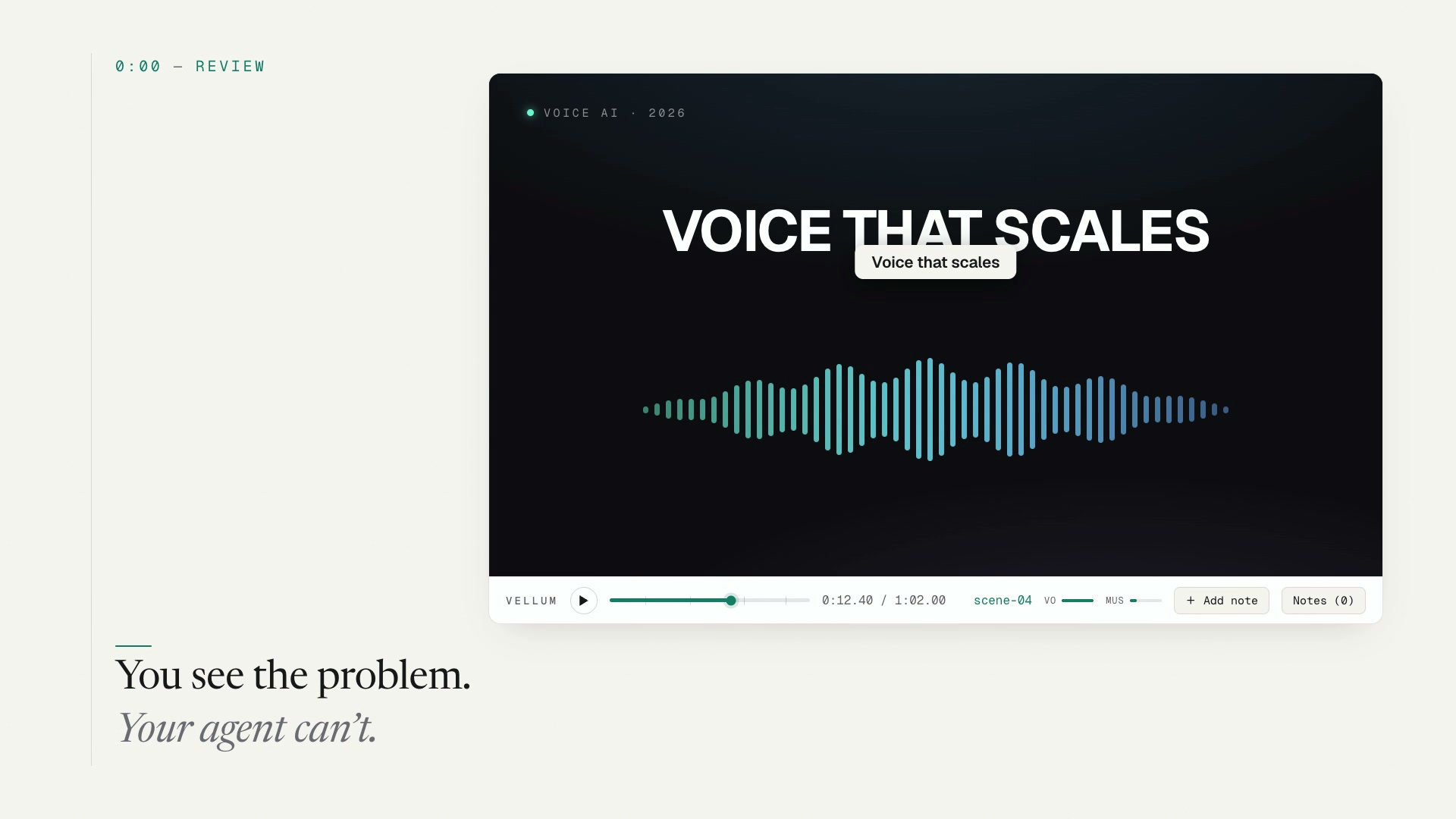
### You see the problem. Your agent can't.
**Vellum is a visual feedback interface for AI-edited video —
pin time-coded notes onto any [HyperFrames](https://hyperframes.heygen.com) frame, and your coding agent reads them back and makes the edits.**
[](LICENSE)
[](https://www.npmjs.com/package/vellum-hf)
[](package.json)
[](https://github.com/jakeat11labs/vellum/actions/workflows/test.yml)
[](https://hyperframes.heygen.com)
**[Install](#install)** · **[Use](#use)** · **[Agent handoff](#agent-handoff)** · **[Demo](#try-the-demo)**
Run vellum · pin point or region notes in the browser · your agent reads them back ▶ Watch the 52-second demo
```bash
curl -fsSL https://tryvellum.vercel.app/install | sh
vellum
```
Pin your notes, then tell your agent: “Address my Vellum review notes.”
---
## How it works
You watch the video and spot it instantly — *"this caption lands late," "make this bubble bigger," "cut two seconds here."* Typed into a chat box, that feedback loses **where** on the frame and **when** in the timeline.
Vellum closes the loop. It layers over your *real* `index.html` (HyperFrames runtime, not a render). You scrub, pin, type. Vellum records composition time, the element under your cursor, and pin/box coordinates — then writes files your agent reads.
| Step | What happens |
| --- | --- |
| **1 · Review** | Open the player, scrub to the moment, drop a pin or region note |
| **2 · Persist** | Notes land in `notes/annotations.md` (+ JSON, optional mix levels) |
| **3 · Hand off** | Your coding agent reads the notes and edits the composition |
```mermaid
flowchart LR
A["You pin notes"] --> B["Vellum notes/"]
B --> C["Agent edits HF"]
```
Works on **any** HyperFrames project — scenes come from the `data-start` attributes every composition already has. No per-project configuration.
## Install
From the root of your HyperFrames project:
```bash
curl -fsSL https://tryvellum.vercel.app/install | sh
vellum
```
The installer drops the review tool into `scripts/`, adds a global `vellum` command to `~/.local/bin`, wires npm scripts when you have a `package.json`, and installs the agent skill to `.agents/skills/vellum/`. Pick Claude Code during install and `.claude/skills/vellum/` becomes a **symlink** to the same skill — one copy, both agents stay in sync.
**No HyperFrames project yet?** Run the installer in an empty folder and it offers to scaffold one in place — `hyperframes init` for the composition, the full `/hyperframes` agent skill set, and `npm install` — then layers Vellum on top. Force it with `--init` (or `VELLUM_INIT=1`), skip it with `--no-init`.
Composition in a subfolder? Pass `--dir` during install:
```bash
curl -fsSL https://tryvellum.vercel.app/install | sh -s -- --dir compositions/hero
```
> **Requirements:** a HyperFrames project (an `index.html` composition) and Node ≥ 18 for the review player itself. The optional extras — the `vellum-review` packet and the installer's project scaffolding — shell out to the `hyperframes` CLI, which requires **Node ≥ 22**. The HyperFrames runtime is resolved automatically — from a local `node_modules/hyperframes` if present, otherwise the npx cache or the CDN — so `npx`-style projects work without a local install. `ffmpeg` and the `hyperframes` CLI are only needed for the optional visual review packet.
Installer flags & other install paths
**Flags:** `--dir ` · `--port ` · `--init` · `--no-init` · `--start` · `--tool-only` · `--skill-only` · `--no-bin` · `--no-prompt` · `--no-package`
**npm**
```bash
npm i -g vellum-hf # global vellum + vellum-review commands
npx vellum-hf # one-off, no install — run in a HyperFrames project
```
Installs the **commands only**. The curl installer above also sets up the agent skill, npm scripts, and (in an empty folder) a fresh HyperFrames project — so it's still the recommended path for the full loop. Need just the skill? `curl -fsSL https://tryvellum.vercel.app/install | sh -s -- --skill-only`.
**Clone & run**
```bash
git clone https://github.com/jakeat11labs/vellum.git
node /path/to/vellum/scripts/vellum-server.mjs # from your HF project root
```
Or copy `scripts/` (+ `skills/vellum/` for the agent). Prefer a package manager? `npm i -g vellum-hf` (see **npm** above) ships the `vellum` and `vellum-review` bins.
**shadcn registry** (projects already using [shadcn/ui](https://ui.shadcn.com/docs/registry/github)):
```bash
npx shadcn@latest add jakeat11labs/vellum/vellum
npx shadcn@latest add jakeat11labs/vellum/vellum-skill
```
Registry install copies files only — add npm scripts yourself, or run `node scripts/vellum-server.mjs` directly. On plain HTML projects without shadcn, the curl installer is simpler.
See [`install.sh`](install.sh) for the full script.
## Use
From your HyperFrames project (any subfolder, after install):
```bash
vellum # opens the review player in your browser
vellum-review # optional visual packet for your agent
```
Subfolder compositions: the installer writes `.vellum.env` with your default `VELLUM_DIR`. Override anytime — `VELLUM_DIR=compositions/hero vellum`.
Skipped the global command (`--no-bin`)? Use `npm run vellum` or `./scripts/vellum`. Disable auto-open with `--no-open` or `VELLUM_OPEN=0`.
Keyboard shortcuts & player controls
| Action | How |
| --- | --- |
| Play / pause | `Space` or ▶ |
| Scrub in 0.1s steps | `←` / `→` (hold `Shift` for 1s) |
| Jump between scenes | `↑` / `↓` |
| **Add a note** | `N` or **+ Add note** → click (pin) or drag (region) → type |
| Balance the mix | 🎙 / 🎵 sliders → **Save mix** |
| Review notes | **Notes** drawer → click to jump; edit inline or cycle status |
| Hand off | **Copy prompt** → paste into your coding agent |
## Agent handoff
Every pin becomes a line in `notes/annotations.md` — time, scene, coordinates, target element, and your feedback:
```markdown
# Review notes
3 note(s). Times are composition-time (M:SS.ss).
- **note-1** · **0:02.40** `title` — Hold this a beat longer before the crossfade _(pin 50.0%, 41.2%)_ · on `div.title` “Build it once. Ship everywhere.”
- **note-2** · **0:08.10** `features` — “Reliable” lands late — bring this card in 0.5s earlier _(pin 74.6%, 52.3%)_ · on `div.card` “Reliable”
- **note-3** · **0:13.90** `stat` — make this number count up instead of fading in _(box 24.1 × 30.0%)_ · on `div.stat` “10×”
```
Also written: `annotations.json` (structured) and `mix.json` (if you saved mix levels).
When you're done reviewing:
> *"Address my Vellum review notes."*
The agent then:
1. **Reads** `notes/annotations.md` — each `note-` links time, scene, and DOM target.
2. **Sees what you saw** (optional) — `vellum-review` renders each frame with pins (and any desired-state ghost box / arrow) drawn on: `notes/review/note-.png` + `INDEX.md`. Run it *before* editing and it caches a baseline frame per note, so a re-run after the edit pairs **before · after** in `INDEX.md` for self-checking.
3. **Edits** the composition, snapshots to verify, and reports back note by note.
| Skill / tool | Owns |
| --- | --- |
| `hyperframes` | building & editing the composition |
| `hyperframes-cli` | `lint` · `check` · `preview` · `snapshot` · `render` |
| **`vellum`** | turning human review notes into those edits |
## Try the demo
Self-contained composition:
```bash
git clone https://github.com/jakeat11labs/vellum.git && cd vellum
npm i && VELLUM_DIR=examples/demo vellum
```
Under the hood
Vellum never modifies your composition. It loads your real `index.html` in an **iframe**, injects the HyperFrames runtime, and floats a pin layer on top:
```
┌───────────────────────────────────────┐
│ PIN LAYER (transparent overlay) │ ← Vellum
│ • click = pin • drag = region │
│ ┌───────────────────────────────┐ │
│ │ your index.html + HF runtime │ │ ← unmodified
│ └───────────────────────────────┘ │
└───────────────────────────────────────┘
```
- **Zero server dependencies** — pure Node built-ins; the player uses your project's HyperFrames runtime.
- **Local-only** — binds `127.0.0.1`, no CORS, path-traversal guards on the notes API.
- **Faithful playback** — HTTP Range requests for media seek; audio state re-asserted every frame.
- **Scene-aware markers** — pins only show while their scene is on screen.
**Review packet caveat:** `vellum-review` uses `hyperframes snapshot`, which drives the GSAP timeline but does not toggle `data-start` clip visibility. Compositions that change scenes *only* via clip toggling (not timeline opacity) may show stacked scenes in packet frames. Timeline-driven transitions — like [`examples/demo`](examples/demo/) — render correctly.

 Run
Run