Uni-flatten




## Features
## Installation
```bash
$ npm i --save uni-flatten
```
## Inspiration
There are various popular modules to flatten an object, but they lost context such as numeric keys, dot in object key, special characters etc. These behaviors disabled converting flattened object to original object. This is when `uni-flatten` becomes handy.
## Quick Start
### Flatten a nested object
```ts
import { flatten } from 'uni-flatten';
flatten({
a: {
b: {
c: 123,
},
d: [
{
e: { f: 456 },
},
],
},
'a.b.c': 789,
});
/*
result:
{
'a.b.c': 123, // normal nested object
'a.d[0].e.f': 456, // nested object array, use brackets to represent array index
'["a.b.c"]': 789, // object with special character in keys
},
*/
```
### Unflatten a flat object
```ts
import { unflatten } from 'uni-flatten';
unflatten({
'a.b.c': 123, // normal nested object
'a.d[0].e.f': 456, // nested object array, use brackets to represent array index
'["a.b.c"]': 789, // object with special character in keys
});
/*
result:
{
a: {
b: {
c: 123,
},
d: [
{
e: { f: 456 },
},
],
},
'a.b.c': 789,
}
*/
```
### Flatten a cyclic object
Circular references are serialized as `[Circular->""]` when flattened, which is useful for unflattening.
```ts
import { flatten, unflatten } from 'uni-flatten';
const obj = { a: { b: { c: 1 } } };
obj.a.d = obj.a;
const flattened = flatten(obj); // { 'a.b.c': 1, 'a.d': '[Circular->"a"]' }
const restored = unflatten(obj); // { a: [ { b: { c: 1 }, d: [Circular *1] }
```
### Flatten and Unflatten Class Instances
`uni-flatten` now supports flattening and unflattening class instances, preserving their constructor information for proper restoration. This is useful when you need to serialize and deserialize complex objects that are instances of custom classes.
> [!NOTE]
> When restoring class instances, `uni-flatten` will construct the object by `new (...)` without any parameters. If constructor call fails, it will throw an error.
```ts
import { flatten, unflatten } from 'uni-flatten';
class Cat {
constructor(public name: string) {}
meow() {
return `Meow! My name is ${this.name}.`;
}
}
const instance = new Cat('Whiskers');
// Flatten the class instance
const flattened = flatten(
{ cat: instance },
{
flattenClassInstances: true,
// A special symbol is added to store the class constructor for unflattening.
// It's not enumerable, so Object.keys should work fine.
// If disabled, the special symbol will not be added.
unflattenToClassInstances: true,
},
);
/*
result: { 'cat.name': 'Whiskers' }
*/
// Unflatten the object back into a class instance
const restored = unflatten(flattened, {
flattenClassInstances: true,
unflattenToClassInstances: true,
});
console.log(restored instanceof Cat); // true
console.log(restored.name); // 'Whiskers'
console.log(restored.meow()); // 'Meow! My name is Whiskers.'
```
## API
Please refer to our [API website](https://nikaple.github.io/uni-flatten) for full documentation.
## Changelog
Please refer to [changelog.md](https://github.com/Nikaple/uni-flatten/blob/main/changelog.md)
## License
[MIT](LICENSE).
## Star History
[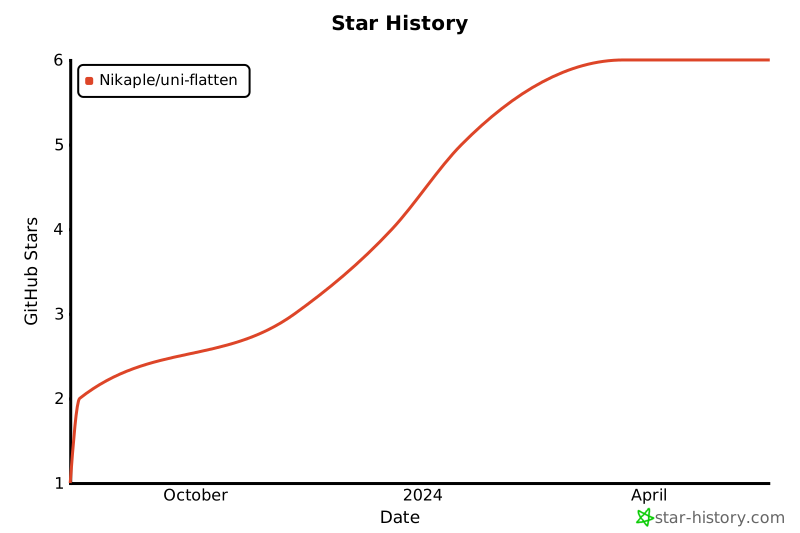](https://star-history.com/#Nikaple/uni-flatten&Date)
]