# tenant-guard
**Guard tests that fail your CI when multi-tenant code can leak across tenants.**



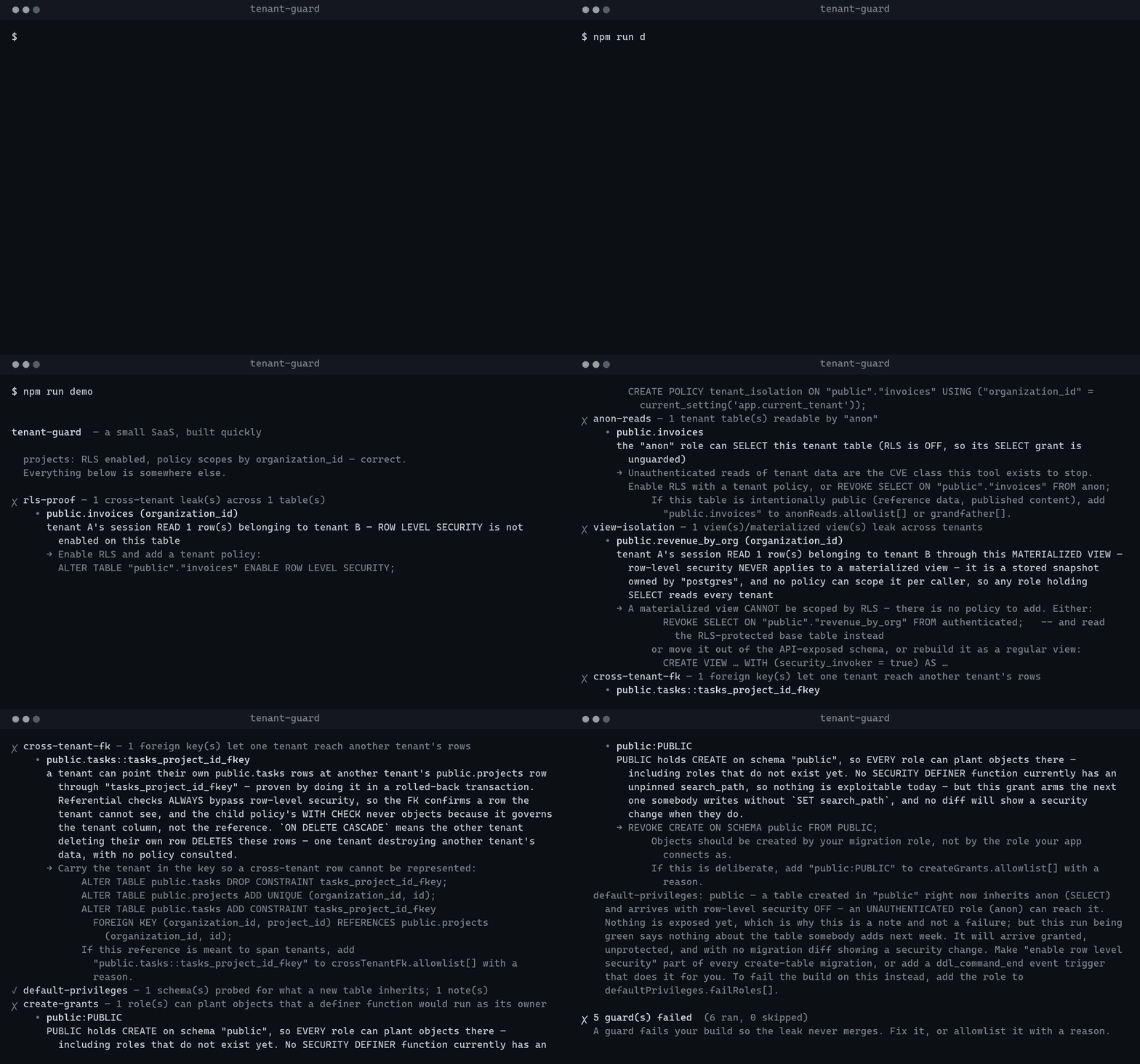
Real output, not a mockup — that's npm run demo, which stands up a throwaway
Postgres and runs the actual guards. The RLS on the main table is correct;
every leak is somewhere else.
Not a scanner you run and then ignore. These are checks that live in your repo,
run in `npm test` and your CI, and **block the merge** — so the cross-tenant
leak never ships. The static guards have **zero dependencies** and run in CI
without `npm ci`; the runtime guards add real Postgres proofs when you opt in.
```bash
npx tenant-guard init # detects your migrations + API routes, writes a config
npx tenant-guard run # static guards — exit 1 if anything can leak
npx tenant-guard all # everything: static guards + every runtime proof
```
Or run one at a time: `prove`, `drift`, `anon-reads`, `anon-writes`, `identity`,
`rpc`, `views`, `storage`, `realtime`, `oracles`, `shadows`, `caps`, `schemas`, `pooler`, `defaults`, `fks`, `creates`, `mfa`,
`columns`, `triggers`.
The view write-through and MCP-config checks run inside `run`, with no database.
`npx tenant-guard list` describes each, and `--help` documents the rest.
Every command also speaks machine: `--json` for anything downstream, `--sarif`
for GitHub code scanning, `--markdown=$GITHUB_STEP_SUMMARY` for the run page.
The exit code is identical in all of them.
---
## The problem
AI code generators — and tired humans — ship the same multi-tenant bugs over
and over:
- an authenticated route loads a row by **bare id** with no tenant filter, so
any user of tenant A can read tenant B's data by guessing an id;
- a new `SECURITY DEFINER` Postgres function is left **callable by `anon`**
because Postgres grants EXECUTE to `PUBLIC` by default;
- two migrations collide on a number and apply in the wrong order.
These aren't exotic. Under [CVE-2025-48757](https://nvd.nist.gov/vuln/detail/CVE-2025-48757),
303 endpoints across 170 Lovable projects had Supabase tables readable by
**unauthenticated** requests using the public anon key — the exact class
`tenant-guard anon-reads` proves against. [Wiz found an auth
bypass in Base44](https://www.wiz.io/blog/critical-vulnerability-base44) that
reached into private enterprise apps. [Veracode's 2025 study](https://www.veracode.com/resources/analyst-reports/2025-genai-code-security-report/)
found 45% of LLM-generated code introduces an OWASP Top 10 flaw — and larger,
newer models were **not** safer.
## What it catches (run against a typical vibe-coded app)
```
tenant-guard — guard tests for multi-tenant isolation
✓ migration-collisions — 3 migrations scanned; 0 grandfathered duplicate(s) ignored
✗ definer-grants — 1 unsafe function(s)
• 200_add_reset_helper.sql
function "reset_workspace" is SECURITY DEFINER + mutates but EXECUTE is not revoked from PUBLIC/anon
→ In the SAME migration add: REVOKE EXECUTE ON FUNCTION public.reset_workspace() FROM PUBLIC, anon;
If it is intentionally pre-auth, add "reset_workspace" to definerGrants.allowlist[] in your tenant-guard config.
✗ route-org-scoping — 1 route(s) can leak across tenants
• src/app/api/invoices/[id]/route.ts
authenticated + filters by bare id + never scopes by a tenant column
→ Add the tenant column to every query in this route, e.g. .eq('organization_id', auth.organizationId).
If this route is genuinely tenant-agnostic, add "src/app/api/invoices/[id]/route.ts" to routeOrgScoping.allowlist[] with a one-line justification.
✗ updatable-view-writethrough — 1 view(s) write through to their base table, bypassing its RLS
• 202_public_profiles.sql
view "public_profiles" is auto-updatable (one relation, no aggregation) and runs as its OWNER — security_invoker is not set — so INSERT/UPDATE/DELETE pass straight through to "users", with that table's RLS evaluated as the owner rather than the caller. No REVOKE of INSERT/UPDATE/DELETE appears in these migrations, and this looks like a Supabase project (it references anon/authenticated), where default privileges grant writes on every new object in public. Granting only SELECT does not make a view read-only: the write privileges arrive on their own.
→ REVOKE INSERT, UPDATE, DELETE ON public_profiles FROM anon, authenticated;
A view that exists to expose safe columns should be readable only. If writes ARE intended,
make them go through checks: CREATE VIEW … WITH (security_invoker = true), or an INSTEAD OF trigger.
If this view is deliberately writable, add "public_profiles" to updatableViews.allowlist[] with a reason.
✗ 3 guard(s) failed (4 ran, 0 skipped)
A guard fails your build so the leak never merges. Fix it, or allowlist it with a reason.
```
(That output is real — it's `examples/leaky-demo/`. Reproduce it:
`cd examples/leaky-demo && node ../../bin/tenant-guard.mjs run`.)
## Every one of these fails silently
That is the thing they have in common, and it is why a passing test suite is not
evidence. An isolation bug does not throw. It returns fewer rows.
- RLS denies a read → **`0 rows`**, which is indistinguishable from "no data yet".
- A PostgREST embed is denied → **`null`**, which renders as a blank name.
- A trigger's uniqueness check cannot see the colliding row → **it passes**, and
the duplicate is written.
- A policy is too tight → the app writes a row and then cannot read it back.
Nothing errors; the page just renders empty.
None of that shows up in an error log, and some of it gets *worse* as you harden
the database: lock a table down correctly and the trigger that guarded it
silently stops guarding. Reproduced exactly that way — in invoker mode the
duplicate row was inserted, and the identical trigger marked `SECURITY DEFINER`
raised.
So the guards are built to make the silence loud, and to be honest about which
kind of statement each one is making:
- **A skip is never a pass.** No database, no `pg`, no second tenant to compare
against — each says so, by name, instead of reporting green.
- **"Not proven" is its own verdict.** RLS on with zero policies looks exactly
like perfect isolation from the outside; it is reported as unfinished.
- **Both directions are checked.** Isolation fails by leaking *and* by being too
tight, and most tools only name the first.
- **Findings are proven, not inferred.** Where a catalog fact could be read two
ways, the guard performs the write in a rolled-back transaction and reports
what actually happened — because a fix you apply blind has to be safe, and
advice built on inference once caused an outage in a real database.
- **Every guard has to prove it CAN fail.** `test/negative-control.test.mjs`
builds a database broken in exactly the way each guard exists to detect and
requires a violation, then builds the corrected version of that same schema and
requires silence. A guard that returns green on its own worst case is not a
guard, however green its other tests are. Suggested by
[u/Guidondor](https://github.com/Guidondor/expo-supabase-starter), whose own
RLS smoke test sat green for weeks because Postgres was raising a type error on
the line that built the failure message — *a suite that can't fail looks
exactly like a suite that passes, and you can't tell them apart from the
outside.*
## The guards
**Static** — read files on disk, zero dependencies, no database:
| Guard | Fails when… | Why a scanner misses it |
|---|---|---|
| `route-org-scoping` | an authenticated route filters by a bare `id` and never mentions a tenant column | catches the *shape* of the IDOR (auth + bare-id + no-tenant), and it lives in your CI so it blocks the merge instead of adding one more report |
| `definer-grants` | a mutating `SECURITY DEFINER` function's **final** definition isn't revoked from `PUBLIC`/`anon` | requires knowing Postgres default grants + PostgREST exposure interact — *revoking from `anon` alone is a no-op*; judged on the net state of history, so a fix in a later repair migration counts |
| `updatable-view-writethrough` | a view built to expose SAFE columns is also **writable through** to its base table | three ordinary defaults collide and nobody writes any of them down: a view over one relation with no aggregation is **auto-updatable**, so Postgres passes `INSERT`/`UPDATE`/`DELETE` to the base table; `security_invoker` is off by default, so those writes run as the view's **owner** and the base table's RLS never applies to the caller; and Supabase's default privileges grant `anon`/`authenticated` writes on every new object, so `GRANT SELECT` does not make it read-only. Reported from production, where `DELETE /rest/v1/public_profiles` with the public anon key wiped the users table. `view-isolation` cannot see it — that proves READ isolation, and this is a write |
| `migration-collisions` | two migrations share a numeric prefix | a project-specific CI invariant (your numbering scheme), not a code smell |
**Runtime — the core proof**, against a seeded test database:
| Guard | Fails when… | Why a scanner misses it |
|---|---|---|
| `rls-proof` | a tenant's session can actually read **or write** another tenant's rows | it isn't reading source at all — it runs real queries as your app role (SELECT, plus `UPDATE`/`DELETE`/tenant-hop/`INSERT`/omitted-tenant probes) and measures the leak; nothing static can prove isolation *holds*, and RLS is per-command so reads passing says nothing about writes. Also runs a **positive control**: isolation has two failure modes and most tools name one. A policy that is too TIGHT never leaks and still breaks the product — so the guard inserts a row belonging to the acting tenant and checks it can read it back. Conclusive, because the database accepted the row: if a table it CAN read does not show it, the read policy is narrower than the write policy. |
| `rls-drift` | the database has RLS enabled or a policy that **no migration declares** | catches security posture applied by hand in the dashboard/psql — invisible to code review, absent from CI, changeable with no diff or history |
**Runtime — who can reach your data:**
| Guard | Fails when… | Why a scanner misses it |
|---|---|---|
| `anon-reads` | the **anonymous** role can SELECT a **tenant** table, view, or materialized view | the CVE-2025-48757 class — the public anon key reads every tenant's data with no login; scoped to objects with a tenant column so public content isn't flagged, and it *probes* as `anon` so it evaluates the real policy, not just the grant |
| `anon-writes` | the **anonymous** role can INSERT/UPDATE/DELETE a table | a table with no tenant column, writable by `anon`, is neither a tenant leak nor drift — it's the cache-poisoning class; it proves the real `USING`/`WITH CHECK` by probing, so it doesn't false-flag `TO public USING (auth.uid()…)` policies. Covers **views** as well as tables, at runtime: a view has no RLS of its own, and unless it was declared `security_invoker = true` it runs as its owner, so a write through it reaches the base table with that table's policies never consulted. `ALTER DEFAULT PRIVILEGES ... ON TABLES` arms every view created afterwards, which is why nothing in the migrations reads like a security change. Selected from the catalog (writes must actually pass through — an aggregate or join view carries the same grant and passes nothing) and then proven by probe. |
| `definer-rpc` | a `SECURITY DEFINER` **RPC** hands out another tenant's rows, **or lets a caller inject SQL that runs as its owner** | the purest form of "the policy exists but the access path around it doesn't": a definer function runs as its **owner**, so it bypasses RLS on everything it touches, and PostgREST exposes it at `/rest/v1/rpc/`. A function that doesn't re-filter by tenant — or that trusts a tenant id the **caller passes in** — routes around flawless policies, and every table-level check still reports green. It also reads the body for **SQL injection** (a parameter concatenated into `EXECUTE`, or passed through `format()`'s `%s`) — injected SQL runs as the *owner*, so it bypasses RLS wholesale — and for an unpinned `search_path`. Only `STABLE`/`IMMUTABLE` functions are ever *called*: Postgres guarantees those cannot write. Also catches the pin that isn't one: `SET search_path = public, app` reads as pinned and protects nothing if `public` is writable — verified, the function returned a planted table. `pg_catalog` first is what makes it a pin. |
| `identity-trust` | the caller can **forge the identity** your policies authorize from, or **write the thing that grants it** | every other guard asks "given a correct identity, is the data scoped?" — this asks whether the identity itself is controllable. A policy reading `user_metadata` (which the *user* can rewrite) is defeated by forging that claim; a callable `SECURITY DEFINER` that sets your tenant GUC from an argument is a "become any tenant" primitive; a `memberships` table the caller can write makes a *flawless* policy bypassable; and — the one most apps have — **a user can make themselves an admin**: because **RLS is row-level and cannot restrict columns**, the textbook-correct `USING (id = auth.uid()) WITH CHECK (id = auth.uid())` self-update policy pins *which rows* you may touch and says nothing about *which columns*, so `update profiles set is_admin = true where id = me` succeeds. Checked on every table with an update policy — including when the flag is read by a policy on that same table, or by nothing in the database at all because your application checks it. A column-level `GRANT` is the only real fix, and the guard recognises one as such |
| `pooler-bleed` | the tenant identity **outlives the request that set it** | the only guard that has to read the database *and* your source, which is why this one goes unnoticed: the catalog says which custom GUC your policies authorize from, the source says whether you set it with `is_local = false` or a bare `SET` — which lasts for the whole **connection**. On a pooled connection the next request inherits the previous tenant and the policy hands over their rows **working exactly as designed**. Run one request and isolation is perfect, which is why every other check here passes: the leak exists only *between* requests |
**Runtime — the surfaces that aren't base tables:**
| Guard | Fails when… | Why a scanner misses it |
|---|---|---|
| `view-isolation` | a **view** or **materialized view** leaks across tenants | a view runs with its **owner's** rights unless `security_invoker` is set, and RLS **never applies to a materialized view at all** — so a perfectly-RLS'd table can still be handed out wholesale by the view beside it, and every table-only checker (including `rls-proof`) sees nothing wrong |
| `storage-isolation` | Supabase **Storage** leaks across tenant folders | storage has no tenant *column* — tenancy lives in the object **path**. Two things follow that a column-based check cannot see: the **client picks the path on upload**, so a perfect read policy still lets a user write into another tenant's folder; and a **public bucket** is served with no auth and no RLS at all, making "the path is unguessable" the whole boundary. Also reports **objects that outlived their row**: a signed URL is a bearer token checked against its signature and clock, never against RLS, and it cannot be revoked — so an object left behind by a delete keeps being served for the whole expiry window, and no policy you write reaches it. Reported by a user whose signed URLs kept serving with the record long gone. The link between your tables and storage is established by EVIDENCE (a column whose values actually match object names), and when none can be proven it says so rather than calling every object an orphan. |
| `realtime-isolation` | Supabase **Realtime** channels leak across tenants | Realtime is a second way out of the database, easy to forget once REST looks locked down. Broadcast and Presence authorize channels through RLS on `realtime.messages` — with none, any client joins any tenant's channel, reads every payload on it, and (since joining is a write) **publishes into it**. The tenant lives in the *topic*, not a column |
**Runtime — where tenant data goes, and what else the role can reach:**
| Guard | Fails when… | Why a scanner misses it |
|---|---|---|
| `shadow-tables` | a trigger copies tenant data into a table nothing protects | the source has flawless RLS; the audit log, outbox or cache it feeds usually has **no tenant column at all**, so every tenant-aware check walks past it. Verified: the source returns one row to its tenant while the shadow returns both tenants', and `rls-proof` reports green |
| `role-capabilities` | the app role holds a capability that defeats RLS, or a direct grant on the `auth` schema | `dblink` opens a **new connection** as whatever role its string names — RLS on it has nothing to do with the caller's; file reads never touch the policy layer; and `auth.users` is every tenant's email in one table with no policy of yours in front of it. Outbound HTTP (`pg_net`) is surfaced as a **note**: real, but exfiltration rather than a cross-tenant read |
| `schema-tenancy` | one role can read **more than one tenant schema** | the other multi-tenant architecture — a schema per tenant — where the boundary is **GRANTs and nothing else**. `search_path` is not a control: it doesn't stop anyone writing `tenant_b.docs` directly, and the client can reset it. Every column-based check is blind here: point `rls-proof` at such a database and it reports "1/1 proven isolated" while the app role reads both tenants |
| `default-privileges` | a table created **tomorrow** arrives granted and unprotected | the only guard about the database as it *will be*. `ALTER DEFAULT PRIVILEGES` grants on every table created after it, and Postgres never enables RLS by default — so a green run says nothing about the table somebody adds next week: it arrives already granted, with no policy, exposed the instant it exists, and **no migration diff shows a security change**. It proves rather than infers, by creating a table inside a rolled-back transaction and reading what that table actually inherited |
| `cross-tenant-fk` | a foreign key lets one tenant reach — and **destroy** — another tenant's rows | the only finding here where a tenant *deletes* another tenant's data rather than reading it. **Referential integrity checks always bypass RLS** — they must, or a constraint could be defeated by hiding a row. So a key carrying an id but not the tenant lets tenant A point their row at tenant B's (the FK confirms a row A cannot see; the `WITH CHECK` governs the tenant column, not the reference), and then **`ON DELETE CASCADE` means B deleting their own row deletes A's**. Verified end to end, on a database `rls-proof` calls isolated |
| `create-grants` | someone who is not your migration role can **plant objects** in your database | `CREATE` is the quietest privilege in Postgres — nothing about it looks like data access — and it is the precondition that turns an unpinned `SECURITY DEFINER` `search_path` into escalation: you can only shadow an object if you can create one. That is CVE-2018-1058's shape, and why **Postgres 15 stopped granting it on `public` to `PUBLIC`**. Reported **even when no definer function exists yet**, because the grant arms the next one somebody writes — the one state a function-by-function check has nothing to evaluate in |
| `mfa-enforcement` | your second factor gates the **login screen**, not the data | PostgREST honours whatever JWT the client presents, so the only thing that can refuse a single-factor token at the data layer is a policy checking the assurance level. And an `aal2` check written **PERMISSIVELY enforces nothing** — Postgres ORs permissive policies and ANDs restrictive ones, so it can only *widen* access. Verified: with a permissive gate an `aal1` session reads every row; with `AS RESTRICTIVE` it reads none. The policy reads exactly right and does nothing. Also flags factors enrolled with no `aal` policy anywhere, and enforcement that covers only some tenant tables |
| `trigger-visibility` | a trigger **enforces** a rule by reading a table RLS hides from it | a trigger function runs as the INVOKER unless declared `SECURITY DEFINER`, so a uniqueness check inside one sees only the rows RLS shows the **writing** role. The day someone locks that table down — the correct thing to do — the check stops finding collisions and silently starts passing. Verified, and worse than a missed check: in invoker mode the duplicate row was **inserted**; the identical trigger marked `SECURITY DEFINER` raised. Requires an enforcement signal (`RAISE` / `RETURN NULL`) and a measured visibility gap, so it stays off every `set_updated_at` in the schema |
| `column-exposure` | a **sensitive column** is served to the anonymous internet, on the table no tenancy guard covers | the waitlist, the author directory, the `api_clients` lookup — no tenant column, so `anon-reads` and `rls-proof` are silent on them *correctly*: nothing leaks across tenants because there are none. It leaks to everyone. **Proven by reading, never inferred from a grant** — measured, a single table-level `GRANT SELECT` expands to every column in `information_schema.column_privileges`, so a grant-based check reported a fully-isolated table as exposing all seven of its columns and fired on a table RLS already closes. This one fails only when `anon` gets a real non-null value back, and the probe is a `count()` so the finding never carries the leaked value into your CI log |
| `mcp-config` | an MCP server was handed a **credential or an admin account** in a file you commit | an MCP server with a database connection is an invokable path to your data, and the Postgres/Supabase ones connect with a service role or PAT that **bypasses RLS entirely** — so every proof in this table is silent about what that path can reach (point `prove` at the role and it says so: *identity switch is not enforcing RLS*). This reads the config: a service-role key or PAT written inline rather than referenced, a connection string running as `postgres`, a Supabase server without `--read-only`. An `env` reference is the correct shape and is never reported. Deliberately narrow — it says nothing about prompt injection or whether an agent will misuse a legitimate tool, which is a different instrument |
**Catalog** — the schema's shape rather than its behaviour:
| Guard | Fails when… | Why a scanner misses it |
|---|---|---|
| `constraint-oracles` | a constraint answers questions **across** tenants | RLS hides rows, not constraints — and constraints are enforced *below* it. `users.email UNIQUE` on a tenant table means inserting `victim@corp.com` raises a duplicate-key error even though RLS hides the row that caused it, so anyone can test whether a value exists in another tenant (and `ON CONFLICT DO NOTHING` asks the same question with no error at all). Nothing about the policies is wrong; the *schema* is the leak |
## Which databases this is for
**PostgreSQL, and anything that speaks it.** The runtime guards work by dropping to
your app role and proving row-level security actually holds — so they need an
engine that *has* RLS, and a `pg_catalog` to introspect.
| | Status |
|---|---|
| **Supabase** | Fully supported, and the Supabase-only surfaces (Storage, Realtime, the `auth` schema) have guards of their own |
| **Neon, RDS/Aurora, Cloud SQL, Timescale, self-hosted Postgres** | **Fully supported.** Nothing is Supabase-specific except the guards that say so, and those *skip cleanly* with a stated reason rather than failing you |
| **CockroachDB** | Untested. It speaks the Postgres wire protocol and has Postgres-compatible RLS from v25.2, so this may work as-is — if you try it, a report either way is welcome |
| **MySQL, MariaDB, PlanetScale, SQLite, MongoDB** | **Not supported, and not planned.** These have no row-level security, so there is no policy layer to prove. Isolation there is enforced in application code or by schema/database separation — a genuinely different check, not a port of this one |
| **SQL Server, Oracle** | Not supported. Both have real RLS (predicate functions, VPD), but a different driver, catalog and impersonation model — that's a rewrite sharing a name, not an extension |
If your tenancy is **one schema per tenant** rather than a tenant column, that's
covered too — see `tenant-guard schemas`. It's the usual pattern on engines
without RLS, and it's common on Postgres as well.
A non-Supabase run looks like this — real guards doing real work, and the
Supabase-only ones stepping aside:
```
rls-proof ok | 1/1 tenant table(s) proven isolated (read + write)
anon-reads ok | 1 tenant table(s) checked; none readable by "app_user"
identity-trust ok | 1 tenant policy/policies checked; identity sources look unforgeable
storage-isolation ok | skipped — no storage schema
realtime-isolation ok | skipped — no realtime schema
```
## How it fits your project
tenant-guard runs **inside your repository**, against the files already on disk.
It is **not** a scanner you point at a URL or a website, and there is no hosted
service — you run it where your code is (locally or in CI). The only thing you
ever "point it at" is a **test database connection string**, and only for the
runtime guards.
| Part | What it reads | What you provide |
|---|---|---|
| static guards (`run`) | your API-route and SQL-migration **files** in the current directory | nothing — it reads the folder |
| runtime guards (`prove`, `drift`, `anon-*`, `identity`, `views`, `storage`, `realtime`, `oracles`) | a live **Postgres** database | a connection string to a *test/staging* DB (never a URL, never prod) |
| everything (`all`) | both of the above, in order | as above — anything without a database **skips**, and a skip is never a pass |
Three places it runs, all inside the repo:
- **Locally** — `cd your-project && npx tenant-guard run` scans that folder.
- **In CI** — your pipeline checks out the repo and runs `npx tenant-guard run`
(or `all`, with a test database), so a leak **blocks the merge**.
- **In your test suite** — `import { runAll, prove } from 'tenant-guard'` and
assert no violations, so it runs with `npm test`.
Anyone else uses it identically in **their own** repo: `npx` pulls it from npm
(no clone of this repo, no account, no server), `init` autodetects their layout,
and they commit a `tenant-guard.config.json` so their team and CI share one
baseline. It works on any stack with API-route files and SQL migrations — see
[Config](#config) to point the signals at a non–Next.js/Supabase layout.
It does **not** take a repo URL, crawl GitHub, make HTTP requests to your app, or
run as a SaaS.
## Prove it at runtime — the part no scanner can do
The static guards read source text: they catch the obvious leak cheaply, but they
can't *prove* isolation holds. `tenant-guard prove` can. Against a seeded test
database it:
1. finds every table with a tenant column — including **partitioned** tables and
each of their partitions — noting whether RLS is even on;
2. as the privileged role (which bypasses RLS, like Supabase `service_role`)
picks two real tenant ids that already have data;
3. drops to your **non-superuser app role** (e.g. `authenticated`), assumes
tenant A's identity, and asserts A's session can neither **read nor write**
tenant B's rows — SELECT, plus the full write path: `UPDATE`/`DELETE` of B's
rows, a **tenant-hop** (reassigning A's own row *into* B), an **`INSERT`** that
creates a row in B, and an **omitted-tenant `INSERT`** (tenant column `NULL`)
that creates an orphan row every tenant can read — then checks the other
direction.
If RLS is off, a policy is `USING (true)`, a policy forgot the tenant predicate,
**the write path is unprotected** (RLS is per-command — a correct `SELECT` policy
does not cover `UPDATE`/`DELETE`, and `USING` does not cover `INSERT` or where an
update *lands*; those need `WITH CHECK`), or **RLS is on with no policy at all** (a
deny-all that only *looks* isolated), the proof names it and **fails your build**.
**Before trusting any pass it runs a negative control**: it drops to your app role
and asserts that role *cannot* read a deliberately deny-all table. If it can, RLS
isn't being enforced for it — a superuser, a `BYPASSRLS` role, a table owner — so
every "isolated" result would be a vacuous pass, and the run fails instead of
reporting one. A check you can't falsify is worthless.
See it catch a real leak with zero infrastructure:
```bash
npm i @electric-sql/pglite # embedded Postgres — no Docker
node examples/rls-proof/demo.mjs # passes a good policy, fails a leaky one
```
Against your own database (a **test/staging** one, never production):
```bash
npm i -D pg
export TENANT_GUARD_DATABASE_URL="postgres://…/your_test_db"
npx tenant-guard prove
```
Every write probe runs inside a `SAVEPOINT` that is rolled back, and the whole run
is one transaction that is rolled back — non-destructive by construction (set
`probeWrites: false` to test reads only). A skip (no database, or `pg` not
installed) is **not** a pass, and the CLI says so. Full setup — including the
Supabase JWT-claim config and seeding mode for an empty CI database — is in
[`examples/rls-proof/`](examples/rls-proof/README.md).
## The rest of the surface
Each of these is one command, inherits the same identity config, and skips cleanly
when it doesn't apply to your stack.
**`drift` — prove your RLS is in version control.** RLS can be enabled and given
policies **by hand in the Supabase dashboard** and never captured in a migration.
When that happens the table's real posture is invisible to code review, absent
from every fresh/CI database, and editable in the UI with no diff and no history.
A permissive policy letting `anon` write a shared table can live in production for
months without appearing in a single pull request. (Not hypothetical — it's how a
real cache-poisoning bug hid in a Supabase app we ran this against.) `drift` diffs
every `ENABLE ROW LEVEL SECURITY` / `CREATE POLICY` in your migrations (net of
`DROP`/`DISABLE`) against the live catalog; anything in the database that no
migration declares fails the build.
**`anon-reads` / `anon-writes` — the unauthenticated surface.** The public anon key
ships in every browser bundle. `anon-reads` proves it can't SELECT tenant data
(the CVE-2025-48757 class); `anon-writes` proves it can't write a shared table (the
cache-poisoning class). Reliability is the point: well-secured Supabase apps write
`TO public USING (auth.uid() = …)`, which a catalog-only check can't evaluate and
would false-flag — so both **probe as `anon`** and evaluate the real
`USING`/`WITH CHECK` rather than guessing from grants.
**`identity` — can the caller forge the identity itself?** Everything above assumes
the identity is honest. This asks whether it is: a policy authorizing from
`user_metadata` (user-writable, unlike `app_metadata`) is *proven* forgeable by
forging exactly that claim; a callable `SECURITY DEFINER` that sets your tenant GUC
from an argument is a "become any tenant" primitive; a membership table you can
write makes a correct policy bypassable; and a self-update policy still lets you
rewrite the `role` column that grants your access, because **RLS cannot restrict
columns** — only a column-level `GRANT` can.
That last one is worth spelling out, because it is the one most applications
have and the one that looks correct in review:
```sql
-- The policy is right. Everyone reviews this and moves on.
CREATE POLICY self ON profiles FOR UPDATE
USING (id = auth.uid()) WITH CHECK (id = auth.uid());
-- And then:
UPDATE profiles SET is_admin = true WHERE id = auth.uid(); -- succeeds
```
RLS decides *which rows* you may touch. It has nothing to say about *which
columns*, so a policy that correctly confines you to your own row does not stop
you rewriting the field that grants your access. The guard checks every table
carrying an update policy — including when the flag is read by a policy on that
same table, or by **nothing in the database at all** because your application is
what checks it — and grades accordingly: a tenant column or a column some policy
reads **fails the build**; a column merely *named* like an authorization field
(`is_admin`, `role`, `plan`, …) that no policy reads is a **note**, since SQL
cannot see whether your app treats it as one. Add your own names with
`identityTrust.authorizationColumns`. The fix it gives is the only one that
works:
```sql
REVOKE UPDATE ON profiles FROM authenticated;
GRANT UPDATE (display_name, avatar_url) ON profiles TO authenticated;
```
and once that grant is in place the guard goes quiet, because the column really
is unwritable.
**`views`, `storage`, `realtime` — the surfaces that aren't base tables.** A view
runs with its *owner's* rights unless `security_invoker` is set; a materialized
view ignores RLS entirely; Storage and Realtime key tenancy off an object **path**
and a channel **topic** rather than a column, and in both the *client* chooses that
string when it writes. Each is invisible to a table-only check — there is a test
asserting `rls-proof` passes while `view-isolation` fails on the same database.
**`rpc` — the function that runs as its owner.** A `SECURITY DEFINER` function
bypasses RLS on everything it touches and is exposed by PostgREST as an endpoint.
If it doesn't re-filter by an auth-derived tenant — or filters by a tenant id the
*caller* supplies — the policies on the underlying tables never get a say. This is
also where the tool is most careful about its own blast radius: it will only
**call** a function Postgres has classified `STABLE` or `IMMUTABLE`, because the
engine enforces that those cannot write. A `VOLATILE` definer function is never
invoked — it is reported from a read of its body, as a note, saying exactly that.
**`shadows` and `caps` — where the data goes, and what else the role holds.** A
trigger on a protected table writes to an audit log that nothing protects, and the
data is out. Separately, some grants make every table-level question moot: `dblink`
opens a connection RLS knows nothing about, and a direct grant on `auth.users`
hands over every tenant's email.
**`oracles` — the schema itself.** RLS hides rows, not constraints. A globally
`UNIQUE` natural key on a tenant table lets anyone test whether a value exists in
another tenant, through an error message they were never meant to see.
## Why not just a SAST scanner?
There is a good static scanner for this space —
[`mcp-tenant-isolation`](https://www.npmjs.com/package/mcp-tenant-isolation)
(57 rules, SARIF). If you want a report of findings, use it; the two compose.
tenant-guard is a **different tool for a different failure mode**. A scanner
produces a list of findings that a busy team learns to ignore (alert fatigue).
tenant-guard's checks are **tests in your own suite** — red in `npm test`, the
PR can't merge, and they carry a per-project **allowlist**: when you adopt it on
a legacy repo you allowlist the debt you can't fix today, the build goes green,
and *it can only get better from there*. It's the
[ArchUnit](https://www.archunit.org/) philosophy — architecture rules as
executable tests — pointed at tenant isolation, which nobody had done.
## Adopt it
**GitHub Actions** — one step, no config, no install:
```yaml
# .github/workflows/tenant-guard.yml
name: tenant-guard
on: [pull_request]
jobs:
guard:
runs-on: ubuntu-latest
permissions:
contents: read
security-events: write # so findings reach the Security tab
steps:
- uses: actions/checkout@v4
- uses: FedericoTs/tenant-guard@v0
```
That runs the static guards, **blocks the merge** on a finding, writes a result
table to the run summary page, and annotates each finding on the pull-request
diff. Add a database to turn on the runtime proofs:
```yaml
- uses: FedericoTs/tenant-guard@v0
with:
command: all
database-url: ${{ secrets.TEST_DATABASE_URL }}
```
> **Never point the runtime guards at production.** They write — inside a
> rolled-back transaction, but they write. Use a seeded test or staging database.
Locally, or on any other CI:
```bash
npx tenant-guard init # writes tenant-guard.config.json
npx tenant-guard run # allowlist any legacy finding you can't fix yet
npx tenant-guard all --json # results as data, for anything downstream
```
Adopting on a codebase that will light up on day one? Set `fail-on-error: false`
so findings appear without blocking, or allowlist the debt you can't fix today —
from then on the guard can only ratchet in your favour.
📘 **[docs/CI.md](docs/CI.md)** — inputs and outputs, a Postgres service
container, seeding two tenants on an empty CI database, GitLab and other CI,
troubleshooting.
📗 **[docs/OUTPUT.md](docs/OUTPUT.md)** — `--json`, `--sarif`, `--markdown`, and
the exit-code contract.
Or import the guards into your existing vitest/jest suite:
```js
import { runAll } from 'tenant-guard';
test('no cross-tenant leaks (static)', () => {
const failed = runAll().filter(r => !r.ok && !r.skipped);
expect(failed).toEqual([]);
});
```
The runtime guards drop straight into your suite too — hand any of them a Postgres
client whose `query(text, values)` returns `{ rows }` (node-postgres, or an
embedded pglite in tests):
```js
import { prove, checkViews, checkIdentity } from 'tenant-guard';
test('RLS actually isolates tenants', async () => {
const res = await prove({ query: (t, v) => pool.query(t, v) });
expect(res.violations).toEqual([]);
});
```
## Config
`tenant-guard.config.json` (see `examples/tenant-guard.config.json` for the
annotated version, or run `tenant-guard init` to generate it). Every guard is
opt-in and autodetects its paths; a guard that doesn't apply to your stack
**skips**, it never fails you.
```json
{
"migrations": { "dir": "supabase/migrations", "grandfather": ["031", "101"] },
"definerGrants": { "baseline": 189, "allowlist": ["validate_public_token"] },
"routeOrgScoping": { "routesDir": "src/app/api", "allowlist": [] },
"rlsProof": { "role": "authenticated", "claim": "org_id", "tenantColumns": ["organization_id"], "grandfather": ["shared_lookup"] },
"rlsDrift": { "schemas": ["public"], "allowlist": ["public.some_supabase_managed_table"] },
"anonReads": { "role": "anon", "allowlist": ["public.published_posts"] },
"anonWrites": { "role": "anon", "allowlist": [] },
"identityTrust": { "allowlist": [] },
"viewIsolation": { "allowlist": ["public.admin_reporting_view"] },
"storageIsolation": { "pathSegment": 1, "allowlist": ["brand-assets"] },
"realtimeIsolation": { "topicSeparator": ":", "allowlist": [] },
"constraintOracles": { "allowlist": ["public.orgs"] }
}
```
The runtime guards run only when `TENANT_GUARD_DATABASE_URL` (or `DATABASE_URL`)
is set, so they stay skipped until you opt in. **Identity is configured once**:
`viewIsolation`, `identityTrust`, `storageIsolation` and `realtimeIsolation`
inherit `role` / `becomeTenant` / `claim` from `rlsProof` unless you override them.
**Assuming a tenant's identity.** `becomeTenant` defaults to the canonical
Postgres GUC pattern. For Supabase JWT policies the `claim` shortcut is usually all
you need — `"claim": "org_id"` builds the `request.jwt.claims` impersonation and
sets `role` to `authenticated`, so **CI never needs your JWT secret**. Apps that
resolve the tenant through a memberships table use an explicit `becomeTenant`
(arbitrary SQL) plus `rlsProof.seed`, which manufactures two synthetic tenants
inside the rolled-back transaction so the proof works on an **empty CI database**.
Details in [`examples/rls-proof/`](examples/rls-proof/README.md).
**Per-user apps** (the tenant is a *user*, not an org). The defaults key off
`organization_id`/`tenant_id` and deliberately **don't** treat `user_id` as a
tenant column — in a B2B app `user_id` is often just the creator, and treating it
as the tenant boundary would hide real org leaks. If *your* isolation boundary is
the user, add it to both signals:
```json
{
"routeOrgScoping": { "tenantSignals": ["user_id", "organization_id"] },
"rlsProof": { "tenantColumns": ["user_id", "organization_id"] }
}
```
> **You probably no longer need the `routeOrgScoping` half.** A route filtering
> by the session user's own id — `.eq('user_id', user.id)`, `.eq('id', user.id)` —
> is recognised as a per-user scope on its own since 0.41.0, because the guard
> reads the filter's *value* and not just its column name. Adding `user_id` to
> `tenantSignals` also silences `.eq('user_id', params.userId)`, which **is** an
> IDOR — verified — so reach for it only if your session value is spelled in a way
> the defaults miss, and prefer `sessionValueSignals` for that:
>
> ```json
> { "routeOrgScoping": { "sessionValueSignals": ["ctx.viewer.id"] } }
> ```
Then **allowlist genuinely shared tables/routes** — a Google-Places cache, a
public reference table — with a one-line reason, rather than scoping data that is
supposed to be global.
Defaults target Next.js App Router + Supabase/Postgres, but every signal
(auth helpers, tenant column names, route glob) is configurable, so it works on
any stack that has API routes and SQL migrations. The bare-id detector ships
with patterns for **Supabase** (`.eq('id')`), **Prisma** (`where: { id }`), and
**Drizzle** (`eq(table.id, …)`) out of the box; raw SQL (`where id = …`) is left
out of the default to avoid false positives on self-loads — widen
`idFilterPattern` in config if you want it. These claims are backed by tests in
[`test/flexibility.test.mjs`](test/flexibility.test.mjs), which also prove
`rls-proof` against Supabase JWT-claim policies and non-Supabase session-GUC
apps.
## Honest limits
**The full map is [`THREAT-MODEL.md`](THREAT-MODEL.md)** — every way tenant
isolation is known to break, each tagged covered / partial / out-of-scope, with
*why* for the ones that are out of scope. It is the coverage target this project
builds against, and the honest statement of what a green run does and doesn't
prove. Read it before trusting one.
The **static** guards are heuristics on source text, deliberately conservative:
they catch a bug *shape*, not every instance. The real defence is row-level
security enforced in the database, which is exactly why the runtime guards exist —
they don't guess from source, they run queries as your app role and measure
whether isolation actually holds.
The **runtime** guards have limits of their own, and report them rather than
papering over them:
- They prove isolation for what they can reach with the tenant identity you
configure. A mismatch between `becomeTenant` and your real policies shows up as
*"sees none of its own rows either"* — **not** as a false pass.
- A table holding one tenant's data can often still be proven, by impersonating a
tenant that exists elsewhere. When it genuinely can't be, it is reported as
**not proven**, never as passing.
- Some findings are deliberately **notes rather than build failures** — a
client-settable tenant GUC, `TRUNCATE` privilege, single-column foreign keys —
because whether they are exploitable depends on architecture SQL cannot see.
Failing the build on an unfalsifiable finding is how a security tool becomes
ignorable.
And four classes are **out of scope by construction**, because "run SQL as the app
role" cannot see them. They need a different instrument, and they stay listed in
the threat model rather than being quietly omitted:
- **App-layer IDOR** through a service-role/admin connection that forgets
`.eq('organization_id', …)`. The database serves it correctly; the bug is in the
application. (`route-org-scoping` covers the shape of this, statically.)
- **A leaked `service_role` key** in a client bundle — needs a secret scan.
- **Connection-pooler state bleed** (`SET` instead of `SET LOCAL` on a
transaction-pooled connection) — invisible from inside a single session.
- **A weak or leaked JWT secret** — key management, not RLS.
It is a strong proof on every commit, not a substitute for a pen test.
## Background
These guards were extracted from a production multi-tenant EU SaaS (now retired)
where they ran green on every push. The interesting finding from that codebase
is written up in [`METHODOLOGY.md`](METHODOLOGY.md): **the descriptive docs
written for the AI agent all rotted, while every executable guard survived.**
Since then the project stopped growing one reported bug at a time and started
building down [`THREAT-MODEL.md`](THREAT-MODEL.md) instead — which promptly
surfaced a **false negative in the flagship guard** (partitioned tables reporting
green while leaking) that no amount of waiting for bug reports had found.
## Documentation
| | |
|---|---|
| [`docs/CI.md`](docs/CI.md) | Wiring it into CI — the GitHub Action's inputs and outputs, a Postgres service container, seeding two tenants on an empty CI database, GitLab and other CI, troubleshooting |
| [`docs/OUTPUT.md`](docs/OUTPUT.md) | `--json`, `--sarif`, `--markdown`, the exit-code contract, and programmatic use |
| [`THREAT-MODEL.md`](THREAT-MODEL.md) | Every way tenant isolation breaks, what is covered, and what this method **cannot** see |
| [`METHODOLOGY.md`](METHODOLOGY.md) | Where these guards came from, and why the executable ones outlived the written ones |
| [`examples/`](examples/) | An annotated config, a CI workflow, a runtime-proof walkthrough, and `leaky-demo` — a repo that fails on purpose |
## Licence
MIT — see [`LICENSE`](LICENSE). By Federico Sciuca.