[](https://github.com/heggria/taskflow/actions/workflows/ci.yml)
[](https://nodejs.org)
[](https://github.com/heggria/taskflow/blob/main/LICENSE)
[](#host-adapters)
**English** · [简体中文](https://github.com/heggria/taskflow/blob/main/README.zh-CN.md)
[1.0 overview](#taskflow-10-declarative-coding-agent-workflows) · [Quickstart](#quickstart) · [Docs](https://heggria.github.io/taskflow/en/docs) · [Examples](https://github.com/heggria/taskflow/blob/main/examples) · [Changelog](https://github.com/heggria/taskflow/blob/main/CHANGELOG.md)
---
# taskflow 1.0: declarative coding-agent workflows
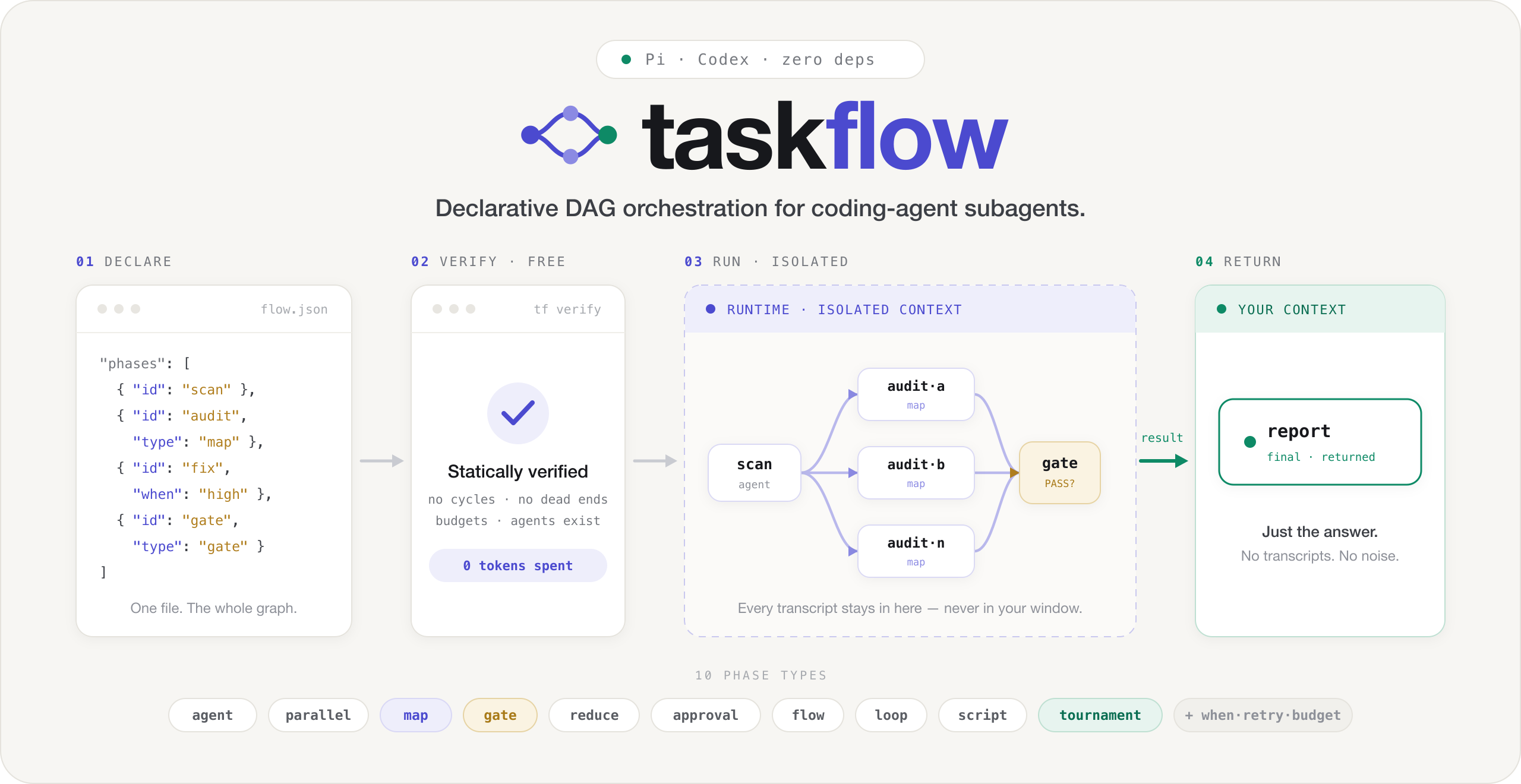
**taskflow is a declarative runtime for coding-agent workflows.** It turns a graph into a verifiable execution contract, runs phases in isolation, and keeps intermediate work out of the host conversation. In Taskflow 1.0, the contract also describes the effects a phase is allowed to propose.
> **Taskflow 1.0.0** includes the DAG runtime, trusted filesystem effects and complete Control Plane (CLI/MCP/WebUI). [GitHub Releases](https://github.com/heggria/taskflow/releases) and npm establish publication; see the [acceptance scoreboard](https://github.com/heggria/taskflow/blob/main/docs/internal/1.0.0-ga-scoreboard.md) for verified scope and limits.
## The declared-effect contract
An agent can propose content. It should not become the mutation authority merely because it can run a command.
For admitted, declared filesystem-write targets, taskflow 1.0 makes the path explicit and routes the final mutation through the resources transaction:
```text
flow / .tf.ts
│
▼
validate + verify ──► EffectIR + FlowIR hash
│ │
│ ▼
│ admit declared targets
│ │
▼ ▼
isolated phase ───────► stage → commit | restore + reject
│
▼
ledger-backed why-effect
```
This is **not** an OS sandbox. Resolve-only hosts cannot prevent every write to an undeclared path. Secret and service references are typed and fail closed in this cut; they do not imply a vault or network backend.
## The 1.0 target and current implementation
| Layer | What it does | Support boundary |
|---|---|---|
| **Taskflow runtime** | Declarative DAGs, 12 phase types, budgets, retries, approvals, isolation, resume, replay, trace, and recompute | Stable runtime contract |
| **Trusted Effects** | Closed `EffectIR`, `PathRef` / `SecretRef` / `ServiceRef`, confidentiality/integrity labels, effect validation, overlap checks, and ledger-backed `why-*` explainers | Declared-target contract |
| **Resource transaction** | Snapshot → lease → durable intent/permit → stage → commit, or restore and reject | Declared-target contract |
| **Host adapters** | Pi, Codex, Claude Code, OpenCode, Grok Build, and Hermes Agent use the same flow contract | Existing host surface; support remains host-specific |
| **Control Plane** | Authenticated multi-project admission, global concurrency, durable replay, approvals/CAS, Receipts and operator CLI/MCP | Bundled in public `taskflow-mcp-core`; Unix UDS, Windows pipes non-GA |
| **WebUI** | Runs, approval edits, Receipts and evidence browsing | Local token login, live authorization and project isolation |
The [1.0 release plan](https://github.com/heggria/taskflow/blob/main/docs/internal/1.0.0-release-plan.md) defines the stable scope and acceptance gates. The filesystem-transaction details are in [`docs/internal/0.3.0-trusted-effects-mvp.md`](https://github.com/heggria/taskflow/blob/main/docs/internal/0.3.0-trusted-effects-mvp.md). The 0.3-C Control Plane plan is [`docs/internal/0.3-c-control-plane-plan.md`](https://github.com/heggria/taskflow/blob/main/docs/internal/0.3-c-control-plane-plan.md).
## Quickstart
Use Node.js **≥ 22.19.0**. To run from the 1.0 source checkout:
```bash
git clone https://github.com/heggria/taskflow.git
cd taskflow
git checkout v1.0.0
pnpm install
pnpm run typecheck
pnpm test
```
Install the matching 1.0.0 package set after confirming the release is available:
```bash
npm install --global pi-taskflow@1.0.0
npm install --global codex-taskflow@1.0.0
```
The host-specific plugin and MCP commands remain in the [host guides](https://heggria.github.io/taskflow/en/docs/guides/).
Run the no-LLM Trusted Effects vertical-slice fixture:
```bash
pnpm exec node --conditions=development --experimental-strip-types --test \
packages/taskflow-core/test/effects-e2e-fixture.test.ts
```
This exercises the checked-in `examples/trusted-effects-write.json` path without a live LLM. For an interactive run, use the host guide for the adapter you already run. The [release guide](https://github.com/heggria/taskflow/blob/main/RELEASE.md) covers packed-consumer validation and release gates.
### Local Control Console
In Pi, run `/tf web` to start the bundled local Control Console and open the default browser. If browser opening fails, the command shows a manual loopback URL. Use the one-use token in the reported private (0600) handoff file to log in; tokens are never included in the URL or command notifications.
The console shows Control Plane runs, approvals, Receipts and existing evidence. Legacy Pi run transcripts are outside this view. Repeating the command in the same project reuses its service; changing projects or leaving the Pi session stops only the console process started by that session. Unix local transport is required. If another host already owns the Control home, stop that owner explicitly before launching this console.
See [Pi compatibility](https://github.com/heggria/taskflow/blob/main/docs/pi-compatibility.md) for the tested SDK matrix and the distinction between real-process fixtures and live-provider acceptance.
## Declare an effect
Effects are part of the flow contract, not a free-form prompt promise:
```json
{
"name": "trusted-effects-write",
"phases": [
{
"id": "write-report",
"type": "script",
"run": ["node", "scripts/render-report.mjs"],
"effects": [
{
"id": "report",
"kind": "fs.write",
"purpose": "write final report",
"target": {
"kind": "path",
"path": {
"workspace": "project",
"subpath": { "literalPath": "out/report.md" },
"intent": "create-file"
}
},
"confidentiality": "internal",
"integrity": "project"
}
],
"final": true
}
]
}
```
The declaration is not authorization by itself. The runtime resolves the `PathRef`, checks labels and overlaps, records the resource intent, and only then permits the transaction to stage and finalize the declared target. `taskflow_why_effect` explains the resulting authorization and ledger state without model calls.
## The runtime contract
The 0.2 runtime remains the foundation. A flow can be authored as portable JSON or compiled from TypeScript DSL to FlowIR:
```text
JSON / .tf.ts
│
▼
validate → Taskflow JSON → FlowIR + content hash
│
▼
isolated DAG runtime
│
resume · replay · recompute · trace
│
▼
finalOutput to the host
```
## One runtime, 12 phase types
| Family | Phases | Use them for |
|---|---|---|
| **Work** | `agent` · `parallel` · `map` · `reduce` · `script` | Single tasks, static concurrency, dynamic fan-out, aggregation, and zero-token shell steps |
| **Control** | `gate` · `approval` · `flow` · `loop` | Quality decisions, human checkpoints, composition, and iterative refinement |
| **Selection** | `tournament` · `race` | Best-of-N quality or first-success latency |
| **Dynamic graph** | `expand` | Validate and execute a runtime-produced nested or grafted fragment |
Across those phase types, the runtime provides shared behavior: dependencies, conditions, retries, timeouts, output contracts, budgets, workspace isolation, explicit final-output selection, and persistence for resume. Each phase kind accepts only the fields that are safe and meaningful for it.
Useful zero-token operations include:
| Operation | Question it answers |
|---|---|
| `taskflow_plan` | What will run, what arguments bind, and what is the worst-case agent-call bound? |
| `taskflow_verify` / `taskflow_compile` | Is the graph structurally valid and what is its canonical form? |
| `taskflow_trace` / `taskflow_replay` | What happened, or what would a zero-token what-if replay decide? |
| `taskflow_why_stale` / `taskflow_recompute` | What changed and what is the smallest affected frontier? |
| `taskflow_why_effect` | Why was a declared effect allowed, staged, committed, rejected, or left unknown? |
| `taskflow_analytics` | How have recent runs behaved? |
The MCP surface currently exposes **20 tools**. Intermediate transcripts remain inside the runtime unless you explicitly inspect them with `peek` or `trace`; the host normally receives only `finalOutput`.
## Host adapters
The same flow contract can be delivered through six coding-agent hosts:
- **Pi** — native extension, `/tf` commands, live run views, and interactive approvals.
- **Codex** — plugin and stdio MCP server.
- **Claude Code** — plugin and stdio MCP server.
- **OpenCode** — MCP configuration and generated skill.
- **Grok Build** — MCP configuration and generated skill.
- **Hermes Agent** — MCP delivery with explicit child toolsets and isolation policy.
Host support is not a blanket security guarantee. Read the [host support baseline](https://github.com/heggria/taskflow/blob/main/conformance/workspace/host-support-baseline.json) and the [Trusted Effects documentation](https://github.com/heggria/taskflow/blob/main/docs/internal/0.3.0-trusted-effects-mvp.md) before enabling mutating phases.
## Security boundaries we state plainly
- `effects[]` is a declaration and validation surface; it is not ambient authority.
- The resources layer is the only finalizer for admitted declared filesystem effects.
- Direct writes to declared targets are detected and restored by the MVP path.
- Writes to undeclared paths remain host-policy dependent under resolve-only execution.
- `SecretRef` and `ServiceRef` are typed handles only; no vault or live service adapter ships in this cut.
- There is no FileBroker or full OS sandbox claim in 0.3 MVP.
- Control Plane admission, authorized replay, durable approvals, Receipts, global coordination and WebUI are implemented. Public `taskflow-mcp-core` provides the control binaries; operator actions require an explicitly provisioned separate credential. Request audit fields never grant authority.
## Development
```bash
pnpm install
pnpm run typecheck
pnpm test
pnpm run build
pnpm run build:website
pnpm run test:pack
```
The monorepo contains the host-neutral `taskflow-core`, Trusted Effects and resources code, the `taskflow-control` 0.3-C contract package, the TypeScript DSL, MCP/host adapters, examples, and the website. See [`AGENTS.md`](https://github.com/heggria/taskflow/blob/main/AGENTS.md) for architecture and coding conventions.
## Documentation
| Start here | Use it for |
|---|---|
| [1.0 overview](https://heggria.github.io/taskflow/en/docs) | 1.0 scope, support, and the security boundary |
| [Getting Started](https://heggria.github.io/taskflow/en/docs/getting-started) | First flow and host setup |
| [Core Concepts](https://heggria.github.io/taskflow/en/docs/concepts/) | DAGs, isolation, verification, resume, and evidence |
| [Compiler & Runtime](https://heggria.github.io/taskflow/en/docs/compiler-runtime/) | JSON, TypeScript DSL, FlowIR, replay, and recompute |
| [Host Guides](https://heggria.github.io/taskflow/en/docs/guides/) | Pi, Codex, Claude Code, OpenCode, Grok, and Hermes |
| [Examples](https://github.com/heggria/taskflow/blob/main/examples) | Runnable flow definitions, including Trusted Effects |
| [Changelog](https://github.com/heggria/taskflow/blob/main/CHANGELOG.md) | Release history and version notes |
## License
[MIT](https://github.com/heggria/taskflow/blob/main/LICENSE) © [heggria](https://github.com/heggria)
**Declare the effect. Verify the path. Commit through one authority.**
[Read the docs](https://heggria.github.io/taskflow/en/docs) · [Install Taskflow 1.0](#quickstart) · [View releases](https://github.com/heggria/taskflow/releases)