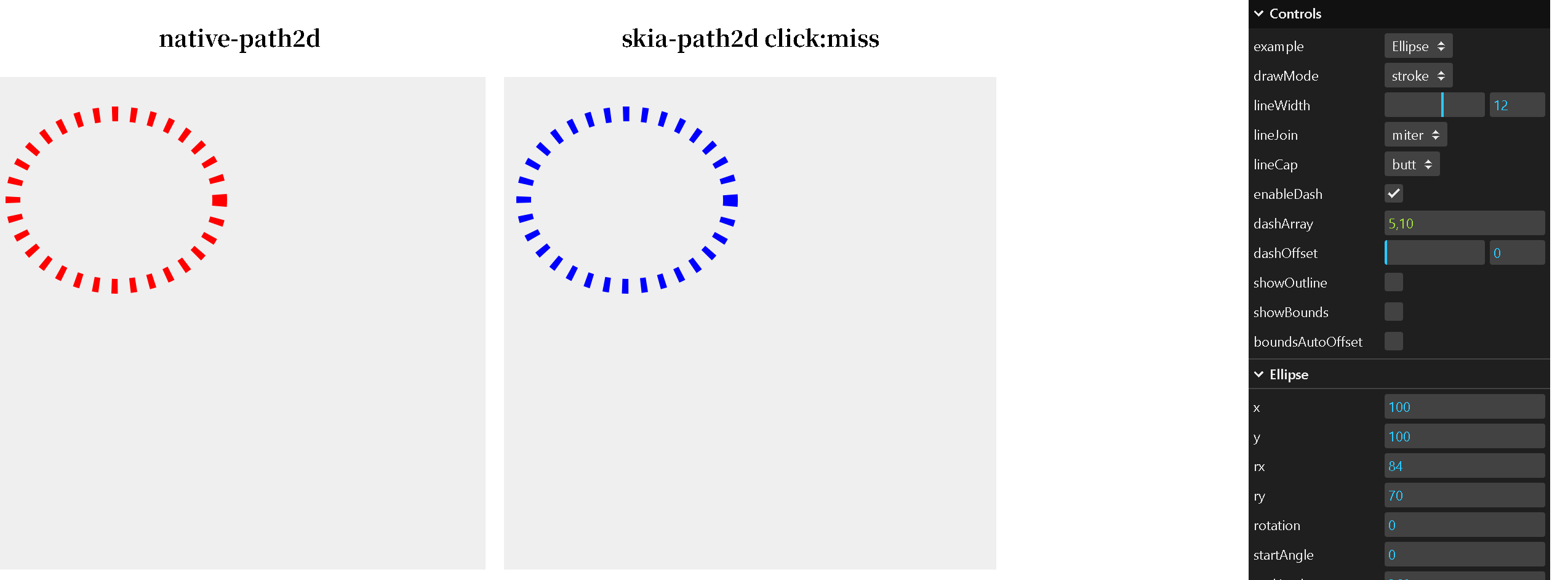
Open Demo
# use
```bash
npm install skia-path2d
```
# SkiaPath2D
Extracts core code related to Path2D, PathStore, and isPointInPath from the Skia source code and rewrites it in TypeScript.
**PathBuilder**: The core class, ported from Skia's PathBuilder class, with some methods rewritten to remove redundant code and simplify logic.
Additionally, a **Path2D** object is added to ensure compatibility with the browser's native Path2D API. The rendering behavior is tested to be consistent with the native Path2D, including support for parameters such as `startAngle`, `sweepAngle`, and `rotationAngle` in methods like `arcTo`, `arc`, and `ellipse`.
**New methods added to Path2D**:
- `ellipseArc`
- `conicTo`
- `contains`
## Core Classes
Includes `PathBuilder`, `Path2D`, `PathStroker`,`PathStrokeDash`, and `ProxyPath2D`:
### PathBuilder
Path generation, with core code ported from Skia's PathBuilder class but simplified.
### Path2D
Internally acts as a proxy for PathBuilder but does not directly expose PathBuilder's methods. Instead, it provides a layer of encapsulation similar to the browser's native Path2D, supporting arcs, ellipses, rounded rectangles, and maintaining identical rendering effects and parameters.
Additional methods:
- `conicTo`, `ellipseArc`, `getBounds`, `computeTightBounds`, `contains`, `fromSvgPath`, `toSvgPath`, `toPath2D`, `toCanvas`.
- The `contains` method is fully ported from Skia, ensuring hit testing accuracy matches the browser's behavior, even for complex shapes with `lineJoin`, `lineCap`, and curved lines (e.g., `ellipseArc`, `conicTo`).
### PathStroker
Generates stroke outlines from paths, with core code ported from Skia's PathStroker class.
### PathStrokeDash
Generates dashed stroke outlines from paths, with core code ported from Skia's DashPath class.
### ProxyPath2D
A lightweight proxy for `Path2D` that only stores commands and coordinates without generating actual rendering paths. For example:
- `Path2D` approximates curves through calculations, while `ProxyPath2D` directly stores commands and coordinates (e.g., `PathCommand<'E', [number, number, number, number, number, number, number, boolean]>`).
## Bounding Box
```typescript
path.getBounds(); // Bounding box includes curve control points
path.computeTightBounds(); // Excludes curve control points
```
## Hit Testing
```typescript
// Check if a point is inside the fill area
path.contains(x, y, "evenodd" | "nonzero");
// Check if a point is on the path
let newPath = stroker.stroke(path, {
strokeWidth: 20,
lineJoin: 'round', // 'miter' | 'round' | 'bevel'
lineCap: 'butt',
miterLimit: 10
});
newPath.contains(x, y);
```
## Usage in Canvas
```typescript
import { Path2D, PathStroker, PathBuilder } from 'skia-path2d';
let canvas = document.createElement('canvas');
let ctx = canvas.getContext('2d');
let path2d = new Path2D();
path2d.ellipse(100, 100, 50, 60, 0, 0, Math.PI * 2, false);
path2d.toCanvas(ctx);
```
## Usage in SVG
```typescript
let svgCmd = 'M100 100A50 60 0 1 1 100 100 Z';
let path = new Path2D(svgCmd);
path.arc(100, 100, 100, 0, Math.PI * 2, false);
// Or:
path.ellipseArc(100, 100, 50, 60, 0, 0, Math.PI * 2, false);
let svgCmd = path.toSvgPath(); // Returns SVG path string
// In SVG:
```
## Usage in WebGL
```typescript
import { tesselate } from 'tess2';
let path = new Path2D();
path.arc(100, 100, 100, 0, Math.PI * 2, false);
let stroker = new PathStroker();
let path_builder = path.getPath();
let newPathBuild = stroker.stroke(path_builder, {
strokeWidth: 20,
lineJoin: 'round', // 'miter' | 'round' | 'bevel'
lineCap: 'butt',
miterLimit: 10
});
// WebGL rendering
let gl = canvas.getContext('webgl');
const res = tesselate({
windingRule: 1,
contours: newPathBuild.toPolygons(),
vertexSize: 2,
})!;
// Process triangles
let vertices = [];
for (let i = 0; i < res.elements.length; i += 3) {
let a = res.elements[i], b = res.elements[i + 1], c = res.elements[i + 2];
vertices.push(
res.vertices[a * 2], res.vertices[a * 2 + 1],
res.vertices[b * 2], res.vertices[b * 2 + 1],
res.vertices[c * 2], res.vertices[c * 2 + 1]
);
}
let vertexBuffer = gl.createBuffer();
gl.bindBuffer(gl.ARRAY_BUFFER, vertexBuffer);
gl.bufferData(gl.ARRAY_BUFFER, new Float32Array(vertices), gl.STATIC_DRAW);
gl.enableVertexAttribArray(0);
gl.vertexAttribPointer(0, 2, gl.FLOAT, false, 0, 0);
gl.drawArrays(gl.TRIANGLES, 0, vertices.length / 2);
gl.disableVertexAttribArray(0);
```
## PathStore Effect

## RoundRect

## ArcTo

## PathStrokeDash Effect