import { ExternalSystemArray } from "../external/ExternalSystemArray";
import { ParallelSystem } from "./ParallelSystem";
import { InvokeHistory } from "../slave/InvokeHistory";
import { Invoke } from "../../protocol/invoke/Invoke";
/**
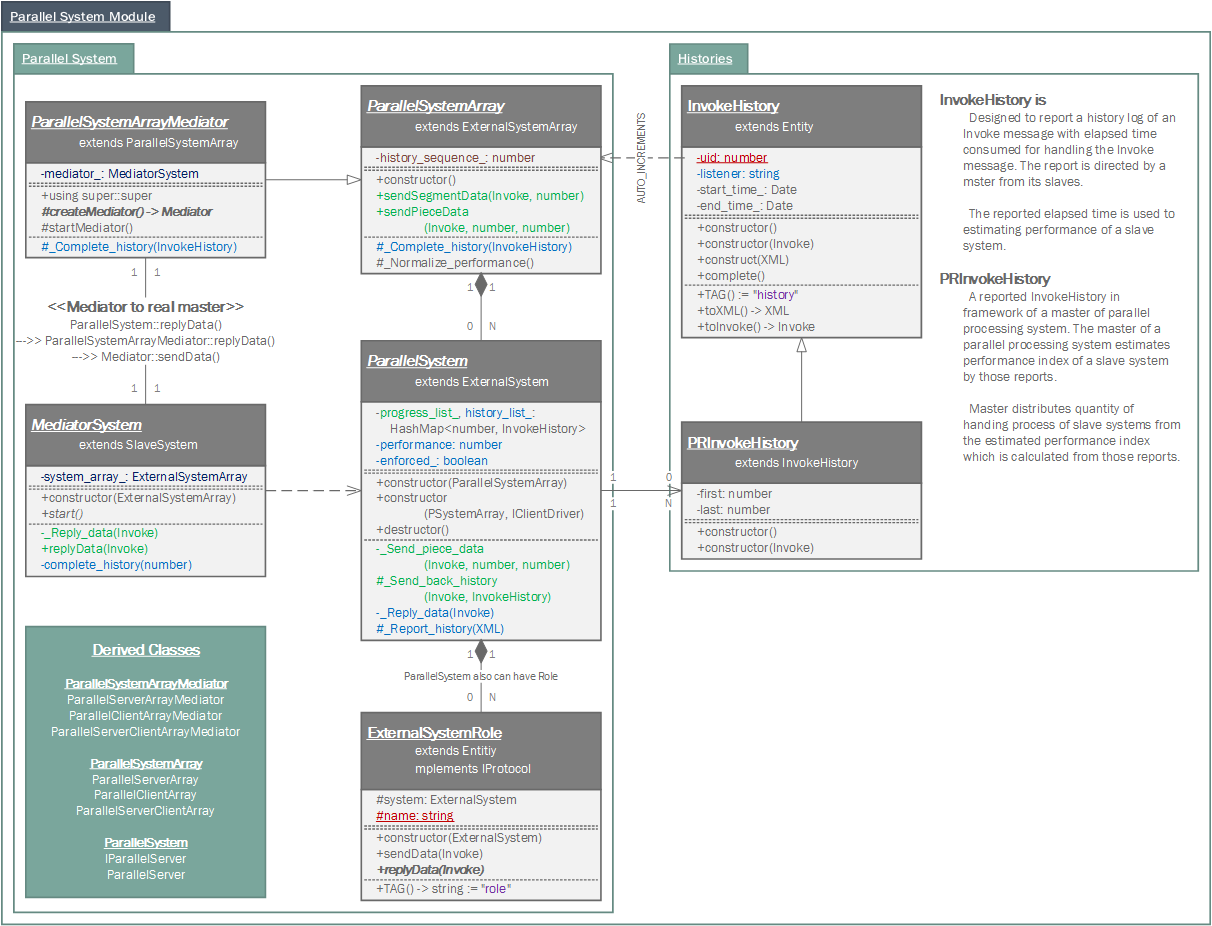
* Master of Parallel Processing System.
*
* The {@link ParallelSystemArray} is an abstract class containing and managing remote parallel **slave** system
* drivers, {@link ParallelSystem} objects. Within framework of network, {@link ParallelSystemArray} represents your
* system, a **Master** of *Parallel Processing System* that requesting *parallel process* to **slave** systems and the
* children {@link ParallelSystem} objects represent the remote **slave** systems, who is being requested the
* *parallel processes*.
*
* You can specify this {@link ParallelSystemArray} class to be *a server accepting parallel clients* or
* *a client connecting to parallel servers*. Even both of them is possible. Extends one of them below and overrides
* abstract factory method(s) creating the child {@link ParallelSystem} object.
*
* - {@link ParallelClientArray}: A server accepting {@link ParallelSystem parallel clients}.
* - {@link ParallelServerArray}: A client connecting to {@link ParallelServer parallel servers}.
* - {@link ParallelServerClientArray}: Both of them. Accepts {@link ParallelSystem parallel clients} and connects to
* {@link ParallelServer parallel servers} at the same time.
*
* When you need the **parallel process**, then call one of them: {@link sendSegmentData} or {@link sendPieceData}.
* When the **parallel process** has completed, {@link ParallelSystemArray} estimates each {@link ParallelSystem}'s
* {@link ParallelSystem.getPerformance performance index} basis on their execution time. Those performance indices
* will be reflected to the next **parallel process**, how much pieces to allocate to each {@link ParallelSystem}.
*
*
*  *
*
* #### Proxy Pattern
* This class {@link ParallelSystemArray} is derived from the {@link ExternalSystemArray} class. Thus, you can take
* advantage of the *Proxy Pattern* in the {@link ParallelSystemArray} class. If a process to request is not the
* *parallel process* (to be distrubted to all slaves), but the **exclusive process** handled in a system, then it
* may better to utilizing the *Proxy Pattern*:
*
* The {@link ExternalSystemArray} class can use *Proxy Pattern*. In framework within user, which
* {@link ExternalSystem external system} is connected with {@link ExternalSystemArray this system}, it's not
* important. Only interested in user's perspective is *which can be done*.
*
* By using the *logical proxy*, user dont't need to know which {@link ExternalSystemRole role} is belonged
* to which {@link ExternalSystem system}. Just access to a role directly from {@link ExternalSystemArray.getRole}.
* Sends and receives {@link Invoke} message via the {@link ExternalSystemRole role}.
*
*
* -
* {@link ExternalSystemRole} can be accessed from {@link ExternalSystemArray} directly, without inteferring
* from {@link ExternalSystem}, with {@link ExternalSystemArray.getRole}.
*
* -
* When you want to send an {@link Invoke} message to the belonged {@link ExternalSystem system}, just call
* {@link ExternalSystemRole.sendData ExternalSystemRole.sendData()}. Then, the message will be sent to the
* external system.
*
* - Those strategy is called *Proxy Pattern*.
*
*
* @handbook [Templates - Parallel System](https://github.com/samchon/framework/wiki/TypeScript-Templates-Parallel_System)
* @author Jeongho Nam
*/
export declare abstract class ParallelSystemArray extends ExternalSystemArray {
/**
* @hidden
*/
private history_sequence_;
/**
* Default Constructor.
*/
constructor();
/**
* Send an {@link Invoke} message with segment size.
*
* Sends an {@link Invoke} message requesting a **parallel process** with its *segment size*. The {@link Invoke}
* message will be delivered to children {@link ParallelSystem} objects with the *piece size*, which is divided
* from the *segment size*, basis on their {@link ParallelSystem.getPerformance performance indices}.
*
* - If segment size is 100,
* - The segment will be allocated such below:
*
* Name | Performance index | Number of pieces to be allocated | Formula
* --------|-------------------|----------------------------------|--------------
* Snail | 1 | 10 | 100 / 10 * 1
* Cheetah | 4 | 40 | 100 / 10 * 4
* Rabbit | 3 | 30 | 100 / 10 * 3
* Turtle | 2 | 20 | 100 / 10 * 2
*
* When the **parallel process** has completed, then this {@link ParallelSystemArraY} will estimate
* {@link ParallelSystem.getPerformance performance indices} of {@link ParallelSystem} objects basis on their
* execution time.
*
* @param invoke An {@link Invoke} message requesting parallel process.
* @param size Number of pieces to segment.
*
* @return Number of {@link ParallelSystem slave systems} participating in the *Parallel Process*.
*
* @see {@link sendPieceData}, {@link ParallelSystem.getPerformacen}
*/
sendSegmentData(invoke: Invoke, size: number): number;
/**
* Send an {@link Invoke} message with range of pieces.
*
* Sends an {@link Invoke} message requesting a **parallel process** with its *range of pieces [first, last)*.
* The {@link Invoke} will be delivered to children {@link ParallelSystem} objects with the newly computed
* *range of sub-pieces*, which is divided from the *range of pieces (first to last)*, basis on their
* {@link ParallelSystem.getPerformance performance indices}.
*
* - If indices of pieces are 0 to 50,
* - The sub-pieces will be allocated such below:
*
* Name | Performance index | Range of sub-pieces to be allocated | Formula
* --------|-------------------|-------------------------------------|------------------------
* Snail | 1 | ( 0, 5] | (50 - 0) / 10 * 1
* Cheetah | 4 | ( 5, 25] | (50 - 0) / 10 * 4 + 5
* Rabbit | 3 | (25, 40] | (50 - 0) / 10 * 3 + 25
* Turtle | 2 | (40, 50] | (50 - 0) / 10 * 2 + 40
*
* When the **parallel process** has completed, then this {@link ParallelSystemArraY} will estimate
* {@link ParallelSystem.getPerformance performance indices} of {@link ParallelSystem} objects basis on their
* execution time.
*
* @param invoke An {@link Invoke} message requesting parallel process.
* @param first Initial piece's index in a section.
* @param last Final piece's index in a section. The range used is [*first*, *last*), which contains
* all the pieces' indices between *first* and *last*, including the piece pointed by index
* *first*, but not the piece pointed by the index *last*.
*
* @return Number of {@link ParallelSystem slave systems} participating in the *Parallel Process*.
*
* @see {@link sendSegmentData}, {@link ParallelSystem.getPerformacen}
*/
sendPieceData(invoke: Invoke, first: number, last: number): number;
/**
* @hidden
*/
protected _Complete_history(history: InvokeHistory): boolean;
/**
* @hidden
*/
protected _Normalize_performance(): void;
}