import { ParallelSystem } from "../parallel/ParallelSystem";
import { DistributedSystemArray } from "./DistributedSystemArray";
import { ExternalSystemRole } from "../external/ExternalSystemRole";
import { InvokeHistory } from "../slave/InvokeHistory";
import { IClientDriver } from "../../protocol/communicator/IClientDriver";
import { Invoke } from "../../protocol/invoke/Invoke";
import { XML } from "sxml";
/**
* A driver for a distributed slave system.
*
* The {@link DistributedSystem} is an abstract class represents a **slave** system in *Distributed Processing System*,
* connected with this **master** system. This {@link DistributedSystem} takes full charge of network communication
* with the remote, distributed **slave** system has connected.
*
* This {@link DistributedSystem} has a {@link getPerformance performance index} that indicates how much the **slave**
* system is fast. The {@link getPerformance performance index} is referenced and revaluated whenever those methods
* are called:
*
* - Requesting a *parallel process*
* - {@link DistributedSystemArray.sendSegmentData}
* - {@link DistributedSystemArray.sendPieceData}
* - Requesting a *distributed process*: {@link DistributedProcess.sendData}
*
* Note that, this {@link DistributedSystem} class derived from the {@link ExternalSystem} class. Thus, this
* {@link DistributedSystem} can also have children {@link ExternalSystemRole} objects exclusively. However, the
* children {@link ExternalSystemRole roles} objects are different with the {@link DistributedProcess}. The
* domestic {@link ExternalSystemRole roles} are belonged to only a specific {@link DistributedSystem} object.
* Otherwise, the {@link DistributedProcess} objects are belonged to a {@link DistributedSystemArray} object.
* Furthermore, the relationship between this {@link DistributedSystem} and {@link DistributedProcess} classes are
* **M: N Associative**.
*
* Articles | {@link DistributedProcess} | {@link ExternalSystemRole}
* -------------|--------------------------------|----------------------------
* Belonged to | {@link DistributedSystemArray} | {@link DistributedSystem}
* Relationship | M: N Associative | 1: N Composite
* Ownership | References | Exclusive possession
*
*
* 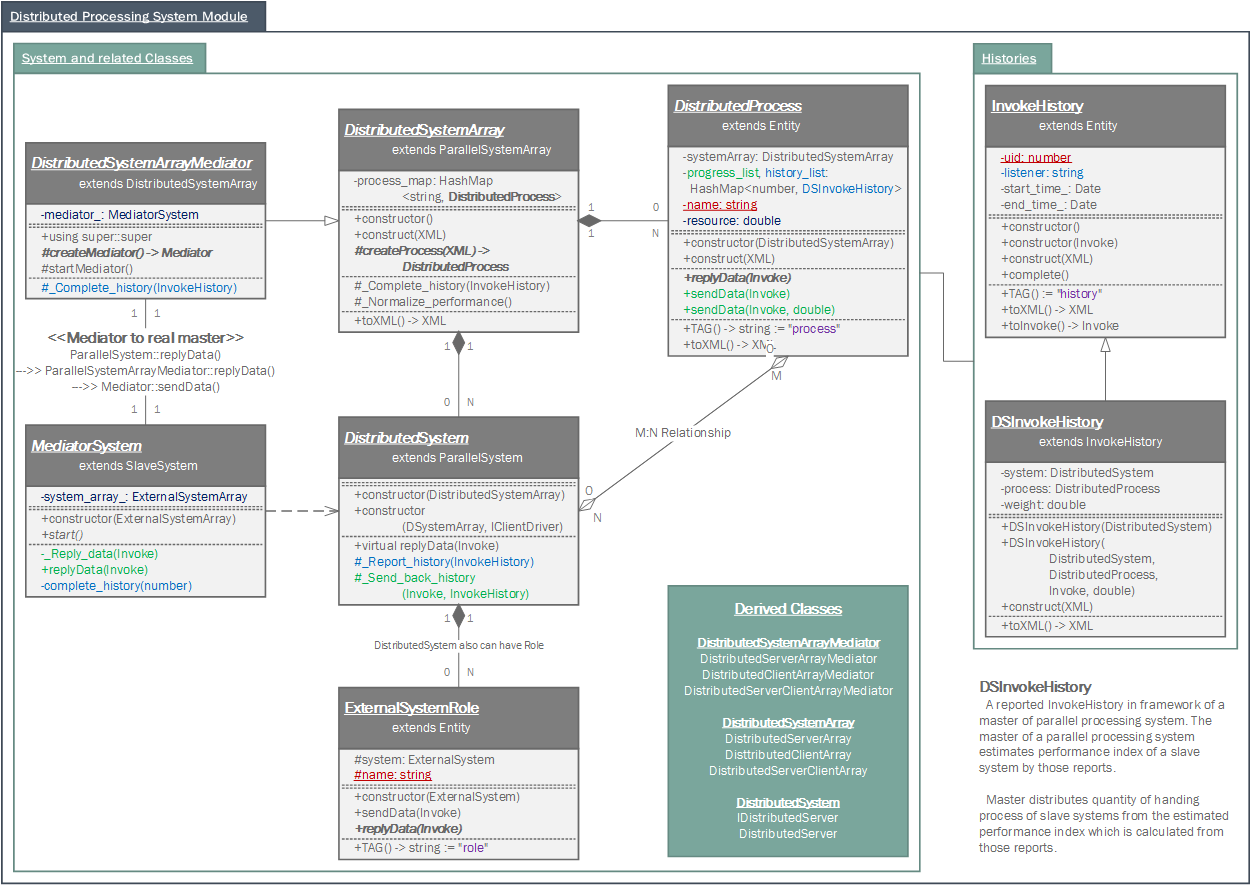 *
*
* @handbook [Templates - Distributed System](https://github.com/samchon/framework/wiki/TypeScript-Templates-Distributed_System)
* @author Jeongho Nam
*/
export declare abstract class DistributedSystem extends ParallelSystem {
/**
* Construct from parent {@link DistributedSystemArray}.
*
* @param systemArray The parent {@link DistributedSystemArray} object.
*/
constructor(systemArray: DistributedSystemArray);
/**
* Constrct from parent {@link DistributedSystemArray} and communicator.
*
* @param systemArray The parent {@link DistributedSystemArray} object.
* @param communicator A communicator communicates with remote, the external system.
*/
constructor(systemArray: DistributedSystemArray, communicator: IClientDriver);
/**
* Factory method creating a {@link ExternalSystemRole child} object.
*
* In {@link distributed} module, the process class {@link DistributedProcess} is not belonged to a specific
* {@link DistributedSystem} object. It only belongs to a {@link DistributedSystemArray} object and has a
* **M: N Associative Relationship** between this {@link DistributedSystem} class.
*
* By that reason, it's the normal case that the {@link DistributedSystem} object does not have any children
* {@link ExternalSystemRole} object. Thus, default {@link createChild} returns ```null```.
*
* However, if you want a {@link DistributedSystem} to have its own domestic {@link ExternalSystemRole} objects
* without reference to the {@link DistributedProcess} objects, it is possible. Creates and returns the
* domestic {@link ExternalSystemRole} object.
*
* @param xml {@link XML} represents the {@link ExternalSystemRole child} object.
* @return A newly created {@link ExternalSystemRole} object or ```null```.
*/
createChild(xml: XML): ExternalSystemRole;
/**
* Get manager of this object.
*
* @return The parent {@link DistributedSystemArray} object.
*/
getSystemArray(): DistributedSystemArray;
/**
* Get manager of this object.
*
* @return The parent {@link DistributedSystemArray} object.
*/
getSystemArray>(): SystemArray;
/**
* @hidden
*/
private _Compute_average_elapsed_time;
/**
* @inheritdoc
*/
replyData(invoke: Invoke): void;
/**
* @hidden
*/
protected _Report_history(xml: XML): void;
/**
* @hidden
*/
protected _Send_back_history(invoke: Invoke, history: InvokeHistory): void;
}