import { Entity } from "../../protocol/entity/Entity";
import { IProtocol } from "../../protocol/invoke/IProtocol";
import { DistributedSystemArray } from "./DistributedSystemArray";
import { DistributedSystem } from "./DistributedSystem";
import { Invoke } from "../../protocol/invoke/Invoke";
/**
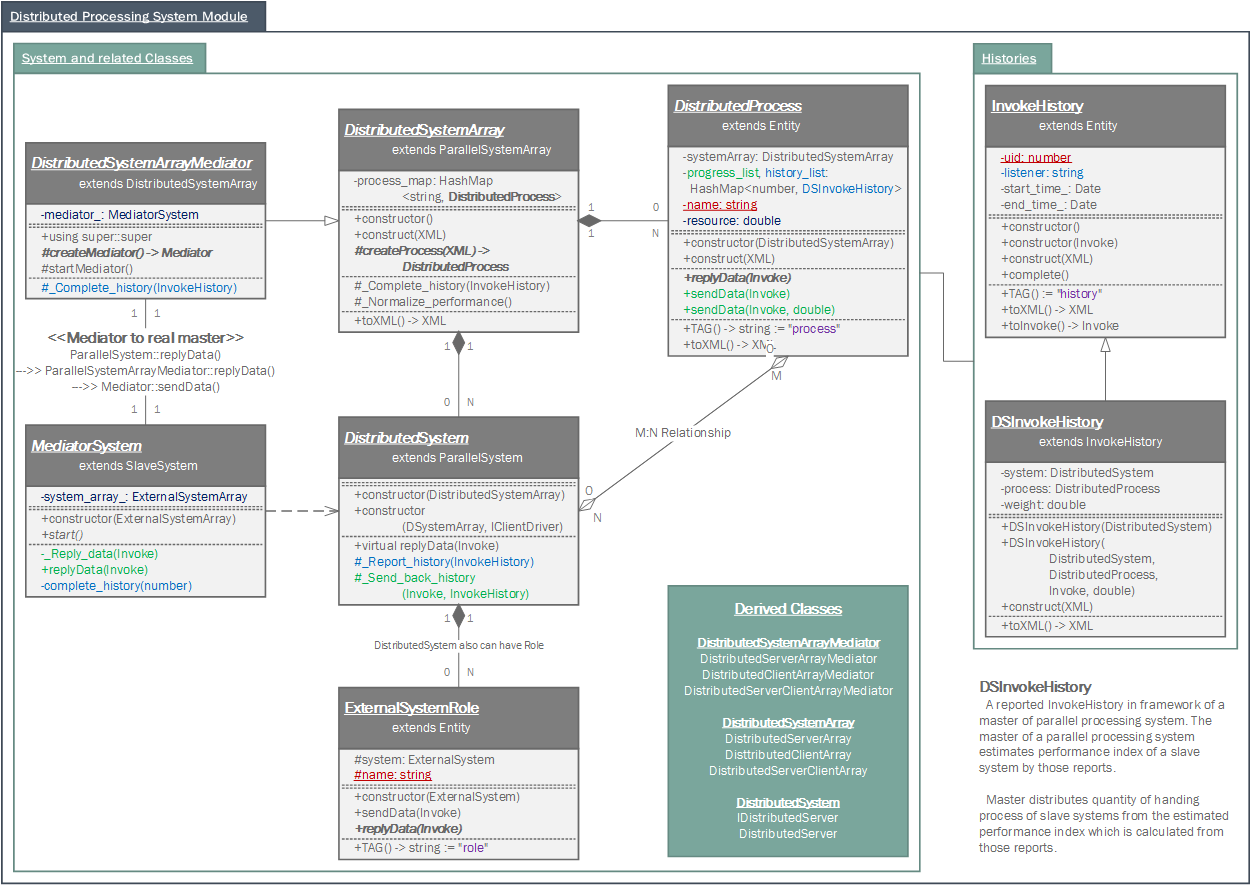
* A process of Distributed Processing System.
*
* The {@link DistributedProcess} is an abstract class who represents a **process**, *SOMETHING TO DISTRIBUTE* in a Distributed
* Processing System. Overrides the {@link DistributedProcess} and defines the *SOMETHING TO DISTRIBUTE*.
*
* Relationship between {@link DistributedSystem} and {@link DistributedProcess} objects are **M: N Associative**.
* Unlike {@link ExternalSystemRole}, the {@link DistributedProcess} objects are not belonged to a specific
* {@link DistributedSystem} object. The {@link DistributedProcess} objects are belonged to the
* {@link DistributedSystemArrayMediator} directly.
*
* When you need the **distributed process**, then call {@link sendData sendData()}. The {@link sendData} will find
* the most idle {@link DistributedSystem slave system} considering not only number of processes on progress, but also
* {@link DistributedSystem.getPerformance performance index} of each {@link DistributedSystem} object and
* {@link getResource resource index} of this {@link DistributedProcess} object. The {@link Invoke} message
* requesting the **distributed process** will be sent to the most idle {@link DistributedSystem slave system}.
*
* Those {@link DistributedSystem.getPerformance performance index} and {@link getResource resource index} are
* revaluated whenever the **distributed process** has completed basis on the execution time.
*
*
*  *
*
* @handbook [Templates - Distributed System](https://github.com/samchon/framework/wiki/TypeScript-Templates-Distributed_System)
* @author Jeongho Nam
*/
export declare abstract class DistributedProcess extends Entity implements IProtocol {
/**
* @hidden
*/
private system_array_;
/**
* A name, represents and identifies this {@link DistributedProcess process}.
*
* This {@link name} is an identifier represents this {@link DistributedProcess process}. This {@link name} is
* used in {@link DistributedSystemArray.getProcess} and {@link DistributedSystemArray.getProcess}, as a key elements.
* Thus, this {@link name} should be unique in its parent {@link DistributedSystemArray} object.
*/
protected name: string;
/**
* @hidden
*/
private progress_list_;
/**
* @hidden
*/
private history_list_;
/**
* @hidden
*/
private resource;
/**
* @hidden
*/
private enforced_;
/**
* Constrct from parent {@link DistributedSystemArray} object.
*
* @param systemArray The parent {@link DistributedSystemArray} object.
*/
constructor(systemArray: DistributedSystemArray);
/**
* Identifier of {@link ParallelProcess} is its {@link name}.
*/
key(): string;
/**
* Get parent {@link DistributedSystemArray} object.
*
* @return The parent {@link DistributedSystemArray} object.
*/
getSystemArray(): DistributedSystemArray;
/**
* Get parent {@link DistributedSystemArray} object.
*
* @return The parent {@link DistributedSystemArray} object.
*/
getSystemArray>(): SystemArray;
/**
* Get name, who represents and identifies this process.
*/
getName(): string;
/**
* Get resource index.
*
* Get *resource index* that indicates how much this {@link DistributedProcess process} is heavy.
*
* If this {@link DistributedProcess process} does not have any {@link Invoke} message had handled, then the
* *resource index* will be ```1.0```, which means default and average value between all
* {@link DistributedProcess} instances (that are belonged to a same {@link DistributedSystemArray} object).
*
* You can specify the *resource index* by yourself, but notice that, if the *resource index* is higher than
* other {@link DistributedProcess} objects, then this {@link DistributedProcess process} will be ordered to
* handle less processes than other {@link DistributedProcess} objects. Otherwise, the *resource index* is
* lower than others, of course, much processes will be requested.
*
* - {@link setResource setResource()}
* - {@link enforceResource enforceResource()}
*
* Unless {@link enforceResource enforceResource()} is called, This *resource index* is **revaluated** whenever
* {@link sendData sendData()} is called.
*
* @return Resource index.
*/
getResource(): number;
/**
* Set resource index.
*
* Set *resource index* that indicates how much this {@link DistributedProcess process} is heavy. This
* *resource index* can be **revaulated**.
*
* Note that, initial and average *resource index* of {@link DistributedProcess} objects are ```1.0```. If the
* *resource index* is higher than other {@link DistributedProcess} objects, then this
* {@link DistributedProcess} will be ordered to handle more processes than other {@link DistributedProcess}
* objects. Otherwise, the *resource index* is lower than others, of course, less processes will be requested.
*
* Unlike {@link enforceResource}, configuring *resource index* by this {@link setResource} allows the
* **revaluation**. This **revaluation** prevents wrong valuation from user. For example, you *mis-valuated* the
* *resource index*. The {@link DistributedProcess process} is much heavier than any other, but you estimated it
* to the lightest one. It looks like a terrible case that causes
* {@link DistributedSystemArray entire distributed processing system} to be slower, however, don't mind. The
* {@link DistributedProcess process} will the direct to the *propriate resource index* eventually with the
* **revaluation**.
*
* - The **revaluation** is caused by the {@link sendData sendData()} method.
*
* @param val New resource index, but can be revaluated.
*/
setResource(val: number): void;
/**
* Enforce resource index.
*
* Enforce *resource index* that indicates how much heavy the {@link DistributedProcess process is}. The
* *resource index* will be fixed, never be **revaluated**.
*
* Note that, initial and average *resource index* of {@link DistributedProcess} objects are ```1.0```. If the
* *resource index* is higher than other {@link DistributedProcess} objects, then this
* {@link DistributedProcess} will be ordered to handle more processes than other {@link DistributedProcess}
* objects. Otherwise, the *resource index* is lower than others, of course, less processes will be requested.
*
* The difference between {@link setResource} and this {@link enforceResource} is allowing **revaluation** or not.
* This {@link enforceResource} does not allow the **revaluation**. The *resource index* is clearly fixed and
* never be changed by the **revaluation**. But you've to keep in mind that, you can't avoid the **mis-valuation**
* with this {@link enforceResource}.
*
* For example, there's a {@link DistributedProcess process} much heavier than any other, but you
* **mis-estimated** it to the lightest. In that case, there's no way. The
* {@link DistributedSystemArray entire distributed processing system} will be slower by the **mis-valuation**.
* By the reason, using {@link enforceResource}, it's recommended only when you can clearly certain the
* *resource index*. If you can't certain the *resource index* but want to recommend, then use {@link setResource}
* instead.
*
* @param val New resource index to be fixed.
*/
enforceResource(val: number): void;
/**
* @hidden
*/
private _Compute_average_elapsed_time;
/**
* @inheritdoc
*/
abstract replyData(invoke: Invoke): void;
/**
* Send an {@link Invoke} message.
*
* Sends an {@link Invoke} message requesting a **distributed process**. The {@link Invoke} message will be sent
* to the most idle {@link DistributedSystem} object, which represents a slave system, and the most idle
* {@link DistributedSystem} object will be returned.
*
* When the **distributed process** has completed, then the {@link DistributedSystemArray} object will revaluate
* {@link getResource resource index} and {@link DistributedSystem.getPerformance performance index} of this
* {@link DistributedSystem} and the most idle {@link DistributedSystem} objects basis on the execution time.
*
* @param invoke An {@link Invoke} message requesting distributed process.
* @return The most idle {@link DistributedSystem} object who may send the {@link Invoke} message.
*/
sendData(invoke: Invoke): DistributedSystem;
/**
* Send an {@link Invoke} message.
*
* Sends an {@link Invoke} message requesting a **distributed process**. The {@link Invoke} message will be sent
* to the most idle {@link DistributedSystem} object, which represents a slave system, and the most idle
* {@link DistributedSystem} object will be returned.
*
* When the **distributed process** has completed, then the {@link DistributedSystemArray} object will revaluate
* {@link getResource resource index} and {@link DistributedSystem.getPerformance performance index} of this
* {@link DistributedSystem} and the most idle {@link DistributedSystem} objects basis on the execution time.
*
* @param invoke An {@link Invoke} message requesting distributed process.
* @param weight Weight of resource which indicates how heavy this {@link Invoke} message is. Default is 1.
*
* @return The most idle {@link DistributedSystem} object who may send the {@link Invoke} message.
*/
sendData(invoke: Invoke, weight: number): DistributedSystem;
/**
* @hidden
*/
private _Complete_history;
/**
* @inheritdoc
*/
TAG(): string;
}