# Architecture
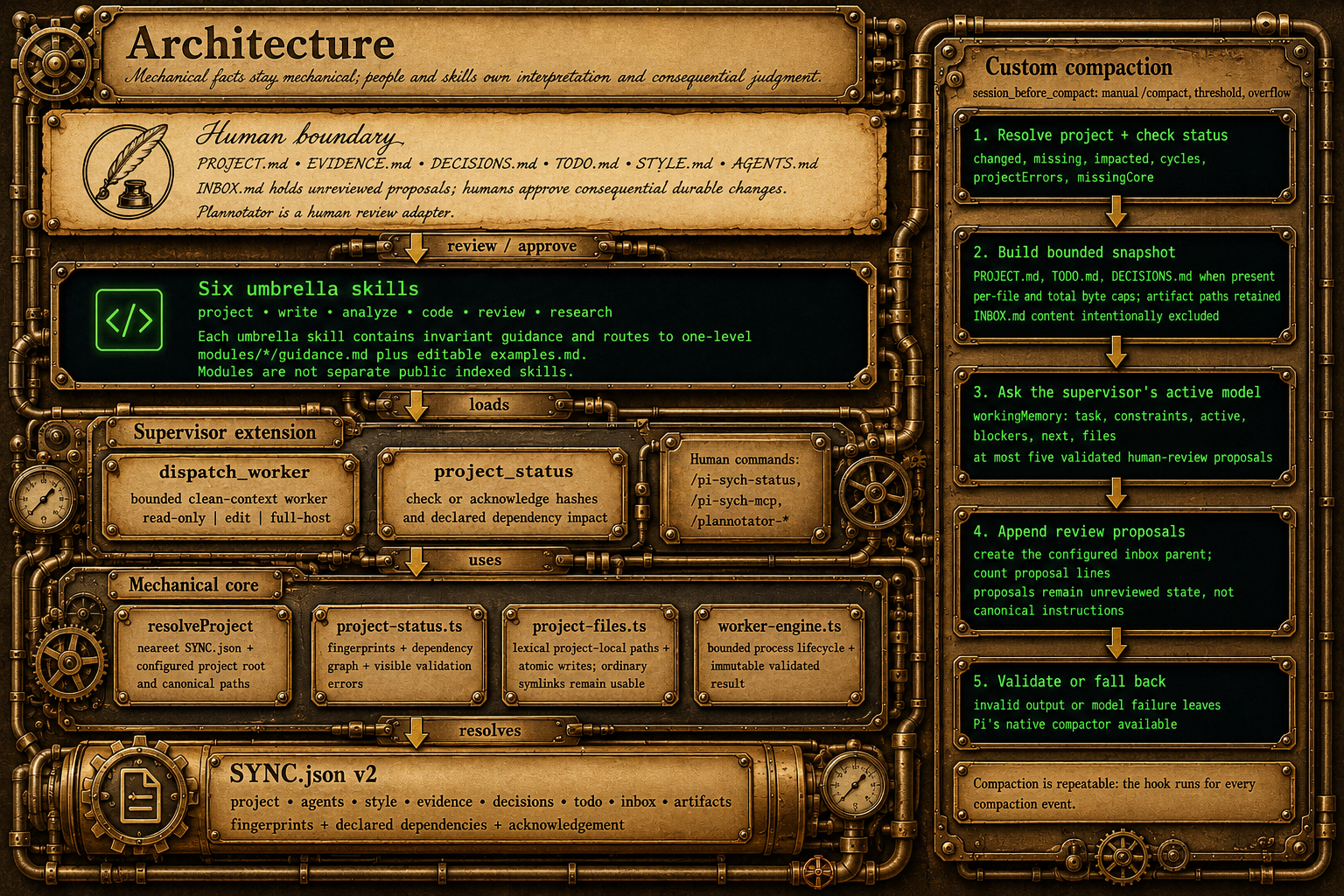
This section is for the supervisor model and for contributors who need
to understand the runtime boundary. Pi Sych is deliberately a small
mechanical layer: it tracks paths and hashes, launches bounded workers,
and preserves explicit human review. Skills and humans own semantic
judgment.
## Supervisor contract
The supervisor sees two agent tools:
- `project_status` checks or acknowledges mechanical project state;
- `dispatch_worker` runs one short-lived clean-context worker.
Human commands are separate: `/pi-sych-status`, `/pi-sych-mcp`,
`/plannotator-last`, `/plannotator-annotate`, and `/plannotator-review`.
There is no plan controller, worker registry, semantic reconciliation
tool, or automatic promotion mechanism.
When a turn starts, Pi Sych adds its static guidance and, when present,
the configured project `agents` file. The private model catalog is
loaded lazily: direct project work does not require worker setup, while
a worker dispatch requires a valid exact-role catalog.
The supervisor should pass the smallest complete worker packet: task,
expected output, capability mode, context files, selected skills, model
role, and a bounded timeout. Workers receive no supervisor transcript.
Tool modes control visible Pi tools; they are not sandboxes and do not
remove host permissions.
## Worker lifecycle
A worker is a clean Pi process with one terminal result. The launcher:
1. resolves the project and selected context;
2. checks that the worker agent directory was explicitly bootstrapped;
3. creates a temporary result directory;
4. starts Pi with the selected tools, skills, model, and optional
MCPorter extension;
5. stops it on cancellation or timeout, escalating from `SIGTERM` to
`SIGKILL`; and
6. accepts a result only when it is valid, immutable, complete, and the
process exits normally.
Reported files must be relative, remain inside the project root, and
exist when the result is accepted. The temporary result directory is
removed whether the worker succeeds or fails.
## Project state
`SYNC.json` version 2 records tracked file hashes and dependency paths.
`project_status` reports missing files, changed hashes, persisted
statuses, project-brief validation problems, and direct or transitive
dependency impact. It never decides semantic drift, authority, quality,
or correctness.
Acknowledgement is atomic and rechecks selected files immediately before
writing. If a file changed during the review window, acknowledgement
aborts instead of recording an obsolete fingerprint. A changed hash
proves only that content changed after acknowledgement.
Artifact paths are project-local by lexical path, while symlinks remain
ordinary project files and are not treated as a security boundary.
Explicit canonical paths are configuration: they may be absolute or
external and are checked for readability rather than treated as a
sandbox boundary.
## Compaction
Compaction sends the previous summary, compacted conversation, a concise
status projection, and a bounded snapshot of `PROJECT.md`, `TODO.md`,
and `DECISIONS.md` when present. It retains relevant artifact paths
without loading every artifact. `INBOX.md` is intentionally excluded
because it contains unreviewed proposals.
Text snapshots are capped per file and in total. Truncation is reported
to the model. At most five validated proposals may be appended to the
configured inbox, which is created as needed and counted by proposal
lines, not by newline accidents.
## Skills, MCPorter, and Plannotator
Only six umbrella skills are public: `project`, `write`, `analyze`,
`code`, `review`, and `research`. Their one-level modules provide
focused guidance and editable examples without enlarging the initial
catalog.
MCPorter is enabled only for explicitly requested remote research. Its
configuration is not generated by worker bootstrap. Diagnostics report
availability, configuration presence, and server names without printing
credentials.
Plannotator remains a narrow human review adapter. Last-message feedback
enters the conversation. File annotation writes `.feedback.md`;
code-review feedback writes `/PLANNOTATOR_REVIEW.md`.