# pi-reasoning-zip




Compress reasoning blocks to keep the context short.
**WARNING: Extension trades token and latency for shorter context!**
## Why
There are `thinking` blocks in your Pi session filling your context window. But there is a major difference between **open** and **closed** models.
- Hosted providers of **closed models** usually keep full internal reasoning inside the API and expose only final response and summarized opaque `thinking` block.
- The _**open reasoning models**_ usually expose the whole `thinking` block to Pi.
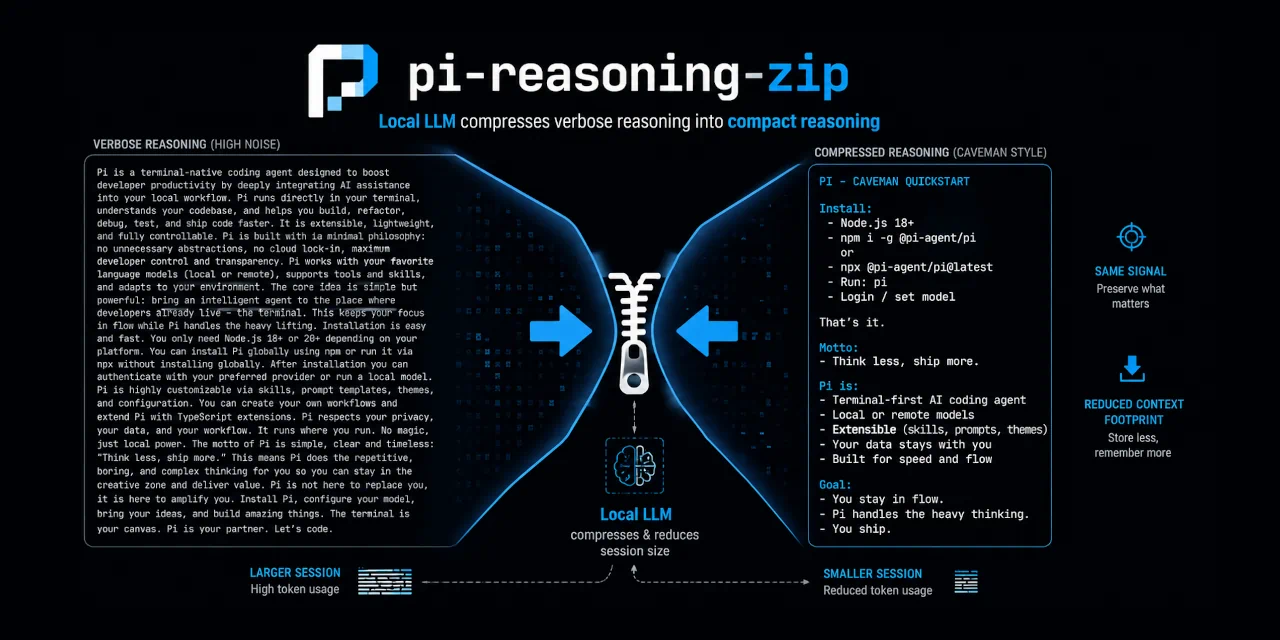
`pi-reasoning-zip` compresses _**open reasoning model**_ `thinking` blocks into a caveman-style compact thinking block before they are stored in the session.
- caveman-ed compaction costs additional tokens but reduces context usage
- intentional usage of `pi-reasoning-zip` is when your Pi is using local model, in which case your `reasoningZip.compactor` is often the same as your active Pi model

### Compaction effectiveness
From my [local benchmark](#local-benchmark)
| Metric across 7 sessions | Normal | Zip ON | Change |
|---|-------:|-------:|---:|
| Stored thinking characters | 15,242 | 4,631 | -69.6% |
| Complete session JSONL bytes | 57,902 | 49,317 | -14.8% |
## Install
From npm:
```bash
pi install npm:pi-reasoning-zip
```
From git
```bash
pi install git:github.com/Ryu-CZ/pi-reasoning-zip
```
## Commands
`pi-reasoning-zip` registers a Pi command for toggling the `reasoningZip.enabled` setting:
```text
/reasoning-zip status
/reasoning-zip enable [global|project]
/reasoning-zip disable [global|project]
/reasoning-zip toggle [global|project]
```
Without an explicit scope, writes update the nearest existing `reasoningZip` settings section, falling back to global Pi settings. The extension rereads settings for each hook call, so enable/disable affects subsequent compaction and prompt-injection events. When enabled, Pi's footer shows `reasoningZip.footerStatus` from global settings, defaulting to `🗜️ Zip`.
## Features
- **Forward-only compaction** — modifies only the new assistant message being finalized.
- **Stored compact traces** — future turns naturally replay compact `thinking` because that is what Pi stored.
- **Local compactor** — calls a configured OpenAI-compatible `/chat/completions` endpoint directly.
- **llama.cpp-first targeting** — defaults to llama.cpp-like providers such as `llama-server=http://127.0.0.1:7484`.
- **Prompt minimization** — optional grug-style request injection for target local providers.
- **Fail-open safety** — preserves original messages on errors, timeouts, invalid output, or unknown payloads.
- **Opaque reasoning guard** — skips signed, encrypted, redacted, or provider-opaque reasoning metadata while allowing llama.cpp's plain `reasoning_content` traces.
## Configuration
Settings live in project `.pi/settings.json` or global `~/.pi/agent/settings.json` under the `reasoningZip` key. Project settings take precedence.
```json
{
"reasoningZip": {
"enabled": true,
"mode": "local-only",
"storageMode": "compact-new",
"compressionRole": "grug",
"injectPrompt": true,
"footerStatus": "🗜️ Zip",
"compactor": {
"baseUrl": "http://127.0.0.1:7484/v1",
"model": "Qwen3.6-27B",
"apiKey": "sk-placeholder",
"maxTokens": 512,
"temperature": 0.1,
"timeoutMs": 30000
},
"thresholds": {
"minChars": 1000,
"maxInputChars": 50000,
"maxTraceChars": 2000
}
}
}
```
`footerStatus` is read from global settings only; project settings can still control compaction behavior.
### Modes
| Mode | Behavior |
|---|---|
| `llama-only` | Compact llama.cpp-like providers only |
| `local-only` | Compact local URL providers and local `llama-server=` endpoints only |
| `all` | Compact any eligible plain Pi `thinking` block |
| `disabled` | No-op |
### Storage modes
| Storage mode | Behavior |
|---|---|
| `compact-new` | Compact new assistant thinking before storage |
| `off` | Do not alter assistant messages |
### Compression roles
| Role | Behavior |
|---|---|
| `balanced` | concise bullets while preserving extra context |
| `grug` | terse, keyword-heavy default |
| `ultra-grug` | most aggressive fragment-style trace |
## Compactor endpoint
The compactor must expose an OpenAI-compatible chat completions endpoint:
```text
POST {baseUrl}/chat/completions
```
The extension first sends `chat_template_kwargs: { "enable_thinking": false }` and `thinking_budget_tokens: 0` so llama.cpp/Qwen-style compactor calls return the compact trace in `message.content` instead of spending tokens on compactor-side reasoning. If a stricter OpenAI-compatible endpoint rejects those fields with HTTP 400/422, the request is retried once without them.
The extension asks the compactor to produce terse output like:
```text
facts:
- ...
decisions:
- ...
constraints:
- ...
failed:
- ...
next:
- ...
```
The configured `compressionRole` guides the compactor's terse style. If the compactor returns `none`, empty output, inline reasoning wrappers, truncated output, output longer than the original, or output over `thresholds.maxTraceChars`, the original block is preserved.
## Safety model
This extension does **not**:
- rewrite previous sessions
- backfill older entries in the current session
- mutate replayed context with the `context` hook
- claim to reduce hidden provider-side reasoning tokens
- touch signed, encrypted, or opaque provider reasoning metadata
It skips:
- non-assistant messages
- messages without array content
- short thinking below `thresholds.minChars`
- thinking above `thresholds.maxInputChars`
- assistant messages that include tool calls
- cryptographically signed, encrypted, or redacted thinking blocks
- unknown providers by default in `llama-only`
- hosted/non-local providers in `local-only`
If a compactor request fails, the extension preserves the original reasoning and sends a Pi warning notification.
## Local Benchmark
On 2026-07-09, a paired local benchmark ran seven high-thinking Pi tasks against
`Qwen3.6-27B` on llama.cpp. The same model served both the main Pi task and the
compactor. All other installed Pi extensions stayed enabled; tools were disabled
for repeatability. The enabled arm loaded this extension from source, while the
disabled arm changed only `reasoningZip.enabled`. Temporary Pi settings were
restored after the run.
The benchmark used `compressionRole: "grug"`, `injectPrompt: false`,
`minChars: 200`, `maxTraceChars: 2000`, and `compactor.maxTokens: 512` so it
measured stored-trace compression rather than prompt injection.
| Metric across 7 sessions | Disabled | Enabled | Change |
|---|---:|---:|---:|
| Stored thinking characters | 15,242 | 4,631 | -69.6% |
| Complete session JSONL bytes | 57,902 | 49,317 | -14.8% |
Quality was checked by feeding each of the seven original traces to the same
local compactor and comparing the result with its source. Six traces compacted
from 14,593 to 4,642 characters while retaining the task facts, decisions,
constraints, operational risks, and explicit rollback actions where present.
The remaining short trace returned `none`; the extension's fail-open rule kept
the original trace instead of storing an empty summary.
This is a storage benchmark, not a latency benchmark. The compactor makes an
additional request, and a single-slot llama.cpp server changes its KV-cache
state between calls. Dynamic context supplied by other extensions can also vary
between sessions, so provider input-token and response-time counters are not
directly comparable across the two arms.
## Smoke tests
Automated local smoke test:
```bash
npm run smoke
```
This loads `dist/index.js`, registers the Pi hooks against a mock extension API, uses a temporary `.pi/settings.json`, mocks the OpenAI-compatible compactor, and verifies thinking compaction plus targeted prompt injection.
Manual Pi smoke test:
1. Start a local llama.cpp/OpenAI-compatible server that can compact text.
2. Configure `reasoningZip.compactor.baseUrl` and `reasoningZip.compactor.model`.
3. Enable `mode: "llama-only"` and use a llama.cpp provider in Pi.
4. Ask a prompt that produces long visible reasoning/thinking.
5. Inspect the session JSONL.
6. Confirm the new assistant message contains compact `thinking`, not raw verbose reasoning.
7. Confirm older session entries were not changed.
8. Send another prompt and confirm Pi replays the compact trace because that is what was stored.
## Development
### How it works
`pi-reasoning-zip` works through Pi lifecycle hooks:
| Hook | Purpose |
|---|---|
| `message_end` | Compact eligible new assistant `thinking` blocks before storage |
| `before_provider_request` | Optionally inject terse-reasoning guidance for target local providers |
### Self inspecting
The npm library entrypoint still builds to `dist/index.js`, but Pi package metadata points at `./extensions` so Pi can inspect the source it loads.
### Useful commands
```bash
npm run typecheck
npm test
npm run build
npm run check
npm run smoke
pi -e ./extensions --no-extensions --offline --list-models
npm pack --dry-run
```
For local development you can also load the readable source extension directly:
```bash
pi -e ./extensions
```
### Release checklist
1. Update the version in `package.json` and `package-lock.json`.
```bash
npm version --no-git-tag-version
```
2. Move completed `CHANGELOG.md` entries from `[Unreleased]` to the new version section.
```md
## [Unreleased]
## [x.y.z] - YYYY-MM-DD
```
3. Update changelog links at the bottom.
```md
[Unreleased]: https://github.com/Ryu-CZ/pi-reasoning-zip/compare/vx.y.z...HEAD
[x.y.z]: https://github.com/Ryu-CZ/pi-reasoning-zip/compare/vprevious...vx.y.z
```
For the first release, link the version to the release page:
```md
[0.1.0]: https://github.com/Ryu-CZ/pi-reasoning-zip/releases/tag/v0.1.0
```
4. Verify build, source-extension load, smoke test, package contents, and npm publish metadata.
```bash
npm run check
npm run smoke
pi -e ./extensions --no-extensions --offline --list-models
npm pack --dry-run
npm publish --dry-run
```
5. Commit and tag the release.
```bash
git add package.json package-lock.json CHANGELOG.md
git commit -m "chore: release vx.y.z"
git tag -a vx.y.z -m "vx.y.z"
```
6. Push branch and tag.
```bash
git push origin main
git push origin vx.y.z
```
7. Publish to npm when ready.
```bash
npm publish
```