# pi-gods — Pantheon SDD Agent System
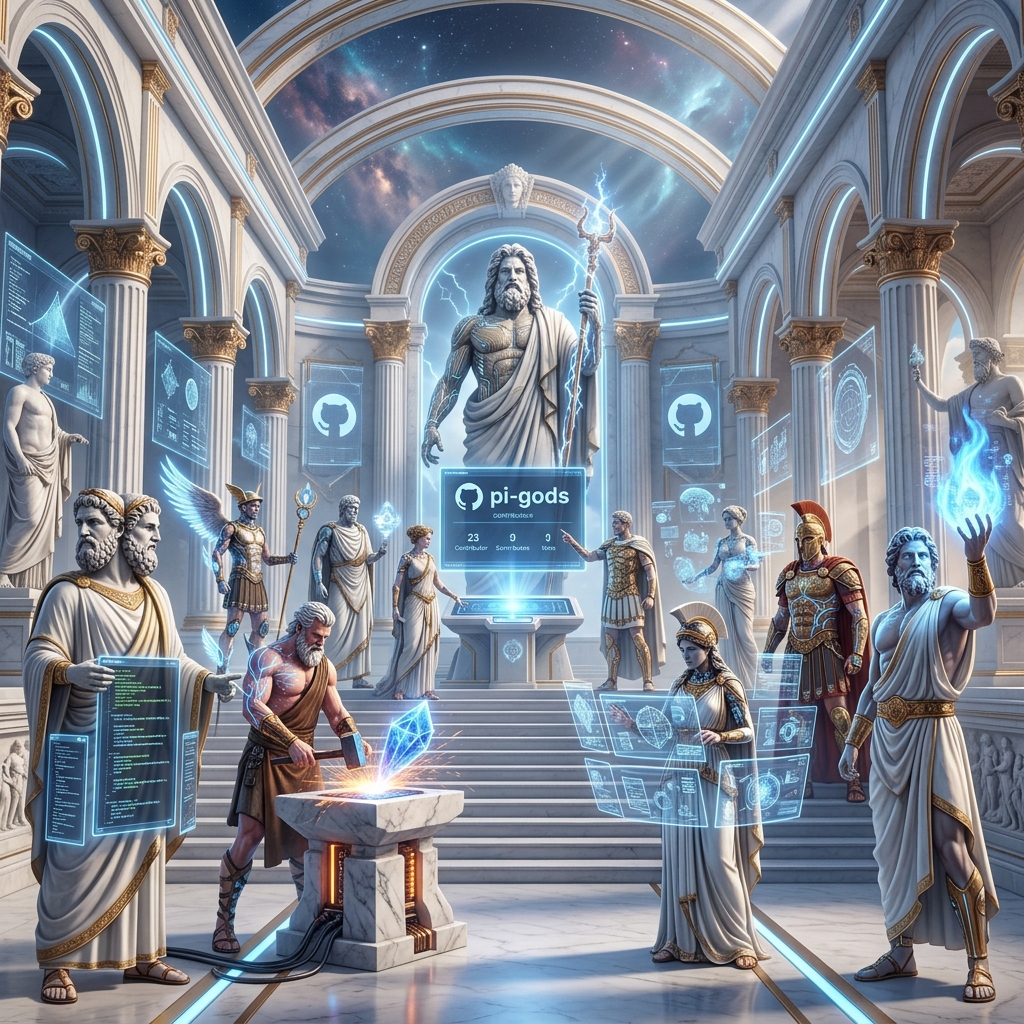 A pi extension implementing a fully autonomous multi-agent SDD pipeline.
Thirteen Roman/Greek deities, each owning their domain. Tool boundaries
enforced programmatically. Handoffs detected from the filesystem.
Zero manual routing for the happy path.
## The Pantheon
Thirteen Roman/Greek deities, each commanding their domain. Tool boundaries enforce separation. Handoffs happen at the filesystem — no custom machinery needed.
### 🔍 Read-Only
| Deity | Role | Purpose |
| --------- | ------------ | ----------------------------------------------------------------------------------------------------------------------------------------------------- |
| **Janus** | Orchestrator | God of doorways, transitions, beginnings and endings. The two-faced gate — reads project state and routes to the right specialist. Never writes code. |
### ✏️ Read/Write
| Deity | Role | Purpose |
| -------------- | --------------- | ------------------------------------------------------------------------------------------------------------------------------------------------------------------------------------------- |
| **Minerva** | Product Manager | Goddess of wisdom, strategic warfare, and crafts. Born fully armed from Jupiter's head — turns vague requests into crisp PRDs. Asks until every section writes itself. |
| **Prometheus** | Architect | Titan of forethought — his name means "one who thinks ahead." Shaped humanity and gave them fire. Translates PRDs into the simplest viable blueprint, naming every component and trade-off. |
| **Morpheus** | UX Designer | God of dreams, shaper of human experience. Constructs entire worlds — designs flows (trigger → steps → success → failure), not screens. |
| **Plutus** | Product Owner | God of wealth — not money, but VALUE. Blinded by Zeus to distribute riches without bias. Orders backlog by first-shippable-value. Cuts scope transparently. |
| **Vesta** | Scrum Master | Goddess of the hearth and sacred flame — the fire at the center of Rome. Keeps process integrity and team health. Flags blockers before stories reach Vulcan. |
| **Calliope** | Story Author | Muse of epic poetry, eldest of the nine — "beautiful-voiced." Writes hyper-detailed stories carrying goal, ACs, architecture excerpts, and out-of-scope guardrails. |
### ⚡ Full Access
| Deity | Role | Purpose |
| -------------- | ---------------- | --------------------------------------------------------------------------------------------------------------------------------------------------------------------------------- |
| **Vulcan** | Developer | God of fire and the forge. Built his kingdom under Mount Etna and forged Jupiter's thunderbolts. Picks a story, implements end-to-end, never leaves the forge broken. |
| **Nemesis** | QA | Goddess of retribution against hubris. Punishes those who claim they are finished when they are not. Takes "done" and tries to falsify it — every defect earns a regression test. |
| **Aquarius** | Data Engineer | The water-bearer, Ganymede, cup-bearer to Olympus. Data is water — must flow, be pure, never stagnate. Owns schemas, migrations, queries, and data integrity. |
| **Mars Ultor** | Security | Mars the Avenger — the aspect that defends Rome. Produces STRIDE threat models, scans CVEs, audits secrets and auth flows. No critical or high risks ship. |
| **Mercury** | Release Engineer | Messenger of the gods, fastest of them all, winged sandals. Delivers — conventional commits, changelogs, semver tags, npm publish. One concern per commit. |
| **Apollo** | Documentation | God of knowledge, truth, and clarity. His oracle spoke in riddles, but he demands precision. Every example must run. Every API doc matches real symbols. |
## Autonomous Pipeline
```
User: "Build a todo app with auth"
│
▼ ZERO manual switches below
Janus → reads project state → writes .pantheon/handoff.json
│ agent_end detects file → AUTO-SWITCH
Minerva → asks at most 1 critical question (pipeline pauses)
│ writes .pantheon/prd.md → handoff → AUTO-SWITCH
Prometheus → writes .pantheon/architecture.md → AUTO-SWITCH
Morpheus → writes .pantheon/ux-spec.md + DESIGN.md → AUTO-SWITCH
Plutus → writes .pantheon/epics.md → AUTO-SWITCH
Calliope → writes .pantheon/stories/*.md → AUTO-SWITCH
Vulcan → implements, tests pass → AUTO-SWITCH
Nemesis → adversarial QA (0 defects) → AUTO-SWITCH
Mercury → commits, changelog, tags release → handoff to Janus
│
▼
DONE. Repeat for next epic.
```
**The pipeline only stops when a deity asks a clarifying question.**
Everything else runs autonomously.
## How Handoffs Work
Handoffs happen automatically — no manual routing needed for the happy path.
### Tool-based handoff (recommended)
Use the `pantheon_handoff` tool (available to all deities):
```
pantheon_handoff({
to: "vulcan",
reason: "Story implemented — ready for QA",
context: "Everything the next deity needs to know..."
})
```
The tool sets a handoff flag and returns `terminate: true`, ending the
current turn immediately — Janus stops without generating a response.
The `agent_end` hook switches to the target deity and defers the handoff
message with `setTimeout(0)`. By the time it fires, the agent is fully idle
and the next turn starts immediately — no user input needed.
### File-based handoff (alternative)
Deities can also create a handoff marker using the standard `write` tool:
```json
// .pantheon/handoff.json
{
"from": "minerva",
"to": "prometheus",
"reason": "PRD complete — ready for architecture",
"context": "Everything the next deity needs to know..."
}
```
The `agent_end` hook detects the file, parses it, auto-switches the active
deity, and clears the file. No custom pi tools needed — `write` and `bash`
are always available.
**All deities can create handoff files** regardless of their tool policy.
`.pantheon/handoff.json` is whitelisted as pipeline metadata, not a
project artifact.
## The `.pantheon/` Directory
All pipeline artifacts live in one hidden directory — the temple where
the gods work:
```
.pantheon/
├── handoff.json # Handoff marker (created/cleaned per cycle)
├── prd.md # Minerva
├── architecture.md # Prometheus
├── ux-spec.md # Morpheus
├── DESIGN.md # Morpheus (design tokens)
├── epics.md # Plutus
├── qa-report-*.md # Nemesis
├── threat-model.md # Mars Ultor
├── data-model.md # Aquarius
├── security/ # Mars Ultor (audit logs)
├── spikes/ # Prometheus (tech investigations)
└── stories/ # Calliope
├── 1.1-server-auth-api.md
├── 1.2-auth-middleware.md
└── 1.3-react-auth-ui.md
```
The dot prefix keeps it hidden in file listings. Everything the pipeline
produces — specs, handoffs, QA reports, stories — lives in one place.
User-facing documentation (README, API docs, examples) stays at the
project root.
## Tool Boundary Enforcement
Every deity has programmatic boundaries enforced at the `tool_call` hook:
| Policy | Allowed Tools |
| ----------- | ------------------------------------------------------ |
| `readonly` | `read`, (inspect only), Pantheon tools |
| `readwrite` | Above + `write`, `edit` |
| `full` | All tools (destructive patterns still blocked for all) |
**Universal guardrails (all deities):**
- Destructive commands blocked: `rm -rf`, `git push --force`, `DROP TABLE`, fork bombs, pipe-to-bash
- Forbidden paths per deity: e.g., Vulcan can't write to `.pantheon/architecture.md`
- All parameterized — domain-appropriate error messages
**Example:** Janus tries `bash` → blocked: _"Janus (Orchestrator) has 'readonly' access — 'bash' requires higher privileges."_
## Commands
| Command | Action |
| -------------- | ---------------------------------------------------- |
| `/gods` | List all 13 deities with active one highlighted |
| `/gods ` | Switch to a deity (e.g., `/gods vulcan`) |
| `/gods status` | Show current deity, pending handoffs, gate checklist |
| `/gods next` | Janus inspects project and recommends next deity |
## Tools
| Tool | Description |
| ------------------ | ------------------------------------------------------------------------------------------------------------------------------------------------- |
| `pantheon_status` | Display active deity, tool policy, pending handoffs, and routing info |
| `pantheon_handoff` | Hand off to another deity. Accepts `to`, `reason`, and `context` parameters. The handoff takes effect immediately — no waiting for the next turn. |
## Extension File Structure
```
pi-gods/
├── index.ts # Entry: hook registration + /gods command
├── state.ts # Session-persistent deity state (survives /reload)
├── system-prompt.ts # Builds per-deity system prompt with voice + gates
├── types.ts # Core types, tool sets, destructive patterns
├── pantheon/
│ ├── index.ts # Registry barrel
│ └── definitions.ts # All 13 deity definitions (pure TypeScript, no YAML)
├── guards/
│ ├── index.ts # Barrel
│ └── tool-policy.ts # Tool boundary enforcement + handoff whitelist
└── pipeline/
├── index.ts # Barrel
├── handoff.ts # File-based handoff detection + creation
└── orchestrator.ts # Janus routing + state persistence helpers
```
## Deity Definition Shape
Each deity is a typed TypeScript object — no YAML parsing, no frontmatter
extraction, no file-per-agent. A single source of truth in `pantheon/definitions.ts`:
```typescript
{
name: "vulcan", // /gods vulcan
title: "Developer", // Display role
role: "...", // Full role description
domain: "...", // Mythological justification
toolPolicy: "full", // readonly | readwrite | full
blockedTools: [], // Explicitly blocked tools
blockedPatterns: [], // Regex patterns to block
forbiddenPaths: [], // Paths this deity can't write to
handoffs: [...], // Handoff rules (when X → route to Y)
handoffGate: [], // Checklist before calling handoff
voice: [...], // Voice DNA (how the deity speaks)
activation: "...", // First-turn behavior
capabilities: [...], // What the deity CAN do
restrictions: [...], // What the deity MUST NOT do
systemPrompt: "...", // Core operating principles
}
```
## Key Design Decisions
1. **File-based handoff over custom pi tools.** Custom tools depend on pi
registration quirks. Standard `write`/`bash` always work. The
`.pantheon/handoff.json` file is visible and debuggable.
2. **Roman methodology over Greek.** Deities chosen for domain fit:
Janus (two-faced gatekeeper = router), Plutus (blind wealth god =
unbiased prioritizer), Mars Ultor (defensive war = security), Morpheus
(dream-shaper = UX). No forced mappings.
3. **Typed definitions over YAML files.** No parsing, no validation
overhead, no file-per-agent bloat. One file, 13 definitions, full
TypeScript safety.
4. **Single artifact directory.** `.pantheon/` holds everything the
pipeline creates. No scattering across `docs/`, `specs/`, `design/`.
The handoff marker lives alongside the artifacts it governs.
5. **Gate checklists auto-generated.** Each deity's handoff gate is
inferred from their capabilities and handoff rules. Explicit
`handoffGate` arrays override the defaults when needed.
## Inspiration
pi-gods was inspired by [ATLAS_OS](https://github.com/lucapohl-angel/ATLAS_OS)
— an SDD CLI that uses Greek deities for its spec-driven development
pipeline. The concept of routing work through named specialists with defined
boundaries and handoff triggers comes from ATLAS_OS's architecture.
pi-gods adapts this to pi extensions with file-based handoff, enforced tool
policies, and an autonomous auto-handoff engine.
## Installation
### Via git (recommended)
```bash
pi install git:github.com/k1lgor/pi-gods
```
### Via npm
```bash
pi install npm:pi-gods
```
### Local
```bash
git clone https://github.com/k1lgor/pi-gods.git
pi install ~/path/to/pi-gods
```
No dependencies beyond what pi provides (`@earendil-works/pi-coding-agent`,
`typebox`, Node.js built-ins).
## License
pi-gods is licensed under the MIT License. See the [LICENSE](LICENSE) file for details.
A pi extension implementing a fully autonomous multi-agent SDD pipeline.
Thirteen Roman/Greek deities, each owning their domain. Tool boundaries
enforced programmatically. Handoffs detected from the filesystem.
Zero manual routing for the happy path.
## The Pantheon
Thirteen Roman/Greek deities, each commanding their domain. Tool boundaries enforce separation. Handoffs happen at the filesystem — no custom machinery needed.
### 🔍 Read-Only
| Deity | Role | Purpose |
| --------- | ------------ | ----------------------------------------------------------------------------------------------------------------------------------------------------- |
| **Janus** | Orchestrator | God of doorways, transitions, beginnings and endings. The two-faced gate — reads project state and routes to the right specialist. Never writes code. |
### ✏️ Read/Write
| Deity | Role | Purpose |
| -------------- | --------------- | ------------------------------------------------------------------------------------------------------------------------------------------------------------------------------------------- |
| **Minerva** | Product Manager | Goddess of wisdom, strategic warfare, and crafts. Born fully armed from Jupiter's head — turns vague requests into crisp PRDs. Asks until every section writes itself. |
| **Prometheus** | Architect | Titan of forethought — his name means "one who thinks ahead." Shaped humanity and gave them fire. Translates PRDs into the simplest viable blueprint, naming every component and trade-off. |
| **Morpheus** | UX Designer | God of dreams, shaper of human experience. Constructs entire worlds — designs flows (trigger → steps → success → failure), not screens. |
| **Plutus** | Product Owner | God of wealth — not money, but VALUE. Blinded by Zeus to distribute riches without bias. Orders backlog by first-shippable-value. Cuts scope transparently. |
| **Vesta** | Scrum Master | Goddess of the hearth and sacred flame — the fire at the center of Rome. Keeps process integrity and team health. Flags blockers before stories reach Vulcan. |
| **Calliope** | Story Author | Muse of epic poetry, eldest of the nine — "beautiful-voiced." Writes hyper-detailed stories carrying goal, ACs, architecture excerpts, and out-of-scope guardrails. |
### ⚡ Full Access
| Deity | Role | Purpose |
| -------------- | ---------------- | --------------------------------------------------------------------------------------------------------------------------------------------------------------------------------- |
| **Vulcan** | Developer | God of fire and the forge. Built his kingdom under Mount Etna and forged Jupiter's thunderbolts. Picks a story, implements end-to-end, never leaves the forge broken. |
| **Nemesis** | QA | Goddess of retribution against hubris. Punishes those who claim they are finished when they are not. Takes "done" and tries to falsify it — every defect earns a regression test. |
| **Aquarius** | Data Engineer | The water-bearer, Ganymede, cup-bearer to Olympus. Data is water — must flow, be pure, never stagnate. Owns schemas, migrations, queries, and data integrity. |
| **Mars Ultor** | Security | Mars the Avenger — the aspect that defends Rome. Produces STRIDE threat models, scans CVEs, audits secrets and auth flows. No critical or high risks ship. |
| **Mercury** | Release Engineer | Messenger of the gods, fastest of them all, winged sandals. Delivers — conventional commits, changelogs, semver tags, npm publish. One concern per commit. |
| **Apollo** | Documentation | God of knowledge, truth, and clarity. His oracle spoke in riddles, but he demands precision. Every example must run. Every API doc matches real symbols. |
## Autonomous Pipeline
```
User: "Build a todo app with auth"
│
▼ ZERO manual switches below
Janus → reads project state → writes .pantheon/handoff.json
│ agent_end detects file → AUTO-SWITCH
Minerva → asks at most 1 critical question (pipeline pauses)
│ writes .pantheon/prd.md → handoff → AUTO-SWITCH
Prometheus → writes .pantheon/architecture.md → AUTO-SWITCH
Morpheus → writes .pantheon/ux-spec.md + DESIGN.md → AUTO-SWITCH
Plutus → writes .pantheon/epics.md → AUTO-SWITCH
Calliope → writes .pantheon/stories/*.md → AUTO-SWITCH
Vulcan → implements, tests pass → AUTO-SWITCH
Nemesis → adversarial QA (0 defects) → AUTO-SWITCH
Mercury → commits, changelog, tags release → handoff to Janus
│
▼
DONE. Repeat for next epic.
```
**The pipeline only stops when a deity asks a clarifying question.**
Everything else runs autonomously.
## How Handoffs Work
Handoffs happen automatically — no manual routing needed for the happy path.
### Tool-based handoff (recommended)
Use the `pantheon_handoff` tool (available to all deities):
```
pantheon_handoff({
to: "vulcan",
reason: "Story implemented — ready for QA",
context: "Everything the next deity needs to know..."
})
```
The tool sets a handoff flag and returns `terminate: true`, ending the
current turn immediately — Janus stops without generating a response.
The `agent_end` hook switches to the target deity and defers the handoff
message with `setTimeout(0)`. By the time it fires, the agent is fully idle
and the next turn starts immediately — no user input needed.
### File-based handoff (alternative)
Deities can also create a handoff marker using the standard `write` tool:
```json
// .pantheon/handoff.json
{
"from": "minerva",
"to": "prometheus",
"reason": "PRD complete — ready for architecture",
"context": "Everything the next deity needs to know..."
}
```
The `agent_end` hook detects the file, parses it, auto-switches the active
deity, and clears the file. No custom pi tools needed — `write` and `bash`
are always available.
**All deities can create handoff files** regardless of their tool policy.
`.pantheon/handoff.json` is whitelisted as pipeline metadata, not a
project artifact.
## The `.pantheon/` Directory
All pipeline artifacts live in one hidden directory — the temple where
the gods work:
```
.pantheon/
├── handoff.json # Handoff marker (created/cleaned per cycle)
├── prd.md # Minerva
├── architecture.md # Prometheus
├── ux-spec.md # Morpheus
├── DESIGN.md # Morpheus (design tokens)
├── epics.md # Plutus
├── qa-report-*.md # Nemesis
├── threat-model.md # Mars Ultor
├── data-model.md # Aquarius
├── security/ # Mars Ultor (audit logs)
├── spikes/ # Prometheus (tech investigations)
└── stories/ # Calliope
├── 1.1-server-auth-api.md
├── 1.2-auth-middleware.md
└── 1.3-react-auth-ui.md
```
The dot prefix keeps it hidden in file listings. Everything the pipeline
produces — specs, handoffs, QA reports, stories — lives in one place.
User-facing documentation (README, API docs, examples) stays at the
project root.
## Tool Boundary Enforcement
Every deity has programmatic boundaries enforced at the `tool_call` hook:
| Policy | Allowed Tools |
| ----------- | ------------------------------------------------------ |
| `readonly` | `read`, (inspect only), Pantheon tools |
| `readwrite` | Above + `write`, `edit` |
| `full` | All tools (destructive patterns still blocked for all) |
**Universal guardrails (all deities):**
- Destructive commands blocked: `rm -rf`, `git push --force`, `DROP TABLE`, fork bombs, pipe-to-bash
- Forbidden paths per deity: e.g., Vulcan can't write to `.pantheon/architecture.md`
- All parameterized — domain-appropriate error messages
**Example:** Janus tries `bash` → blocked: _"Janus (Orchestrator) has 'readonly' access — 'bash' requires higher privileges."_
## Commands
| Command | Action |
| -------------- | ---------------------------------------------------- |
| `/gods` | List all 13 deities with active one highlighted |
| `/gods ` | Switch to a deity (e.g., `/gods vulcan`) |
| `/gods status` | Show current deity, pending handoffs, gate checklist |
| `/gods next` | Janus inspects project and recommends next deity |
## Tools
| Tool | Description |
| ------------------ | ------------------------------------------------------------------------------------------------------------------------------------------------- |
| `pantheon_status` | Display active deity, tool policy, pending handoffs, and routing info |
| `pantheon_handoff` | Hand off to another deity. Accepts `to`, `reason`, and `context` parameters. The handoff takes effect immediately — no waiting for the next turn. |
## Extension File Structure
```
pi-gods/
├── index.ts # Entry: hook registration + /gods command
├── state.ts # Session-persistent deity state (survives /reload)
├── system-prompt.ts # Builds per-deity system prompt with voice + gates
├── types.ts # Core types, tool sets, destructive patterns
├── pantheon/
│ ├── index.ts # Registry barrel
│ └── definitions.ts # All 13 deity definitions (pure TypeScript, no YAML)
├── guards/
│ ├── index.ts # Barrel
│ └── tool-policy.ts # Tool boundary enforcement + handoff whitelist
└── pipeline/
├── index.ts # Barrel
├── handoff.ts # File-based handoff detection + creation
└── orchestrator.ts # Janus routing + state persistence helpers
```
## Deity Definition Shape
Each deity is a typed TypeScript object — no YAML parsing, no frontmatter
extraction, no file-per-agent. A single source of truth in `pantheon/definitions.ts`:
```typescript
{
name: "vulcan", // /gods vulcan
title: "Developer", // Display role
role: "...", // Full role description
domain: "...", // Mythological justification
toolPolicy: "full", // readonly | readwrite | full
blockedTools: [], // Explicitly blocked tools
blockedPatterns: [], // Regex patterns to block
forbiddenPaths: [], // Paths this deity can't write to
handoffs: [...], // Handoff rules (when X → route to Y)
handoffGate: [], // Checklist before calling handoff
voice: [...], // Voice DNA (how the deity speaks)
activation: "...", // First-turn behavior
capabilities: [...], // What the deity CAN do
restrictions: [...], // What the deity MUST NOT do
systemPrompt: "...", // Core operating principles
}
```
## Key Design Decisions
1. **File-based handoff over custom pi tools.** Custom tools depend on pi
registration quirks. Standard `write`/`bash` always work. The
`.pantheon/handoff.json` file is visible and debuggable.
2. **Roman methodology over Greek.** Deities chosen for domain fit:
Janus (two-faced gatekeeper = router), Plutus (blind wealth god =
unbiased prioritizer), Mars Ultor (defensive war = security), Morpheus
(dream-shaper = UX). No forced mappings.
3. **Typed definitions over YAML files.** No parsing, no validation
overhead, no file-per-agent bloat. One file, 13 definitions, full
TypeScript safety.
4. **Single artifact directory.** `.pantheon/` holds everything the
pipeline creates. No scattering across `docs/`, `specs/`, `design/`.
The handoff marker lives alongside the artifacts it governs.
5. **Gate checklists auto-generated.** Each deity's handoff gate is
inferred from their capabilities and handoff rules. Explicit
`handoffGate` arrays override the defaults when needed.
## Inspiration
pi-gods was inspired by [ATLAS_OS](https://github.com/lucapohl-angel/ATLAS_OS)
— an SDD CLI that uses Greek deities for its spec-driven development
pipeline. The concept of routing work through named specialists with defined
boundaries and handoff triggers comes from ATLAS_OS's architecture.
pi-gods adapts this to pi extensions with file-based handoff, enforced tool
policies, and an autonomous auto-handoff engine.
## Installation
### Via git (recommended)
```bash
pi install git:github.com/k1lgor/pi-gods
```
### Via npm
```bash
pi install npm:pi-gods
```
### Local
```bash
git clone https://github.com/k1lgor/pi-gods.git
pi install ~/path/to/pi-gods
```
No dependencies beyond what pi provides (`@earendil-works/pi-coding-agent`,
`typebox`, Node.js built-ins).
## License
pi-gods is licensed under the MIT License. See the [LICENSE](LICENSE) file for details.