# Flow reference
## Workflow presets
Presets are the intent-level entrypoint over the raw mode table. A call such as:
```json
{
"preset": "code-review",
"task": "Review HEAD against main and issue #25 exactly once",
"why": "author-independent verification"
}
```
loads one Markdown definition, substitutes `{task}`, applies its declared
workflow-shape overrides plus safe caller controls such as capture, tracing,
trust, and `maxCostUsd`, then validates and runs the expanded call as an
ordinary mode. Presets do not bypass mode bounds, budgets, delegation contracts,
project trust, capture policy, or traces.
For `code-review`, the caller task names the Git range as `base..head`,
`base...head`, or `head against base`. The harness resolves both refs before
dispatch, pins those commit IDs into both review tasks, and derives the
changed-file manifest from that requested range. A three-dot range is pinned at
the merge base, so the manifest is the branch's own change set rather than a
two-endpoint diff. Both typed returns must attest to those exact IDs.
Unresolvable, mismatched, or incomplete ranges produce `PARTIAL`.
Bundled presets:
| Preset | Expansion | Bounded outcome |
|---|---|---|
| `scout` | One `recon` run | One read-only evidence pass |
| `map-codebase` | `orchestrate` with at most four recon subtasks | One decomposed map and synthesis |
| `code-review` | Two concurrent read-only (`bash-ro`) `overwatch` runs, roles `standards` and `spec` | Exactly one pass; typed coverage/findings; `CLEAN`, `FINDINGS`, or `PARTIAL` |
`code-review` is deliberately one-shot: it never fixes findings, posts review
comments, or repeats until clean.
Preset discovery uses the same precedence as agents: bundled `presets/*.md`,
user `~/.pi/agent/flow-presets/*.md`, then project
`.pi/flow-presets/*.md`. Project presets require `agentScope:"project"` or
`"all"` and use the project-local trust gate. A preset file contains
frontmatter plus a JSON body:
```md
---
name: my-scout
description: Inspect one target with recon.
overrides: cwd,timeoutMs,maxGeneratedTokens
---
{"agent":"recon","task":"{task}","timeoutMs":900000,"maxGeneratedTokens":4000}
```
A preset declares which top-level parameters callers may override (`overrides` in
its frontmatter); undeclared or workflow-shape overrides fail with
`PRESET_OVERRIDE_INVALID`.
A template may set `recordContent`/`redactSecrets` to tighten capture, but never
to loosen it. The effective policy is the stricter of the caller's and the
template's in both directions: a template cannot turn the caller's redaction
off, and a caller cannot re-enable content a template deliberately withholds.
`traceStrict` follows the same rule — a template can turn the evidence gate on,
but a template-authored `traceStrict:false` is dropped so the caller and
`PI_FLOWS_TRACE_STRICT` still decide. `why`, `agentScope`,
`confirmProjectAgents`, and `allowSharedWriteCwd` are caller-only: a template
cannot justify its own delegation, opt its source into trust, or take the
shared-write exception on the caller's behalf.
## Modes
Exactly one mode is valid per call.
| Mode | Shape | Runs a child pi process? |
|---|---|---:|
| List | `{ "list": true }` | No |
| Config | `{ "showConfig": true }` | No |
| Single | `{ "agent": "recon", "task": "..." }` | Yes |
| Parallel | `{ "tasks": [{ "agent": "recon", "task": "..." }] }` | Yes |
| Chain | `{ "task": "...", "chain": [{ "agent": "recon", "task": "..." }] }` | Yes |
| Evaluate | `{ "task": "...", "evaluate": { "maxIterations": 3 } }` | Yes |
| Vote | `{ "task": "...", "vote": { "voters": [{ "agent": "recon" }, { "agent": "overwatch" }] } }` | Yes |
| Route | `{ "task": "...", "route": { "candidates": ["recon","strategist"] } }` | Yes |
| Orchestrate | `{ "task": "...", "orchestrate": {} }` | Yes |
| Graph | `{ "task": "...", "graph": { "nodes": [{ "id": "a", "agent": "recon", "task": "..." }] } }` | Yes |
| Loop | `{ "task": "...", "loop": { "body": { "agent": "operator" } } }` | Yes |
| Search | `{ "task": "...", "search": { "candidates": 3 } }` | Yes |
| Workflow | `{ "task": "...", "workflow": { "phases": [{ "id": "a", "agent": "recon", "task": "..." }] } }` | For work phases |
| Worktree | `{ "task": "...", "worktree": { "tasks": [{ "id": "a", "agent": "operator", "task": "..." }, { "id": "b", "agent": "operator", "task": "..." }] } }` | Yes |
| Debate | `{ "task": "...", "debate": { "participants": [{ "agent": "analyst" }, { "agent": "strategist" }] } }` | Yes |
| Dossier | `{ "task": "...", "dossier": { "sections": [{ "agent": "recon", "task": "source A" }, { "agent": "analyst", "task": "source B" }] } }` | Yes |
| Monitor | `{ "task": "...", "monitor": { "command": "./probe" } }` | On trigger |
## Live TUI monitoring
Two surfaces cover a flow's life in interactive Pi, both fed by the same
in-memory flow updates:
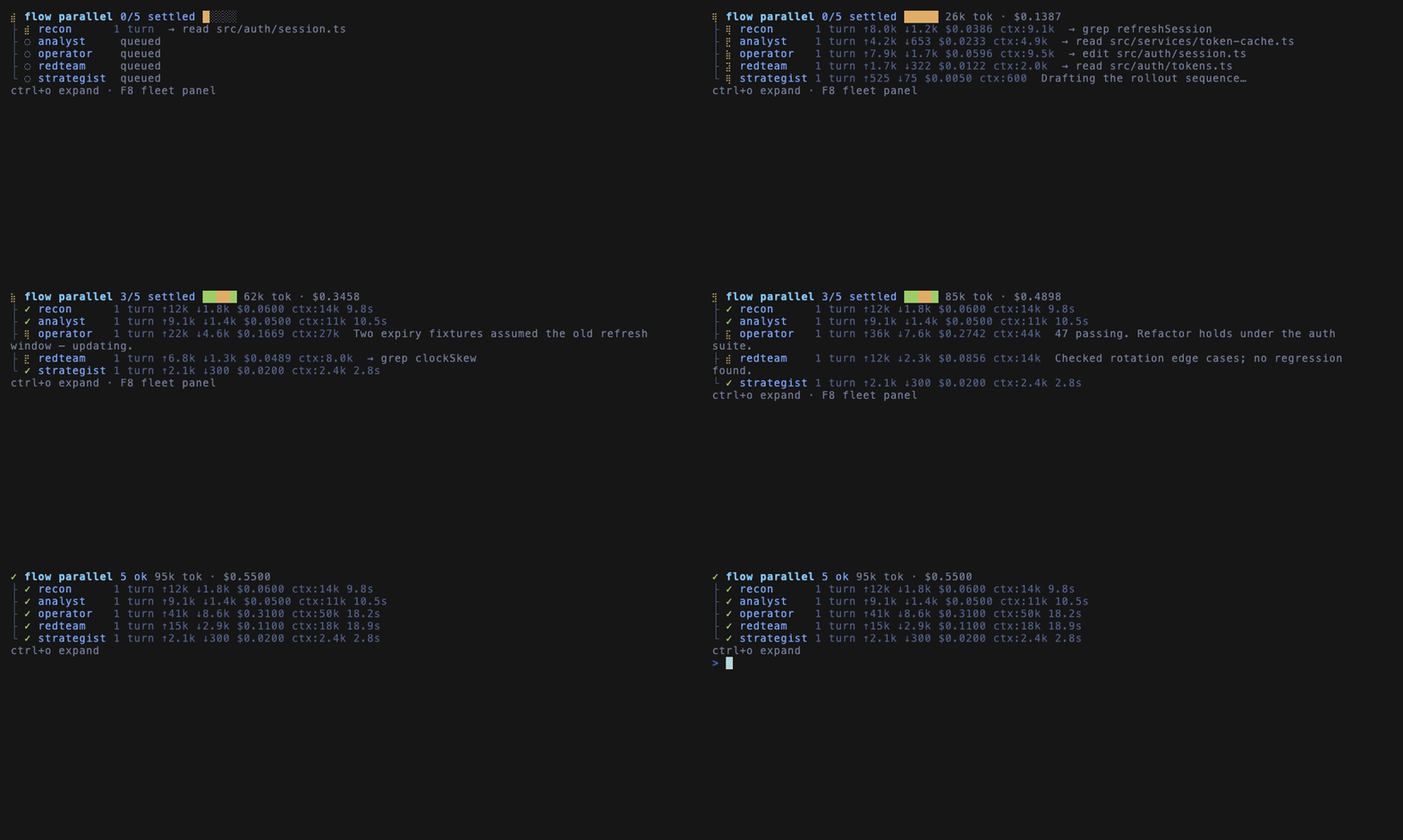
- **The tool row is live.** While children run, the `flow` tool row shows a
progress bar, per-run state with a spinner, each running child's current
tool call or latest message, and a token/cost rollup — updating in place.
Before the first child starts, the tool call and row also disclose every
configured cost/token ceiling as a `flow ceiling` or `contract ceiling`.
`ctrl+o` expands the settled row into full per-run output.
 - **`/flows inspect` drills into one child.** Select a queued or running child
to see its task, status, usage, and recent text/tool activity. Use Up/Down to
scroll, End to return to the latest activity, and Escape to close the overlay
without interrupting the child.
### What the fan-out counter counts
The tool row heads a fan-out with `1/3 settled`: the numerator
counts [**settled**](../../CONTEXT.md#delegation-model) runs, not successful ones.
Once the flow itself has settled the ratio is replaced by the outcome —
`2 failed` or `3 ok` — because `3/3` reads as a success total. A single-run flow
shows neither, since the header would only restate the one run below it.
A multi-stage mode settles one stage's runs before spawning the next: `evaluate`
returns its generator before the check command and the critic panel run. Between
stages the header keeps the labeled ratio and the spinner rather than announcing
an outcome the flow has not reached, so `2/2 settled` with a spinner means "both
runs so far are done, the flow is still working".
The inline tool row is the single primary live progress view. The extension
clears its footer status and above-editor widget instead of repeating that row's
summary elsewhere. On the two board surfaces a flow-level error is reported
alongside the run counts, as a status icon on the tool row and an `error:` line
on both.
After a flow settles, a durable flow card entry stays in the session transcript
(and re-renders after `pi` restarts): status, per-run duration bars, cost
rollup, failure codes, and the trace file pointer when tracing was on.
## Activation thresholds
Use the least coordination that materially improves correctness. Do not auto-use
any flow for a simple task or a **saturated** task, where direct parent execution
already meets the acceptance criteria reliably and leaves no useful quality
headroom. In that case, extra subprocesses are only cost and latency.
Every spawning call must pass `why` — one sentence naming the reason delegation
beats direct execution (an explicit user request, fan-out one context cannot
hold, or author-independent verification). Calls without it are refused with
`WHY_REQUIRED` before any child spawns. This is deliberate structural friction:
if no justification can be stated, the task belongs in the parent context.
| Mode | Activate when | Stay direct or use a simpler mode when |
|---|---|---|
| `workflow` | Named phases, persisted artifacts, deterministic gates, or a resumable human approval are part of correctness. | The work is one small edit or an ordinary linear handoff; use the parent, `single`, `chain`, or `evaluate`. |
| `worktree` | Isolation, ownership boundaries, or shared integration conflicts are part of correctness for multiple write-capable tasks, and a verified integration branch is required. | The parent can safely make the edits in one checkout, even when two files are involved; use direct execution, `single`/`evaluate`, or read-only `parallel`. |
| `debate` | The user explicitly requests independent advocates/rebuttal/adjudication for a consequential decision. | Debate is not an automatic route today: direct Codex matched its decision quality with lower latency/tokens in the paired baseline. Answer directly unless independent opposition is itself requested. |
| `dossier` | At least two sources or claim families must be cited and reconciled, including contradictions and gaps. | One source or lookup is enough; use `single` with `recon`/`analyst`. |
| `monitor` | A deterministic probe must be repeated under a hard bound, and a typed event should trigger one diagnosis/response. | One status check is enough, or the need is durable/background scheduling; run the command directly or use an external automation system. |
## Parameters
| Parameter | Default | Notes |
|---|---|---|
| `preset` | (none) | Named workflow preset expanded before mode validation. Prefer it when its intent matches. |
| `why` | (required to spawn) | One sentence justifying delegation over direct parent execution. Required for every spawning mode; `list`/`showConfig` never need it. Missing/empty ⇒ `WHY_REQUIRED`. |
| `agentScope` | `user` | Applies to both presets and agents: `user` = package + user; `project` = package + project; `all` = all three sources. |
| `confirmProjectAgents` | `true` | Interactive sessions prompt. Headless sessions refuse project presets/agents unless this is explicitly `false` after review. |
| `concurrency` | `4` | Concurrent fan-out, including parallel, vote, orchestrate, worktree, debate, and dossier. Integer `1..8`, validated once at dispatch for every mode — an out-of-range value is refused even in modes that run sequentially. |
| `timeoutMs` | `36000000` | Per child process timeout (10 hours). Independently of it, a child that reports a terminal provider error and then stalls is terminated after a short grace (`PI_FLOWS_ERROR_GRACE_MS`, default 30000ms) with `CHILD_PROVIDER_ERROR`. |
| `recordContent` | `true` | Return/store child message content after redaction. Set `false` to retain structural status/usage only. |
| `redactSecrets` | `true` | Redacts secret-shaped strings, emails, and home paths from content/details. |
| `maxCostUsd` | (none) | Cumulative USD cost ceiling across every child in this flow. Once reached at a completed model-response boundary, the active child stops and no further child spawns. |
| `maxTokens` | (none) | Cumulative input+output token ceiling across every child in this flow. Once reached, no further child spawns. |
| `maxGeneratedTokens` | (none) | Cumulative generated/output token ceiling across every child in this flow. Once reached, the active child stops at the completed model-response boundary and no further child spawns. Omit to run uncapped. |
| `traceFile` | (none) | Append OpenInference-shaped JSON spans to this JSONL file — one per child run, one per stage (wave/round/phase), one per coordination event, plus a root span. Trace data any OpenTelemetry pipeline (or a coding agent via `jq`/SQL) can read. Also settable via `PI_FLOWS_TRACE_FILE`. Relative paths resolve against `cwd`. Values are redacted/capped first. |
| `traceLabel` | (none) | Use-case label attached to trace spans so reports can group execution success, verified outcome success, TPSO, cost, and warning counts by journey/release gate. |
| `traceContext` | (none) | Stable `{runId,caseId,trialId,trialIndex?,arm?,attempt?}` linkage for eval/runtime correlation. Redacted, bounded identifiers are copied to every runtime span and `details.trace` returns the exact trace/root-span reference plus trace health. |
| `traceStrict` | `false` | Require complete trace evidence. A missing `traceFile`, dropped spans, or failed writes fail the call with `TRACE_INCOMPLETE`. For evaluation/release gates; ordinary flows keep best-effort tracing. Also settable via `PI_FLOWS_TRACE_STRICT`. |
| `handoffPolicy` | `warn` | Call-level injection handling at inter-agent boundaries: `warn` preserves the flagged payload with a warning, `quarantine` substitutes a payload-free marker, and `fail` returns `HANDOFF_POLICY_VIOLATION` before the recipient spawns. |
| `modeHandoffPolicy` | (none) | Per-mode minimums, e.g. `{"workflow":"fail"}`. The effective policy is the stricter of this mode requirement and `handoffPolicy`; a call cannot downgrade a high-consequence mode. |
| `returnContract` | (none) | Prose return requirements appended to delegated worker/generator/synthesis tasks. Use it to require a shape, fields, max length, or evidence format. It is prompt-enforced, not a machine-checked delegation contract. |
| `requireEvidence` | `false` | Appends an evidence requirement to delegated prompts: load-bearing claims need file:line refs, command output, citations, or explicit gaps. |
| `contract` | (none) | Machine-checked delegation contract. It may replace prose `task` in single/evaluate, acts as the final-role fallback in integration modes, and requires a validated `pi-flows.return-envelope.v1` response. Fan-out tasks, graph nodes, workflow phases, worktree tasks, voters/participants, dossier sections, and agent refs can set role-specific delegation contracts. |
| `incompleteHandoffPolicy` | `fail` | Integration modes reject `partial`/`blocked` return envelopes by default. Set `"include"` only as an explicit decision to synthesize while preserving incomplete status and provenance in the returned handoffs/header. |
| `allowSharedWriteCwd` | `false` | By default, concurrent write-capable agents may not share one `cwd`. Set `true` only when shared writes are intentional. |
| `checkpoint` | (none) | Optional human checkpoint. `checkpoint.before:"spawn"` asks before any child runs; `"finalize"` asks after child work before returning the final answer. Headless contexts fail closed. |
| `reflexion` | disabled | Optional local cross-run lessons. `reflexion.enabled:true` reads/appends recent lessons from `.pi/flow-reflections.jsonl` by default. |
| `model` | agent/default | Flow-wide exact-model fallback. A task, phase, participant, or role-level `model` overrides it. Prefer `tier` unless the user named a concrete model. |
| `tier` | agent/default | Flow-wide capability-tier fallback (`fast`, `capable`, `deep`), overridable per task/phase/role. Resolves against the [model roster](#the-model-roster) derived from the models this install can run, so it works with no configuration. A call-level `tier:"capable"` always resolves, forcing the default model even on a `fast`/`deep` agent; a `fast`/`deep` tier the roster could not resolve falls through to the agent's own pin. |
| `thinking` | agent/tier | Flow-wide thinking-level fallback (`off`, `minimal`, `low`, `medium`, `high`, `xhigh`, `max`), overridable per task/phase/role. Independent of `tier`: sets effort without changing which model runs. Lowered automatically to what the resolved model supports, and a child with no level named anywhere leaves pi's own default alone. |
| `tools` | agent/default | Comma-separated tools, `none`, or `default`. `bash-ro` grants bash under a child-enforced read-only allowlist (see [write isolation](#return-requirements-delegation-contracts-and-write-isolation)); a toolset carrying both `bash` and `bash-ro` resolves to plain `bash`. |
| `cwd` | parent cwd | Child process working directory. |
### The model roster
`tier` and `thinking` resolve against a roster derived from pi's model registry — the models this install has configured auth for — rather than from a list pi-flows maintains. `fast` takes the cheapest usable model (preferring the parent's own provider) at `low`; `capable` names the model this session is running (not pi's configured default, which a fresh child would otherwise load) at the session's current thinking level; `deep` takes the most capable model, preferring one that supports extended thinking, at `max`. When the default model is already the best available, `deep` differs by thinking level instead of pinning a redundant `--model`.
When the session has a model scope (`/scoped-models`, `--models`), automatic derivation ranks `fast` and `deep` within that scope only — a model you disabled is never auto-assigned a tier. `capable` still mirrors the session's active model even if it sits outside the cycling scope, and explicit `model` pins (call, agent, or config) remain deliberate overrides that the scope does not rewrite. A non-empty scope that leaves the automatic tiers nothing rankable fails closed down a ladder, never through: the tiers anchor to the session's own model; without one they bind to a decoded scoped reference directly (even below the ranking floor — the user enabled exactly those models); and a scope with no readable reference and no session model refuses the automatic tier outright (`MODEL_SCOPE_UNSATISFIABLE`) rather than spawning an unpinned child, which would load pi's configured default — a model the scope may exclude. A scope you configured is never silently widened back to the full registry; only an absent or empty scope means unscoped, and an explicit model (call, agent, or config) always clears the refusal.
Inspect it with `/flows models` or `flow showConfig:true` — every rung states the model, the level, and the reason it was chosen:
```text
modelTier.fast: anthropic/claude-haiku-4-5, thinking low — cheapest model this install can run on anthropic
modelTier.capable: anthropic/claude-opus-5, thinking high — the model this session is running, at its current thinking level (high)
modelTier.deep: anthropic/claude-opus-5, thinking max — the model this session is running is already the most capable available, so deep differs by thinking level (max), not by model
```
Override a tier from `/flows models`, or in `~/.pi/agent/pi-flows.json`:
```json
{
"models": {
"fast": "anthropic/claude-haiku-4-5:low",
"deep": { "model": "anthropic/claude-opus-5", "thinking": "max" },
"capable": { "model": null, "thinking": "high" }
}
}
```
`"model": null` (shorthand `"default"`) runs that tier with no `--model`, so the child loads pi's configured default — distinct from omitting `model`, which keeps the derived one, and from `capable`, which names this session's model. A level set alongside it cannot be pre-checked against that model, since pi does not expose its configured default to an extension. Config that fails to parse is reported as a `modelRoster.issue` line beside the roster, so an override that never took effect is visible rather than silent.
A trusted project may override in `.pi/pi-flows.json` — found by walking up from the working directory (searching for the file itself, so an unrelated nested `.pi` does not shadow it), like project agents, so it applies when you start pi in a subdirectory. An untrusted project's file is ignored, since choosing the model also chooses which vendor sees the task. A project override narrows a tier field by field — a project that sets only `thinking` keeps your model pin — and `/flows models` warns before saving a tier the project already claims, since project config outranks your user file. `PI_FLOWS_FAST_MODEL` / `PI_FLOWS_DEEP_MODEL` still work but are outranked by the config file. Full order, narrowest first: call `model` > call `tier`/`thinking` > agent `model` pin > agent `tier`/`thinking` > project config (trusted) > user config > env > derived roster > pi default.
A flow budget bounds one flow call. It does not cross the process boundary: the outer
ceiling never sees a nested flow's spend, and that nested flow is bounded only by the
ceilings its own call sets — uncapped if it sets none, which is the default.
The fan-out ceiling `maxParallelTasks` (`8`) is a fixed internal cap on `tasks`,
voters, subtasks, worktree writers, debate participants, and dossier sections --
not a per-call input. It is enforced by the runtime and surfaced read-only in
`details.config`.
### Handoff injection policy
Every value that crosses from one coordination role into another is treated as
untrusted data. The flow-scoped guard strips invisible/bidi controls, scans
high-signal instruction-override and exfiltration markers, and retains a bounded
history so fragments that are benign alone but malicious when joined across
several boundaries are detected as a compositional attack. This includes child
output, retrieved content repeated by a child, routing metadata, ballots,
critic/check-command feedback, graph dependencies, workflow phases, and
synthesis inputs.
`handoffPolicy` selects the call behavior:
- `warn` (default) preserves current compatibility: the cleaned payload crosses
with a visible untrusted-data notice.
- `quarantine` withholds the flagged payload and carries only a fixed
quarantine marker. Downstream coordination may continue, but it cannot read
the flagged content.
- `fail` returns `HANDOFF_POLICY_VIOLATION` and the child-dispatch seam refuses
the recipient before a process is spawned.
`modeHandoffPolicy` declares a non-downgradable minimum for a mode. Resolution
uses `warn < quarantine < fail`, so
`handoffPolicy:"warn", modeHandoffPolicy:{"workflow":"fail"}` resolves to
`fail`. Workflow approval receipts bind that resolution; resuming with a changed
call or mode policy requires fresh approval.
`maxCostUsd` / `maxTokens` / `maxGeneratedTokens` form the **flow budget** and close the cost dimension of bounded execution: the iteration, fan-out, and time caps bound how *many* children run and how *long* each runs, but not total spend. Usage is known only after a model response completes, so a response can cross a ceiling. At that accounting boundary, cost and generated-output ceilings stop the active child and refuse subsequent children; the legacy total-token ceiling preserves the completed response and refuses subsequent children. A cost-bounded child also stops with `BUDGET_UNOBSERVABLE` if its provider omits cost telemetry, rather than treating unknown spend as zero. A delegation contract may independently impose a **contract budget**, including a tighter timeout.
At 80% of any ceiling that would stop the live run (cost, generated output, or a contract's total tokens), the child receives a **wrap-up notice**: a steered message asking it to stop working and emit its return envelope now, recording unfinished work as skipped coverage and `unresolvedQuestions` with status `partial`. The transition belongs to the ceiling, not to one child: when any child's settled turn crosses the threshold of a shared budget, every live child governed by that budget is steered at the same moment, and a child spawned while a shared ceiling is already inside the window is steered at spawn, before its first turn. A child that crosses the ceiling after the notice demonstrably reached it (the steered message is seen echoed into its session) is still terminated — the spend stays bounded — but the run settles gracefully (`stopReason: "budget_wrap_up"`, exit 0) and its final output proceeds to envelope validation instead of being forfeited as `BUDGET_EXCEEDED`. That graceful settlement is provisional for a contracted child: delivery of the notice is not compliance, and a wrap-up response that then fails envelope validation revokes the success — the run reports the validation error (for example `RETURN_ENVELOPE_INVALID`, naming the failing role) rather than rendering as ✓ beside a flow error. To make honoring the notice achievable, a contracted child's notice also states the exact envelope requirement: the `contractId` it must carry and the return-envelope format its final message must be. A ceiling crossed before any wrap-up could be requested (one turn jumping from below 80% past 100%), or whose notice never reached the child (for example with child extensions disabled), keeps the hard-stop semantics. The wrap-up request (`child.wrap_up`, with `flow.budget.wrapup_delivered`) and a graceful exhaustion (`child.exhausted` with `flow.budget.graceful`) are recorded as budget events on the trace. Size ceilings as runaway backstops (~3x the expected normal spend), not as governors inside the normal cost range — a ceiling that sits inside the normal range converts routine runs into losses.
The generated tool call, collapsed live row, and durable Flow card
all disclose configured cost/token ceilings with their authority. Identical
contract ceilings are collapsed into one compact line; distinct ceilings remain
separate. The durable entry persists these static ceiling definitions, so a
`BUDGET_EXCEEDED` result still names the binding configuration after a session
reload. Timeout-only contracts are not presented as cost/token ceilings, and
omitting all ceiling fields means uncapped execution rather than a hidden
default.
### Trace export (observability)
Set `traceFile` (or `PI_FLOWS_TRACE_FILE`) to write one append-only JSON span per delegated child, plus a root span for the whole flow call. Child spans carry per-run `flow.duration_ms`; root spans carry distinct `flow.elapsed_time_ms` (end-to-end wall clock), `flow.worker_time_ms` (sum of completed child runtimes), and, when the mode topology is known, `flow.critical_path_ms`. `flow.critical_path_available:false` means the runtime did not have enough dependency data and did not fabricate a value. Other OpenInference-style attributes include `flow.mode`, `flow.agent`, `llm.model_name`, `flow.thinking_level` (the level passed to the child, after clamping to its model) paired with `flow.thinking_level_verified` (whether that clamp could be applied — `false` for a child naming no model, whose configured default pi-flows cannot read and whose level pi may lower internally, so treat the value as requested rather than effective), `llm.token_count.*`, `flow.cost_usd`, status, and (when `recordContent` is on) redacted `input.value` / `output.value`. When `traceContext` is supplied, redacted `flow.run_id`, `flow.case_id`, `flow.trial_id`, `flow.trial_index`, and `flow.arm` values are copied to every span; `details.trace` reports health and the exact trace/root identifiers while redacting and bounding the displayed trace path, context, and write error. Export is best-effort and never fails a flow.
#### Span topology
Every span declares its role in `flow.span_role`:
| Role | What it is |
| --- | --- |
| `root` | The whole flow call. |
| `stage` | A wave, round, iteration, fan-out group, or workflow phase. |
| `child` | One delegated child run. |
| `event` | A zero-duration coordination boundary (see below). |
Children nest under the stage that scheduled them rather than hanging flat off the root, so a critic belongs to a visible revision round and a graph node to a visible wave. `flow.unit_key` names the unit (`alpha`, `worker-2`, `phase-deploy`), and `flow.stage_key` / `flow.stage_span_count` describe the stage.
Consumers link through the boundary that produced what they read, not around it: a synthesizer that consumes a validated handoff depends on `.handoff` rather than on ``, because validation, filtering, and the injection scan sit between a child's output and what the next prompt actually carried. This holds wherever one agent's output becomes another's prompt — an evaluate critic reads the prepared artifact, a loop judge the prepared body, a search scorer the prepared candidate — not only in the modes that use the integration adapter.
Dependencies are recorded as **links, not parentage**: a graph node that consumed another node's output was scheduled by its wave, not spawned by the node it read. `flow.depends_on` lists the unit keys and `flow.depends_on_span_ids` the resolved span ids. Both are comma-joined, and because node/phase/task ids are author-supplied, `%` and `,` inside a key are percent-escaped (`build,linux` → `build%2Clinux`) — decode before matching a key against `flow.unit_key`, which is escaped the same way. `flow.depends_on_unresolved` lists (same escaping, same structural cap) any declared keys that resolved to no span at write time — the writer's record of a handler bug, a `dependsOn` naming a unit that never registered; `flow.depends_on_unresolved_truncated` mirrors `flow.depends_on_truncated`. A row carrying the marker is structurally valid: read-back counts such edges as **dangling links**, reported separately from incomplete or structurally invalid traces, and `npm run trace:report -- --strict` still passes — an honest record of a bad link is not lost evidence.
#### Coordination events
Not every failure happens inside a child run. Approvals, state transitions, budget refusals, gate results, and handoff acceptance move the flow without spawning anything, so each is written as its own zero-duration span with `flow.event_kind` ∈ `artifact`, `state`, `retry`, `approval`, `budget`, `validation`, `handoff`.
Contract validation is recorded at every contracted consumption, and the event name says whether a role boundary was crossed: `handoff.accepted` / `handoff.rejected` where another role consumed the result, `envelope.validated` / `envelope.rejected` for a terminal (parent-facing) report — which the glossary says is not a handoff — each followed by an `artifact.referenced` or `artifact.rejected` event per declared artifact. A terminal report stays exempt from injection-policy *enforcement*; only the recording is unconditional, so a digest mismatch leaves the same evidence whether the spend fed another role or came straight back to the parent.
Handoff events record what crossed the boundary — `flow.handoff.status`, `.compatibility`, `.acceptance` (`accepted` or `rejected:
- **`/flows inspect` drills into one child.** Select a queued or running child
to see its task, status, usage, and recent text/tool activity. Use Up/Down to
scroll, End to return to the latest activity, and Escape to close the overlay
without interrupting the child.
### What the fan-out counter counts
The tool row heads a fan-out with `1/3 settled`: the numerator
counts [**settled**](../../CONTEXT.md#delegation-model) runs, not successful ones.
Once the flow itself has settled the ratio is replaced by the outcome —
`2 failed` or `3 ok` — because `3/3` reads as a success total. A single-run flow
shows neither, since the header would only restate the one run below it.
A multi-stage mode settles one stage's runs before spawning the next: `evaluate`
returns its generator before the check command and the critic panel run. Between
stages the header keeps the labeled ratio and the spinner rather than announcing
an outcome the flow has not reached, so `2/2 settled` with a spinner means "both
runs so far are done, the flow is still working".
The inline tool row is the single primary live progress view. The extension
clears its footer status and above-editor widget instead of repeating that row's
summary elsewhere. On the two board surfaces a flow-level error is reported
alongside the run counts, as a status icon on the tool row and an `error:` line
on both.
After a flow settles, a durable flow card entry stays in the session transcript
(and re-renders after `pi` restarts): status, per-run duration bars, cost
rollup, failure codes, and the trace file pointer when tracing was on.
## Activation thresholds
Use the least coordination that materially improves correctness. Do not auto-use
any flow for a simple task or a **saturated** task, where direct parent execution
already meets the acceptance criteria reliably and leaves no useful quality
headroom. In that case, extra subprocesses are only cost and latency.
Every spawning call must pass `why` — one sentence naming the reason delegation
beats direct execution (an explicit user request, fan-out one context cannot
hold, or author-independent verification). Calls without it are refused with
`WHY_REQUIRED` before any child spawns. This is deliberate structural friction:
if no justification can be stated, the task belongs in the parent context.
| Mode | Activate when | Stay direct or use a simpler mode when |
|---|---|---|
| `workflow` | Named phases, persisted artifacts, deterministic gates, or a resumable human approval are part of correctness. | The work is one small edit or an ordinary linear handoff; use the parent, `single`, `chain`, or `evaluate`. |
| `worktree` | Isolation, ownership boundaries, or shared integration conflicts are part of correctness for multiple write-capable tasks, and a verified integration branch is required. | The parent can safely make the edits in one checkout, even when two files are involved; use direct execution, `single`/`evaluate`, or read-only `parallel`. |
| `debate` | The user explicitly requests independent advocates/rebuttal/adjudication for a consequential decision. | Debate is not an automatic route today: direct Codex matched its decision quality with lower latency/tokens in the paired baseline. Answer directly unless independent opposition is itself requested. |
| `dossier` | At least two sources or claim families must be cited and reconciled, including contradictions and gaps. | One source or lookup is enough; use `single` with `recon`/`analyst`. |
| `monitor` | A deterministic probe must be repeated under a hard bound, and a typed event should trigger one diagnosis/response. | One status check is enough, or the need is durable/background scheduling; run the command directly or use an external automation system. |
## Parameters
| Parameter | Default | Notes |
|---|---|---|
| `preset` | (none) | Named workflow preset expanded before mode validation. Prefer it when its intent matches. |
| `why` | (required to spawn) | One sentence justifying delegation over direct parent execution. Required for every spawning mode; `list`/`showConfig` never need it. Missing/empty ⇒ `WHY_REQUIRED`. |
| `agentScope` | `user` | Applies to both presets and agents: `user` = package + user; `project` = package + project; `all` = all three sources. |
| `confirmProjectAgents` | `true` | Interactive sessions prompt. Headless sessions refuse project presets/agents unless this is explicitly `false` after review. |
| `concurrency` | `4` | Concurrent fan-out, including parallel, vote, orchestrate, worktree, debate, and dossier. Integer `1..8`, validated once at dispatch for every mode — an out-of-range value is refused even in modes that run sequentially. |
| `timeoutMs` | `36000000` | Per child process timeout (10 hours). Independently of it, a child that reports a terminal provider error and then stalls is terminated after a short grace (`PI_FLOWS_ERROR_GRACE_MS`, default 30000ms) with `CHILD_PROVIDER_ERROR`. |
| `recordContent` | `true` | Return/store child message content after redaction. Set `false` to retain structural status/usage only. |
| `redactSecrets` | `true` | Redacts secret-shaped strings, emails, and home paths from content/details. |
| `maxCostUsd` | (none) | Cumulative USD cost ceiling across every child in this flow. Once reached at a completed model-response boundary, the active child stops and no further child spawns. |
| `maxTokens` | (none) | Cumulative input+output token ceiling across every child in this flow. Once reached, no further child spawns. |
| `maxGeneratedTokens` | (none) | Cumulative generated/output token ceiling across every child in this flow. Once reached, the active child stops at the completed model-response boundary and no further child spawns. Omit to run uncapped. |
| `traceFile` | (none) | Append OpenInference-shaped JSON spans to this JSONL file — one per child run, one per stage (wave/round/phase), one per coordination event, plus a root span. Trace data any OpenTelemetry pipeline (or a coding agent via `jq`/SQL) can read. Also settable via `PI_FLOWS_TRACE_FILE`. Relative paths resolve against `cwd`. Values are redacted/capped first. |
| `traceLabel` | (none) | Use-case label attached to trace spans so reports can group execution success, verified outcome success, TPSO, cost, and warning counts by journey/release gate. |
| `traceContext` | (none) | Stable `{runId,caseId,trialId,trialIndex?,arm?,attempt?}` linkage for eval/runtime correlation. Redacted, bounded identifiers are copied to every runtime span and `details.trace` returns the exact trace/root-span reference plus trace health. |
| `traceStrict` | `false` | Require complete trace evidence. A missing `traceFile`, dropped spans, or failed writes fail the call with `TRACE_INCOMPLETE`. For evaluation/release gates; ordinary flows keep best-effort tracing. Also settable via `PI_FLOWS_TRACE_STRICT`. |
| `handoffPolicy` | `warn` | Call-level injection handling at inter-agent boundaries: `warn` preserves the flagged payload with a warning, `quarantine` substitutes a payload-free marker, and `fail` returns `HANDOFF_POLICY_VIOLATION` before the recipient spawns. |
| `modeHandoffPolicy` | (none) | Per-mode minimums, e.g. `{"workflow":"fail"}`. The effective policy is the stricter of this mode requirement and `handoffPolicy`; a call cannot downgrade a high-consequence mode. |
| `returnContract` | (none) | Prose return requirements appended to delegated worker/generator/synthesis tasks. Use it to require a shape, fields, max length, or evidence format. It is prompt-enforced, not a machine-checked delegation contract. |
| `requireEvidence` | `false` | Appends an evidence requirement to delegated prompts: load-bearing claims need file:line refs, command output, citations, or explicit gaps. |
| `contract` | (none) | Machine-checked delegation contract. It may replace prose `task` in single/evaluate, acts as the final-role fallback in integration modes, and requires a validated `pi-flows.return-envelope.v1` response. Fan-out tasks, graph nodes, workflow phases, worktree tasks, voters/participants, dossier sections, and agent refs can set role-specific delegation contracts. |
| `incompleteHandoffPolicy` | `fail` | Integration modes reject `partial`/`blocked` return envelopes by default. Set `"include"` only as an explicit decision to synthesize while preserving incomplete status and provenance in the returned handoffs/header. |
| `allowSharedWriteCwd` | `false` | By default, concurrent write-capable agents may not share one `cwd`. Set `true` only when shared writes are intentional. |
| `checkpoint` | (none) | Optional human checkpoint. `checkpoint.before:"spawn"` asks before any child runs; `"finalize"` asks after child work before returning the final answer. Headless contexts fail closed. |
| `reflexion` | disabled | Optional local cross-run lessons. `reflexion.enabled:true` reads/appends recent lessons from `.pi/flow-reflections.jsonl` by default. |
| `model` | agent/default | Flow-wide exact-model fallback. A task, phase, participant, or role-level `model` overrides it. Prefer `tier` unless the user named a concrete model. |
| `tier` | agent/default | Flow-wide capability-tier fallback (`fast`, `capable`, `deep`), overridable per task/phase/role. Resolves against the [model roster](#the-model-roster) derived from the models this install can run, so it works with no configuration. A call-level `tier:"capable"` always resolves, forcing the default model even on a `fast`/`deep` agent; a `fast`/`deep` tier the roster could not resolve falls through to the agent's own pin. |
| `thinking` | agent/tier | Flow-wide thinking-level fallback (`off`, `minimal`, `low`, `medium`, `high`, `xhigh`, `max`), overridable per task/phase/role. Independent of `tier`: sets effort without changing which model runs. Lowered automatically to what the resolved model supports, and a child with no level named anywhere leaves pi's own default alone. |
| `tools` | agent/default | Comma-separated tools, `none`, or `default`. `bash-ro` grants bash under a child-enforced read-only allowlist (see [write isolation](#return-requirements-delegation-contracts-and-write-isolation)); a toolset carrying both `bash` and `bash-ro` resolves to plain `bash`. |
| `cwd` | parent cwd | Child process working directory. |
### The model roster
`tier` and `thinking` resolve against a roster derived from pi's model registry — the models this install has configured auth for — rather than from a list pi-flows maintains. `fast` takes the cheapest usable model (preferring the parent's own provider) at `low`; `capable` names the model this session is running (not pi's configured default, which a fresh child would otherwise load) at the session's current thinking level; `deep` takes the most capable model, preferring one that supports extended thinking, at `max`. When the default model is already the best available, `deep` differs by thinking level instead of pinning a redundant `--model`.
When the session has a model scope (`/scoped-models`, `--models`), automatic derivation ranks `fast` and `deep` within that scope only — a model you disabled is never auto-assigned a tier. `capable` still mirrors the session's active model even if it sits outside the cycling scope, and explicit `model` pins (call, agent, or config) remain deliberate overrides that the scope does not rewrite. A non-empty scope that leaves the automatic tiers nothing rankable fails closed down a ladder, never through: the tiers anchor to the session's own model; without one they bind to a decoded scoped reference directly (even below the ranking floor — the user enabled exactly those models); and a scope with no readable reference and no session model refuses the automatic tier outright (`MODEL_SCOPE_UNSATISFIABLE`) rather than spawning an unpinned child, which would load pi's configured default — a model the scope may exclude. A scope you configured is never silently widened back to the full registry; only an absent or empty scope means unscoped, and an explicit model (call, agent, or config) always clears the refusal.
Inspect it with `/flows models` or `flow showConfig:true` — every rung states the model, the level, and the reason it was chosen:
```text
modelTier.fast: anthropic/claude-haiku-4-5, thinking low — cheapest model this install can run on anthropic
modelTier.capable: anthropic/claude-opus-5, thinking high — the model this session is running, at its current thinking level (high)
modelTier.deep: anthropic/claude-opus-5, thinking max — the model this session is running is already the most capable available, so deep differs by thinking level (max), not by model
```
Override a tier from `/flows models`, or in `~/.pi/agent/pi-flows.json`:
```json
{
"models": {
"fast": "anthropic/claude-haiku-4-5:low",
"deep": { "model": "anthropic/claude-opus-5", "thinking": "max" },
"capable": { "model": null, "thinking": "high" }
}
}
```
`"model": null` (shorthand `"default"`) runs that tier with no `--model`, so the child loads pi's configured default — distinct from omitting `model`, which keeps the derived one, and from `capable`, which names this session's model. A level set alongside it cannot be pre-checked against that model, since pi does not expose its configured default to an extension. Config that fails to parse is reported as a `modelRoster.issue` line beside the roster, so an override that never took effect is visible rather than silent.
A trusted project may override in `.pi/pi-flows.json` — found by walking up from the working directory (searching for the file itself, so an unrelated nested `.pi` does not shadow it), like project agents, so it applies when you start pi in a subdirectory. An untrusted project's file is ignored, since choosing the model also chooses which vendor sees the task. A project override narrows a tier field by field — a project that sets only `thinking` keeps your model pin — and `/flows models` warns before saving a tier the project already claims, since project config outranks your user file. `PI_FLOWS_FAST_MODEL` / `PI_FLOWS_DEEP_MODEL` still work but are outranked by the config file. Full order, narrowest first: call `model` > call `tier`/`thinking` > agent `model` pin > agent `tier`/`thinking` > project config (trusted) > user config > env > derived roster > pi default.
A flow budget bounds one flow call. It does not cross the process boundary: the outer
ceiling never sees a nested flow's spend, and that nested flow is bounded only by the
ceilings its own call sets — uncapped if it sets none, which is the default.
The fan-out ceiling `maxParallelTasks` (`8`) is a fixed internal cap on `tasks`,
voters, subtasks, worktree writers, debate participants, and dossier sections --
not a per-call input. It is enforced by the runtime and surfaced read-only in
`details.config`.
### Handoff injection policy
Every value that crosses from one coordination role into another is treated as
untrusted data. The flow-scoped guard strips invisible/bidi controls, scans
high-signal instruction-override and exfiltration markers, and retains a bounded
history so fragments that are benign alone but malicious when joined across
several boundaries are detected as a compositional attack. This includes child
output, retrieved content repeated by a child, routing metadata, ballots,
critic/check-command feedback, graph dependencies, workflow phases, and
synthesis inputs.
`handoffPolicy` selects the call behavior:
- `warn` (default) preserves current compatibility: the cleaned payload crosses
with a visible untrusted-data notice.
- `quarantine` withholds the flagged payload and carries only a fixed
quarantine marker. Downstream coordination may continue, but it cannot read
the flagged content.
- `fail` returns `HANDOFF_POLICY_VIOLATION` and the child-dispatch seam refuses
the recipient before a process is spawned.
`modeHandoffPolicy` declares a non-downgradable minimum for a mode. Resolution
uses `warn < quarantine < fail`, so
`handoffPolicy:"warn", modeHandoffPolicy:{"workflow":"fail"}` resolves to
`fail`. Workflow approval receipts bind that resolution; resuming with a changed
call or mode policy requires fresh approval.
`maxCostUsd` / `maxTokens` / `maxGeneratedTokens` form the **flow budget** and close the cost dimension of bounded execution: the iteration, fan-out, and time caps bound how *many* children run and how *long* each runs, but not total spend. Usage is known only after a model response completes, so a response can cross a ceiling. At that accounting boundary, cost and generated-output ceilings stop the active child and refuse subsequent children; the legacy total-token ceiling preserves the completed response and refuses subsequent children. A cost-bounded child also stops with `BUDGET_UNOBSERVABLE` if its provider omits cost telemetry, rather than treating unknown spend as zero. A delegation contract may independently impose a **contract budget**, including a tighter timeout.
At 80% of any ceiling that would stop the live run (cost, generated output, or a contract's total tokens), the child receives a **wrap-up notice**: a steered message asking it to stop working and emit its return envelope now, recording unfinished work as skipped coverage and `unresolvedQuestions` with status `partial`. The transition belongs to the ceiling, not to one child: when any child's settled turn crosses the threshold of a shared budget, every live child governed by that budget is steered at the same moment, and a child spawned while a shared ceiling is already inside the window is steered at spawn, before its first turn. A child that crosses the ceiling after the notice demonstrably reached it (the steered message is seen echoed into its session) is still terminated — the spend stays bounded — but the run settles gracefully (`stopReason: "budget_wrap_up"`, exit 0) and its final output proceeds to envelope validation instead of being forfeited as `BUDGET_EXCEEDED`. That graceful settlement is provisional for a contracted child: delivery of the notice is not compliance, and a wrap-up response that then fails envelope validation revokes the success — the run reports the validation error (for example `RETURN_ENVELOPE_INVALID`, naming the failing role) rather than rendering as ✓ beside a flow error. To make honoring the notice achievable, a contracted child's notice also states the exact envelope requirement: the `contractId` it must carry and the return-envelope format its final message must be. A ceiling crossed before any wrap-up could be requested (one turn jumping from below 80% past 100%), or whose notice never reached the child (for example with child extensions disabled), keeps the hard-stop semantics. The wrap-up request (`child.wrap_up`, with `flow.budget.wrapup_delivered`) and a graceful exhaustion (`child.exhausted` with `flow.budget.graceful`) are recorded as budget events on the trace. Size ceilings as runaway backstops (~3x the expected normal spend), not as governors inside the normal cost range — a ceiling that sits inside the normal range converts routine runs into losses.
The generated tool call, collapsed live row, and durable Flow card
all disclose configured cost/token ceilings with their authority. Identical
contract ceilings are collapsed into one compact line; distinct ceilings remain
separate. The durable entry persists these static ceiling definitions, so a
`BUDGET_EXCEEDED` result still names the binding configuration after a session
reload. Timeout-only contracts are not presented as cost/token ceilings, and
omitting all ceiling fields means uncapped execution rather than a hidden
default.
### Trace export (observability)
Set `traceFile` (or `PI_FLOWS_TRACE_FILE`) to write one append-only JSON span per delegated child, plus a root span for the whole flow call. Child spans carry per-run `flow.duration_ms`; root spans carry distinct `flow.elapsed_time_ms` (end-to-end wall clock), `flow.worker_time_ms` (sum of completed child runtimes), and, when the mode topology is known, `flow.critical_path_ms`. `flow.critical_path_available:false` means the runtime did not have enough dependency data and did not fabricate a value. Other OpenInference-style attributes include `flow.mode`, `flow.agent`, `llm.model_name`, `flow.thinking_level` (the level passed to the child, after clamping to its model) paired with `flow.thinking_level_verified` (whether that clamp could be applied — `false` for a child naming no model, whose configured default pi-flows cannot read and whose level pi may lower internally, so treat the value as requested rather than effective), `llm.token_count.*`, `flow.cost_usd`, status, and (when `recordContent` is on) redacted `input.value` / `output.value`. When `traceContext` is supplied, redacted `flow.run_id`, `flow.case_id`, `flow.trial_id`, `flow.trial_index`, and `flow.arm` values are copied to every span; `details.trace` reports health and the exact trace/root identifiers while redacting and bounding the displayed trace path, context, and write error. Export is best-effort and never fails a flow.
#### Span topology
Every span declares its role in `flow.span_role`:
| Role | What it is |
| --- | --- |
| `root` | The whole flow call. |
| `stage` | A wave, round, iteration, fan-out group, or workflow phase. |
| `child` | One delegated child run. |
| `event` | A zero-duration coordination boundary (see below). |
Children nest under the stage that scheduled them rather than hanging flat off the root, so a critic belongs to a visible revision round and a graph node to a visible wave. `flow.unit_key` names the unit (`alpha`, `worker-2`, `phase-deploy`), and `flow.stage_key` / `flow.stage_span_count` describe the stage.
Consumers link through the boundary that produced what they read, not around it: a synthesizer that consumes a validated handoff depends on `.handoff` rather than on ``, because validation, filtering, and the injection scan sit between a child's output and what the next prompt actually carried. This holds wherever one agent's output becomes another's prompt — an evaluate critic reads the prepared artifact, a loop judge the prepared body, a search scorer the prepared candidate — not only in the modes that use the integration adapter.
Dependencies are recorded as **links, not parentage**: a graph node that consumed another node's output was scheduled by its wave, not spawned by the node it read. `flow.depends_on` lists the unit keys and `flow.depends_on_span_ids` the resolved span ids. Both are comma-joined, and because node/phase/task ids are author-supplied, `%` and `,` inside a key are percent-escaped (`build,linux` → `build%2Clinux`) — decode before matching a key against `flow.unit_key`, which is escaped the same way. `flow.depends_on_unresolved` lists (same escaping, same structural cap) any declared keys that resolved to no span at write time — the writer's record of a handler bug, a `dependsOn` naming a unit that never registered; `flow.depends_on_unresolved_truncated` mirrors `flow.depends_on_truncated`. A row carrying the marker is structurally valid: read-back counts such edges as **dangling links**, reported separately from incomplete or structurally invalid traces, and `npm run trace:report -- --strict` still passes — an honest record of a bad link is not lost evidence.
#### Coordination events
Not every failure happens inside a child run. Approvals, state transitions, budget refusals, gate results, and handoff acceptance move the flow without spawning anything, so each is written as its own zero-duration span with `flow.event_kind` ∈ `artifact`, `state`, `retry`, `approval`, `budget`, `validation`, `handoff`.
Contract validation is recorded at every contracted consumption, and the event name says whether a role boundary was crossed: `handoff.accepted` / `handoff.rejected` where another role consumed the result, `envelope.validated` / `envelope.rejected` for a terminal (parent-facing) report — which the glossary says is not a handoff — each followed by an `artifact.referenced` or `artifact.rejected` event per declared artifact. A terminal report stays exempt from injection-policy *enforcement*; only the recording is unconditional, so a digest mismatch leaves the same evidence whether the spend fed another role or came straight back to the parent.
Handoff events record what crossed the boundary — `flow.handoff.status`, `.compatibility`, `.acceptance` (`accepted` or `rejected:`), `.raw_bytes` / `.carried_bytes` / `.filtered`, `.injection_warnings`, `.policy`, `.policy_action`, `.compositional`, `.scan_flagged`, `.payload_propagated`, `.payload_withheld`, `.sensitive_request_propagated`, `.artifact_refs`, and `.preserved_constraint_ids` — but never the summary prose or the envelope `data`. Constraint ids are content-derived (`constraint.1:`), so the same constraint keeps the same id at every hop and "was this preserved?" is answerable without copying the constraint text into the trace. These are operational enforcement facts, not ground-truth attack outcomes. The deterministic fault-portfolio report, whose scripted scenarios know whether content was benign and what the recipient actually did, keeps benign utility, attack success, propagation, containment, sensitive exposure, and false-positive block rates separate rather than deriving them from scanner labels.
Child spans additionally identify the authority they ran under: `flow.agent_prompt_version` (a digest of the system prompt that actually ran), `flow.allowed_tools`, `flow.authority_may` / `_must_not` / `_requires_approval`, `flow.side_effect_class`, `flow.contract_id`, `flow.return_schema_digest`, `flow.constraint_ids`, `flow.delegation_reason` (the call's `why`), and the budget state after the run.
#### Trace health and strict mode
The root span accounts for the export itself: `flow.trace.expected_spans`, `.observed_spans`, `.dropped_spans`, `.redacted_spans`, `.failed_exports`, and `.health` (`recorded` / `degraded` / `missing`). The same counters come back on `details.trace.spans`. Reading a trace back compares the declared expectation against the rows actually present, so spans lost *after* a successful write still register as dropped.
Trace health is deliberately not folded into execution success. A run whose spans were dropped is not a failed run — it is an unauditable one, and conflating the two turns every exporter hiccup into a phantom agent regression.
Tracing stays best-effort by default. Set `traceStrict:true` (or `PI_FLOWS_TRACE_STRICT=1`) to make evidence a gate: a missing trace file, dropped spans, or failed writes then fail the call with `TRACE_INCOMPLETE`. The in-process gate covers what the exporter failed to write; spans lost after a successful write are caught on read-back by `npm run trace:report -- --strict`. Use it for evaluation and release runs, not for ordinary user flows. The eval harness has the matching switch — `npm run eval -- --strict-trace` blocks a run whose runtime traces are incomplete, reported as its own score family rather than as subject failures.
Summarize a trace file from inside pi:
```text
/flows report flow-trace.jsonl
```
Or from a checkout:
```bash
npm run trace:report -- flow-trace.jsonl
npm run trace:report -- --strict flow-trace.jsonl # exit 1 on incomplete evidence
```
The report groups runs by `flow.mode` and `traceLabel`. **Execution success** means a run or flow settled without a process or coordination failure; it does not establish that the requested outcome was correct. **Verified outcome success** means an independent verifier established that the requested outcome met its acceptance criteria. It and verified TPSO are available only when an `evaluate` critic or explicit orchestrate verifier returned evidence; ordinary process completion is never promoted to verified outcome success. Elapsed, worker, and critical-path time remain separate. A trace-health line reports observed-vs-expected spans, drops, redactions, failed exports, and how many runs are incomplete, plus a topology line counting stage spans and coordination events. Older traces with root `flow.duration_ms_total` remain readable, are interpreted as accumulated worker time, and are explicitly marked as legacy compatibility data; traces written before span roles existed are read as root-plus-children.
## Return requirements, delegation contracts, and write isolation
`returnContract` and `requireEvidence` supply prose **return requirements** that
prevent summary loss at handoff boundaries. They are appended to child tasks in `single`, `parallel`, `chain`,
`evaluate`, `vote`, `route`, and to `orchestrate` workers/synthesis. Workflow
phases, worktree tasks, and dossier sections accept task-level return requirements; those
override the top-level return requirements. Dossier sections and worktree tasks require
evidence by default. `orchestrate.workerReturnContract` can set a worker-specific
set of return requirements while the top-level `returnContract` still applies to synthesis.
For durable machine-checked handoffs, a delegation `contract` is the structured alternative.
It contains `objective`, `constraints`, `nonGoals`, `dependencies`, `authority`
(`may`, `mustNot`, `requiresApproval`), `sideEffectClass`, `budget`,
`acceptanceChecks`, a JSON Schema `returnSchema`, and `owner`. All fields are
required; arrays and the budget object may be empty. Each dispatched delegation contract has
a canonical `sha256:` identity. Every contracted mode, chain steps included, requires the child to echo
that identity as `contractId`, so missing/stale returns fail with
`RETURN_CONTRACT_MISMATCH` before a dependent child, synthesizer, or worktree
merge can consume them. JSON Schema, artifact-boundary, and digest validation
also happen before integration.
Single/evaluate use the top-level delegation contract and chain uses it as the step fallback.
Parallel tasks and vote/debate roles may use it directly; graph nodes, workflow
phases, worktree tasks, dossier sections, and orchestrate roles can set their own
delegation contract because their objectives and return schemas often differ. Final
debrief/integrator roles fall back to the top-level delegation contract.
Every consumed result becomes a **handoff envelope** (`pi-flows.handoff-envelope.v1`)
with source agent and step provenance. Return envelopes retain delegation-contract identity, status, evidence,
artifact references/digests, and schema-checked data. Existing prose-only results
remain supported as `compatibility:"legacy-prose"` handoff envelopes with
`contractId:null`; downstream prompts receive that explicit compatibility shape
instead of trusting unlabelled prose. Partial and blocked return envelopes fail
closed unless `incompleteHandoffPolicy:"include"` is explicitly selected.
Contract budgets apply at dispatch: timeout tightens the top-level limit, while
cost and token limits are independently enforced. Chain resets the contract
budget per step; evaluate shares it across generator revisions. Flow budgets
remain shared across the flow.
```json
{
"agent": "recon",
"contract": {
"objective": "Find the configured sample identifier.",
"constraints": ["Read only."],
"nonGoals": ["Do not edit configuration."],
"dependencies": ["settings.txt"],
"authority": {
"may": ["Read repository files."],
"mustNot": ["Write repository files."],
"requiresApproval": []
},
"sideEffectClass": "read-only",
"budget": { "timeoutMs": 30000, "maxGeneratedTokens": 2000 },
"acceptanceChecks": ["Return the exact value and source path."],
"returnSchema": {
"type": "object",
"required": ["answer"],
"properties": { "answer": { "type": "string" } },
"additionalProperties": false
},
"owner": "parent"
}
}
```
The child must return `pi-flows.return-envelope.v1` with `status`, `summary`,
`evidence`, `artifactReferences`, `digests`, `changedState`,
`unresolvedQuestions`, `retry`, and `data`. `data` is checked against
`returnSchema`; declared SHA-256 digests are checked against files inside the
child `cwd`; runtime usage is attached when available. Invalid schema data,
unsafe/missing artifacts, or digest mismatches fail closed with a structured
error before a chain step or evaluate critic can consume the handoff. The
validated envelope is retained on `details.results[].envelope`.
Existing `task`, `returnContract`, and `requireEvidence` calls remain prose-based
and behave as before.
Parallel fan-out is read-optimized by default. If two write-capable agents would
run concurrently in the same `cwd`, pi-flows returns `SHARED_WRITE_CWD` before
spawning them. A role is write-capable when its effective tools are pi defaults,
or include `bash`, `edit`, or `write` — the toolset decides, never the role name
or prompt, and the refusal names the tools that classified each agent. To
recover, serialize with `concurrency:1`, use agents whose effective tools
exclude `bash`/`edit`/`write`, swap `bash` for `bash-ro`, or give each writer a
separate worktree/cwd. Set `allowSharedWriteCwd:true` only as a last resort,
after deciding that concurrent writes in one shared checkout are intentional.
`bash-ro` is not write-capable. It is enforced in two layers:
- **OS sandbox (the security boundary).** On macOS the child runs under
`sandbox-exec` with a profile that denies file writes anywhere under the
reviewed `cwd` while allowing everything else, so a write into the shared
checkout fails at the kernel regardless of what command produced it. Writes
outside the checkout (pi's own temp files, npm/node caches) still work.
Opt out with `PI_FLOWS_BASH_RO_NO_SANDBOX=1`.
- **In-child command allowlist (defense-in-depth, and an opt-in fallback).**
The child loads an enforcer extension via an explicit `-e` (which survives
`--no-extensions`, since pi only drops *discovered* extensions) that blocks
bash commands outside a read-only allowlist: git inspection
(`log`/`diff`/`show`/`blame`/`status`/...), file inspection
(`ls`/`cat`/`grep`/`find`/...), and repo verification (`npm test`,
`npm run