# peepshow-sink-zulip
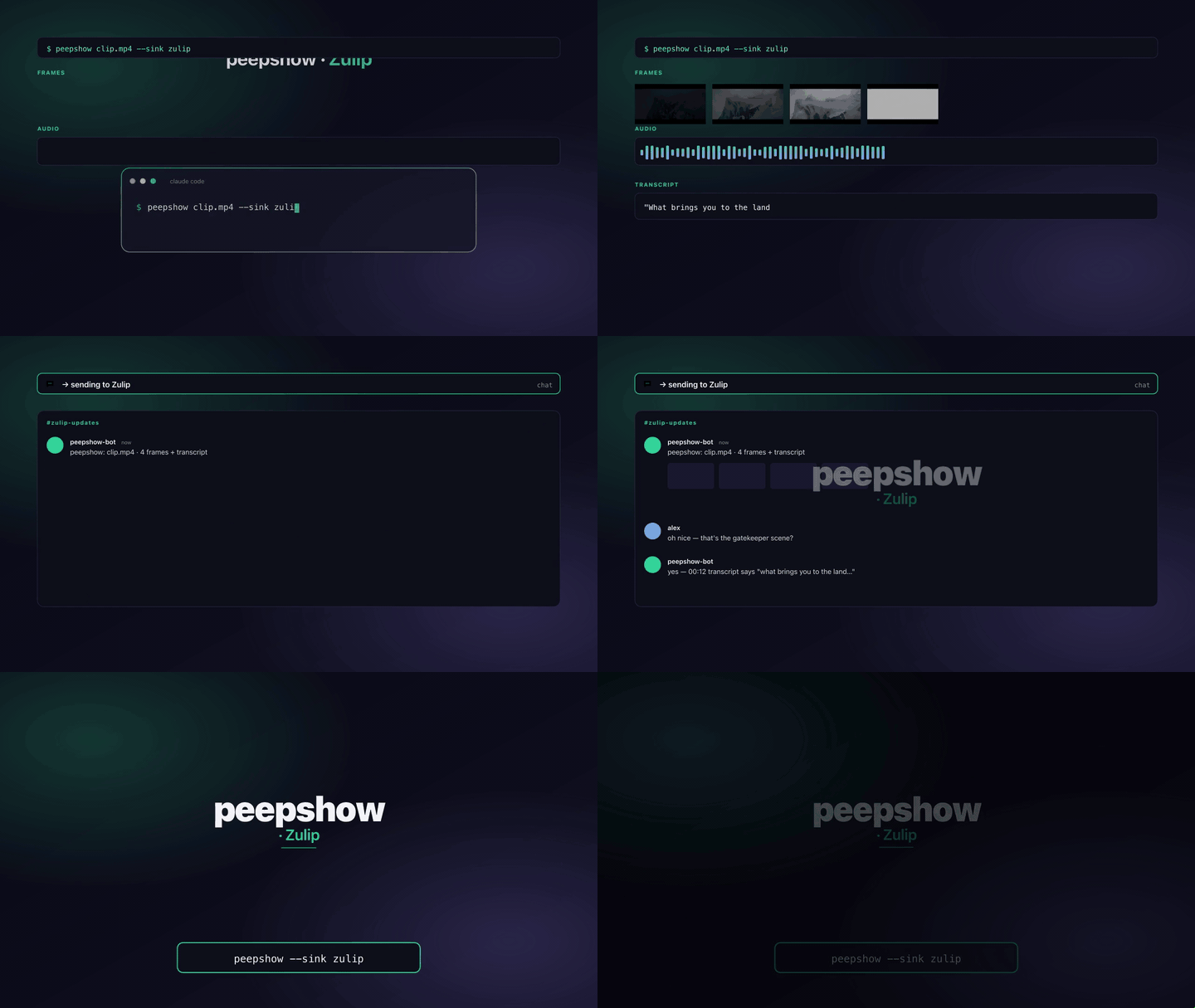
POST a peepshow run as a markdown message to a Zulip stream topic (or
private DM) via `/api/v1/messages`. The body is form-encoded
(`application/x-www-form-urlencoded`) and authed with Basic
`email:api_key`.
Message body shows the title, a single-line summary
(`N frames · strategy=… · codec=…`), optional metadata lines
(Duration / Resolution / Director / Studio), then either embedded
images (when `ZULIP_IMAGE_BASE` is set) or a bullet list of frame paths.
## Configuration
| Env | Required | Default | Purpose |
|-----|----------|---------|---------|
| `ZULIP_SITE` | ✓ | — | Org URL, e.g. `https://myorg.zulipchat.com`. Trailing slashes are stripped. |
| `ZULIP_EMAIL` | ✓ | — | Bot email (Basic auth user). |
| `ZULIP_API_KEY` | ✓ | — | Bot API key (Basic auth password). |
| `ZULIP_STREAM` | ✓ | — | Stream name (`type=stream`) **or** comma-separated list of emails (`type=private`). |
| `ZULIP_TOPIC` | | `peepshow` | Topic name for stream messages. Ignored when `type=private`. |
| `ZULIP_TYPE` | | `stream` | `stream` or `private`. |
| `ZULIP_IMAGE_BASE` | | — | URL prefix — each frame embeds as `` up to `ZULIP_MAX_IMAGES`. Leave unset if frames aren't served publicly. |
| `ZULIP_MAX_IMAGES` | | `8` | Cap on embedded images. |
## Exit codes
| 0 | Message posted (`result: success`). |
| 2 | Missing required env var. |
| 4 | stdin malformed. |
| 5 | Zulip returned non-2xx, or 200 with `result: error`. |
## Use with an LLM agent
Every peepshow sink is a zero-config extension point for any LLM CLI —
Claude Code, Cursor, Windsurf, Codex, Gemini, or any agent that can shell
out. The LLM doesn't need a plugin; it just needs `peepshow` on `PATH` and
the sink's env vars in the shell it runs under.
### 1. Set the environment
Add the sink's required env vars to your shell rc (`~/.zshrc`,
`~/.bashrc`, PowerShell profile) or a project-local `.env` that your
agent tooling loads. Example:
```sh
export ZULIP_SITE="https://example.com"
export ZULIP_EMAIL="you@example.com"
export ZULIP_API_KEY="…"
export ZULIP_STREAM="your-value"
```
### 2. Register as an auto-sink
Auto-sinks fire on every `peepshow` run without per-invocation flags,
so the LLM doesn't have to remember a pipeline — the routing is
declarative:
```sh
peepshow sinks add zulip
# Optional: only fire for matching inputs
peepshow sinks add zulip --when extension=mp4,mov
peepshow sinks add zulip --when studio=Pixar
```
See [`peepshow sinks`](../../docs/PLUGINS.md) for the full matching
vocabulary.
### 3. An LLM session, end-to-end
> **You**: drop a `clip.mov` into Claude Code (or ask
> "what's in ~/bugs/crash.mov?")
>
> **Claude Code**: the `UserPromptSubmit` hook detects the video and
> auto-invokes `/peepshow:slides ~/bugs/crash.mov`. peepshow extracts
> frames + audio, transcribes locally if `whisper.cpp` is on `PATH`,
> then forwards the run to the `Zulip` sink.
>
> **`Zulip`**: sends a markdown message addressed to a stream topic or DM with optional inline frame embeds.
>
> **Claude Code**: reads the frames back as images, combines them with
> the audio transcript, and writes a summary that references the
> downstream record.
### 4. What the sink sees
The sink receives the complete `--emit json` payload on stdin — not just
the frame paths. That includes:
- `video` — codec, duration, resolution, container tags (director / studio
/ title etc).
- `frames[]` — every extracted frame path + byte size.
- `audio` — `path`, `durationSeconds`, codec, loudness peak, silence
ratio.
- `audio.transcript` — `segments[]` with timestamps, full `text`,
language — populated when transcription is enabled (v0.4.0+).
- `extraction` — strategy, thresholds, ffmpeg path used.
> **Transcript handling**: the transcript snippet is posted alongside the frames as a secondary message in the thread.