# peepshow-sink-letta
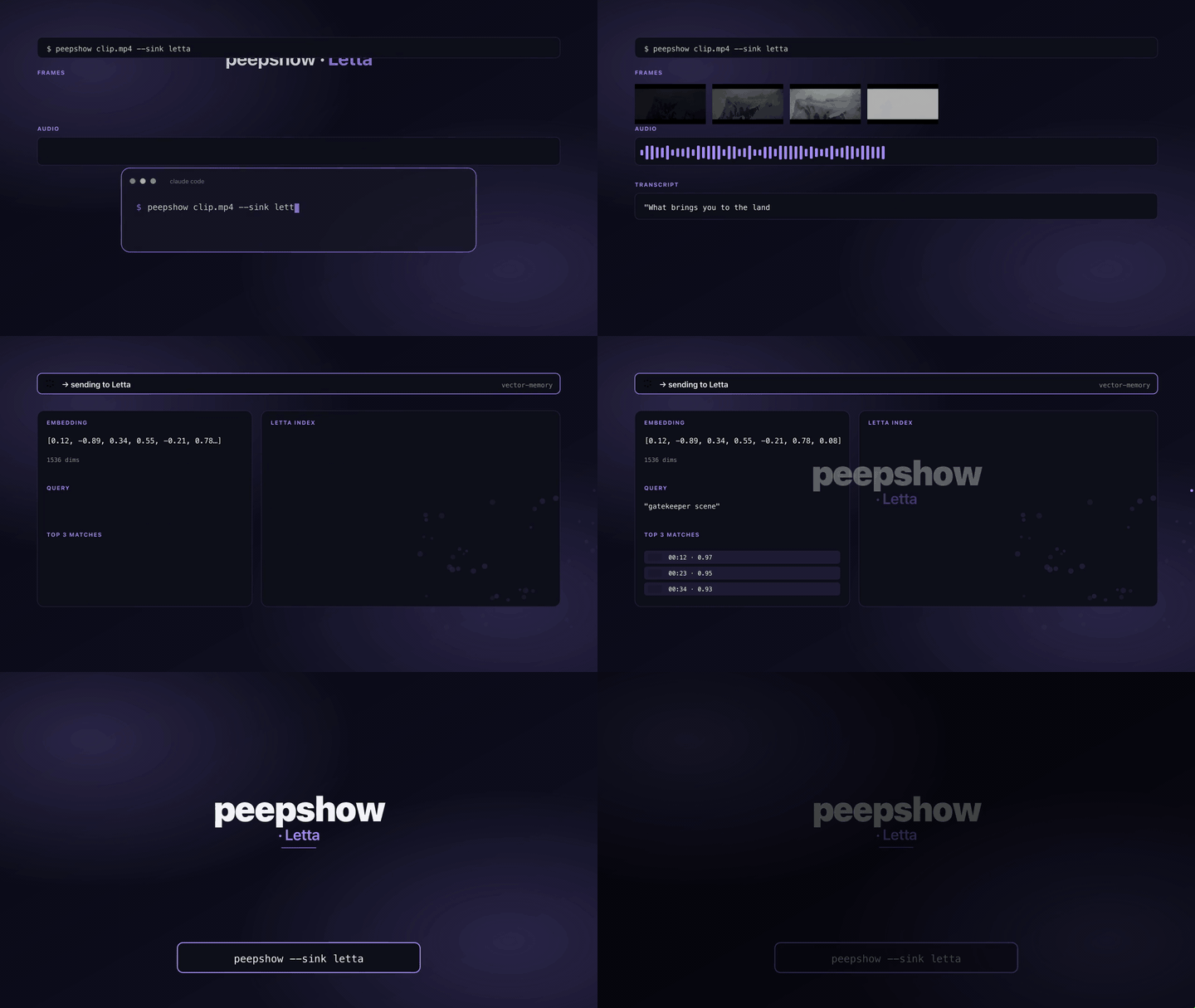
Post a peepshow run summary to a [Letta](https://letta.com) (formerly MemGPT)
agent's inbox as a single user message. The agent's built-in memory pipeline
distils the message into recall memory so it can answer questions about the
run later.
Works with Letta Cloud and self-hosted deployments.
## Install
Ships built-in — the bin lands on PATH after `npm i -g peepshow`.
## Invocation
```bash
peepshow ./bug-repro.mov --sink letta
```
## Configuration
| Env | Required | Default | Purpose |
|-----|----------|---------|---------|
| `LETTA_BASE_URL` | ✓ | — | Base URL, e.g. `https://app.letta.com` (cloud) or `http://localhost:8283` (self-hosted). Trailing slashes are stripped. |
| `LETTA_AGENT_ID` | ✓ | — | Target agent id the message is posted to. |
| `LETTA_API_KEY` | | (none) | Bearer token. **Required for Letta Cloud**; optional for self-hosted. |
## Message shape
The sink posts a single user-role message to
`POST /v1/agents//messages`:
```
peepshow run:
Summary:
- <N> frames extracted (<strategy> strategy)
- Codec: <codec>
- Duration: <N>s (when known)
- Resolution: <WxH> (when known)
- Director: <director> (when tag present)
- Studio: <studio> (when tag present)
Frames (first <up to 10>):
- <frame_path_1>
- <frame_path_2>
…
(+N more) (only when total > 10)
Output directory: <output_dir>
```
Title falls back to `video.tags.title` → `video.tags.show` → `"peepshow run"`.
## Exit codes
| Code | Meaning |
|------|---------|
| 0 | Message accepted. |
| 2 | Missing `LETTA_BASE_URL` / `LETTA_AGENT_ID`. |
| 4 | stdin malformed / empty. |
| 5 | Letta returned non-2xx. |
## Use with an LLM agent
Every peepshow sink is a zero-config extension point for any LLM CLI —
Claude Code, Cursor, Windsurf, Codex, Gemini, or any agent that can shell
out. The LLM doesn't need a plugin; it just needs `peepshow` on `PATH` and
the sink's env vars in the shell it runs under.
### 1. Set the environment
Add the sink's required env vars to your shell rc (`~/.zshrc`,
`~/.bashrc`, PowerShell profile) or a project-local `.env` that your
agent tooling loads. Example:
```sh
export LETTA_BASE_URL="https://example.com"
export LETTA_AGENT_ID="your-value"
```
### 2. Register as an auto-sink
Auto-sinks fire on every `peepshow` run without per-invocation flags,
so the LLM doesn't have to remember a pipeline — the routing is
declarative:
```sh
peepshow sinks add letta
# Optional: only fire for matching inputs
peepshow sinks add letta --when extension=mp4,mov
peepshow sinks add letta --when genre=tutorial
```
See [`peepshow sinks`](../../docs/PLUGINS.md) for the full matching
vocabulary.
### 3. An LLM session, end-to-end
> **You**: drop a `clip.mov` into Claude Code (or ask
> "what's in ~/bugs/crash.mov?")
>
> **Claude Code**: the `UserPromptSubmit` hook detects the video and
> auto-invokes `/peepshow:slides ~/bugs/crash.mov`. peepshow extracts
> frames + audio, transcribes locally if `whisper.cpp` is on `PATH`,
> then forwards the run to the `Letta` sink.
>
> **`Letta`**: posts a concise run summary as one user message to a Letta (MemGPT) agent so its memory pipeline distils it into recall memory.
>
> **Claude Code**: reads the frames back as images, combines them with
> the audio transcript, and writes a summary that references the
> downstream record.
### 4. What the sink sees
The sink receives the complete `--emit json` payload on stdin — not just
the frame paths. That includes:
- `video` — codec, duration, resolution, container tags (director / studio
/ title etc).
- `frames[]` — every extracted frame path + byte size.
- `audio` — `path`, `durationSeconds`, codec, loudness peak, silence
ratio.
- `audio.transcript` — `segments[]` with timestamps, full `text`,
language — populated when transcription is enabled (v0.4.0+).
- `extraction` — strategy, thresholds, ffmpeg path used.
> **Transcript handling**: the transcript text is a natural embedding target — indexed alongside the frames so later retrieval covers spoken content too.