# peepshow-sink-graphql
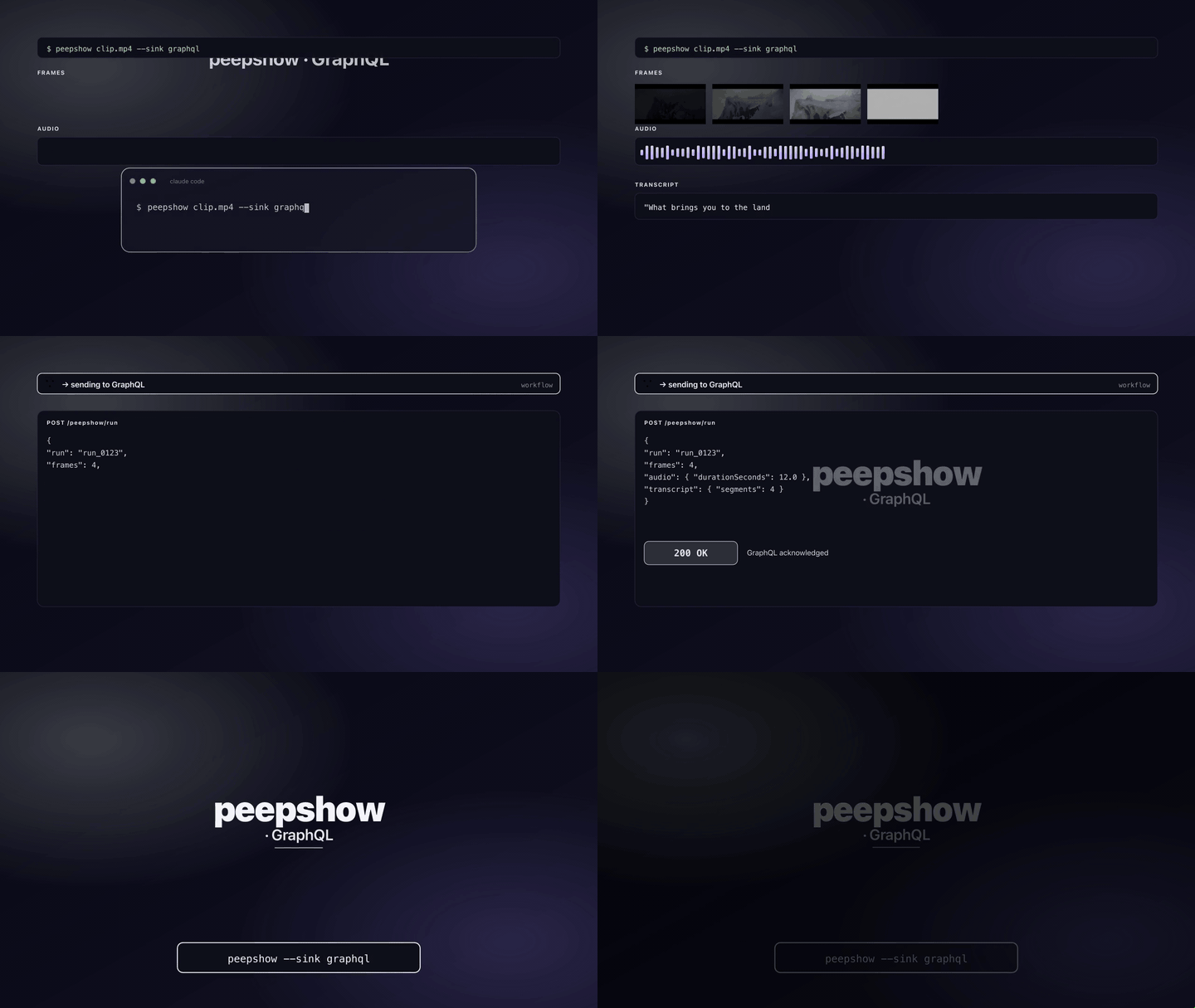
POSTs a GraphQL mutation with the peepshow payload to any GraphQL endpoint. Default mutation targets a schema with `recordPeepshowRun(input: PeepshowRunInput!)` — override for your own schema.
## Config
| Env var | Required | Default | Purpose |
| :------ | :------- | :------ | :------ |
| `PEEPSHOW_GRAPHQL_URL` | yes | — | endpoint URL |
| `PEEPSHOW_GRAPHQL_AUTH` | no | — | full `Authorization` header, verbatim |
| `PEEPSHOW_GRAPHQL_MUTATION` | no | built-in | mutation string; variable is `$input: !` |
| `PEEPSHOW_GRAPHQL_OP_NAME` | no | — | `operationName` if your API distinguishes operations |
## Use
Default mutation (your schema must have `recordPeepshowRun`):
```bash
export PEEPSHOW_GRAPHQL_URL="https://api.example/graphql"
export PEEPSHOW_GRAPHQL_AUTH="Bearer sk-live-xxx"
peepshow sinks add graphql
```
Custom mutation:
```bash
export PEEPSHOW_GRAPHQL_MUTATION='mutation Save($input: VideoRunIn!) { videoRuns { insert(object: $input) { id } } }'
export PEEPSHOW_GRAPHQL_OP_NAME=Save
```
## Request shape
```json
POST
Content-Type: application/json
Authorization:
{
"query": "",
"variables": { "input": { "outputDir": "...", "strategy": "scene", "frames": [...], "video": {...}, "extraction": {...} } },
"operationName": ""
}
```
## Hasura / PostgREST compatibility
Hasura, Supabase, PostGraphile, and similar tools autogenerate CRUD mutations. Example Hasura-style:
```graphql
mutation Save($input: peepshow_runs_insert_input!) {
insert_peepshow_runs_one(object: $input) {
id
}
}
```
## Caveats
- GraphQL errors are reported and the sink exits non-zero even when HTTP 200 (most servers return 200 for logical errors).
- No batching; one POST per peepshow run.
## Use with an LLM agent
Every peepshow sink is a zero-config extension point for any LLM CLI —
Claude Code, Cursor, Windsurf, Codex, Gemini, or any agent that can shell
out. The LLM doesn't need a plugin; it just needs `peepshow` on `PATH` and
the sink's env vars in the shell it runs under.
### 1. Set the environment
Add the sink's required env vars to your shell rc (`~/.zshrc`,
`~/.bashrc`, PowerShell profile) or a project-local `.env` that your
agent tooling loads. Example:
```sh
export PEEPSHOW_GRAPHQL_URL="https://example.com"
```
### 2. Register as an auto-sink
Auto-sinks fire on every `peepshow` run without per-invocation flags,
so the LLM doesn't have to remember a pipeline — the routing is
declarative:
```sh
peepshow sinks add graphql
# Optional: only fire for matching inputs
peepshow sinks add graphql --when extension=mp4,mov
peepshow sinks add graphql --when director=Kubrick
```
See [`peepshow sinks`](../../docs/PLUGINS.md) for the full matching
vocabulary.
### 3. An LLM session, end-to-end
> **You**: drop a `clip.mov` into Claude Code (or ask
> "what's in ~/bugs/crash.mov?")
>
> **Claude Code**: the `UserPromptSubmit` hook detects the video and
> auto-invokes `/peepshow:slides ~/bugs/crash.mov`. peepshow extracts
> frames + audio, transcribes locally if `whisper.cpp` is on `PATH`,
> then forwards the run to the `GraphQL` sink.
>
> **`GraphQL`**: fires a parameterised GraphQL mutation with the peepshow payload as variables.
>
> **Claude Code**: reads the frames back as images, combines them with
> the audio transcript, and writes a summary that references the
> downstream record.
### 4. What the sink sees
The sink receives the complete `--emit json` payload on stdin — not just
the frame paths. That includes:
- `video` — codec, duration, resolution, container tags (director / studio
/ title etc).
- `frames[]` — every extracted frame path + byte size.
- `audio` — `path`, `durationSeconds`, codec, loudness peak, silence
ratio.
- `audio.transcript` — `segments[]` with timestamps, full `text`,
language — populated when transcription is enabled (v0.4.0+).
- `extraction` — strategy, thresholds, ffmpeg path used.
> **Transcript handling**: the transcript rides along inside the JSON payload your downstream consumer receives.