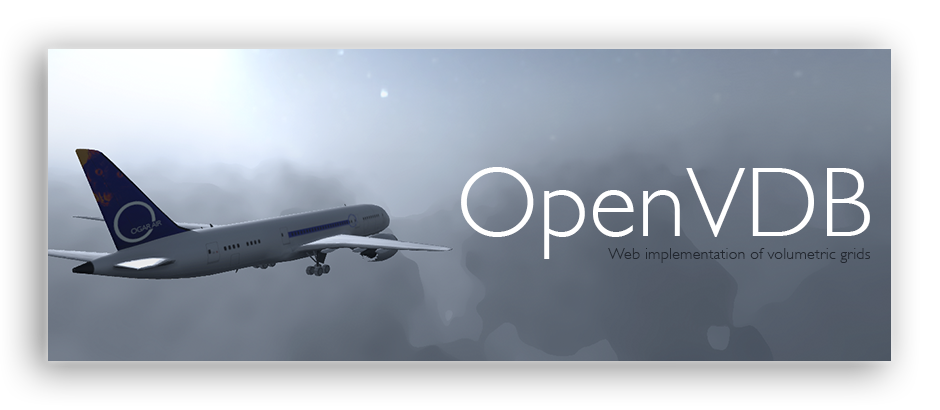
 # OpenVDB
This project indirectly ports OpenVDB file format and tools to JavaScript, TypeScript, and Node.
Specific 3D library implementations can be found in sub-directories.
## What is OpenVDB
VDB is a volumetric data format originally implemented in C++ ([AcademySoftwareFoundation/openvdb](https://github.com/AcademySoftwareFoundation/openvdb).) It allows to efficiently store voxel structures of this like smoke, fire, and fluid simulations - as well as normal 3D models converted to voxels.
Keep in mind that, due to memory-access and multithreading limitations of JS, this repo may be more similar to a read-only [NanoVDB](https://github.com/AcademySoftwareFoundation/openvdb/tree/master/nanovdb/nanovdb), instead of the original OpenVDB. Code is nevertheless based on original [OpenVDB](https://github.com/AcademySoftwareFoundation/openvdb/tree/master/openvdb/openvdb).
## Usage
### With `three.js`:
```js
import * as Three from 'three';
import * as OpenVDB from 'openvdb/three';
const scene = new Three.Scene();
// NOTE To load an existing VDB model - use VDBLoader:
new OpenVDB.VDBLoader().load('./assets/bunny.vdb', function (vdb) {
const fogVolume = new OpenVDB.FogVolume(vdb, {
resolution: 100,
progressive: true,
steps: 20,
absorbance: 1.0,
baseColor: 0xff00ff,
});
scene.add(fogVolume);
});
// NOTE To create a primitive volumetric shape - use volume converters directly:
const primitiveVolume = new OpenVDB.SphereVolume();
const fogPrimitive = new OpenVDB.FogVolume(primitiveVolume, {
resolution: 50,
progressive: false,
steps: 50,
absorbance: 0.5,
baseColor: 0xff00ff,
});
scene.add(fogPrimitive);
```
### With `react-three-fiber`:
```jsx
import * as Three from 'three';
import * as OpenVDB from 'openvdb/three';
export const VDBComponent = () => {
const [model, setModel] = useState(new Three.Object3D());
useEffect(() => {
new OpenVDB.VDBLoader().load('./assets/bunny.vdb', function (vdb) {
const fogVolume = new OpenVDB.FogVolume(vdb, {
resolution: 100,
progressive: true,
steps: 20,
absorbance: 1.0,
baseColor: 0xff00ff,
});
setModel(fogVolume);
});
return () => {
fogVolume.dispose();
};
}, []);
return ;
};
```
### Without library:
```js
import * as OpenVDB from 'openvdb';
const vdbReader = await OpenVDB.loadVDB('./assets/bunny.vdb');
vdbReader.grids.forEach(function (grid) {
const voxelValue = grid.getValue({ x: 0.0, y: 0.0, z: 1.0 });
});
```
## Docs
### loadVDB
- `loadVDB( url ): Promise`
Loads OpenVDB file and parses its grids. Grids can be accessed via `.grids` property of the value returned from the Promise.
Each grid has a `.getValue( position: Three.Vector3 ): float` method, which returns a voxel value for the given position. See `src/openvdb/three/VolumeToFog.js` for an example of VDB file parsing.
---
### VDBLoader
- `VDBLoader( manager: Three.LoadingManager )`
- `VDBLoader.load( url, onLoad, onProgress, onError ): void`
Loads VDB model. onLoad is called when VDB is loaded and parsed. onError is called when error happens. onProgress is currently not used.
---
### VolumeToBbox
- `VolumeToBbox( vdb: OpenVDB.OpenVDBReader | OpenVDB.GridDescriptor | Array ): Three.Object3D`
Converts given `OpenVDBReader` to `Three.Object3D`. Resulting object consists of wireframe bounding boxes of all internal nodes within the given VDB. If multiple grids are given - each grid is drawn in a different wireframe color.
---
### VolumeToFog
- `VolumeToFog( vdb: OpenVDB.OpenVDBReader | OpenVDB.GridDescriptor | Array, { resolution, steps, progressive, absorbance, opacity, radius, baseColor }, onConverted: () => void, onProgress: ({ convertedVoxels, totalVoxels, convertedGrids, totalGrids }) => void ): Three.Object3D`
Converts given `OpenVDBReader` to a volumetric `Three.Object3D`. `onConverted` and `onProgress` are called as the VDB is converted to a fog. Most importantly:
* `resolution: number` - (required) resolution of the resulting 3D texture. Keep in mind this will be risen to the power of 3 - so resolution 200 results in 8 million voxels.
* `steps: number` - (default: 100) detail of the resulting fog volume. High amount of steps combined with large amount of lights in the scene may decrease performance significantly.
* `progressive: boolean` - set to `true` to render the fog on-the-go as it is being parsed, while preserving 60fps.
* `absorbance: number` - (default: `1.0`) `1.0` means fog absorbs all the light going through it, lower values all light to partially traverse through the fog.
* `densityScale: number` - scales density of the entire grid.
* `densityCutoff: number` - defines sharpness of the shape.
* `opacity: number` - alpha opacity of the fog (doesn't affect light calculations.)
* `baseColor: Three.Color | string | number` - (default: `0x000000`) albedo color of the fog volume.
* `emissiveGrid` - VDB emission grid.
* `baseColorGrid` - VDB grid equivalent of `baseColor`.
* `maskGrid` - static VDB grid mask applied to each voxel. Not affected by UV offset.
* `lights` - bitmask of light types affecting the volume (`lights.useDirectionalLights | lights.usePointLights | lights.useSpotLights | lights.useHemisphereLights | lights.useEnvironment`)
---
### VolumeToLevelSet
- `VolumeToLevelSet( vdb: OpenVDB.OpenVDBReader | OpenVDB.GridDescriptor | Array, onConverted: () => void, onProgress: () => void ): Three.Object3D`
Not yet finished. Converts the given `OpenVDBReader` to a 3D mesh using marching cubes.
---
### CubeVolume
- `CubeVolume(): OpenVDB.GridDescriptor`
Generates a 1x1x1 volumetric cube.
---
### SphereVolume
- `SphereVolume(): OpenVDB.GridDescriptor`
Generates a 1x1x1 volumetric sphere.
---
### CloudVolume
- `CloudVolume( { height: number, density: number } ): OpenVDB.GridDescriptor`
Generates a 1x1x1 volumetric clouds based on noise inputs.
---
### ParametricVolume
- `ParametricVolume( valueFunction(position: Three.Vector3) => number ): OpenVDB.GridDescriptor`
Generates a 1x1x1 volume with values defined using a `valueFunction`. `valueFunction` is called with position of each voxel within the volumetric bounding cube - and expects a value between `0.0` and `1.0` to be returned (`0.0` meaning given voxel is fully transparent, `1.0` meaning given voxel is fully opaque.)
---
## Current Feature Support
Based on files hosted on [https://www.openvdb.org/download/](https://www.openvdb.org/download/).
| Model | Support | Notes |
| -------------------- | ---------- | ------------------------------------------------------------- |
| armadillo.vdb | ✅ Yes | |
| buddha.vdb | ✅ Yes | |
| bunny.vdb | ✅ Yes | |
| bunny_cloud.vdb | ✅ Yes | |
| crawler.vdb | ❓ Partial | Exceeds memory limits |
| cube.vdb | ✅ Yes | |
| dragon.vdb | ✅ Yes | |
| emu.vdb | ✅ Yes | |
| explosion.vdb | ✅ Yes | |
| fire.vdb | ✅ Yes | |
| icosahedron.vdb | ✅ Yes | |
| iss.vdb | ✅ Yes | |
| smoke1.vdb | ✅ Yes | |
| smoke2.vdb | ✅ Yes | |
| space.vdb | ❓ Partial | Exceeds memory limits |
| sphere.vdb | ✅ Yes | |
| torus.vdb | ✅ Yes | |
| torus_knot.vdb | ✅ Yes | |
| utahteapot.vdb | ✅ Yes | |
| venusstatue.vdb | ✅ Yes | |
| boat_points.vdb | ❓ Partial | Loads ok, points rendering not fully implemented |
| bunny_points.vdb | ❓ Partial | Loads ok, points rendering not fully implemented |
| sphere_points.vdb | ❓ Partial | Loads ok, points rendering not fully implemented |
| waterfall_points.vdb | ❓ Partial | Loads ok, points rendering not fully implemented |
## Development
```
git clone https://github.com/mjurczyk/openvdb
cd ./openvdb
npm run i
npm run dev
```
## Credits
To avoid re-coding same things over again, parts of the library may be based / taken directly from the following:
- [gkjohnson/three-mesh-bvh](https://github.com/gkjohnson/three-mesh-bvh): BVH implementation
- [manzt/numcodecs.js](https://github.com/manzt/numcodecs.js/): BLOSC & ZLIB compression
- [nodeca/pako](https://github.com/issues): ZLIB compression
Be sure to ⭐️ those!
# OpenVDB
This project indirectly ports OpenVDB file format and tools to JavaScript, TypeScript, and Node.
Specific 3D library implementations can be found in sub-directories.
## What is OpenVDB
VDB is a volumetric data format originally implemented in C++ ([AcademySoftwareFoundation/openvdb](https://github.com/AcademySoftwareFoundation/openvdb).) It allows to efficiently store voxel structures of this like smoke, fire, and fluid simulations - as well as normal 3D models converted to voxels.
Keep in mind that, due to memory-access and multithreading limitations of JS, this repo may be more similar to a read-only [NanoVDB](https://github.com/AcademySoftwareFoundation/openvdb/tree/master/nanovdb/nanovdb), instead of the original OpenVDB. Code is nevertheless based on original [OpenVDB](https://github.com/AcademySoftwareFoundation/openvdb/tree/master/openvdb/openvdb).
## Usage
### With `three.js`:
```js
import * as Three from 'three';
import * as OpenVDB from 'openvdb/three';
const scene = new Three.Scene();
// NOTE To load an existing VDB model - use VDBLoader:
new OpenVDB.VDBLoader().load('./assets/bunny.vdb', function (vdb) {
const fogVolume = new OpenVDB.FogVolume(vdb, {
resolution: 100,
progressive: true,
steps: 20,
absorbance: 1.0,
baseColor: 0xff00ff,
});
scene.add(fogVolume);
});
// NOTE To create a primitive volumetric shape - use volume converters directly:
const primitiveVolume = new OpenVDB.SphereVolume();
const fogPrimitive = new OpenVDB.FogVolume(primitiveVolume, {
resolution: 50,
progressive: false,
steps: 50,
absorbance: 0.5,
baseColor: 0xff00ff,
});
scene.add(fogPrimitive);
```
### With `react-three-fiber`:
```jsx
import * as Three from 'three';
import * as OpenVDB from 'openvdb/three';
export const VDBComponent = () => {
const [model, setModel] = useState(new Three.Object3D());
useEffect(() => {
new OpenVDB.VDBLoader().load('./assets/bunny.vdb', function (vdb) {
const fogVolume = new OpenVDB.FogVolume(vdb, {
resolution: 100,
progressive: true,
steps: 20,
absorbance: 1.0,
baseColor: 0xff00ff,
});
setModel(fogVolume);
});
return () => {
fogVolume.dispose();
};
}, []);
return ;
};
```
### Without library:
```js
import * as OpenVDB from 'openvdb';
const vdbReader = await OpenVDB.loadVDB('./assets/bunny.vdb');
vdbReader.grids.forEach(function (grid) {
const voxelValue = grid.getValue({ x: 0.0, y: 0.0, z: 1.0 });
});
```
## Docs
### loadVDB
- `loadVDB( url ): Promise`
Loads OpenVDB file and parses its grids. Grids can be accessed via `.grids` property of the value returned from the Promise.
Each grid has a `.getValue( position: Three.Vector3 ): float` method, which returns a voxel value for the given position. See `src/openvdb/three/VolumeToFog.js` for an example of VDB file parsing.
---
### VDBLoader
- `VDBLoader( manager: Three.LoadingManager )`
- `VDBLoader.load( url, onLoad, onProgress, onError ): void`
Loads VDB model. onLoad is called when VDB is loaded and parsed. onError is called when error happens. onProgress is currently not used.
---
### VolumeToBbox
- `VolumeToBbox( vdb: OpenVDB.OpenVDBReader | OpenVDB.GridDescriptor | Array ): Three.Object3D`
Converts given `OpenVDBReader` to `Three.Object3D`. Resulting object consists of wireframe bounding boxes of all internal nodes within the given VDB. If multiple grids are given - each grid is drawn in a different wireframe color.
---
### VolumeToFog
- `VolumeToFog( vdb: OpenVDB.OpenVDBReader | OpenVDB.GridDescriptor | Array, { resolution, steps, progressive, absorbance, opacity, radius, baseColor }, onConverted: () => void, onProgress: ({ convertedVoxels, totalVoxels, convertedGrids, totalGrids }) => void ): Three.Object3D`
Converts given `OpenVDBReader` to a volumetric `Three.Object3D`. `onConverted` and `onProgress` are called as the VDB is converted to a fog. Most importantly:
* `resolution: number` - (required) resolution of the resulting 3D texture. Keep in mind this will be risen to the power of 3 - so resolution 200 results in 8 million voxels.
* `steps: number` - (default: 100) detail of the resulting fog volume. High amount of steps combined with large amount of lights in the scene may decrease performance significantly.
* `progressive: boolean` - set to `true` to render the fog on-the-go as it is being parsed, while preserving 60fps.
* `absorbance: number` - (default: `1.0`) `1.0` means fog absorbs all the light going through it, lower values all light to partially traverse through the fog.
* `densityScale: number` - scales density of the entire grid.
* `densityCutoff: number` - defines sharpness of the shape.
* `opacity: number` - alpha opacity of the fog (doesn't affect light calculations.)
* `baseColor: Three.Color | string | number` - (default: `0x000000`) albedo color of the fog volume.
* `emissiveGrid` - VDB emission grid.
* `baseColorGrid` - VDB grid equivalent of `baseColor`.
* `maskGrid` - static VDB grid mask applied to each voxel. Not affected by UV offset.
* `lights` - bitmask of light types affecting the volume (`lights.useDirectionalLights | lights.usePointLights | lights.useSpotLights | lights.useHemisphereLights | lights.useEnvironment`)
---
### VolumeToLevelSet
- `VolumeToLevelSet( vdb: OpenVDB.OpenVDBReader | OpenVDB.GridDescriptor | Array, onConverted: () => void, onProgress: () => void ): Three.Object3D`
Not yet finished. Converts the given `OpenVDBReader` to a 3D mesh using marching cubes.
---
### CubeVolume
- `CubeVolume(): OpenVDB.GridDescriptor`
Generates a 1x1x1 volumetric cube.
---
### SphereVolume
- `SphereVolume(): OpenVDB.GridDescriptor`
Generates a 1x1x1 volumetric sphere.
---
### CloudVolume
- `CloudVolume( { height: number, density: number } ): OpenVDB.GridDescriptor`
Generates a 1x1x1 volumetric clouds based on noise inputs.
---
### ParametricVolume
- `ParametricVolume( valueFunction(position: Three.Vector3) => number ): OpenVDB.GridDescriptor`
Generates a 1x1x1 volume with values defined using a `valueFunction`. `valueFunction` is called with position of each voxel within the volumetric bounding cube - and expects a value between `0.0` and `1.0` to be returned (`0.0` meaning given voxel is fully transparent, `1.0` meaning given voxel is fully opaque.)
---
## Current Feature Support
Based on files hosted on [https://www.openvdb.org/download/](https://www.openvdb.org/download/).
| Model | Support | Notes |
| -------------------- | ---------- | ------------------------------------------------------------- |
| armadillo.vdb | ✅ Yes | |
| buddha.vdb | ✅ Yes | |
| bunny.vdb | ✅ Yes | |
| bunny_cloud.vdb | ✅ Yes | |
| crawler.vdb | ❓ Partial | Exceeds memory limits |
| cube.vdb | ✅ Yes | |
| dragon.vdb | ✅ Yes | |
| emu.vdb | ✅ Yes | |
| explosion.vdb | ✅ Yes | |
| fire.vdb | ✅ Yes | |
| icosahedron.vdb | ✅ Yes | |
| iss.vdb | ✅ Yes | |
| smoke1.vdb | ✅ Yes | |
| smoke2.vdb | ✅ Yes | |
| space.vdb | ❓ Partial | Exceeds memory limits |
| sphere.vdb | ✅ Yes | |
| torus.vdb | ✅ Yes | |
| torus_knot.vdb | ✅ Yes | |
| utahteapot.vdb | ✅ Yes | |
| venusstatue.vdb | ✅ Yes | |
| boat_points.vdb | ❓ Partial | Loads ok, points rendering not fully implemented |
| bunny_points.vdb | ❓ Partial | Loads ok, points rendering not fully implemented |
| sphere_points.vdb | ❓ Partial | Loads ok, points rendering not fully implemented |
| waterfall_points.vdb | ❓ Partial | Loads ok, points rendering not fully implemented |
## Development
```
git clone https://github.com/mjurczyk/openvdb
cd ./openvdb
npm run i
npm run dev
```
## Credits
To avoid re-coding same things over again, parts of the library may be based / taken directly from the following:
- [gkjohnson/three-mesh-bvh](https://github.com/gkjohnson/three-mesh-bvh): BVH implementation
- [manzt/numcodecs.js](https://github.com/manzt/numcodecs.js/): BLOSC & ZLIB compression
- [nodeca/pako](https://github.com/issues): ZLIB compression
Be sure to ⭐️ those!