# OpenMate (`om`)
 [](https://github.com/vivekvpai/OpenMate)
[](https://www.npmjs.com/package/openmate)
[](https://www.npmjs.com/package/openmate)
[](https://github.com/vivekvpai/OpenMate)
[](https://github.com/vivekvpai/OpenMate/blob/main/LICENSE)
A fast and friendly CLI tool to manage and open your local repositories in **VS Code**, **Windsurf**, **Cursor**, **Antigravity**, **IntelliJ IDEA**, or **PyCharm** with quick shortcuts. Perfect for developers who frequently switch between projects.
> **Note:** In this context, **repository** refers to your **local project folder** stored on your computer, not remote (GitHub/GitLab/Bitbucket) repositories.
## Table of Contents
- [Table of Contents](#table-of-contents)
- [OpenMate CLI](#openmate-cli)
- [📦 Installation](#📦-installation)
- [⚡ Usage](#⚡-usage)
- [📌 Notes & OS Compatibility](#📌-notes--os-compatibility)
- [MCP](#mcp)
- [OpenMate UI](#openmate-ui)
---
# OpenMate CLI
## 📌 Notes & OS Compatibility
- Supported editors: **VS Code**, **Windsurf**, **Cursor**, **IntelliJ IDEA**, **PyCharm** and **Antigravity**.
- On **Windows**, use double quotes for paths.
---
## 📦 Installation
Install globally via **npm**:
```bash
npm install -g openmate
```
Verify installation:
```bash
om --version
```
---
## ⚡ Usage
### **Available Commands**
#### Repository Management
```
om init Initialize current directory as a repository
om add "" Add a repo (no duplicate names)
om update "" Update stored path for existing name
om remove Remove stored repo
om ide Set preferred IDE (vs, ws, cs, ij, pc, ag)
om list List all stored repos
om path Print the stored path
```
### **Examples**
#### Initialize Current Directory as a Repository
Navigate to your project directory and run:
```bash
om init repo1
```
**Output:**
```
✅ Added "repo1" -> C:/Projects/repo1
```
Now you can open this repository in your default editor using:
```bash
om vs repo1 # Opens in VS Code
# or
om ws repo1 # Opens in Windsurf
```
#### Collection Management
```
om add -c Add/update a collection of repos
om update -c Update a collection's repos
om remove -c Remove a collection
om list -c List all collections
om list Show details of a specific collection
```
#### Open Repositories/Collections
```
om vs Open repo/collection in VS Code
om ws Open repo/collection in Windsurf
om cs Open repo/collection in Cursor
om ij Open repo/collection in IntelliJ IDEA
om pc Open repo/collection in PyCharm
om ag Open repo/collection in Antigravity
om -d Open repo/collection in LOCAL preferred IDE (falls back to global)
om Open repo/collection in GLOBAL preferred IDE (falls back to local)
```
---
### **Examples**
Below are some practical examples of how to use **OpenMate** for managing repositories and collections.
---
#### ✅ **Basic Repository Usage**
A **repository** is a single project folder on your local machine. You can add, update, remove, and open repositories using short commands.
```bash
# Add a repository with a short name (alias)
om add ""
# Open the repository in VS Code
om vs
# Open the repository in Windsurf
om ws
# Open the repository in Cursor
om cs
# Open the repository in IntelliJ IDEA
om ij
# Open the repository in PyCharm
om pc
# Open the repository in Antigravity
om ag
```
**Update or remove a repository:**
```bash
# Update the path of an existing repository
om update ""
# Remove the repository
om remove
```
#### ✅ **Preferred IDE**
You can set a preferred IDE for any repository or collection. This allows you to open it directly without specifying the editor every time.
**Set a preferred IDE:**
```bash
om ide vs # Set VS Code as default
om ide ws # Set Windsurf as default
```
**Open in preferred IDE:**
Once a preferred IDE is set, you can use either of these commands:
Once a preferred IDE is set (locally or via global `ide_default`), you can use:
```bash
# Prioritizes GLOBAL default (if set), then falls back to local preference
om
# Prioritizes LOCAL preference (if set), then falls back to global default
om -d
# Explicitly open in a specific IDE
om vs
om ws
om cs
om ij
om pc
om ag
```
If no preferred IDE is found (neither local nor global), OpenMate will warn you and show usage instructions.
---
#### ✅ **Listing Repositories and Collections**
Use the `list` command to view repositories and collections:
```bash
# List all repositories and collections
om list
# List only repositories
om list -r
# List only collections
om list -c
```
View details of a specific collection:
```bash
om list
# Example Output:
# ✅ Collection "":
# repo1, repo2, repo3
```
If the collection doesn’t exist:
```bash
om list
# Output:
# ❌ Collection "" not found.
# Available collections:
# 1. frontend
# 2. backend
```
---
#### ✅ **Working with Collections**
A **collection** is a group of related repositories you can manage together.
**Create a collection:**
```bash
om add -c repo1,repo2,repo3,repo4
```
Here:
- `-c` indicates you are adding a collection.
- `` is the name of the collection.
- `repo1,repo2,repo3,repo4` are the repository names in the collection.
**Open all repositories in a collection:**
```bash
om vs
```
**Update a collection (add/remove repos):**
```bash
om update -c repo1,repo2,repo3,repo4,repo5
```
**List all collections:**
```bash
om list -c
```
**Remove a collection:**
```bash
om remove -c
```
---
### **Sample Outputs**
#### `om list`
When you run `om list`, it shows all stored repositories and collections:
```
Stored repos:
┌─────┬──────────┬───────────────────────────────┬─────────────┐
│ # │ Name │ Repo Path │ Default IDE │
├─────┼──────────┼───────────────────────────────┼─────────────┤
│ 1 │ repo1 │ C:\Projects\repo1 │ VS │
│ 2 │ repo2 │ C:\Projects\repo2 │ WS │
│ 3 │ repo3 │ C:\Projects\repo3 │ │
│ 4 │ repo4 │ C:\Projects\repo4 │ CS │
└─────┴──────────┴───────────────────────────────┴─────────────┘
Collections:
┌─────┬────────────────────┬──────────┬─────────────┬───────────────────────────┐
│ # │ Name │ Repos │ Default IDE │ Repository Names │
├─────┼────────────────────┼──────────┼─────────────┼───────────────────────────┤
│ 1 │ collection1 │ 2 │ VS │ repo1, repo2 │
│ 2 │ collection2 │ 2 │ │ repo3, repo4 │
└─────┴────────────────────┴──────────┴─────────────┴───────────────────────────┘
```
---
### **List Only Repositories**
```bash
om list -r
```
**Sample Output:**
```
Stored Repositories:
┌─────┬──────────┬───────────────────────────────┬─────────────┐
│ # │ Name │ Repo Path │ Default IDE │
├─────┼──────────┼───────────────────────────────┼─────────────┤
│ 1 │ repo1 │ C:\\Projects\\repo1 │ VS │
│ 2 │ repo2 │ C:\\Projects\\repo2 │ WS │
│ 3 │ repo3 │ C:\\Projects\\repo3 │ │
└─────┴──────────┴───────────────────────────────┴─────────────┘
```
---
### **List Only Collections**
```bash
om list -c
```
**Sample Output:**
```
Collections:
┌─────┬──────────────┬──────────┬─────────────┬───────────────────────────────┐
│ # │ Name │ Repos │ Default IDE │ Repository Names │
├─────┼──────────────┼──────────┼─────────────┼───────────────────────────────┤
│ 1 │ frontend │ 4 │ VS │ repo1, repo2, repo3, repo4 │
│ 2 │ backend │ 2 │ IJ │ repo5, repo6 │
└─────┴──────────────┴──────────┴─────────────┴───────────────────────────────┘
```
---
### **List a Specific Collection**
```bash
om list frontend
```
**Sample Output:**
```
Collection: frontend
Repositories:
┌─────┬──────────┬───────────────────────────────┐
│ # │ Name │ Repo Path │
├─────┼──────────┼───────────────────────────────┤
│ 1 │ repo1 │ C:\\Projects\\repo1 │
│ 2 │ repo2 │ C:\\Projects\\repo2 │
│ 3 │ repo3 │ C:\\Projects\\repo3 │
│ 4 │ repo4 │ C:\\Projects\\repo4 │
└─────┴──────────┴───────────────────────────────┘
```
---
### **Smart Suggestions**
When you type a partial repository or collection name, OpenMate will show you matching suggestions:
```bash
om ws st
```
**Sample Output:**
```
❌ No exact match for "st". Did you mean one of these?
Suggestions:
Repositories: stagentdash stapp stappdocs stboxesmfe stdaisy stsearch
Collections: stagent stsite stuser
```
### **When Collection Doesn't Exist**
```bash
om list nonexistent
```
**Sample Output:**
```
❌ Collection "nonexistent" not found.
Available collections:
1. frontend
2. backend
```
---
# **OpenMate UI**
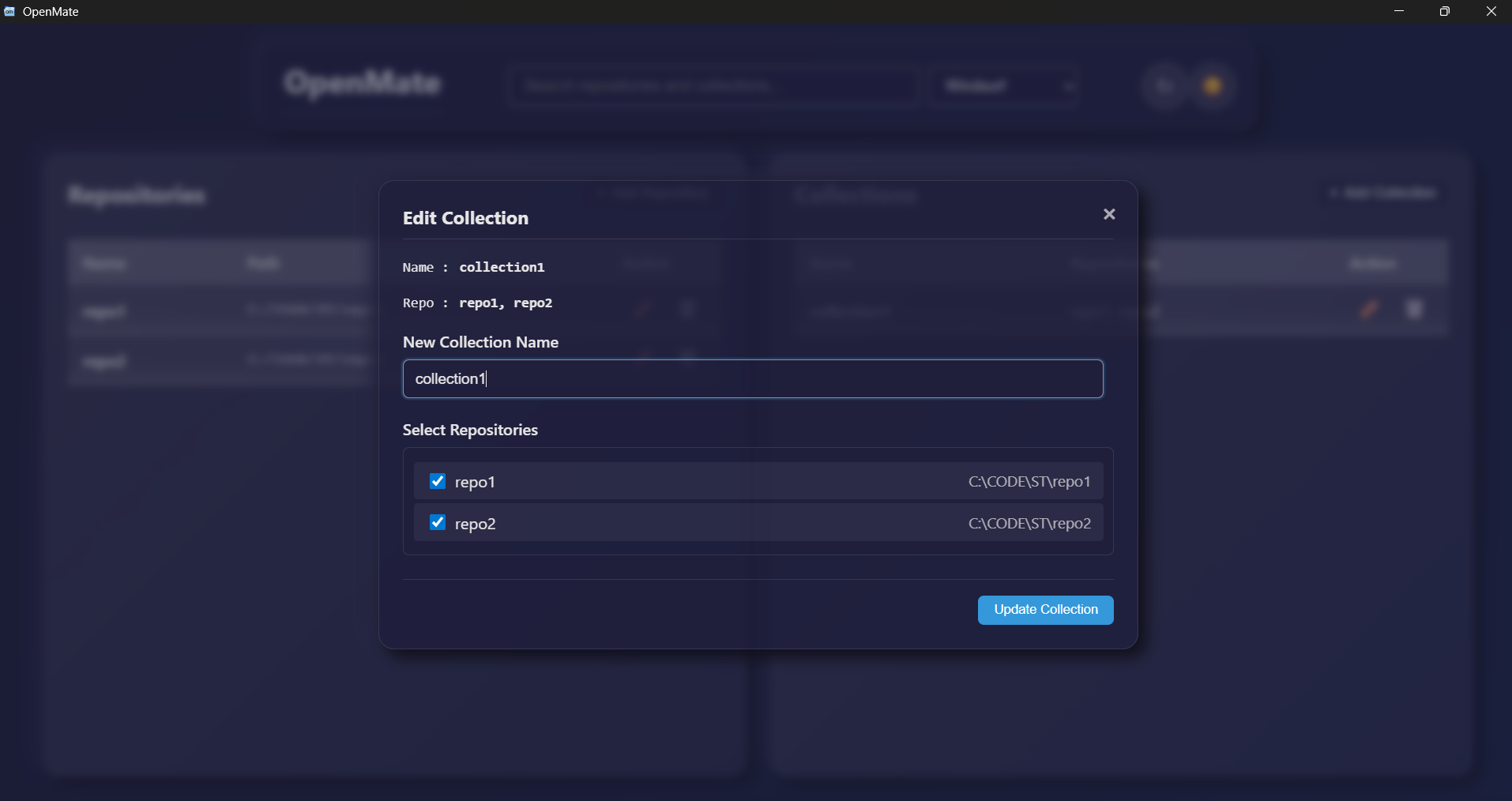
OpenMate UI is a desktop application that allows you to manage and open your local repositories in your favorite editor with quick shortcuts.
[Download](https://github.com/vivekvpai/OpenMate/releases)
**Features:**
> supports all the cli features and also has some extra features.
- Add repositories
- Edit repositories
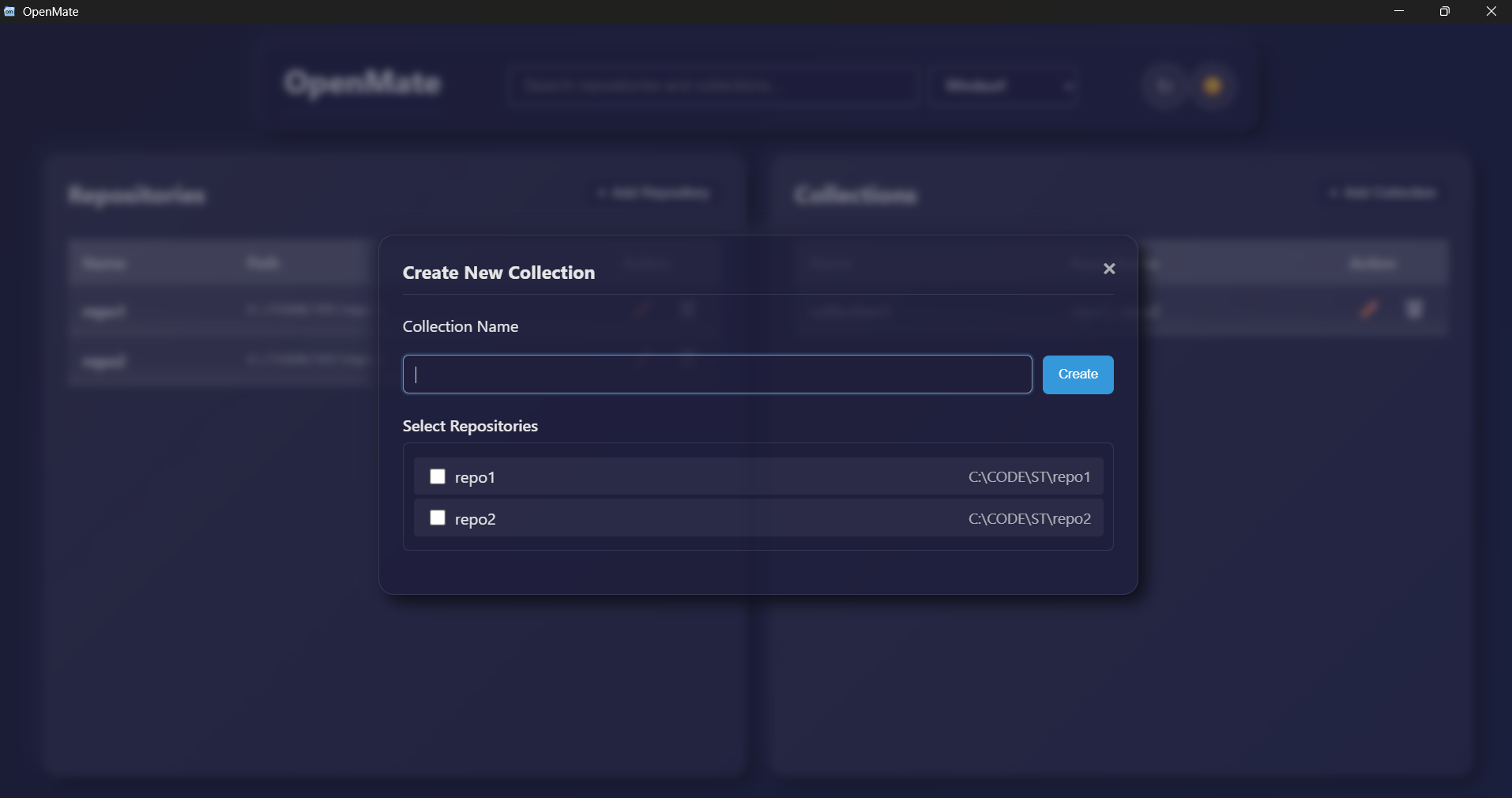
- Add collections
- Edit collections
- Open repositories
- Open collections
**Extra Features:**
- Dark/Light mode
- Select default editor
- Search repositories and collections
**Screenshots**
- Main Window
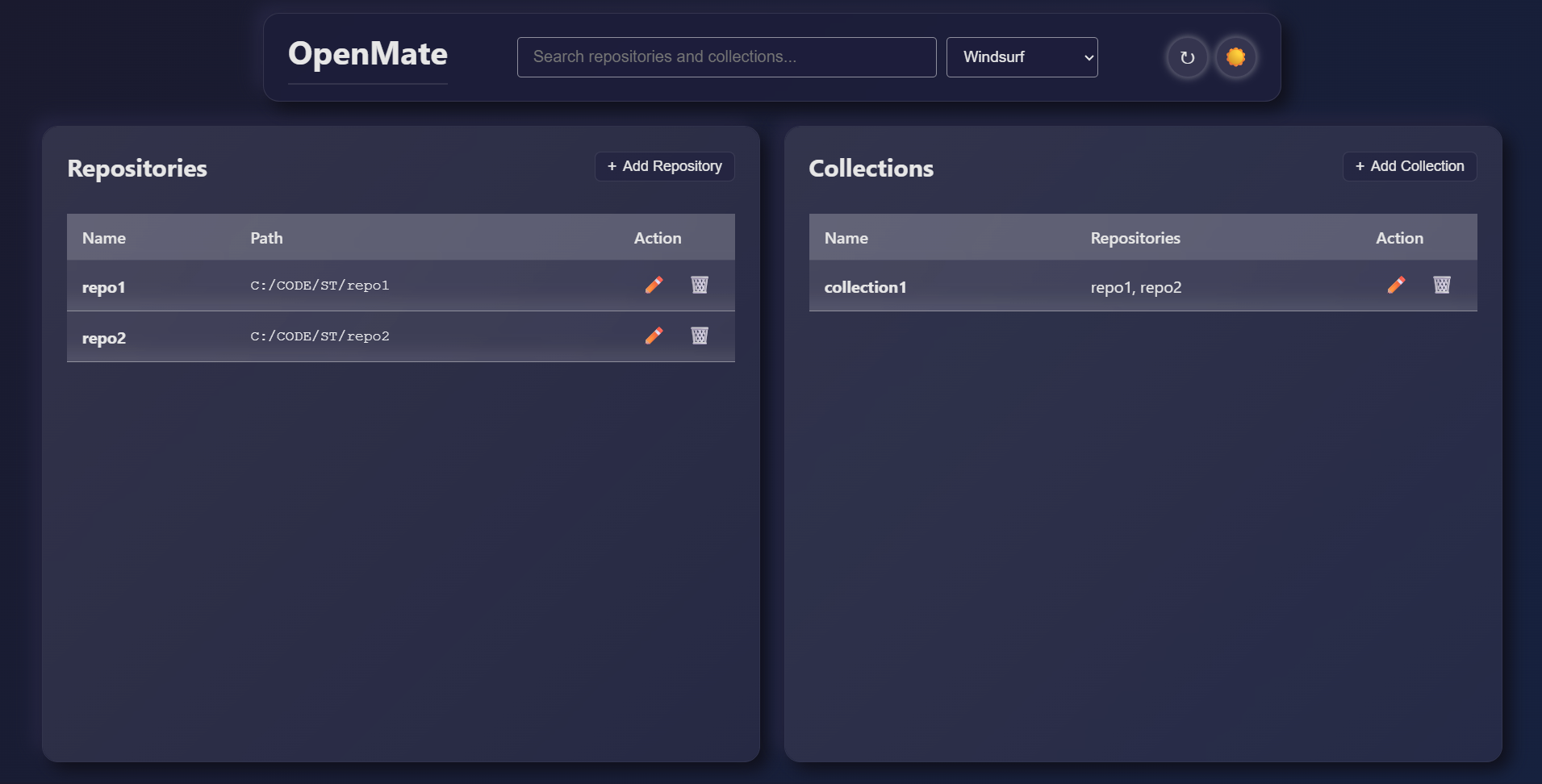
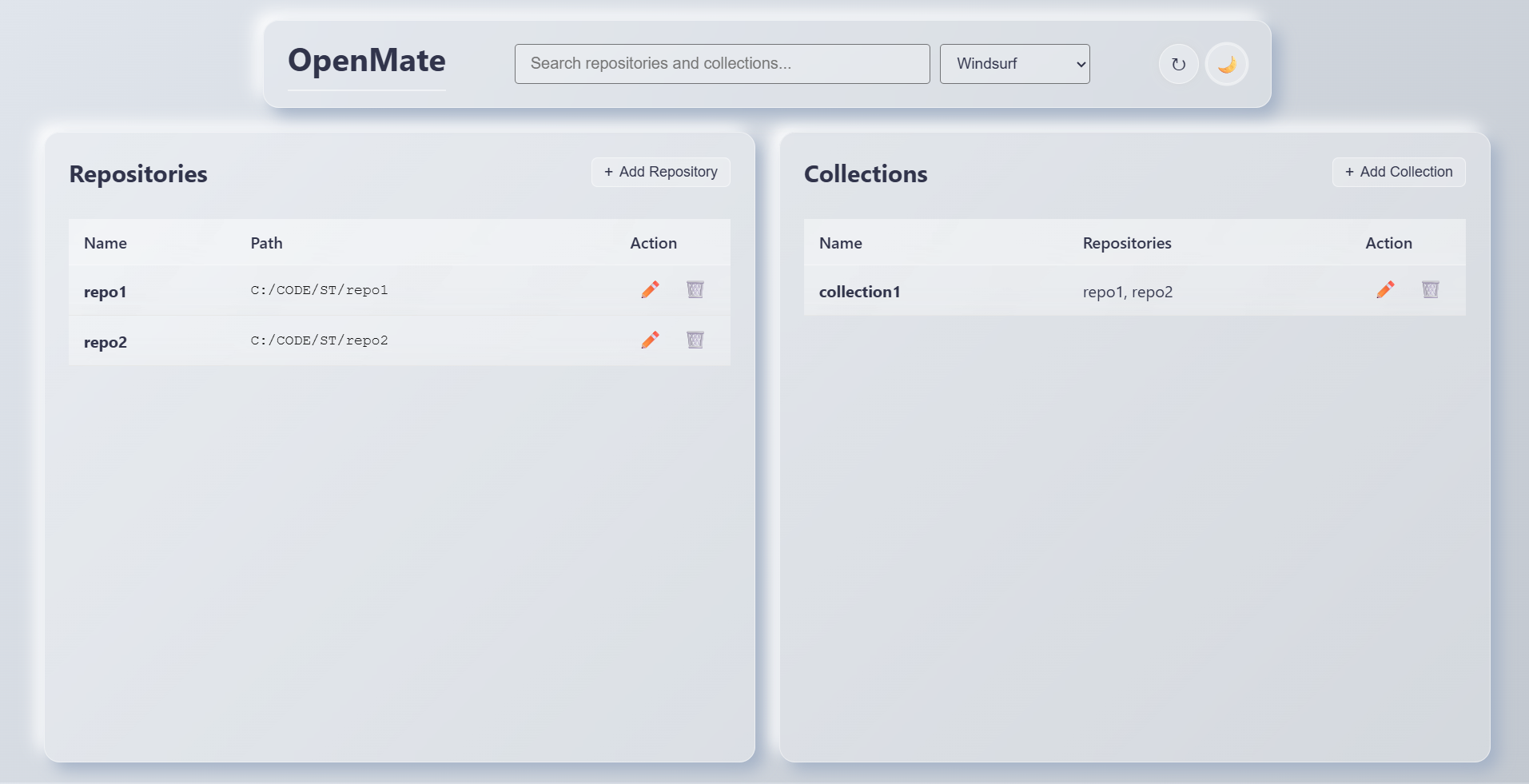
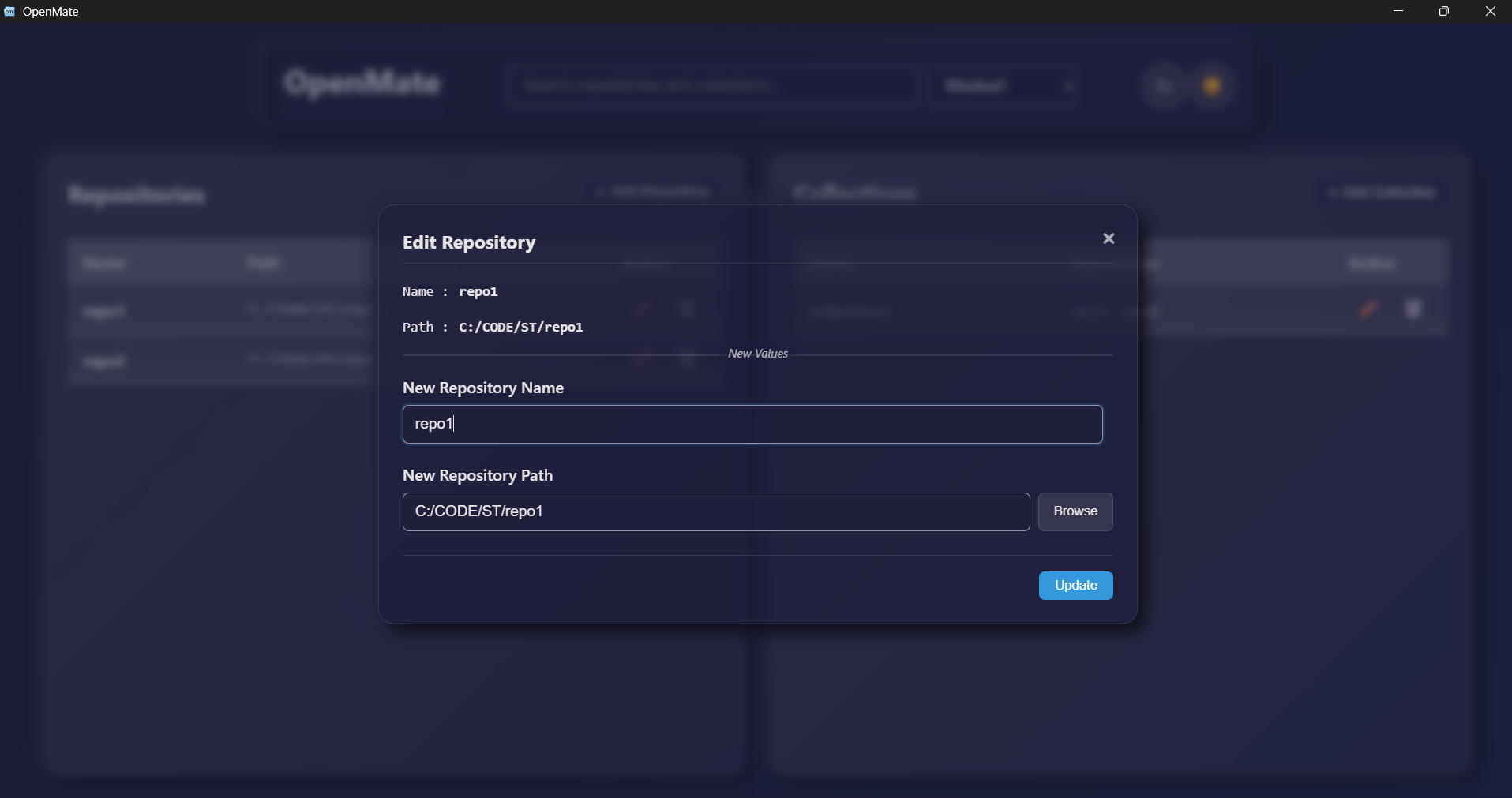
- Add Repository

- Edit Repository
- Add Collection
- Edit Collection
### **Key Tips**
- **Use short names (aliases)** for repositories for quick access.
- **Collections save time** when you work on multiple related repositories.
- **`om vs`**, **`om ws`**, **`om cs`**, **`om ij`**, **`om pc`** and **`om ag`** let you choose your editor (VS Code, Windsurf, Cursor, IntelliJ IDEA, PyCharm or Antigravity).
---
## 🔧 Requirements
### **General**
- **Node.js** (>= 14.x)
### **Windows**
- **VS Code**, **Windsurf**, **Cursor**, **IntelliJ IDEA**, **PyCharm** or **Antigravity** installed and added to PATH
- CLI commands `code`, `windsurf`, `cursor`, `ij`, `pc` or `ag` must be available in terminal
### **macOS**
- **VS Code**, **Windsurf**, **Cursor**, **IntelliJ IDEA**, **PyCharm** or **Antigravity** installed in `/Applications`
- No CLI needed; uses `open -a` internally
---
## 📂 How It Works
- Stores repo names and paths in a local JSON file (`~/.openmate/repos.json`)
- Uses system commands to open editors
- macOS uses `open -a ` for launching apps
---
# OpenMate MCP
OpenMate MCP is available as a [Model Context Protocol](https://modelcontextprotocol.org/) server.
### Install
```bash
npm install -g openmate-mcp
```
### Use with Claude Desktop / Windsurf / Cursor / Antigravity
Add configuration:
```json
{
"mcpServers": {
"openmate": {
"command": "openmate-mcp"
}
}
}
```
### More info [here](https://github.com/vivekvpai/OpenMate-MCP).
---
## 📝 License
MIT License © 2025 Pai
[](https://github.com/vivekvpai/OpenMate)
[](https://www.npmjs.com/package/openmate)
[](https://www.npmjs.com/package/openmate)
[](https://github.com/vivekvpai/OpenMate)
[](https://github.com/vivekvpai/OpenMate/blob/main/LICENSE)
A fast and friendly CLI tool to manage and open your local repositories in **VS Code**, **Windsurf**, **Cursor**, **Antigravity**, **IntelliJ IDEA**, or **PyCharm** with quick shortcuts. Perfect for developers who frequently switch between projects.
> **Note:** In this context, **repository** refers to your **local project folder** stored on your computer, not remote (GitHub/GitLab/Bitbucket) repositories.
## Table of Contents
- [Table of Contents](#table-of-contents)
- [OpenMate CLI](#openmate-cli)
- [📦 Installation](#📦-installation)
- [⚡ Usage](#⚡-usage)
- [📌 Notes & OS Compatibility](#📌-notes--os-compatibility)
- [MCP](#mcp)
- [OpenMate UI](#openmate-ui)
---
# OpenMate CLI
## 📌 Notes & OS Compatibility
- Supported editors: **VS Code**, **Windsurf**, **Cursor**, **IntelliJ IDEA**, **PyCharm** and **Antigravity**.
- On **Windows**, use double quotes for paths.
---
## 📦 Installation
Install globally via **npm**:
```bash
npm install -g openmate
```
Verify installation:
```bash
om --version
```
---
## ⚡ Usage
### **Available Commands**
#### Repository Management
```
om init Initialize current directory as a repository
om add "" Add a repo (no duplicate names)
om update "" Update stored path for existing name
om remove Remove stored repo
om ide Set preferred IDE (vs, ws, cs, ij, pc, ag)
om list List all stored repos
om path Print the stored path
```
### **Examples**
#### Initialize Current Directory as a Repository
Navigate to your project directory and run:
```bash
om init repo1
```
**Output:**
```
✅ Added "repo1" -> C:/Projects/repo1
```
Now you can open this repository in your default editor using:
```bash
om vs repo1 # Opens in VS Code
# or
om ws repo1 # Opens in Windsurf
```
#### Collection Management
```
om add -c Add/update a collection of repos
om update -c Update a collection's repos
om remove -c Remove a collection
om list -c List all collections
om list Show details of a specific collection
```
#### Open Repositories/Collections
```
om vs Open repo/collection in VS Code
om ws Open repo/collection in Windsurf
om cs Open repo/collection in Cursor
om ij Open repo/collection in IntelliJ IDEA
om pc Open repo/collection in PyCharm
om ag Open repo/collection in Antigravity
om -d Open repo/collection in LOCAL preferred IDE (falls back to global)
om Open repo/collection in GLOBAL preferred IDE (falls back to local)
```
---
### **Examples**
Below are some practical examples of how to use **OpenMate** for managing repositories and collections.
---
#### ✅ **Basic Repository Usage**
A **repository** is a single project folder on your local machine. You can add, update, remove, and open repositories using short commands.
```bash
# Add a repository with a short name (alias)
om add ""
# Open the repository in VS Code
om vs
# Open the repository in Windsurf
om ws
# Open the repository in Cursor
om cs
# Open the repository in IntelliJ IDEA
om ij
# Open the repository in PyCharm
om pc
# Open the repository in Antigravity
om ag
```
**Update or remove a repository:**
```bash
# Update the path of an existing repository
om update ""
# Remove the repository
om remove
```
#### ✅ **Preferred IDE**
You can set a preferred IDE for any repository or collection. This allows you to open it directly without specifying the editor every time.
**Set a preferred IDE:**
```bash
om ide vs # Set VS Code as default
om ide ws # Set Windsurf as default
```
**Open in preferred IDE:**
Once a preferred IDE is set, you can use either of these commands:
Once a preferred IDE is set (locally or via global `ide_default`), you can use:
```bash
# Prioritizes GLOBAL default (if set), then falls back to local preference
om
# Prioritizes LOCAL preference (if set), then falls back to global default
om -d
# Explicitly open in a specific IDE
om vs
om ws
om cs
om ij
om pc
om ag
```
If no preferred IDE is found (neither local nor global), OpenMate will warn you and show usage instructions.
---
#### ✅ **Listing Repositories and Collections**
Use the `list` command to view repositories and collections:
```bash
# List all repositories and collections
om list
# List only repositories
om list -r
# List only collections
om list -c
```
View details of a specific collection:
```bash
om list
# Example Output:
# ✅ Collection "":
# repo1, repo2, repo3
```
If the collection doesn’t exist:
```bash
om list
# Output:
# ❌ Collection "" not found.
# Available collections:
# 1. frontend
# 2. backend
```
---
#### ✅ **Working with Collections**
A **collection** is a group of related repositories you can manage together.
**Create a collection:**
```bash
om add -c repo1,repo2,repo3,repo4
```
Here:
- `-c` indicates you are adding a collection.
- `` is the name of the collection.
- `repo1,repo2,repo3,repo4` are the repository names in the collection.
**Open all repositories in a collection:**
```bash
om vs
```
**Update a collection (add/remove repos):**
```bash
om update -c repo1,repo2,repo3,repo4,repo5
```
**List all collections:**
```bash
om list -c
```
**Remove a collection:**
```bash
om remove -c
```
---
### **Sample Outputs**
#### `om list`
When you run `om list`, it shows all stored repositories and collections:
```
Stored repos:
┌─────┬──────────┬───────────────────────────────┬─────────────┐
│ # │ Name │ Repo Path │ Default IDE │
├─────┼──────────┼───────────────────────────────┼─────────────┤
│ 1 │ repo1 │ C:\Projects\repo1 │ VS │
│ 2 │ repo2 │ C:\Projects\repo2 │ WS │
│ 3 │ repo3 │ C:\Projects\repo3 │ │
│ 4 │ repo4 │ C:\Projects\repo4 │ CS │
└─────┴──────────┴───────────────────────────────┴─────────────┘
Collections:
┌─────┬────────────────────┬──────────┬─────────────┬───────────────────────────┐
│ # │ Name │ Repos │ Default IDE │ Repository Names │
├─────┼────────────────────┼──────────┼─────────────┼───────────────────────────┤
│ 1 │ collection1 │ 2 │ VS │ repo1, repo2 │
│ 2 │ collection2 │ 2 │ │ repo3, repo4 │
└─────┴────────────────────┴──────────┴─────────────┴───────────────────────────┘
```
---
### **List Only Repositories**
```bash
om list -r
```
**Sample Output:**
```
Stored Repositories:
┌─────┬──────────┬───────────────────────────────┬─────────────┐
│ # │ Name │ Repo Path │ Default IDE │
├─────┼──────────┼───────────────────────────────┼─────────────┤
│ 1 │ repo1 │ C:\\Projects\\repo1 │ VS │
│ 2 │ repo2 │ C:\\Projects\\repo2 │ WS │
│ 3 │ repo3 │ C:\\Projects\\repo3 │ │
└─────┴──────────┴───────────────────────────────┴─────────────┘
```
---
### **List Only Collections**
```bash
om list -c
```
**Sample Output:**
```
Collections:
┌─────┬──────────────┬──────────┬─────────────┬───────────────────────────────┐
│ # │ Name │ Repos │ Default IDE │ Repository Names │
├─────┼──────────────┼──────────┼─────────────┼───────────────────────────────┤
│ 1 │ frontend │ 4 │ VS │ repo1, repo2, repo3, repo4 │
│ 2 │ backend │ 2 │ IJ │ repo5, repo6 │
└─────┴──────────────┴──────────┴─────────────┴───────────────────────────────┘
```
---
### **List a Specific Collection**
```bash
om list frontend
```
**Sample Output:**
```
Collection: frontend
Repositories:
┌─────┬──────────┬───────────────────────────────┐
│ # │ Name │ Repo Path │
├─────┼──────────┼───────────────────────────────┤
│ 1 │ repo1 │ C:\\Projects\\repo1 │
│ 2 │ repo2 │ C:\\Projects\\repo2 │
│ 3 │ repo3 │ C:\\Projects\\repo3 │
│ 4 │ repo4 │ C:\\Projects\\repo4 │
└─────┴──────────┴───────────────────────────────┘
```
---
### **Smart Suggestions**
When you type a partial repository or collection name, OpenMate will show you matching suggestions:
```bash
om ws st
```
**Sample Output:**
```
❌ No exact match for "st". Did you mean one of these?
Suggestions:
Repositories: stagentdash stapp stappdocs stboxesmfe stdaisy stsearch
Collections: stagent stsite stuser
```
### **When Collection Doesn't Exist**
```bash
om list nonexistent
```
**Sample Output:**
```
❌ Collection "nonexistent" not found.
Available collections:
1. frontend
2. backend
```
---
# **OpenMate UI**
OpenMate UI is a desktop application that allows you to manage and open your local repositories in your favorite editor with quick shortcuts.
[Download](https://github.com/vivekvpai/OpenMate/releases)
**Features:**
> supports all the cli features and also has some extra features.
- Add repositories
- Edit repositories
- Add collections
- Edit collections
- Open repositories
- Open collections
**Extra Features:**
- Dark/Light mode
- Select default editor
- Search repositories and collections
**Screenshots**
- Main Window


- Add Repository

- Edit Repository

- Add Collection

- Edit Collection

### **Key Tips**
- **Use short names (aliases)** for repositories for quick access.
- **Collections save time** when you work on multiple related repositories.
- **`om vs`**, **`om ws`**, **`om cs`**, **`om ij`**, **`om pc`** and **`om ag`** let you choose your editor (VS Code, Windsurf, Cursor, IntelliJ IDEA, PyCharm or Antigravity).
---
## 🔧 Requirements
### **General**
- **Node.js** (>= 14.x)
### **Windows**
- **VS Code**, **Windsurf**, **Cursor**, **IntelliJ IDEA**, **PyCharm** or **Antigravity** installed and added to PATH
- CLI commands `code`, `windsurf`, `cursor`, `ij`, `pc` or `ag` must be available in terminal
### **macOS**
- **VS Code**, **Windsurf**, **Cursor**, **IntelliJ IDEA**, **PyCharm** or **Antigravity** installed in `/Applications`
- No CLI needed; uses `open -a` internally
---
## 📂 How It Works
- Stores repo names and paths in a local JSON file (`~/.openmate/repos.json`)
- Uses system commands to open editors
- macOS uses `open -a ` for launching apps
---
# OpenMate MCP
OpenMate MCP is available as a [Model Context Protocol](https://modelcontextprotocol.org/) server.
### Install
```bash
npm install -g openmate-mcp
```
### Use with Claude Desktop / Windsurf / Cursor / Antigravity
Add configuration:
```json
{
"mcpServers": {
"openmate": {
"command": "openmate-mcp"
}
}
}
```
### More info [here](https://github.com/vivekvpai/OpenMate-MCP).
---
## 📝 License
MIT License © 2025 Pai