This is an absurd project.
It implements a backend for [sql.js](https://github.com/sql-js/sql.js/) (sqlite3 compiled for the web) that treats IndexedDB like a disk and stores data in blocks there. That means your sqlite3 database is persisted. And not in the terrible way of reading and writing the whole image at once -- it reads and writes your db in small chunks.
It basically stores a whole database into another database. Which is absurd.
[See the demo](https://priceless-keller-d097e5.netlify.app/). You can also view an entire app using this [here](https://app-next.actualbudget.com/?wtf_source=absurd).
You should also read [this blog post](https://jlongster.com/future-sql-web) which explains the project in great detail.
If you like my work, feel free to [buy me a coffee!](https://www.buymeacoffee.com/jlongster)
## How do I use it?
You can check out the [example project](https://github.com/jlongster/absurd-example-project) to get started. Or follow the steps below:
First you install the packages:
```
yarn add @jlongster/sql.js absurd-sql
```
Right now you need to use my fork of `sql.js`, but I'm going to open a PR and hopefully get it merged. The changes are minimal.
absurd-sql **must** run in a worker. This is fine because you really shouldn't be blocking the main thread anyway. So on the main thread, do this:
```js
import { initBackend } from 'absurd-sql/dist/indexeddb-main-thread';
function init() {
let worker = new Worker(new URL('./index.worker.js', import.meta.url));
// This is only required because Safari doesn't support nested
// workers. This installs a handler that will proxy creating web
// workers through the main thread
initBackend(worker);
}
init();
```
Then in `index.worker.js` do this:
```js
import initSqlJs from '@jlongster/sql.js';
import { SQLiteFS } from 'absurd-sql';
import IndexedDBBackend from 'absurd-sql/dist/indexeddb-backend';
async function run() {
let SQL = await initSqlJs({ locateFile: file => file });
let sqlFS = new SQLiteFS(SQL.FS, new IndexedDBBackend());
SQL.register_for_idb(sqlFS);
SQL.FS.mkdir('/sql');
SQL.FS.mount(sqlFS, {}, '/sql');
const path = '/sql/db.sqlite';
if (typeof SharedArrayBuffer === 'undefined') {
let stream = SQL.FS.open(path, 'a+');
await stream.node.contents.readIfFallback();
SQL.FS.close(stream);
}
let db = new SQL.Database(path, { filename: true });
// You might want to try `PRAGMA page_size=8192;` too!
db.exec(`
PRAGMA journal_mode=MEMORY;
`);
// Your code
}
```
## Requirements
Because this uses `SharedArrayBuffer` and the `Atomics` API, there are some requirement for code to run.
* It must be run in a worker thread (you shouldn't block the main thread with queries anyway)
* Your server must respond with the following headers:
```
Cross-Origin-Opener-Policy: same-origin
Cross-Origin-Embedder-Policy: require-corp
```
Those headers are required because browsers only enable `SharedArrayBuffer` if you tell it to isolate the process. There are potential security problems if `SharedArrayBuffer` was available everywhere.
## Fallback mode
We do support browsers without `SharedArrayBuffer` (only Safari). Read more about it here: https://jlongster.com/future-sql-web#fallback-mode-without-sharedarraybuffer
There are some limitations in this mode: only one tab can be writing the database at a time. The database will never be corrupted; if multiple tabs try to write it will just throw an error (in the future it should call a handler that you provide so you can notify the user).
## Performance
It consistently beats IndexedDB performance up to 10x:
Read performance: doing something like `SELECT SUM(value) FROM kv`:
 Write performance: doing a bulk insert:
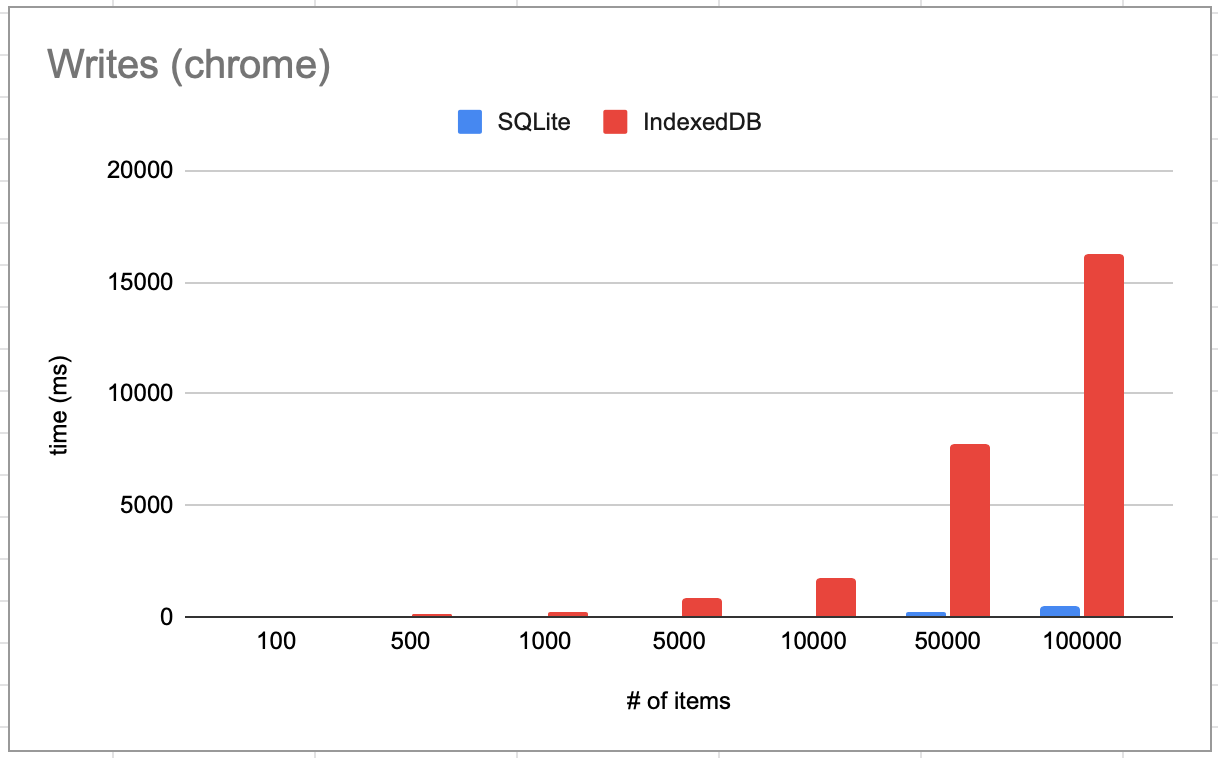 These are all on a 2015 macbook pro. Benchmark code is in `src/examples/bench`.
## How does it work?
Read [this blog post](https://jlongster.com/future-sql-web) for more details.
## Where you can help
There are several things that could be done:
* Add a bunch more tests
* Implement a `webkitFileSystem` backend
* I already started it [here](https://gist.github.com/jlongster/ec00ddbb47b4b29897ab5939b8e32fbe), but initial results showed that it was way slower?
* Bug fixes
These are all on a 2015 macbook pro. Benchmark code is in `src/examples/bench`.
## How does it work?
Read [this blog post](https://jlongster.com/future-sql-web) for more details.
## Where you can help
There are several things that could be done:
* Add a bunch more tests
* Implement a `webkitFileSystem` backend
* I already started it [here](https://gist.github.com/jlongster/ec00ddbb47b4b29897ab5939b8e32fbe), but initial results showed that it was way slower?
* Bug fixes