<div align="center">

<img src="https://raw.githubusercontent.com/murasakijs/murasaki/main/assets/logo.svg" alt="Murasaki — the desktop framework for Next.js developers" width="720">

**The desktop framework for Next.js developers.**

React 19 · Vite · OS WebView · Rust-native · No Chromium

[![npm version](https://img.shields.io/npm/v/murasaki?color=A855F7&label=npm)](https://www.npmjs.com/package/murasaki)
[![npm downloads](https://img.shields.io/npm/dm/murasaki?color=A855F7)](https://www.npmjs.com/package/murasaki)
[![license](https://img.shields.io/npm/l/murasaki?color=A855F7)](https://github.com/murasakijs/murasaki/blob/main/LICENSE)
[![CI](https://github.com/murasakijs/murasaki/actions/workflows/ci.yml/badge.svg)](https://github.com/murasakijs/murasaki/actions/workflows/ci.yml)

[English](https://github.com/murasakijs/murasaki/blob/main/README.md) · [日本語](https://github.com/murasakijs/murasaki/blob/main/README.ja.md)

</div>

---

Murasaki is a TypeScript-first desktop framework with a **Next.js-inspired DX**:
file-based project layout, layouts, metadata, and React 19 server actions,
built on **React 19 + Vite**, rendered through the **OS WebView already
installed on your machine** — no bundled Chromium. The native window, menus,
and OS integrations are powered by a self-authored Rust binding,
[`@murasakijs/native`](https://www.npmjs.com/package/@murasakijs/native) —
you write TypeScript; you never write Rust. Production targets **macOS,
Windows, and Linux** (AppDir/`.AppImage`/`.deb`, with self-update for the
AppImage).

```bash
npm create murasaki@latest my-app
cd my-app
npm run dev
```

```tsx
// src/app/page.tsx
import { useState } from 'react'
import { useContextMenu, Action } from 'murasaki'

export default function Page() {
  const [count, setCount] = useState(0)

  // The window-wide menu — declared as data, right next to your state.
  useContextMenu([
    { label: 'Increment', shortcut: 'command,I', action: () => setCount((n) => n + 1) },
    { separator: true },
    { label: 'Reload', shortcut: 'command,R', action: () => location.reload() },
    { label: 'Copy', action: <Action.Copy /> },
  ])

  return (
    <main>
      <h1>Hello, Murasaki 🦋</h1>
      <button onClick={() => setCount((n) => n + 1)}>Clicked {count} times</button>
    </main>
  )
}
```

Grant that renderer `menu:context` and `clipboard:writeText` in
`murasaki.config.ts`; native menu roles are denied unless their matching
capability is present.

That's a real Vite dev server with React Fast Refresh, rendered in a native
window — and right-clicking anywhere shows a **real OS context menu** (NSMenu
on macOS and HMENU on Windows), not an HTML popup.

---

## Table of Contents

- [Quick start](#quick-start)
- [Example apps](#example-apps)
- [Why murasaki?](#why-murasaki)
- [Features](#features)
- [CLI reference](#cli-reference)
- [Signing & distribution](#signing--distribution)
- [Configuration (`murasaki.config.ts`)](#configuration-murasakiconfigts)
- [Server Actions](#server-actions)
- [API Routes](#api-routes)
- [Architecture](#architecture)
- [Roadmap](#roadmap)
- [Repository layout](#repository-layout)
- [Contributing](#contributing)
- [Code of Conduct](#code-of-conduct)
- [Security](#security)
- [License](#license)

---

## Quick start

```bash
# scaffold
npm create murasaki@latest my-app

# develop with Vite HMR + React Fast Refresh
cd my-app
npm run dev

# ship (macOS, Windows, and Linux — see CLI reference)
npm run build       # dist/client   Vite production build
npm run bundle      # portable native app bundle for the selected target
npm run installer   # .dmg; .zip/.exe/.msi; or .deb, depending on the target
```

The scaffold gives you a React 19 + Vite + Tailwind app with a Next.js-like
layout — you only touch `src/app/` (pages, layouts, `globals.css`), `src/api/`
(API routes), and `src/middleware.ts`. There's no `index.html` or entry
file to maintain: murasaki owns the app shell and the client bootstrap (drop
your own `index.html` in the project root if you want to customize the HTML
head). `murasaki.config.ts` describes your app's identity and window.

---

## Example apps

Three independent, source-first apps test different product directions. Each
has its own source tree, app identity, icon, persistence model, and an explicit
requirement matrix. Read each app's README for the verified level and remaining
framework or distribution gaps.

| App | What it demonstrates | Source |
| --- | --- | --- |
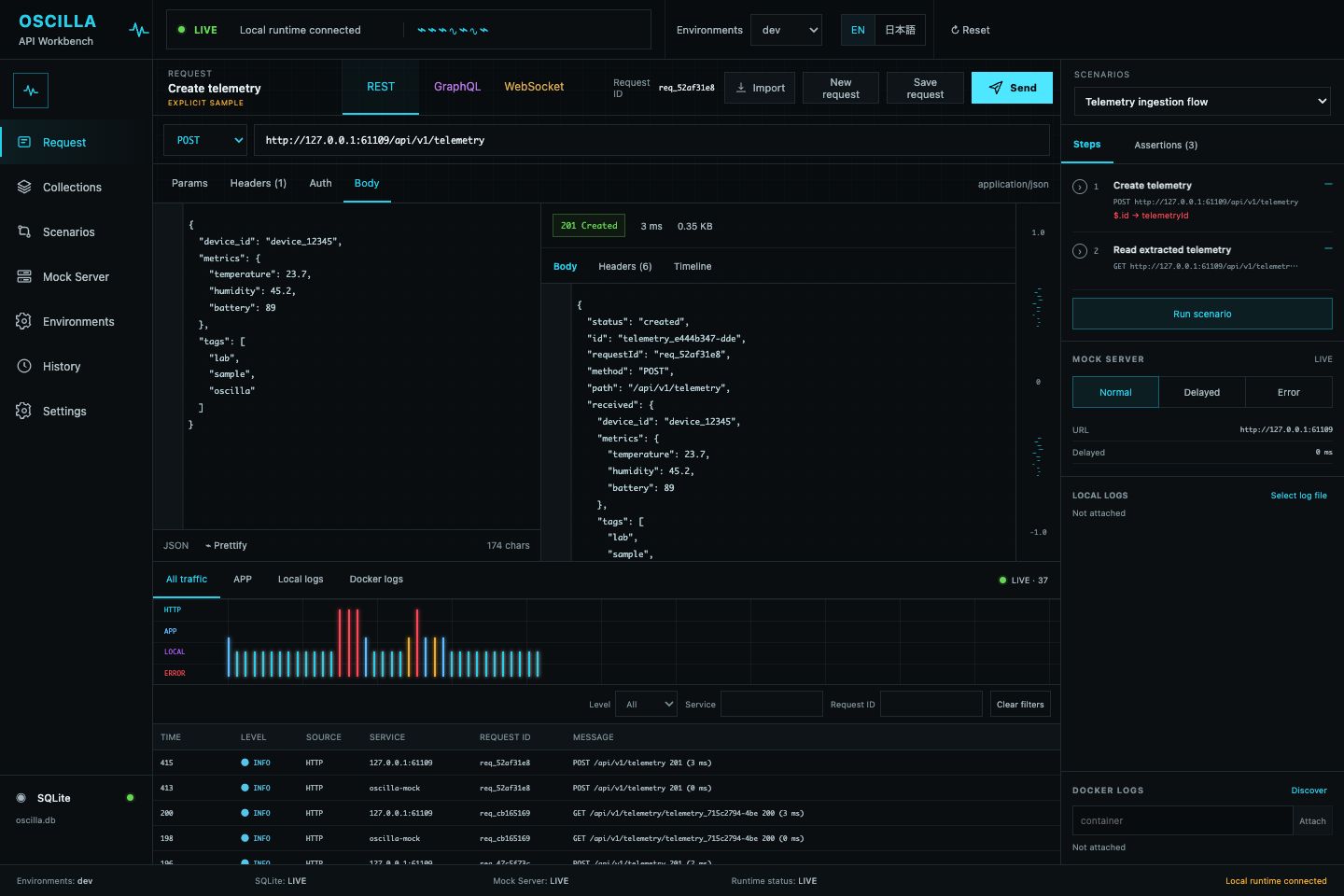
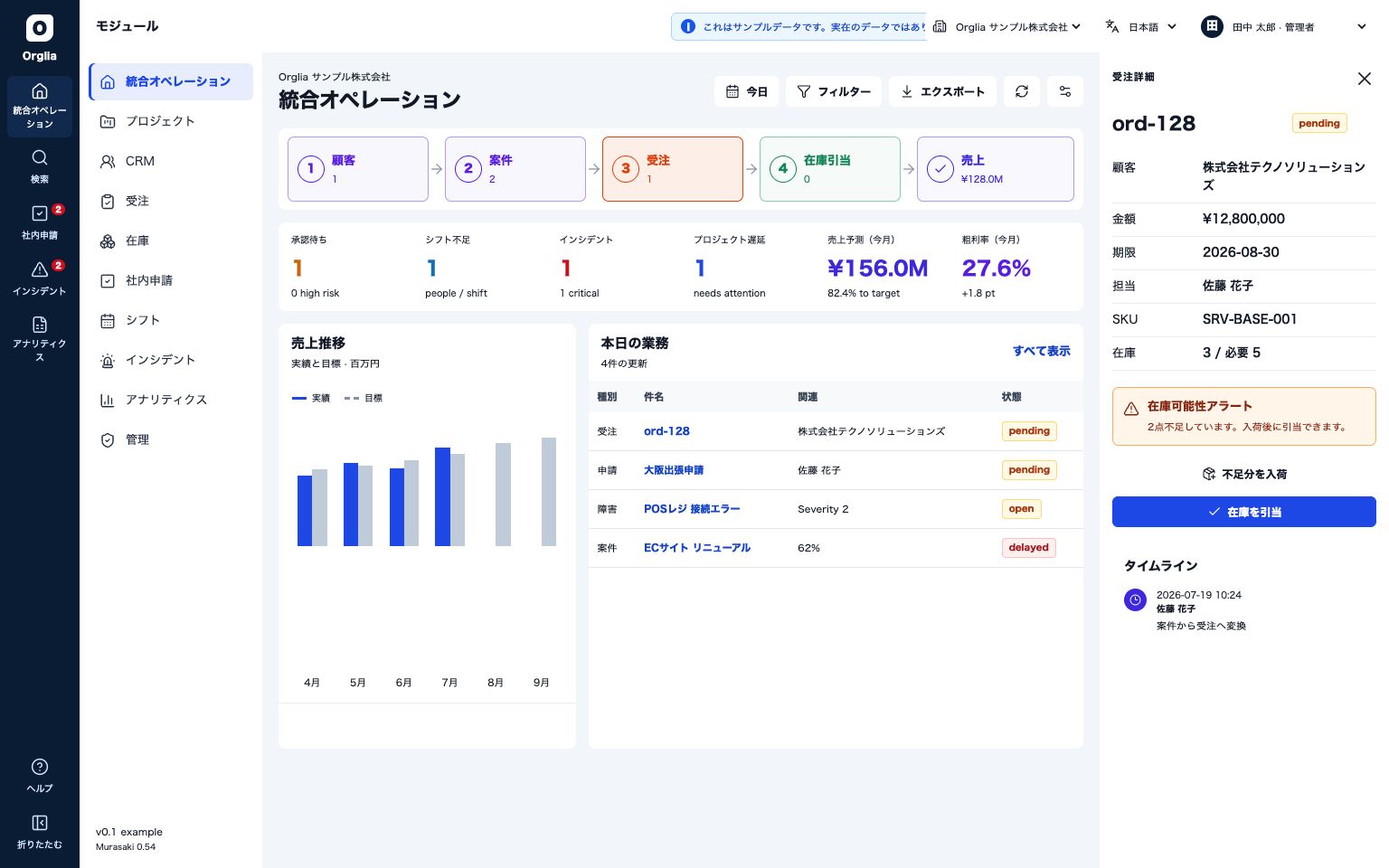
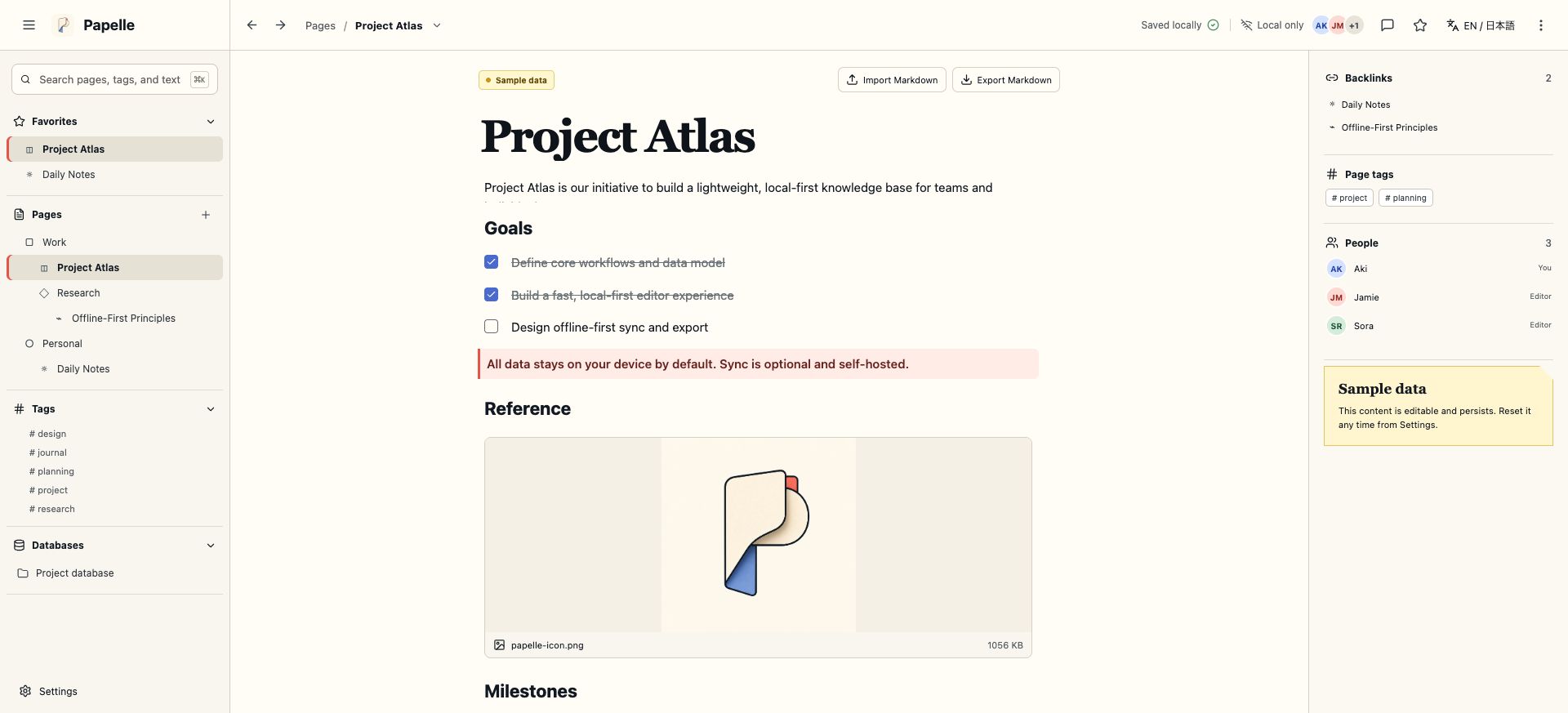
| **Papelle** | Local-first block editor, Markdown, attachments, linked pages, database views, optional self-hosted sync | [`examples/papelle`](https://github.com/murasakijs/murasaki/tree/main/examples/papelle) |
| **Oscilla** | REST/GraphQL/WebSocket workbench, scenarios, mocks, and an integrated traffic timeline | [`examples/oscilla`](https://github.com/murasakijs/murasaki/tree/main/examples/oscilla) |
| **Orglia** | Self-hosted CRM, projects, orders, inventory, approvals, shifts, incidents, and analytics | [`examples/orglia`](https://github.com/murasakijs/murasaki/tree/main/examples/orglia) |

<p align="center">
  <img src="https://raw.githubusercontent.com/murasakijs/murasaki/main/examples/papelle/design/papelle-implementation.png" alt="Papelle" width="31%">
  <img src="https://raw.githubusercontent.com/murasakijs/murasaki/main/examples/oscilla/design/implementation.png" alt="Oscilla" width="31%">
  <img src="https://raw.githubusercontent.com/murasakijs/murasaki/main/examples/orglia/design/overview-implementation.png" alt="Orglia" width="31%">
</p>

These examples are not presented as signed consumer downloads. Reproducible
installer links will be added only after the clean-machine install, first-launch,
update, and uninstall checks recorded in [`examples/README.md`](./examples/README.md)
have passed.

---

## Why murasaki?

The size/memory story is about what each framework bundles, not a number
we've benchmarked head-to-head:

- **Electron** bundles a full Chromium **and** Node into every app.
- **Tauri** renders through the OS WebView (no Chromium) and bundles no
  runtime at all — smallest footprint, but your backend is Rust.
- **murasaki** also renders through the OS WebView (no Chromium), but bundles
  Node so your whole app — client and server-side logic — stays TypeScript.

|                  | **murasaki**                    | Electron                | Tauri                  |
| ---------------- | -------------------------------- | ------------------------ | ------------------------ |
| Rendering        | OS WebView (WKWebView / WebView2 / WebKitGTK) | Bundled Chromium | OS WebView |
| Runtime bundled  | Node.js                          | Chromium + Node          | none                     |
| Backend language | TypeScript                       | TypeScript                | Rust                     |
| You write Rust?  | No (prebuilt native binding)     | No                        | Yes                      |
| Installer size   | **~43 MB `.dmg`** / **~120 MB `.app`** (measured, macOS) | ~80–150 MB\* | ~3–10 MB\* |
| npm ecosystem    | full                              | full                      | client only              |
| Server actions   | `defineAction` / `useAction`     | manual IPC                | manual IPC / commands    |
| Auto-publish CI  | Trusted Publisher OIDC           | manual                    | manual                   |

<sub>\* commonly cited ballparks for Electron/Tauri installers — not measured by us. murasaki's numbers are our own, real `.dmg`/`.app` sizes on macOS.</sub>

### Choose murasaki if...

- You already write **Next.js / React** and don't want to learn Rust.
- You want a **native OS context menu, menus, dialogs, notifications** —
  without writing platform code.
- You're fine with Node being bundled in exchange for **zero Rust**.

### Choose Tauri if...

- You need the smallest possible installer and are willing to write your
  backend in **Rust**.

### Choose Electron if...

- You need a **guaranteed Chromium** environment (specific web APIs, the
  DevTools protocol) regardless of install size.

---

## Features

- **Vite dev server + React Fast Refresh.** `murasaki dev` boots Vite and
  attaches a native window pointed at it — edit and save, the window updates.
- **File-based routing.** Every `src/app/**/page.tsx` becomes a route
  automatically — nested layouts, dynamic `:param` segments, `loading` /
  `error` / `not-found` boundaries, and client-side `<Link>` navigation, with
  no router config to write.
- **Metadata & middleware.** `export const metadata` / `generateMetadata()` on
  a page or layout set the document title and meta tags; `src/middleware.ts`
  runs before every navigation and can redirect (a route guard) — both
  Next.js-shaped.
- **Native context menu.** Declare it with a hook — `useContextMenu([{ label,
  action, shortcut }])` — data next to your state; `action` is a built-in
  `<Action.* />` element or your own function. No id is the
  whole-window menu; give it an id and tag a region with `<ContextMenuTrigger
  id>` to scope it. It posts to the Rust side, which pops a real OS menu (NSMenu
  / HMENU). No HTML popup involved.
- **Native menus, dialogs, clipboard, notifications, shell.** Built on
  [`@murasakijs/native`](https://www.npmjs.com/package/@murasakijs/native):
  open/save/directory dialogs, clipboard read/write, OS notifications, and
  "reveal in Finder/Explorer" — all typed, no Rust required to call them.
- **macOS menu-bar status items / Windows system tray.** One process-wide
  icon with native nested menus, click/menu events, tooltips, and dynamic
  icon/menu replacement, protected by per-renderer capabilities.
- **Per-user login autostart.** Packaged macOS, Windows, and Linux apps can
  expose an opt-in setting through typed `status` / `enable` / `disable`
  calls. Read and write authority are separate, and development hosts cannot
  create persistent registrations.
- **macOS system permissions.** Declare camera/microphone purpose strings and
  optional launch prompts in config; query/request camera, microphone, screen
  recording, and accessibility consent from trusted renderer code.
- **Node Main lifecycle and supervised helpers.** Put long-lived TypeScript in
  `src/main.ts` with `ready`, cancellable `beforeQuit`, bounded `shutdown`,
  second-instance/deep-link delivery, structured logging, diagnostic reports,
  and contained sidecars with explicit restart policies. A packaged host
  detects an unexpected Node exit, tears down the process tree, and exits
  non-zero instead of leaving a dead UI running.
- **Declared multi-window runtime.** Give each window its own route and
  deny-by-default capability policy. Keep secondary templates dormant until
  Node Main calls `windows.create()`, then destroy and recreate them with
  generation-scoped lifecycle events. macOS `hud`, `sidebar`, and `popover`
  vibrancy materials are applied natively.
- **Production security primitives.** Exact-origin native IPC, authenticated
  loopback endpoints, bounded wire payloads, CSP defaults, scoped URL/path/
  window/permission grants, macOS Keychain / Windows Credential Manager,
  owner-scoped global shortcuts, and app-wide private-session/User-Agent/proxy
  configuration ship as typed APIs. See the canonical
  [`capabilities.json`](https://github.com/murasakijs/murasaki/blob/main/packages/murasaki/capabilities.json)
  for exact maturity and limitations.
- **Build-time plugin SDK.** Trusted plugins can contribute Vite options,
  bundle dependencies/resources, and serial dev/build/bundle hooks without
  patching Murasaki core.
- **Server Actions, running end-to-end.** `defineAction` + `useAction` mirror
  React 19's `useActionState` shape, and the `'use server'` function actually
  runs in Node — via a Vite middleware in dev, via a bundled Node child server
  in prod (see [Server Actions](#server-actions)).
- **Theming.** `ThemeProvider` / `useTheme` with light / dark / system modes.
- **Dev error overlay.** Uncaught runtime errors — render errors, unhandled
  promise rejections — surface as a full-screen, murasaki-branded overlay with
  the stack and the React component stack; dismiss with `Esc` or reload. It's
  a no-op in production builds. Since `murasaki dev` serves over
  `http://localhost`, the standard **React DevTools browser extension** also
  works — just open the same URL in Chrome.
- **Packaging.** `murasaki bundle` → a `.app` on macOS, a portable folder /
  `.zip` on Windows. `murasaki installer` → a `.dmg` on macOS, an NSIS `.exe`
  (and an `.msi`, where WiX is available) on Windows. The macOS `.dmg` is
  ~43 MB compressed; the `.app` itself is ~120 MB because it bundles Node and
  your app. See [Platform support](#platform-support) for what's covered.
- **Automatic updates.** Set `updater: true`, drop a `<UpdateButton />` (or the
  `useUpdate()` hook) in your UI, and publish with
  `murasaki release --manifest --sign`. The app fetches the manifest, verifies
  it against your **Ed25519** public key, checks the downloaded asset's
  **SHA-256**, then replaces itself and relaunches. The primary update UI gets
  the internal `app:quit` grant required for that restart; a secondary update
  window must opt in explicitly. macOS and Windows x64 —
  see [Automatic updates](https://murasaki.ichi10.com/en/docs/guides/auto-update).
- **Deep links and file associations.** Declare custom URL schemes and document
  extensions in `murasaki.config.ts`; packaged macOS apps and Windows NSIS/MSI
  installers register them with the OS. Cold starts and running-app opens reach
  one typed Node Main `openRequested()` hook. See
  [Deep links and file associations](https://murasaki.ichi10.com/en/docs/guides/deep-links).
- **Trusted Publisher OIDC.** Tag-push triggers a signed
  `npm publish --provenance` — no long-lived npm tokens in CI.

---

## CLI reference

```
murasaki dev         Start the Vite dev server + native window (HMR, Fast Refresh)
murasaki build       Production Vite build → dist/client
murasaki bundle      Native app folder / .app for the current platform
murasaki installer   Distributable installer for the current platform
murasaki init        Install the Rust toolchain (only if you're hacking on @murasakijs/native)
murasaki icon        Generate Assets.car / .icns / .ico / .png from one PNG
murasaki release     Auto-update manifest helpers
murasaki help        Show this help
```

### Platform support

|                            | `dev` | `bundle`           | `installer`                       | auto-update |
| -------------------------- | :---: | ------------------ | --------------------------------- | :---------: |
| **macOS** (arm64, x64)     |  ✅   | `.app`             | `.dmg` — must be built on macOS   |     ✅      |
| **Windows** (x64)          |  ✅   | folder / `.zip`    | NSIS `.exe`¹, `.msi`²             |     ✅      |
| **Windows** (arm64)        |  ✅   | folder / `.zip`    | NSIS `.exe`¹                      |     ✅      |
| **Linux** (x64, arm64)     |  ✅   | AppDir + `.AppImage`³ | `.deb`³                        |    ✅⁴      |

<sub>¹ needs `makensis` on the build machine — it cross-compiles from macOS/Linux.
² needs WiX v4, and must be built on Windows.
³ `bundle`/`installer` need `mksquashfs` (`squashfs-tools`) to build the
`.AppImage` and cross-compile from any host; the native launcher runs the
produced AppDir/`.AppImage`/`.deb` (window, webview, single-instance, deep
links, crash reporting).
⁴ AppImage only — self-update journal-swaps the running `.AppImage` file in
place and relaunches with `--appimage-extract-and-run` (no FUSE required). A
`.deb` install has no self-contained file to swap; `check()` reports it as
managed by the system package manager instead.</sub>

[`@murasakijs/native`](https://www.npmjs.com/package/@murasakijs/native) ships
prebuilt binaries for all six targets, so none of this asks you to install a
Rust toolchain.

**Known limitations, stated plainly:**

- **Linux signing is GPG-only, with no `.rpm` or repository metadata.**
  `murasaki installer --sign` detached-signs the `.AppImage`, the `.deb`, and
  a combined `SHA256SUMS` with GPG (opportunistically embedding a
  `dpkg-sig` signature too), but there's no apt/dnf keyring or distro-repo
  trust integration, and no Fedora/RHEL package yet.
- **Windows Authenticode needs your own certificate or signing provider.**
  `--sign` wires SignTool across the app executable, portable ZIP payload,
  NSIS setup, and MSI, but Murasaki cannot establish publisher reputation for
  you. A new publisher may still see SmartScreen prompts while reputation grows.
- **macOS signing and notarization need your own paid Apple Developer ID** — see
  [Signing & distribution](#signing--distribution). Unsigned is the default.
- **`mandatory` in the update manifest is advisory.** murasaki hands the flag to
  your app; it does not force the update on the user's behalf.

---

## Signing & distribution

By default, `murasaki bundle`/`murasaki installer` produce an **unsigned**
(ad-hoc) `.app`/`.dmg`. macOS may block copies downloaded through a browser.
Recipients must explicitly allow the app under System Settings → Privacy &
Security, or run `xattr -dr com.apple.quarantine "<path>"` after verifying the
source. Ad-hoc signing alone does not satisfy Gatekeeper distribution policy.

For warning-free distribution, sign and notarize with your own Apple
Developer ID — murasaki ships no certificate of its own:

```
murasaki bundle --sign                 # Developer ID-sign the .app
murasaki installer --sign --notarize   # + submit the .dmg to Apple, staple the ticket
```

On Windows, the same flag Authenticode-signs and verifies every app-owned
artifact with a PFX/store certificate or Microsoft Artifact Signing provider:

```powershell
pnpm exec murasaki installer --target win32-x64 --sign
```

See [Distribution](https://murasaki.ichi10.com/docs/building/distribution) for
certificate selectors, environment variables, timestamping, and CI examples.

The signing identity resolves from `$MURASAKI_SIGN_IDENTITY`, then
`config.sign.identity`, then the first "Developer ID Application" identity in
your keychain. `--notarize` requires `--sign` and reads your notarization
credentials from `APPLE_ID`, `APPLE_TEAM_ID`, and `APPLE_APP_PASSWORD`
(an app-specific password) — never from config or a file. Both require a paid
Apple Developer Program membership.

### Signed releases with GitHub Actions

Build + (optionally) sign + notarize a `.dmg` on tag push and attach it to a
GitHub Release. Add this as `.github/workflows/release.yml` in your app:

```yaml
name: Release
on:
  push:
    tags: ['v*']
jobs:
  release:
    runs-on: macos-14
    permissions:
      contents: write
    steps:
      - uses: actions/checkout@v4
      - uses: pnpm/action-setup@v4
      - uses: actions/setup-node@v4
        with:
          node-version: 24
      - run: pnpm install
      - name: Import signing certificate
        if: ${{ secrets.APPLE_CERTIFICATE_P12 != '' }}
        env:
          CERT_P12: ${{ secrets.APPLE_CERTIFICATE_P12 }}
          CERT_PW: ${{ secrets.APPLE_CERTIFICATE_PASSWORD }}
        run: |
          KC="$RUNNER_TEMP/app.keychain-db"
          security create-keychain -p "" "$KC"
          security set-keychain-settings -lut 21600 "$KC"
          security unlock-keychain -p "" "$KC"
          echo "$CERT_P12" | base64 --decode > "$RUNNER_TEMP/cert.p12"
          security import "$RUNNER_TEMP/cert.p12" -k "$KC" -P "$CERT_PW" -T /usr/bin/codesign
          security set-key-partition-list -S apple-tool:,apple: -s -k "" "$KC"
          security list-keychains -d user -s "$KC" $(security list-keychains -d user | tr -d '"')
      - name: Build installer
        env:
          APPLE_ID: ${{ secrets.APPLE_ID }}
          APPLE_TEAM_ID: ${{ secrets.APPLE_TEAM_ID }}
          APPLE_APP_PASSWORD: ${{ secrets.APPLE_APP_PASSWORD }}
          HAS_CERT: ${{ secrets.APPLE_CERTIFICATE_P12 != '' }}
        run: |
          if [ "$HAS_CERT" = "true" ]; then
            pnpm exec murasaki installer --sign --notarize
          else
            pnpm exec murasaki installer
          fi
      - uses: softprops/action-gh-release@v2
        with:
          files: dist/*.dmg
```

Add these repository secrets to sign + notarize (omit them all for an unsigned
`.dmg`): `APPLE_CERTIFICATE_P12` (base64 of your Developer ID `.p12`),
`APPLE_CERTIFICATE_PASSWORD`, `APPLE_ID`, `APPLE_TEAM_ID`, `APPLE_APP_PASSWORD`.

---

## Configuration (`murasaki.config.ts`)

```ts
import { defineConfig } from 'murasaki'

export default defineConfig({
  appId: 'app.murasaki.example',
  productName: 'Murasaki App',
  version: '0.1.0',
  icon: 'assets/icon.png',
  window: {
    title: 'Murasaki App',
    width: 1000,
    height: 700,
  },
  protocols: [{ scheme: 'murasaki-app' }],
  fileAssociations: [{ extensions: ['murasaki'], role: 'editor' }],
})
```

`MurasakiConfig` also accepts an optional `devPort` (Vite dev server port,
default `5178`), `targets` (build targets array), `protocols`,
`fileAssociations`, and `updater` — auto-update config consumed by
`useUpdate()` and `<UpdateButton />` (both from `murasaki`).

### Environment variables

Murasaki automatically loads `.env`, `.env.local`, `.env.development(.local)`
for `murasaki dev`, and `.env.production(.local)` for build, bundle, and
installer commands. Existing terminal/CI variables always win.

```env
MURASAKI_PUBLIC_API_ORIGIN=https://api.example.com
ACCOUNT_API_TOKEN=keep-this-private
```

Renderer-public values use Murasaki's own prefix:

```ts
const origin = import.meta.env.MURASAKI_PUBLIC_API_ORIGIN
```

Unprefixed values remain Node-only and are available as
`process.env.ACCOUNT_API_TOKEN` in config, plugin hooks, Node Main, Server
Actions, and API Routes. `MURASAKI_PUBLIC_` values are compiled into the client
bundle; never put secrets under that prefix. `.env` files are not copied into
packaged apps.

---

## Server Actions

React 19-style server actions — same shape as `useActionState`:

```ts
// src/actions.ts
'use server'
import { defineAction } from 'murasaki'
import type { ActionState } from 'murasaki'

export const greet = defineAction(
  async (_prev: ActionState<string>, formData: FormData): Promise<ActionState<string>> => {
    const name = formData.get('name')
    return { data: `Hello, ${name}!`, error: null, isPending: false }
  },
)
```

```tsx
// src/app/page.tsx
import { useAction } from 'murasaki'
import { greet } from '../actions'

export default function Home() {
  const [state, run, isPending] = useAction(greet, {
    data: null,
    error: null,
    isPending: false,
  })

  return (
    <form action={run}>
      <input name="name" />
      <button disabled={isPending}>Greet</button>
      {state.data && <p>{state.data}</p>}
    </form>
  )
}
```

`defineAction` is a typed passthrough that carries `'use server'` semantics
through TypeScript; `useAction` wraps React 19's `useActionState` directly, so
`[state, run, isPending]` is exactly the shape you already know from Next.js.
A Vite plugin detects the `'use server'` directive and splits the module: the
client gets a typed `fetch` stub, and the function itself runs on the
server — a Vite middleware in dev, a small bundled Node child server in prod.

---

## API Routes

Next.js-style file-based HTTP endpoints. A `src/api/<path>/route.ts` file
exports one function per HTTP method, served at `/api/<path>`:

```ts
// src/api/hello/route.ts  →  GET /api/hello
import type { RouteHandler } from 'murasaki'

export const GET: RouteHandler = async (request) => {
  return Response.json({ message: `Hello from Node ${process.version}` })
}

export const POST: RouteHandler = async (request) => {
  const body = await request.json()
  return Response.json({ received: body })
}
```

Dynamic segments use a `[name]` folder, exposed on `context.params`:

```ts
// src/api/greet/[name]/route.ts  →  GET /api/greet/:name
import type { RouteHandler } from 'murasaki'

export const GET: RouteHandler = async (_request, { params }) => {
  return Response.json({ greeting: `Hello, ${params.name}!` })
}
```

Handlers take a Web `Request` and return a Web `Response` (`Response.json`,
`new Response`, status codes, headers — all standard). They run on the server
in both dev (a Vite middleware) and prod (the bundled Node server), so they can
reach the filesystem, a database, or secrets. Call them with `fetch('/api/…')`
from your client.

**API routes vs. server actions** — both run on the server; pick by shape. API
routes are addressable HTTP endpoints (any client can `fetch` them — good for
webhooks, third-party callers, REST-ish surfaces). Server actions are typed RPC
wired into React 19's form / `useAction` flow (no URL, no `fetch` boilerplate).
They coexist.

---

## Architecture

```
┌─────────────────────────────────────────┐
│  Your app (src/app/page.tsx, ...)       │  layouts, metadata, theming
├─────────────────────────────────────────┤
│  React 19 + Vite                        │  HMR, Fast Refresh, server-actions plugin
├─────────────────────────────────────────┤
│  murasaki (CLI + murasaki.config.ts)    │  dev / build / bundle / installer
├─────────────────────────────────────────┤
│  @murasakijs/native (Rust, via napi-rs) │  tao / wry / muda / rfd / arboard / notify-rust / open
├─────────────────────────────────────────┤
│  OS WebView                             │  WKWebView / WebView2 / WebKitGTK — no Chromium bundled
└─────────────────────────────────────────┘
```

---

## Roadmap

murasaki is **pre-1.0** — the API can still change before v1.0.

- ✅ **Phase B** — App Router essentially done: routing, Server Actions,
  metadata, middleware, and a dev error overlay all ship.
- ✅ **Phase C** — `@murasakijs/ui` component library, docs site, examples.
- ✅ **Windows packaging** — portable `.zip`, NSIS `.exe`, and `.msi`, all
  cross-compiled from macOS/Linux.
- ✅ **Auto-update** — signed manifests, SHA-256-verified downloads, and
  in-place replacement + relaunch on macOS, Windows x64, and Linux AppImage.
- ✅ **Code signing** — macOS Developer ID + notarization, Windows
  Authenticode (PFX/store certificates or Microsoft Artifact Signing), and
  Linux GPG detached signing (`murasaki installer --sign` signs the
  `.AppImage`, `.deb`, and `SHA256SUMS`; no apt/dnf keyring integration or
  `.rpm` yet).
- ✅ **Linux distribution** — AppDir + `.AppImage` and `.deb`, cross-compiled
  from macOS/Windows/Linux (`mksquashfs` required for the `.AppImage`). The
  native launcher runs the produced bundle end-to-end (window, webview,
  single-instance, deep links, crash reporting) and self-updates via the
  AppImage; no `.rpm` or repository metadata yet.
- 🚧 **Next** — v1.0 stabilization and broader packaged-app smoke coverage
  across supported OS/architecture combinations.
- 🔭 **Exploring (post-1.0):** server-side rendering + streaming. The current
  architecture renders entirely on the client, so this is a bigger
  architectural shift we're evaluating for after v1.0 rather than something
  planned for a near-term phase.

---

## Repository layout

This monorepo is the single source of truth for every package murasaki
publishes — [`murasaki`](https://www.npmjs.com/package/murasaki),
[`@murasakijs/native`](https://www.npmjs.com/package/@murasakijs/native),
[`create-murasaki`](https://www.npmjs.com/package/create-murasaki),
[`@murasakijs/ui`](https://www.npmjs.com/package/@murasakijs/ui), and
[`@murasakijs/mcp`](https://www.npmjs.com/package/@murasakijs/mcp) all live
here and release from here, each via its own tag-triggered GitHub Actions
workflow. See [CONTRIBUTING.md](https://github.com/murasakijs/murasaki/blob/main/CONTRIBUTING.md#repository-layout)
for the package-by-package map.

---

## Contributing

We welcome contributions of all kinds — code, docs, examples, bug reports,
feature requests. See [CONTRIBUTING.md](https://github.com/murasakijs/murasaki/blob/main/CONTRIBUTING.md) for the full
workflow.

Quick setup:

```bash
git clone https://github.com/murasakijs/murasaki.git
cd murasaki
pnpm install
pnpm --filter murasaki build

# only if you're hacking on the native binding (Rust) — most contributors don't need this
pnpm --filter @murasakijs/native build
# or: cd crates/native && pnpm build
```

## Code of Conduct

This project follows the Contributor Covenant. Read [CODE_OF_CONDUCT.md](https://github.com/murasakijs/murasaki/blob/main/CODE_OF_CONDUCT.md)
before participating.

## Security

Please **do not report security issues via public GitHub issues**. See
[SECURITY.md](https://github.com/murasakijs/murasaki/blob/main/SECURITY.md) for how to report responsibly.

## License

MIT © ichi — see [LICENSE](https://github.com/murasakijs/murasaki/blob/main/LICENSE).