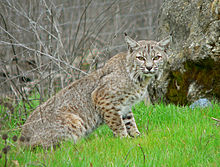
The Bengal tiger (Panthera tigris tigris) is the most numerous tiger. By 2011, the total population was estimated at fewer than 2,500 individuals with a decreasing trend.
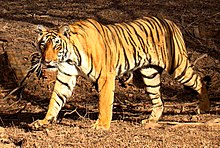
The Indochinese tiger (Panthera tigris corbetti) is a tiger subspecies occurring in Myanmar, Thailand, Lao PDR, Viet Nam, Cambodia and southwestern China.

The Malayan tiger (Panthera tigris jacksoni) is a tiger subspecies that inhabits the southern and central parts of the Malay Peninsula and has been classified as Critically Endangered by IUCN in 2015 as the population was roughly estimated at 250 to 340 adult individuals in 2013; this population likely comprises less than 250 mature breeding individuals, with a declining trend.
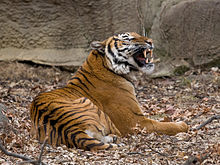
The Siberian tiger (Panthera tigris altaica), also called Amur tiger, is a tiger subspecies inhabiting mainly the Sikhote Alin mountain region with a small population in southwest Primorye Province in the Russian Far East. The Siberian tiger once ranged throughout all of Korea, north-eastern China, Russian Far East, and eastern Mongolia.

The Asiatic lion (Panthera leo persica), also known as the Indian lion and Persian lion, is a lion subspecies that lives as a single population in Gujarat, India. It is listed as Endangered on the IUCN Red List because of its small population size.
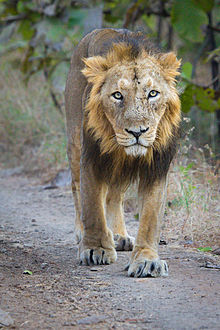
The West African lion (Panthera leo senegalensis), also called Senegal lion, was considered a lion subspecies native to Central and Western Africa.
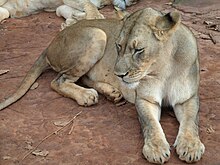
The Ethiopian lion (Panthera leo roosevelti syn. Panthera leo abyssinica), also called "Addis Ababa lion" or "Abyssinian lion," is considered a possible lion subspecies native to Ethiopia, following a genetic and phenotypic analysis on lions in Addis Abeba's zoo. Previously, researchers thought that the East African lion inhabited Ethiopia.
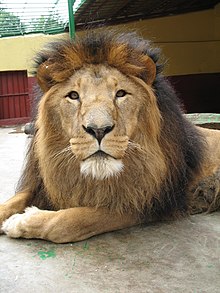
The Masai lion or East African lion (Panthera leo nubica syn. Panthera leo massaica) is a lion subspecies in eastern Africa. The type specimen is described as being from "Nubia".