# hono-honeypot
Security middleware for [Hono.js](https://hono.dev). A mini WAF and honeypot path blocker that intercepts vulnerability scanners (nuclei, nikto, sqlmap, dirbuster, gobuster, wpscan), bot crawlers, and brute-force probes before they reach your route handlers. Optionally bans repeat offenders by IP and reports them to AbuseIPDB.
Built from analyzing hundreds of thousands of real-world malicious requests in production. Pattern matching runs in sub-millisecond time across all Hono runtimes: Cloudflare Workers, Bun, Deno, Node.js, Vercel Edge, and Fastly Compute.
## What this is (and isn't)
`hono-honeypot` is **path-based attack pattern blocking** for Hono.js. It rejects requests to known scanner targets (`/wp-admin`, `/.env`, `/.git/`, `/actuator`, `/@fs/`, etc.) before they reach your handlers, optionally banning repeat offenders by IP. Treat it as a mini web application firewall (WAF), scanner deflector, or bot blocker.
| What it blocks | What it does NOT block |
|---|---|
| Vulnerability scanners: nuclei, nikto, sqlmap, dirbuster, gobuster, wpscan | Spam form submissions (use a hidden form-field trap for that) |
| WordPress, PHP, cPanel, phpMyAdmin probes | Application-level rate limits (use a separate rate limiter) |
| `.env`, `.git`, `.aws`, `.ssh` exfiltration attempts | DDoS and volumetric attacks (terminate at Cloudflare or upstream proxy) |
| Vite dev server exploits (CVE-2025-30208) | OWASP Top 10 injection against your own routes (input validation belongs in handlers) |
| Path traversal probes, SSRF cloud-metadata probes | Behavioral bot detection (use a fingerprint or device-intelligence service) |
| 200+ baked-in patterns covering Spring Actuator, Magento REST, Exchange OWA, IoT routers, K8s probes, CI/CD admin panels, and more | Authentication or authorization (this runs before your auth middleware) |
The name "honeypot" is figurative: when the IP store is enabled, scanners that probe the trap paths get stuck (struck and banned). It is **not** a form-field anti-spam honeypot.
### OWASP alignment
Reduces attack surface for [**OWASP Top 10 2025 A02 Security Misconfiguration**](https://owasp.org/Top10/2025/) (formerly A05:2021, ranked #2 in the 2025 edition). Specifically denies reconnaissance probes targeting:
- **Sample / legacy applications** left on production with default admin accounts (OWASP A02 Scenario #1: WordPress, phpMyAdmin, Adminer, Magento, cPanel)
- **Debug endpoints** insecure by default (Spring `/actuator`, Django `/__debug__`, Laravel `/_ignition`, Vite `/@fs/`)
- **Unnecessary features** enabled in production (admin panels, dev-tooling routes, IoT vendor backdoors)
- **Sensitive files** that should never be web-accessible (`.env`, `.git/`, `.aws/`, `.ssh/`, backup files, dependency manifests)
This is one layer of defense in depth, not a configuration auditor. Pair with proper hardening, secret management, and removal of unused frameworks.
## Install
```bash
npm install hono-honeypot
```
## Quick Start
```typescript
import { Hono } from 'hono'
import { honeypot } from 'hono-honeypot'
const app = new Hono()
app.use('*', honeypot())
```
That's it. 200+ attack patterns are blocked out of the box. Every option below is **optional**.
---
## API Reference
### `honeypot(options?)`
Returns Hono middleware. All options are optional.
```typescript
app.use('*', honeypot({
patterns, // RegExp[] — additional patterns to block
exclude, // RegExp[] — built-in patterns to remove
status, // 410 | 404 | 403 — response status (default: 410)
store, // HoneypotStore — enables IP strike/ban system
strikeThreshold, // number — strikes before ban (default: 3)
getIP, // (c: Context) => string — custom IP extraction
onBlocked, // (info: BlockInfo, c: Context) => void — custom block handler
log, // boolean — console logging (default: true)
}))
```
---
## Features
### Pattern Matching (stateless, zero-config)
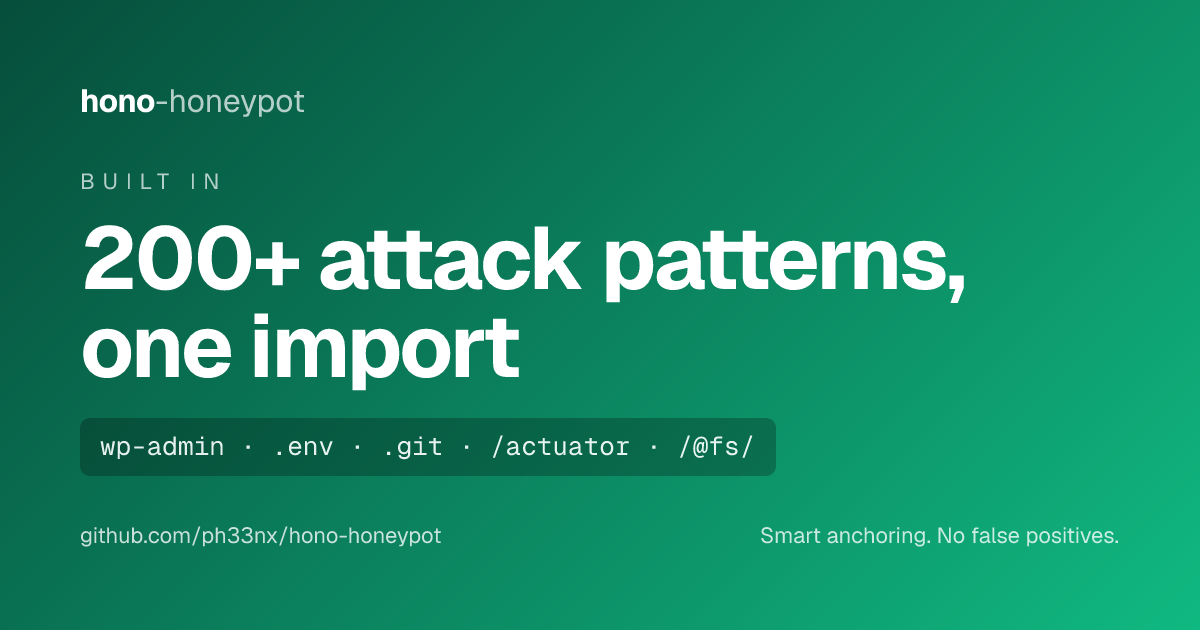
Out of the box, the middleware matches request paths against 200+ regex patterns covering:
| Category | Examples |
|----------|----------|
| PHP/WordPress | `*.php`, `/wp-admin`, `/xmlrpc.php`, `/wp-content/` |
| Admin panels | `/admin`, `/phpmyadmin`, `/cpanel`, `/cgi-bin` |
| CMS frameworks | `/typo3`, `/joomla`, `/drupal`, `/magento` |
| Magento REST API | `/rest/V1/store/storeConfigs` and store-scope variants |
| JS framework fingerprinting | `/_next`, `/_rsc`, `/_vercel`, `next.config.js`, `nuxt.config.ts` |
| Deployment configs | `serverless.yml`, `vercel.json`, `netlify.toml`, `package.json` |
| Docker/container | `docker-compose.yml`, `Dockerfile`, `/docker/` |
| AWS/cloud credentials | `/aws/*`, `aws_s3`, `aws_ses`, `/.aws/` |
| Version control | `/.git/`, `/.svn/`, `/.hg/` |
| Sensitive files | `/.env`, `/.htaccess`, `/.htpasswd`, `*.sql` |
| SSH/auth tokens | `/.ssh/`, `/id_rsa`, `/.npmrc`, `/.pypirc` |
| System path traversal | `/var/task/`, `/var/log/`, `/opt/` |
| Command injection | `$(pwd)`, backtick injection, `{curl,…}` brace expansion |
| Server-side template injection | `${...}` (SpEL / Log4Shell), `<%...%>` (ERB / JSP / ASP) — matched in both raw and percent-decoded form |
| URL normalisation probes | Zero-width Unicode (`U+200B`, `U+FEFF` BOM, U+200C–U+200F, U+202A–U+202E directional overrides) |
| Log files | `*.log`, `error_log` |
| Java/Spring Boot | `/WEB-INF`, `/manager/html`, `/solr`, `/actuator` |
| Dependency manifests | `composer.json`, `Gemfile`, `requirements.txt` |
| WYSIWYG editors | `/ckeditor`, `/tinymce`, `/elfinder` |
| OS metadata | `.DS_Store`, `Thumbs.db` |
| Backup files | `*.bak`, `*.old`, `*.backup`, `*.swp` |
| Path traversal / LFI | `../`, `..%2f`, `/etc/passwd`, `/proc/self/environ` |
| Vite dev server exploits | `/@fs/`, `/@vite/`, `/@id/` (CVE-2025-30208) |
| Laravel/Django debug | `/_ignition`, `/__debug__` |
| SSRF / cloud metadata | `/proxy/`, `169.254.169.254`, `/latest/meta-data` |
| IoT / router exploits | `/HNAP1/`, `/boaform/`, `/GponForm/`, `/setup.cgi` |
| Microsoft Exchange/SharePoint | `/owa/`, `/aspnet_client/`, `/ecp/`, `/_layouts/`, `/_vti_bin/` |
| Self-hosted apps | `/nextcloud/`, `/owncloud/`, `/WebInterface/` (CrushFTP) |
| Collaboration/monitoring | `/geoserver/`, `/confluence/`, `/jira/`, `/grafana/`, `/kibana/`, `/prometheus/` |
| CI/CD / DevOps | `/jenkins/`, `/portainer/`, `/gitea/`, `/gitlab/` |
| Database admin aliases | `/adminer`, `/pma/`, `/myadmin/`, `/mysqladmin`, `/dbadmin` |
| Webmail | `/roundcube/`, `/webmail/` |
| Kubernetes / container | `/metrics`, `/healthz`, `/readyz`, `/livez`, `/.dockerenv` |
| Brute force discovery | `/old`, `/test`, `/demo`, `/script`, `/2017`, `/2024` |
Patterns use smart anchoring to prevent false positives:
```
/admin → blocked (exact root match)
/api/admin → allowed (nested path, not root)
/login → allowed (legitimate app route)
/blog → allowed (legitimate app route)
```
### Custom Patterns
Add application-specific patterns. Merged with the built-in set.
```typescript
app.use('*', honeypot({
patterns: [
/^\/internal-api/i,
/^\/debug/i,
/\.zip$/i, // opt-in: block .zip downloads (not on by default — many apps serve legit .zip)
],
}))
```
> The built-in archive rule blocks `.7z`, `.tar(.gz)`, `.tgz`, `.bz2`, `.war`, and `.jar`, but **not `.zip`** — it is too commonly served legitimately (exports, bundles). Add `/\.zip$/i` if your app never serves zip downloads.
### Excluding Built-in Patterns
Remove specific built-in patterns by matching their regex source string.
```typescript
app.use('*', honeypot({
exclude: [
/^\/admin(\.php)?$/i, // Allow your own /admin route
],
}))
```
### Response Status
Default is `410 Gone`. Alternatives: `404`, `403`.
```typescript
app.use('*', honeypot({ status: 404 }))
```
Why `410 Gone` is the default:
- Google and Bing prioritize `410` for faster deindexing over `404`
- Scanners with retry logic treat `410` as permanent and stop faster than `404`
- Empty response body minimizes bandwidth under high-volume probing
#### Blocked responses are always uncacheable
Every blocked response ships `Cache-Control: no-store` and `CDN-Cache-Control: no-store`, whichever
status you choose. This is not configurable, and the reason matters if you run behind a CDN.
**A blocked response is a statement about the caller, not about the URL.** A CDN cache key contains
no caller component, so a cached block gets replayed to everyone. The ban path makes that concrete:
a banned visitor is blocked on **every** path, including your real pages, so one banned IP
requesting your pricing page could have the edge store "gone" under that URL and serve it to the
next visitor. Cloudflare caches `404` and `410` for about 3 minutes by default, and `410` is the
status search engines act on fastest, so the cached entry is a deindexing signal pointed at a live
page.
This was measured, not theorised: on a production Hono app behind Cloudflare, with a single IP
banned, a live page returned `410` with `cf-cache-status: HIT` and `age: 123`.
If you want your CDN to absorb scanner floods at the edge, scope a cache rule to the attack paths
in your CDN config. That decision belongs where the paths are known, not on a response whose
meaning depends on who sent it.
---
## IP Strike/Ban System
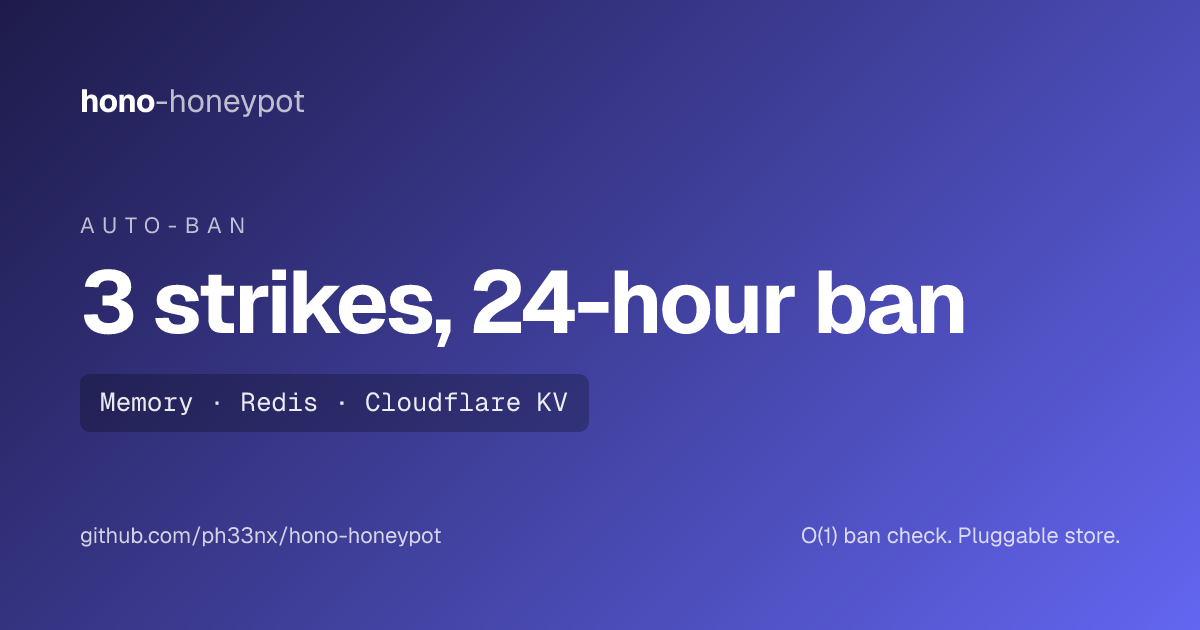
Without a store, the middleware is stateless: it blocks matching paths but imposes no penalty on repeat offenders. With a store, it tracks strikes per IP and bans IPs that exceed the threshold.
**Flow:**
1. Request matches attack pattern → strike recorded against IP
2. IP reaches `strikeThreshold` (default: 3) → IP is banned
3. Banned IP sends any request → instant `410` response, no pattern matching needed (O(1) lookup)
### MemoryStore (built-in)
In-process Map-based store with lazy TTL expiry. Suitable for single-process deployments and development.
```typescript
import { honeypot, MemoryStore } from 'hono-honeypot'
app.use('*', honeypot({
store: new MemoryStore({
strikeTTL: 3600, // optional — strike window in seconds (default: 3600 / 1 hour)
banTTL: 86400, // optional — ban duration in seconds (default: 86400 / 24 hours)
}),
strikeThreshold: 3, // optional — default: 3
}))
```
> **Note:** MemoryStore state is per-isolate. In multi-process, clustered, or serverless environments, use a shared store (Redis, KV, etc.).
### Custom Store (Redis, KV, etc.)
Implement the `HoneypotStore` interface to use any storage backend. All methods may return sync values or Promises.
```typescript
interface HoneypotStore {
/** Check if IP is banned. Called before pattern matching (fast path). */
isBanned(ip: string): Promise | boolean
/** Record a strike. Return new total count. */
addStrike(ip: string): Promise | number
/** Ban an IP. Called when strikes >= threshold. */
ban(ip: string): Promise | void
/** Clear strikes. Called after ban is set. */
resetStrikes(ip: string): Promise | void
}
```
#### Redis example (ioredis)
```typescript
import type { HoneypotStore } from 'hono-honeypot'
import Redis from 'ioredis'
const redis = new Redis()
const redisStore: HoneypotStore = {
async isBanned(ip) {
return (await redis.exists(`honeypot:ban:${ip}`)) === 1
},
async addStrike(ip) {
const key = `honeypot:strikes:${ip}`
const count = await redis.incr(key)
if (count === 1) await redis.expire(key, 3600)
return count
},
async ban(ip) {
await redis.setex(`honeypot:ban:${ip}`, 86400, '1')
},
async resetStrikes(ip) {
await redis.del(`honeypot:strikes:${ip}`)
},
}
app.use('*', honeypot({ store: redisStore }))
```
#### Cloudflare KV example
```typescript
import type { HoneypotStore } from 'hono-honeypot'
function createKVStore(kv: KVNamespace): HoneypotStore {
return {
async isBanned(ip) {
return (await kv.get(`honeypot:ban:${ip}`)) !== null
},
async addStrike(ip) {
const key = `honeypot:strikes:${ip}`
const current = parseInt((await kv.get(key)) || '0')
const count = current + 1
await kv.put(key, String(count), { expirationTtl: 3600 })
return count
},
async ban(ip) {
await kv.put(`honeypot:ban:${ip}`, '1', { expirationTtl: 86400 })
},
async resetStrikes(ip) {
await kv.delete(`honeypot:strikes:${ip}`)
},
}
}
app.use('*', honeypot({ store: createKVStore(env.KV) }))
```
---
## IP Extraction
Default extraction chain: `cf-connecting-ip` > `x-forwarded-for` (first entry) > `x-real-ip` > `'unknown'`.
IPs resolving to `'unknown'` or empty string are not tracked by the strike system (prevents false bans when IP cannot be determined).
Override with a custom function:
```typescript
app.use('*', honeypot({
getIP: (c) => c.req.header('x-real-ip') || 'unknown',
}))
```
---
## Block Handler (`onBlocked`)
Custom callback fired on every blocked request. When provided, suppresses built-in console logging.
The handler receives the `BlockInfo` and the Hono `Context` (use `c` to read request data or env bindings such as `c.env.ABUSEIPDB_API_KEY` on Cloudflare Workers, where `process.env` is empty).
```typescript
app.use('*', honeypot({
onBlocked: (info, c) => {
// info.ip — client IP
// info.path — normalized request path
// info.method — HTTP method
// info.reason — 'pattern' | 'banned'
// info.strikes — current strike count (when store is active, pattern matches only)
// info.banned — true if this request triggered a new ban
logger.warn(`honeypot: ${info.reason} ${info.ip} ${info.method} ${info.path}`)
if (info.banned) {
metrics.increment('honeypot.bans')
}
},
}))
```
Without `onBlocked`, the middleware logs to console when `log: true` (default):
```
🍯 Blocked [203.0.113.5] GET /wp-admin
🚫 Banned [203.0.113.5] GET /.env BANNED
```
Set `log: false` to suppress all output:
```typescript
app.use('*', honeypot({ log: false }))
```
---
## AbuseIPDB Reporting (optional)
Contribute your scanner sightings back to [AbuseIPDB](https://www.abuseipdb.com/) so banned IPs build community reputation. It ships as a **separate subpath export** (`hono-honeypot/abuseipdb`) so the core middleware stays zero-dependency and vendor-neutral — import it only if you want it.
```typescript
import { honeypot, MemoryStore } from 'hono-honeypot'
import { abuseIPDBReporter } from 'hono-honeypot/abuseipdb'
app.use('*', honeypot({
store: new MemoryStore(),
onBlocked: abuseIPDBReporter(), // reports an IP when it crosses the ban threshold
}))
```
**Why pass the key, not auto-read `process.env`?** On Cloudflare Workers — a primary target runtime — `process.env` is empty by default; bindings arrive on `c.env`. The reporter resolves the key in this order: an explicit `apiKey` → `c.env[envKey]` → `process.env[envKey]` (default env var `ABUSEIPDB_API_KEY`). With no key resolvable it is a silent no-op, so it is safe to wire up unconditionally.
```typescript
// Explicit / Cloudflare Workers binding:
abuseIPDBReporter({ apiKey: (c) => c.env.ABUSEIPDB_API_KEY })
// Node (reads process.env.ABUSEIPDB_API_KEY automatically):
abuseIPDBReporter()
```
It **reports only when an IP is banned** (`info.banned`), keeping you well under AbuseIPDB's free-tier limits (1000 reports/day, 15-minute dedup per IP). It is fire-and-forget — never throws, never blocks the request, swallows rate-limit and network errors.
| Option | Type | Default | Description |
|--------|------|---------|-------------|
| `apiKey` | `string \| (c) => string` | env | Key, or a resolver from context |
| `envKey` | `string` | `'ABUSEIPDB_API_KEY'` | Env var name to resolve the key from |
| `fetch` | `Fetcher` | `globalThis.fetch` | Injected fetcher (Workers binding / tests); any fetch-like fn |
| `categories` | `string` | `'21,19'` | Report categories (Web App Attack, Bad Web Bot) |
| `reportOn` | `(info) => boolean` | `info.banned` | When to report |
| `comment` | `(info) => string` | probe line | Public report comment (sanitized, capped) |
| `endpoint` | `string` | AbuseIPDB v2 | Report endpoint override |
> Requires a store (so IPs can be banned). The comment is published publicly on AbuseIPDB — it carries only the attacker's own request line, sanitized to printable ASCII and capped, never your routes or infrastructure.
---
## Exports
```typescript
import { honeypot, MemoryStore } from 'hono-honeypot'
import type { HoneypotOptions, HoneypotStore, BlockInfo } from 'hono-honeypot'
import { abuseIPDBReporter } from 'hono-honeypot/abuseipdb'
import type { AbuseIPDBOptions } from 'hono-honeypot/abuseipdb'
```
| Export | Path | Type | Description |
|--------|------|------|-------------|
| `honeypot` | `hono-honeypot` | function | Middleware factory |
| `MemoryStore` | `hono-honeypot` | class | Built-in in-memory store |
| `HoneypotOptions` | `hono-honeypot` | interface | Options type |
| `HoneypotStore` | `hono-honeypot` | interface | Store adapter contract |
| `BlockInfo` | `hono-honeypot` | interface | Block event payload |
| `abuseIPDBReporter` | `hono-honeypot/abuseipdb` | function | AbuseIPDB `onBlocked` reporter factory |
| `AbuseIPDBOptions` | `hono-honeypot/abuseipdb` | interface | Reporter options type |
| `Fetcher` | `hono-honeypot/abuseipdb` | type | Injectable fetch-like signature |
---
## Performance
| Metric | Value |
|--------|-------|
| Pattern matching overhead | <1ms per request |
| Ban check (store) | O(1) lookup, runs before pattern matching |
| Memory footprint | ~10KB (pattern array) |
| Bundle size | Zero dependencies beyond `hono` peer dep |
---
## Runtime Compatibility
Tested on all Hono.js runtimes: Cloudflare Workers, Bun, Deno, Node.js (>=18), Vercel Edge Functions, Fastly Compute.
## AI Agents
This package ships `AGENTS.md` in the published npm bundle. AI coding agents (Claude Code, Cursor, GitHub Copilot, OpenAI Codex, Gemini CLI) that support `AGENTS.md` will read it automatically from `node_modules/hono-honeypot/AGENTS.md`.
---
## FAQ
**How do I block vulnerability scanners in Hono?**
Add `app.use('*', honeypot())`. It ships 200+ patterns that match the paths nuclei, nikto, sqlmap, dirbuster, gobuster, and wpscan probe for (`/wp-admin`, `/.env`, `/.git/`, `/actuator`, `/@fs/`, …) and returns `410 Gone` before the request reaches your handlers.
**Does it work as a WAF on Cloudflare Workers without a paid plan?**
Yes. It is a code-level mini WAF that runs in your Worker (and on Bun, Deno, Node.js, Vercel Edge, Fastly Compute) with zero dependencies — no Cloudflare WAF subscription needed. Read env bindings via `c.env`, not `process.env`.
**How do I ban repeat attackers by IP?**
Pass a `store` (`new MemoryStore()` for single-process, or a Redis/KV adapter for distributed). After `strikeThreshold` matches (default 3), the IP is banned and every later request gets an O(1) `410`.
**How do I report attackers to AbuseIPDB from Hono?**
Import `abuseIPDBReporter` from `hono-honeypot/abuseipdb` and pass it as `onBlocked`. It reports each IP once, when it is banned. See [AbuseIPDB Reporting](#abuseipdb-reporting-optional).
**Will it block my own `/admin` route?**
The literal path `/admin` is blocked, but `/api/admin`, `/admin/settings`, etc. are not (the pattern is root-anchored). If you serve a real panel at exactly `/admin`, exclude it: `honeypot({ exclude: [/^\/admin(\.php)?$/i] })`.
**Is it a form-field / spam honeypot?**
No. "Honeypot" here is figurative — it traps path scanners, not form bots. It is not a rate limiter, DDoS protection, or auth layer.
## Roadmap
Longer-term direction and the research behind it live in [`docs/live-ruleset-sync.md`](./docs/live-ruleset-sync.md) — the case for (and against) turning this into a live-updating WAF. Help wanted on:
- [ ] **Opt-in live ruleset sync** — auto-fetch a maintained path feed on a schedule, cache it (memory/Redis/KV), fail safe to the bundled patterns. Ships as a separate `hono-honeypot/rules-sync` export so the core stays zero-dependency. ([design](./docs/live-ruleset-sync.md#architecture-when-built--opt-in-fail-safe))
- [ ] **Supply-chain hardening for fetched rules** — trusted-URL allowlist, hash/signature verification, ReDoS sanitization, pattern caps. ([details](./docs/live-ruleset-sync.md#supply-chain-safety-must-non-negotiable))
- [ ] **Coraza/OWASP CRS adapter** — once a real JS/edge WASM build exists, prefer a proper WAF engine over hand-syncing path lists.
- [ ] **More real-traffic patterns** — high-signal, low-false-positive paths from production scanner traffic (not discovery wordlists).
Have a fresh scanner path slipping through, or a false positive? Open an issue with the request line.
## Contributing
Issues and PRs welcome at [github.com/ph33nx/hono-honeypot](https://github.com/ph33nx/hono-honeypot)
Maintainers: `docs/maintenance.md` covers the dependency cadence, the supply-chain cooldown, the
current TypeScript hold and why it exists, and the rule that `bun run build` must pass before any
release (the dts step fails on things `tsc --noEmit` accepts).
## License
MIT