# 🧠 dsh-memory-eternal — A "second brain" for your AI



> **Auto-captures knowledge after every conversation and survives across sessions; recall fetches only the relevant chunks — saves tokens, less noise.**
> Fully self-built, zero third-party memory framework, no DSH source changes, one vault shared by every Agent, plain Markdown & git-manageable.
⭐ Star it if you like it!
DSH one-liner: dsh plugin --profile web add dsh-memory-eternal
---
## 🚀 Get Started in 5 Minutes
### 🟦 DeepSeek Harness (DSH) — focus
**Install** (dsh-desktop via DSH CLI, one command):
```bash
# dsh-desktop (recommended): install via DSH CLI into the profile
dsh plugin --profile web add dsh-memory-eternal
# or update directly in the profile (pnpm workspace). Use pnpm — `npm install` throws EUNSUPPORTEDPROTOCOL
cd ~/.dsh/profiles/web && pnpm add dsh-memory-eternal@latest
```
After **restarting dsh web**, three things are live immediately:
| Effect | Where |
|---|---|
| Auto-capture of knowledge cards | Happens every turn, no action needed |
| `memory_recall` tool | Agent calls it automatically when it needs history |
| Visual UI | Sidebar bottom `Memory` button / Settings → Memory |
**Entry**: The sidebar-footer `Memory` button opens the vault (its left rail includes Cards / Graph / Usage / **Audit Center** / Recycle Bin / **Memory Config**); "DSH Settings → Memory" is the pure config page.
**Edit config**: Vault left rail "Memory Config" (or DSH Settings → Memory) → DSH memory config / cost control / auto-audit config / self-hosting — just hit "Save Config". `autoWebMode` / `watchdogAutoSpawn` changes require a DSH restart.
### 🟨 Claude Code
```bash
npm i -g dsh-memory-eternal # installs CLI + MCP (auto-writes ~/.claude.json + SessionEnd hook)
```
Ready after install: say "recall 数据库选型" in a session → auto-retrieves memory; on session end / before context compaction → auto-captures.
### 🟧 Codex CLI / Cursor
```bash
npm i -g dsh-memory-eternal # auto-writes Codex config.toml / Cursor mcp.json
```
Restart the tool → MCP is in the list; just use: `用 memory_recall 查一下项目历史决策`.
### 🟩 Browser (no Agent needed)
```bash
dsh-memory open # starts web + opens browser (default http://127.0.0.1:7999)
```
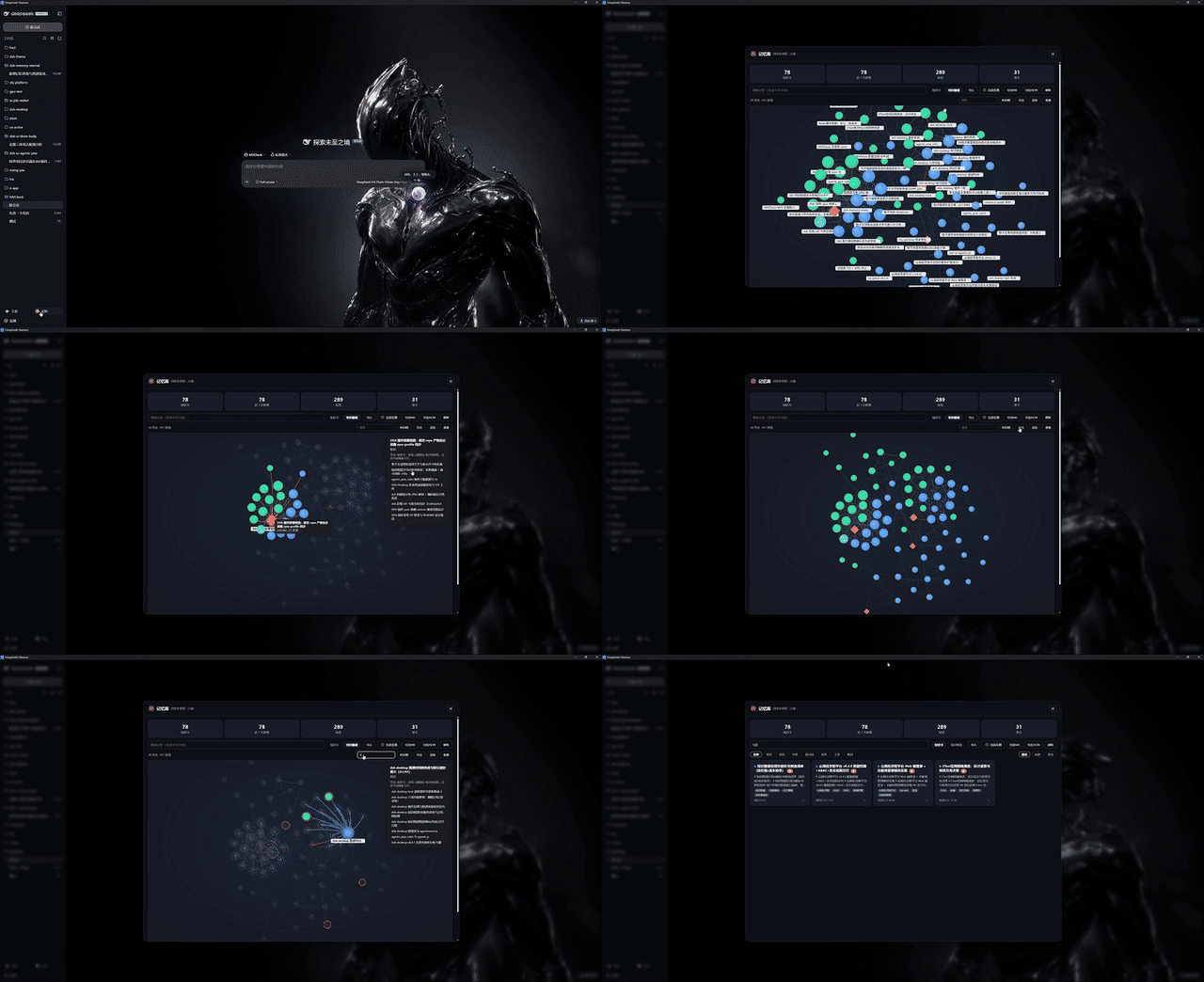
Stats / search / card grid (add-edit-merge-import-export) / knowledge graph — all here. Same UI as the DSH embed; data stays in sync.
> **zcode (Zhipu)**: no native MCP; bridge via [zcode-open-bridge](https://github.com/tizerluo/zcode-open-bridge) or use the CLI directly.
---
## 📖 Command Reference
```bash
dsh-memory recall "database selection" # retrieve
dsh-memory capture "important note..." # manual capture (- reads stdin)
dsh-memory sweep ~/.claude/projects # mine existing sessions
dsh-memory setup [--dry-run] # re-run / preview auto-mount (idempotent)
dsh-memory mcp # MCP stdio (mount to any MCP client)
dsh-memory serve [--port 7999] # run web in foreground
dsh-memory open # ensure web alive + open browser
dsh-memory watchdog [--port 7799] # watchdog keep-alive (standalone process)
```
When not running on DSH, the `dsh-memory` command comes from `npm i -g`.
---
## ⚙️ Self-hosting (plain words)
Three concepts, don't mix them:
- **How the web server stays alive** (`autoWebMode`) → `init`=pull once at DSH start (default); `interval`=DSH in-process timer probes & auto-restarts (0 extra memory); `manual`=fully manual, only from `dsh-memory open`.
- **Watchdog process** (`watchdogAutoSpawn`, default on) → a **standalone** node process that can pull web up even after DSH exits (~+47 MB RAM). Only turn on for 7×24 keep-alive.
- **Auto-mount MCP** (`autoMcpSetup`, default off) → whether to auto-write MCP into Claude Code/Codex/Cursor config. Off = don't touch your machine config; run `dsh-memory setup` manually when needed.
**Change these**: Vault left rail "Memory Config" (or DSH Settings → Memory) → edit the table and save; `autoWebMode` / `watchdogAutoSpawn` need a DSH restart.
**MCP is a protocol, not a resident service**: the agent spawns it per session and exits when done — no "auto-start on boot" concept.
### Three deployment intensities
| Scenario | Config | Memory |
|---|---|---|
| Personal dev (default) | `autoWebMode=init` + `watchdogAutoSpawn=off` | web 47 MB |
| Resident 7×24 | `watchdogAutoSpawn=on` | web + watchdog 47+47 MB |
| True boot auto-start (no DSH) | Windows Task Scheduler runs `dsh-memory watchdog --port 7799 --interval 5000 --max-restart 10` | same |
---
## ⚙️ Memory Config (plain words)
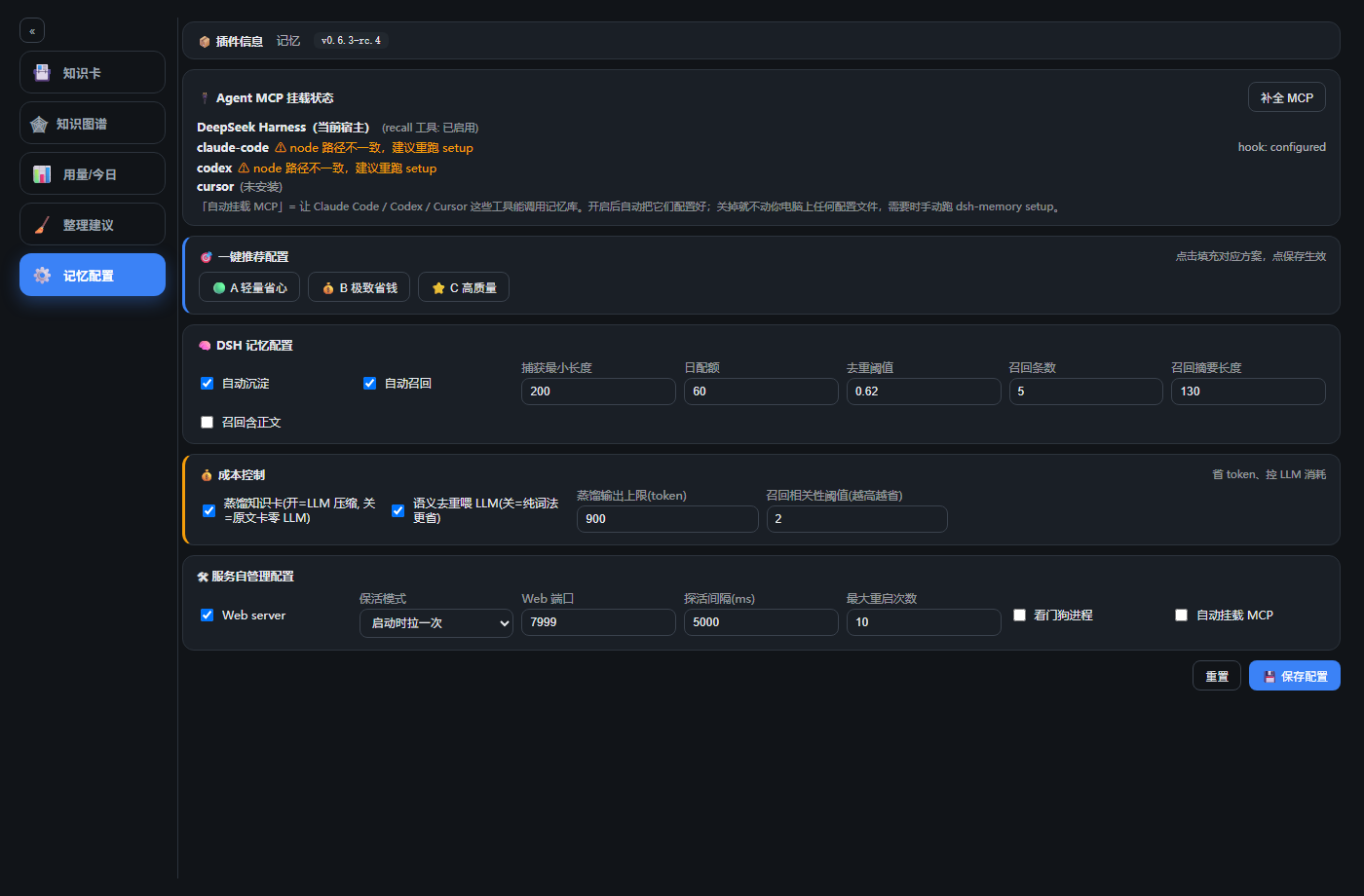
> All settings live in the **vault left rail "Memory Config"** (or DSH Settings → Memory) — edit and hit "Save". Here's the full page (plugin info / Agent MCP mount status / auto-audit config):
### 1. Most used
| Setting | Default | In plain words |
|---|---|---|
| Auto capture | on | auto-store useful content as cards after each turn |
| Auto recall | on | AI auto-queries memory when it needs history |
| Vault dir | `~/.dsh/memory-vault` | where memory lives, plain Markdown & git-able |
### 2. Save money (important)
| Setting | Default | In plain words |
|---|---|---|
| **Distill cards** | on | **compress** a conversation into a sharp card (calls AI, costs money). **Off = store raw text, zero cost** |
| **Dedup feeds AI** | on | judge if new content is a duplicate (calls AI). **Off = simple dedup**, saves one AI call |
| Distill output cap | 900 | max chars per compress, bigger = sharper but pricier |
| Recall min score | 2 | how "close" a match must be to return; bigger = sharper but leaks more (cheaper) |
| Min capture chars | 200 | too-short chats aren't stored (avoids small-talk waste) |
| Daily quota | 60 | max cards per day, prevents AI burning money |
### 3. How the service runs
| Setting | Default | In plain words |
|---|---|---|
| Keep-alive `autoWebMode` | init | `init`=open web once at DSH start; `interval`=periodically check & restart if dead; `manual`=fully manual |
| Watchdog `watchdogAutoSpawn` | on | a **standalone process** keeps web alive (+47 MB). Personal use can turn off |
| Auto-mount MCP `autoMcpSetup` | off | **lets Claude Code / Codex / Cursor use your memory**. On = auto-configures them; Off = never touches your config, run `dsh-memory setup` manually |
> 💰 **To save money**: turn `Distill cards` off, lower `Distill output cap`, raise `Recall min score`.
### 🎯 One-click presets
Top of the config page: **🟢 A Light / 💰 B Budget / ⭐ C Premium** — click to fill, then Save:
| Plan | Scenario | Keep-alive | Watchdog | Distill | Distill cap | Recall min | Memory | LLM cost |
|---|---|---|---|---|---|---|---|---|
| 🟢 **A Light** | Personal dev (default) | init | off | on | 900 | 2 | ~47 MB | normal |
| 💰 **B Budget** | Tight budget / many Agents | init | off | **off** | 500 | 3 | ~47 MB | **~0** |
| ⭐ **C Premium** | Long projects / teams | interval | **on** | on | 1200 | 1 | ~94 MB | high |
---
## 🛡️ Audit Center & Recycle Bin
New cards go to the **Audit Center** (`pending`) by default and enter the main vault only after you approve them; rejected ones move to "Rejected", where you can restore or delete to the recycle bin. Cards matching an exemption (audit mode = skip all / exempt agents / exempt kinds) go straight in; recycle-bin cards are recoverable within 30 days, then auto-purged.
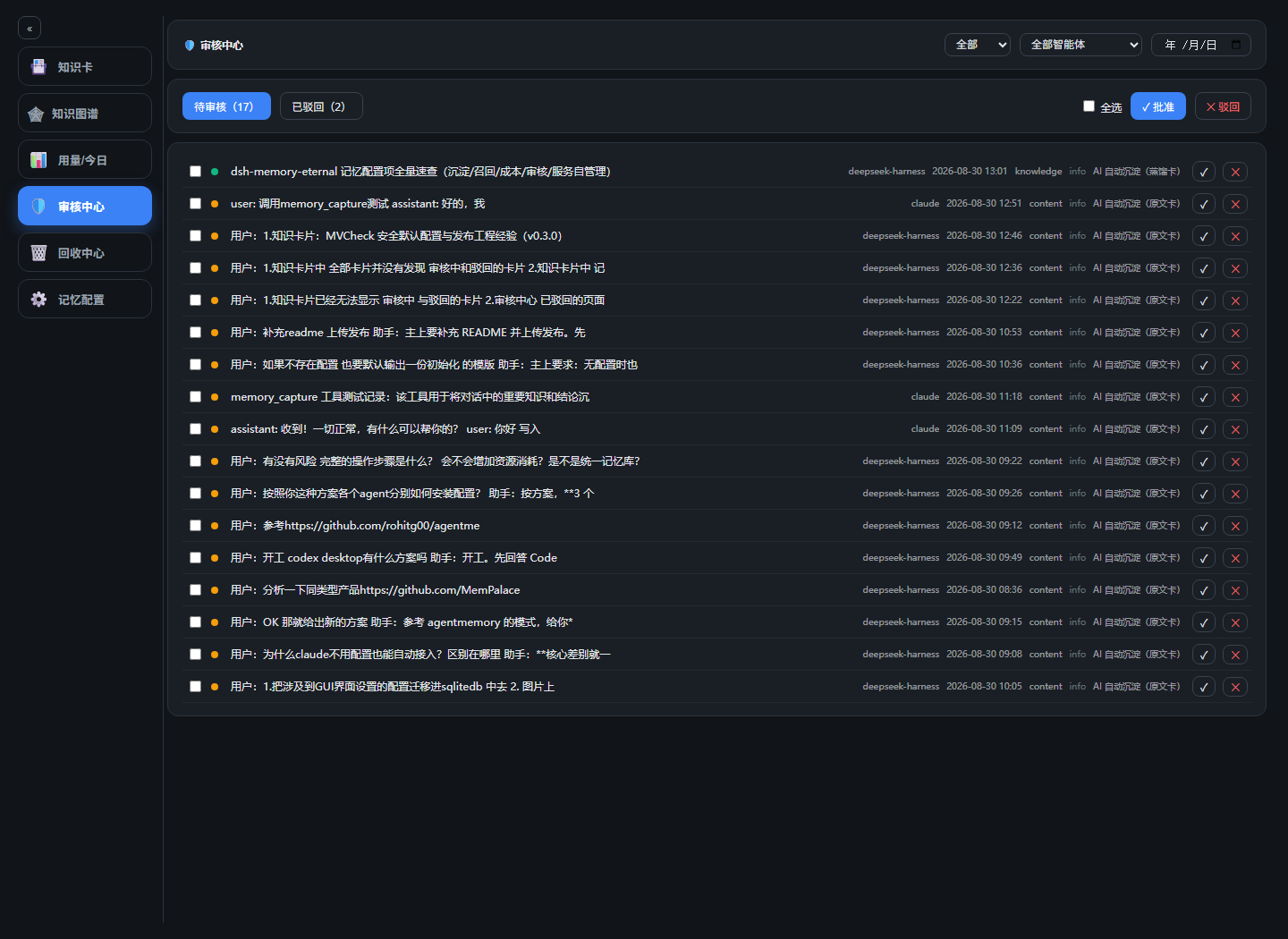
- **Pending / Rejected** tabs, filtered by type / date / agent; select all and approve / reject / delete-to-recycle in one click.
- Rules in "Memory Config → Auto-audit config": `audit mode` (audit all / skip all) + `exempt agents` + `exempt kinds` + `recycle retention days`.
---
## 🧬 Why Fully Self-built
Most memory solutions lean on third-party frameworks / spin up an MCP service / lock memory in a private store. This plugin builds the skeleton itself — **zero third-party runtime deps**, logic readable line by line:
| Module | Self-built | Replaces |
|---|---|---|
| Dedup | lexical Jaccard bigram (0.62) + semantic dedup | duplicate-card prevention |
| Retrieval | CJK-aware: Chinese whole-word + char bigram | no full-text search engine needed |
| Graph | force-directed + `[[wikilink]]`/shared-tag edges | see knowledge links at a glance |
| Storage | plain `.md` with frontmatter | not locked in, readable, git-able, any tool can read |
> Same direction as popular projects (summarize→store→recall), but positioned differently: **local, self-built, zero-dep, readable & controllable**. If you already use mem0/Zep etc., just layer this as a "local persistent memory base".
---
## 🛠 Development / Test
```bash
npm i
npm test # unit tests: vault dedup/retrieval/graph + capture pipeline + API shapes
npm run build # builds lib/client.js (DSH embed) + web/app.js (standalone web bundle)
```
---
## 📄 License
MIT
---
> **Make your AI truly remember: dialogue auto-captured, knowledge at your fingertips.** ⭐ Star it if you like, Let's make AI not forget.
>
> 中文 README: [README.md](README.md)