# Docxodus
**View, edit, and diff Word `.docx` files in the browser.** No server, no upload, no conversion
round-trip — a real OOXML engine compiled to WebAssembly, wrapped in TypeScript.
```bash
npm install docxodus
```
---
## Diff two documents into a redline Word will open
`compareDocuments()` returns a `.docx` carrying **native Word tracked changes** — `w:ins`, `w:del`,
and true move markup — not a text diff with highlighting. Open it in Word and accept/reject as usual.
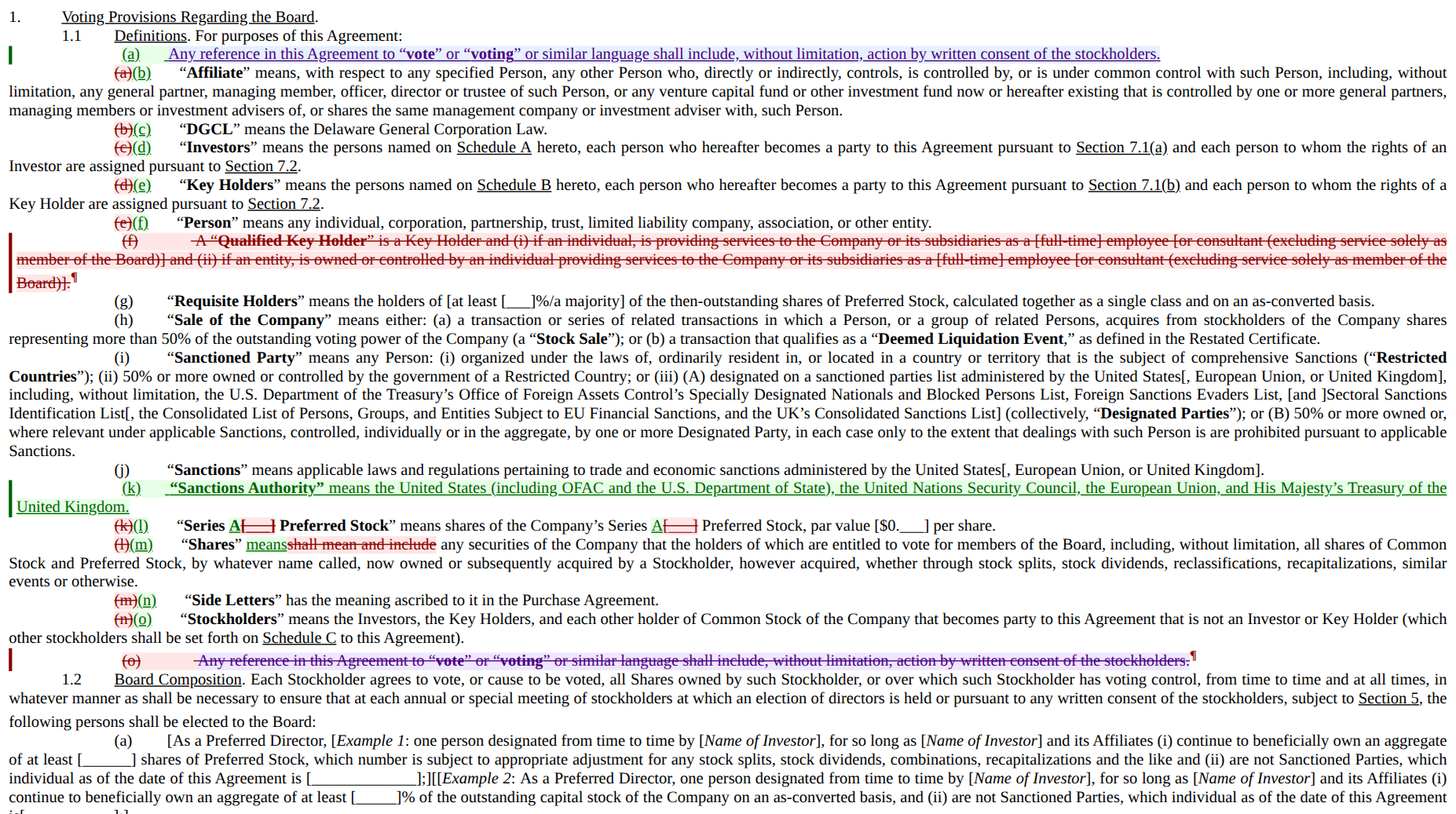
*Real output. One frame: a struck definition, an inserted definition, word-level substitutions inside
an untouched sentence, and a clause **moved** — struck in purple at the bottom, re-inserted at the top,
linked as one operation instead of reported as an unrelated delete and insert.*
`getRevisions()` gives you the same changes as structured data — typed, with move pairing and stable
`kind:scope:unid` anchors — so you can drive a review UI without parsing OOXML.
For audit and verification workflows, `docxDiffGetSemanticChanges(left, right)` returns the stable
`docxodus.semantic-changes` v1 object. It distinguishes content, formatting, structure, table,
story/review, relationship/media, and opaque-package families, with typed before/after values and
deterministic ids. An open session exposes the same opening-to-current comparison through
`session.getSemanticChanges()`; it requires the default `captureInitialProjection: true` setting.
See the [semantic diff contract](../docs/architecture/semantic_diff.md).
## Render a document faithfully
`convertDocxToHtml()` keeps what naive converters drop: justification, style inheritance, legal
numbering, tables, images, comments, headers and footers, and real footnotes with back-references.
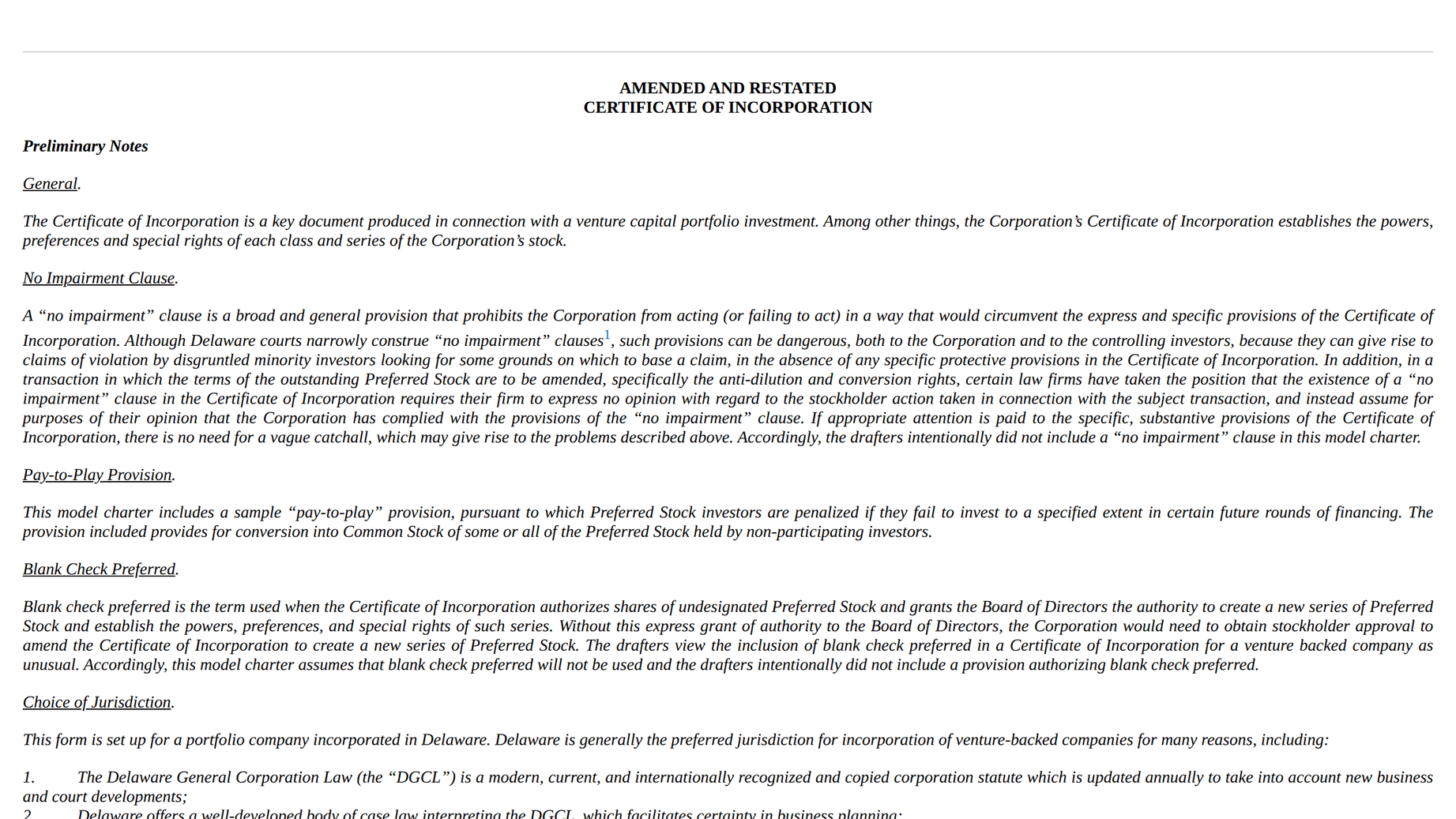
Paginated mode flows content into real page boxes with per-page numbers and page-anchored footnotes —
a print-accurate preview in the browser.
Supply an exact layout token to materialize portable page citations from that layout:
```ts
const result = paginateHtml(html, viewer, {
layoutToken: { documentVersion: session.getVersion(), rendererFingerprint: 'chromium-layout-v1' },
});
session.registerPageMap(result.pageMap!, 'chromium-layout-v1');
const citation = session.getPageCitation(anchorId, {
documentVersion: session.getVersion(),
rendererFingerprint: 'chromium-layout-v1',
});
navigateToPageCitation(viewer, citation);
```
Continuous renderers return explicit unavailability; Docxodus never estimates a citation page.
See the [PageMap contract](../docs/architecture/page_map.md).
## Edit it in place
`DocxEditor` is a framework-agnostic block editor over the live document. Edits go through a
`DocxSession`, and **only the changed block re-renders**, so structural operations cost ~90–360 ms on
a 346-block, 94-footnote filing template. `save()` returns lossless bytes.
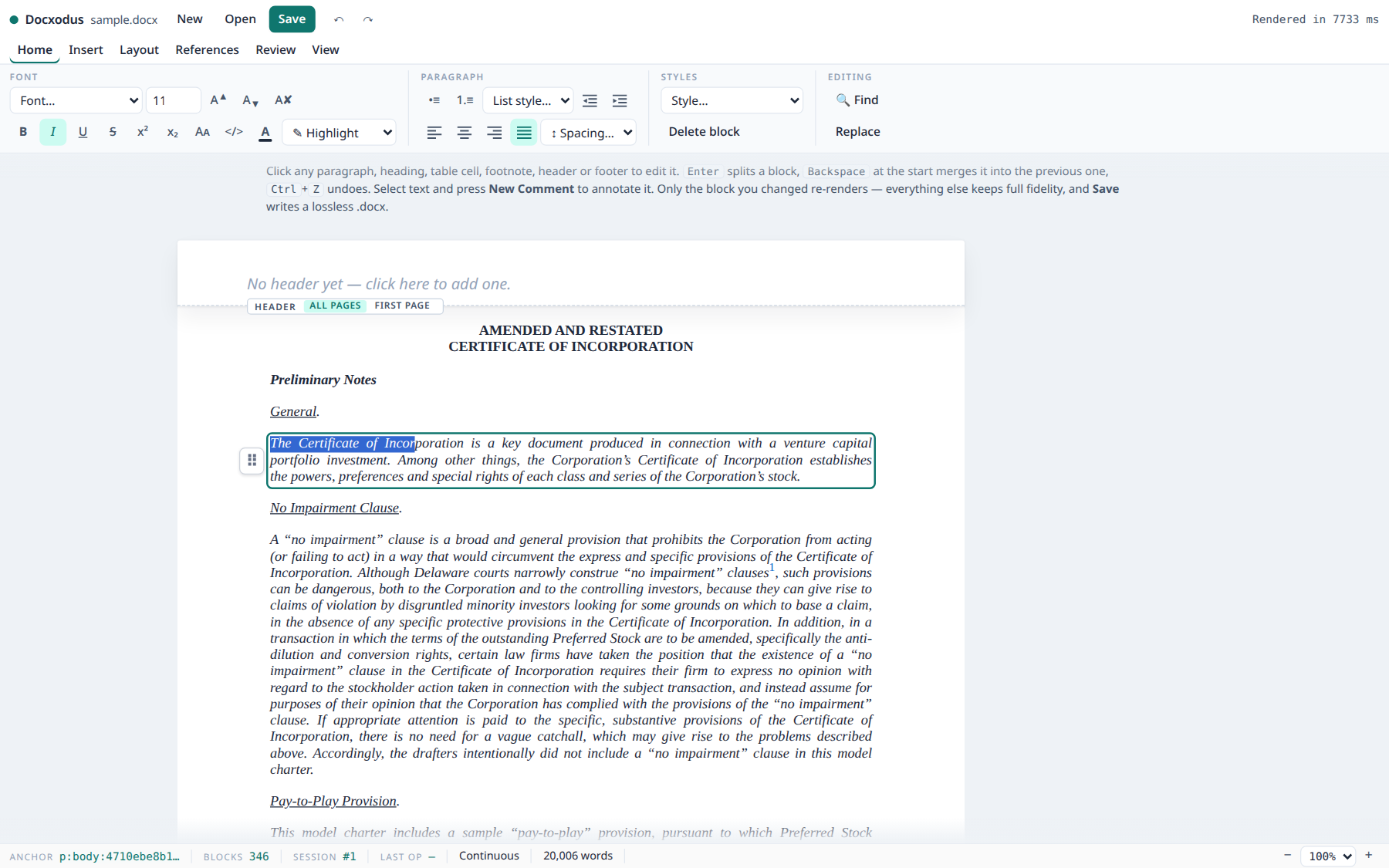
Two layers, so you can take as much UI as you want:
```ts
// The engine, with no chrome — bring your own UI.
import { DocxEditor } from 'docxodus';
const editor = DocxEditor.open(container, docxBytes, exports);
// Long document? Mount it in windows instead, yielding to the event loop between them, so the
// tab stays responsive and you can show progress. The result is the same editor and the same DOM.
const editor = await DocxEditor.openAsync(container, docxBytes, exports, {
windowSize: 24,
onProgress: (mounted, total) => console.log(`${mounted}/${total} blocks`),
});
// Or the whole surface: Word's tabbed ribbon (fonts, colour, styles, find & replace, links,
// pictures, tables, page setup, tracked changes), Word-style comment bubbles beside the page,
// in-place header/footer editing, a status bar with zoom, and the loading overlay.
import { mountRibbon } from 'docxodus';
const ribbon = mountRibbon(container, { exports });
ribbon.open(docxBytes, 'contract.docx');
```
The ribbon picks its layout from the width of the element you give it, so the same call serves a
full-page editor and a narrow embedded panel. [`examples/editor.html`](https://github.com/JSv4/Docxodus/blob/main/npm/examples/editor.html)
is a host for it in ~60 lines.
## Embed it with one script tag
The `embed` entry packages the viewer and editor behind one-call factories, with the WASM
runtime location auto-detected — no build step, no configuration:
```html
```
That gives you the full editor UI. `createEditor('#doc', source, options?)` is the same document
without the chrome, and `createViewer('#doc', source, options?)` is the read-only counterpart.
Bundler users get the same API from `docxodus/embed`; classic-script pages can load
`dist/embed.iife.js` for a global `Docxodus`. See [Embedding via CDN](#embedding-via-cdn) below.
## Project it for an LLM
`convertWmlToMarkdown()` renders the document as markdown where **every block carries a stable id**,
so an agent can point at a clause and edit it — and `openDocxSession()` writes back to that same id.
Multi-step plans are atomic by default. Each callback may call any synchronous
session mutation; success is one version/undo unit, while a failure or throw
restores the complete package and history checkpoint:
```ts
const result = session.executeBatch([
{ tool: 'docx_edit', action: 'replace_text',
mutation: () => session.replaceText(firstAnchor, 'Replacement text') },
{ tool: 'docx_create', action: 'set_header_text',
mutation: () => session.setHeaderText(firstAnchor, 'default', 'Confidential') },
]);
if (!result.success) console.error(result.failure);
```
Pass `'best_effort'` explicitly only when partial successes should be retained.
A retry after a lost response must not apply the edit twice. Give the batch a transaction id
and a serializable description of what it does; an identical retry returns the original result
without executing again, and reusing the id for a different request fails with
`transaction_conflict`:
```ts
const result = session.executeBatch(steps, 'atomic', {
transactionId: 'plan-42-step-3',
request: { replace: firstAnchor, header: 'Confidential' },
});
result.transaction; // { schemaVersion: 1, transactionId, requestFingerprint }
```
`previewBatch` answers "what would this do?" without touching the live session. It runs the
same steps against a complete isolated clone — each callback is handed the shadow session to
mutate — and returns the same receipt plus optional predicted HTML:
```ts
const preview = session.previewBatch([
{ tool: 'docx_edit', action: 'replace_text',
mutation: shadow => shadow.replaceText(firstAnchor, 'Proposed replacement') },
], 'atomic', { html: 'full' });
console.log(preview.html, preview.revisionChanges.added, preview.warnings);
```
The live document's bytes, version and undo/redo history are unchanged either way. Preview
HTML shows tracked changes, comments, annotations, notes and headers/footers — the document
the batch would produce, matching what the Python and MCP clients render for the same batch.
`packageHash` is `null` when it could not be computed, so never assert replay equality
without checking for it.
A preview predicts generated values (new anchor ids, comment ids, revision timestamps), but a
later `executeBatch` runs afresh and may generate them differently. `retain: true` keeps the
successful preview's exact result package, and `commitPreview` makes it the live document as
previewed — one undo step, same ids, same `packageHash`:
```ts
const preview = session.previewBatch(steps, 'atomic', { html: 'full', retain: true });
showToReviewer(preview.html, preview.revisionChanges);
const commit = session.commitPreview(preview.retention!.previewId, {
transactionId: 'plan-42-commit', request: { commit: preview.retention!.previewId },
});
commit.packageHash === preview.packageHash; // true
```
The commit refuses with `preview_stale`, editing nothing, if the session's version, package
content, tracked-changes mode or revision author moved since the preview, and with
`preview_not_found` once the preview expired, was evicted (8 previews, 64 MiB, 15 minutes per
session) or was already committed.
### Delivery receipts from captured evidence
A session opened with `captureDeliveryEvidence: true` records the evidence a delivery change
receipt needs as its edits execute — the exact package before and after every mutation, each
`executeBatch` step's `tool`/`action`/`args`, transaction ids, and undo/redo lineage — and
`buildDeliveryReceipt` mints a receipt the portable verifier accepts:
```ts
const session = openDocxSession(bytes, { captureDeliveryEvidence: true });
session.executeBatch([
{ tool: 'docx_edit', action: 'replace_text', args: { anchorId: firstAnchor, markdown: 'Final wording' },
mutation: () => session.replaceText(firstAnchor, 'Final wording') },
], 'atomic', { transactionId: 'plan-42', request: { replace: firstAnchor } });
const bundle = session.buildDeliveryReceipt({ privacyProfile: 'hashAndSummary' });
const receipt = bundle.artifacts.find(a => a.artifactId === 'change-receipt')!;
const artifacts = Object.fromEntries(bundle.artifacts
.filter(a => a.bytes && a.artifactId !== 'change-receipt')
.map(a => [a.artifactId, a.bytes!]));
await verifyDeliveryReceipt(new TextDecoder().decode(receipt.bytes!), artifacts); // isValid
```
Deliver the bundle's `final-docx` artifact: it is the bytes the receipt attests. A direct call
outside `executeBatch` is still captured exactly but recorded as an unlabeled mutation;
`getDeliveryEvidenceStatus()` counts those and names the first reason a receipt cannot be
minted (capture off, retention of 256 states / 512 MiB exceeded), in which case the bundle is
`incomplete` and the receipt artifact carries the reason instead of claiming a history.
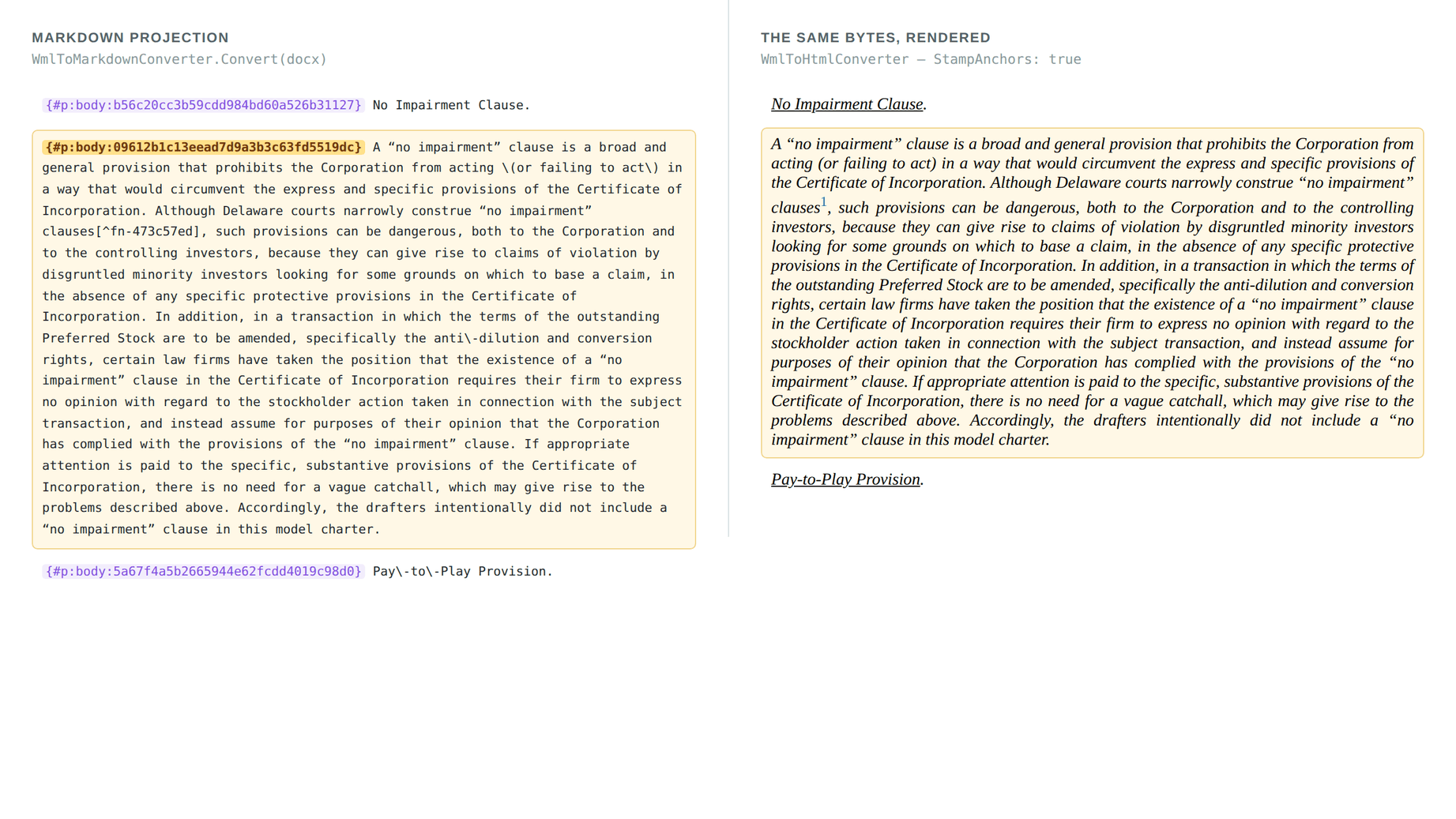
Native links and bookmarks use the same stable anchors and exact character spans:
```ts
const session = openDocxSession(docxBytes, { persistAnchorIds: true });
const paragraph = Object.keys(session.project().anchorIndex)
.find(id => id.startsWith('p:body:'))!;
session.addBookmark('Definitions', {
startAnchorId: paragraph, startOffset: 0,
endAnchorId: paragraph, endOffset: 11,
});
session.addHyperlink(paragraph, { start: 0, length: 11 }, 'internal', 'Definitions');
const links = session.listHyperlinks(); // ids feed updateHyperlink/removeHyperlink
const bookmarks = session.listBookmarks(); // exact endpoint range + per-paragraph segments
```
External links own their relationship in the actual body/header/footer/footnote/endnote part;
internal links are relationship-free bookmark targets. Bookmark rename retargets inbound links
atomically, and unsafe removal or cross-part ranges return typed `EditResult` errors.
Native images are occurrence-addressed too, with bytes kept explicit at the API boundary:
```ts
const capabilities = session.getImageCapabilities();
const inserted = session.insertImage(paragraph, 0, pngBytes, {
widthPoints: 144,
altText: 'Revenue by quarter',
});
const image = session.listImages().find(value => value.id === inserted.imageId)!;
session.setImageDimensions(image.id, { widthPoints: 108 });
```
PNG/JPEG/GIF/BMP/TIFF are writable. Existing WebP, external links, legacy VML, and unsupported
DrawingML remain enumerable with `canMutate: false`. Dimensions use points; floating offsets use
exact EMUs, and omitted insert dimensions use 96 DPI. The browser API accepts `Uint8Array` and
does not fetch image URLs or read paths.
---
## Everything else
- **Move detection** — relocated content is identified as a move, not a delete plus an insert
- **Format change detection** — formatting-only changes (bold, italic, font size, …)
- **Comment rendering** — endnote-style, inline, or margin
- **Document metadata** — fast extraction for lazy loading and pagination
- **OpenContracts export** — for NLP and document-analysis pipelines
- **External annotations** — overlay annotations without modifying the DOCX
- **Web Worker support** — non-blocking WASM execution off the main thread
- **React hooks** — `useDocxodus`, `useConversion`, `useComparison`
- **TypeScript** — full type definitions included
## Quick Start
### Basic Usage
```javascript
import { initialize, convertDocxToHtml, compareDocuments } from 'docxodus';
// Initialize the WASM runtime (call once at app startup)
await initialize('/path/to/wasm/');
// Convert DOCX to HTML
const html = await convertDocxToHtml(docxFile);
// Compare two documents
const redlinedDocx = await compareDocuments(originalFile, modifiedFile, {
authorName: 'Reviewer'
});
```
### React Usage
```tsx
import { useDocxodus, useConversion, useComparison } from 'docxodus/react';
function DocumentViewer() {
const { isReady, isLoading, error, convertToHtml } = useDocxodus('/wasm/');
const [html, setHtml] = useState('');
const handleFile = async (e: React.ChangeEvent) => {
const file = e.target.files?.[0];
if (file && isReady) {
const result = await convertToHtml(file);
setHtml(result);
}
};
if (isLoading) return
);
}
```
## Node.js (ES modules)
Import the engine from `docxodus/core` for server-side conversion, comparison, annotations,
and document sessions. It loads without a bundler or a custom Node loader:
```js
import { readFile, writeFile } from 'node:fs/promises';
import { initialize, convertDocxToHtml, compareDocuments } from 'docxodus/core';
await initialize(); // Finds the WASM runtime included in the installed package.
const original = await readFile('original.docx');
const revised = await readFile('revised.docx');
await writeFile('original.html', await convertDocxToHtml(original));
await writeFile('redline.docx', await compareDocuments(original, revised));
```
`docxodus/core` exposes the engine functions, types, enums, annotation helpers, and history
APIs from `docxodus`, excluding `DocxEditor`, `CommentGutter`, `mountRibbon`, and their editor
types. The existing `docxodus` entry includes those browser editor APIs and requires a browser
bundler; use `docxodus/core` in plain Node ESM. Both entries share the same engine state.
Browser helpers retained in `core`, such as pagination, the document viewport, IndexedDB
storage, and history controls, still require their browser APIs when called.
## API Reference
### Package verification
`generatePackageManifest(document)` inspects supplied bytes without opening an editable package;
`session.getPackageManifest()` describes the current logical session checkpoint, including unsaved
edits, without advancing its version. Both return the same schema-v1 `PackageManifest` with exact
package, ordered OPC-content, and normalized-semantic SHA-256 identities plus entries,
relationships, facts, and structured findings. Worker users can call
`worker.generatePackageManifest(document)` or `await workerSession.getPackageManifest()`. See
[`package_manifests.md`](../docs/architecture/package_manifests.md) for the normalization boundary.
### Stateful inspection and editing
`openDocxSession(bytes)` exposes the live document rather than a one-shot conversion. Inspect the
source before writing it: `listStyles()` returns the document's actual paragraph/character/table
styles, `getFormatting(anchorId)` keeps `directParagraph` separate from `effectiveParagraph`, and
`listInlineSpans(anchorId)` returns `anchorId` + `span` pairs accepted unchanged by `applyFormat`.
```typescript
const session = openDocxSession(bytes);
try {
const anchorId = Object.keys(session.project().anchorIndex)[0];
const style = session.listStyles().find(s => s.name === "Strong Custom");
const run = session.listInlineSpans(anchorId).find(s => s.text === "Defined Term");
if (style && run) {
session.applyFormat(run.anchorId, run.span, { runStyle: style.id });
}
} finally {
session.close();
}
```
An omitted property in a `direct` record means "not written at this layer"; it must not be treated
as false or zero. The matching `effective` record resolves document defaults and the full style
chain. `getListMembership` and `getSectionInfo` likewise return their query `anchorId` so callers
do not have to translate between inspection and mutation coordinate systems.
`effective` is deliberately a shorter cascade than the renderer's: it excludes the numbering
level's own paragraph properties and the table style's conditional formatting, so a list item
indented only by its numbering definition reports `leftIndentTwips: 0` and a run bolded by a
`firstRow` table style reports `bold: false`. Use `getListMembership` for the real numbering
indentation. See `docs/architecture/docx_mutation_api.md` for the exact layer list.
### Core Functions
#### `initialize(basePath?: string): Promise`
Initialize the WASM runtime. Must be called before using any other functions.
#### `convertDocxToHtml(document: File | Uint8Array, options?: ConversionOptions): Promise`
Convert a DOCX document to HTML.
```typescript
import { CommentRenderMode, PaginationMode, AnnotationLabelMode } from 'docxodus';
interface ConversionOptions {
pageTitle?: string; // HTML document title
cssPrefix?: string; // CSS class prefix (default: "docx-")
fabricateClasses?: boolean; // Generate CSS classes (default: true)
additionalCss?: string; // Extra CSS to include
commentRenderMode?: CommentRenderMode; // How to render comments (default: Disabled)
commentCssClassPrefix?: string; // CSS prefix for comments
paginationMode?: PaginationMode; // None (0) or Paginated (1)
paginationScale?: number; // Scale factor for pages (default: 1.0)
renderAnnotations?: boolean; // Render custom annotations
annotationLabelMode?: AnnotationLabelMode; // Above, Inline, Tooltip, or None
renderFootnotesAndEndnotes?: boolean; // Include footnotes/endnotes sections
renderHeadersAndFooters?: boolean; // Include headers and footers
renderTrackedChanges?: boolean; // Show insertions/deletions visually
}
```
##### Comment Render Modes
Control how Word document comments are rendered in HTML output:
```typescript
import { convertDocxToHtml, CommentRenderMode } from 'docxodus';
// Don't render comments (default)
const html = await convertDocxToHtml(docxFile, {
commentRenderMode: CommentRenderMode.Disabled
});
// Render as footnotes with bidirectional links
const htmlEndnote = await convertDocxToHtml(docxFile, {
commentRenderMode: CommentRenderMode.EndnoteStyle
});
// Render as inline tooltips (title attribute + data attributes)
const htmlInline = await convertDocxToHtml(docxFile, {
commentRenderMode: CommentRenderMode.Inline
});
// Render in a side margin column (CSS flexbox layout)
const htmlMargin = await convertDocxToHtml(docxFile, {
commentRenderMode: CommentRenderMode.Margin
});
```
| Mode | Value | Description |
|------|-------|-------------|
| `Disabled` | -1 | Don't render comments (default) |
| `EndnoteStyle` | 0 | Comments at document end with `[1]` style links |
| `Inline` | 1 | Tooltips via `title` and `data-comment` attributes |
| `Margin` | 2 | Side column using CSS flexbox |
#### `compareDocuments(original, modified, options?): Promise`
Compare two DOCX documents and return a redlined DOCX with tracked changes.
```typescript
interface CompareOptions {
authorName?: string; // Author name for revisions (default: "Docxodus")
detailThreshold?: number; // 0.0-1.0, lower = more detailed (default: 0.15)
caseInsensitive?: boolean; // Case-insensitive comparison (default: false)
}
```
#### `compareDocumentsToHtml(original, modified, options?): Promise`
Compare documents and return the result as HTML.
#### `getRevisions(document: File | Uint8Array, options?): Promise`
Extract revision information from a compared document.
```typescript
import {
getRevisions,
RevisionType,
isInsertion,
isDeletion,
isMove,
isMoveSource,
isFormatChange,
findMovePair
} from 'docxodus';
import type { Revision, GetRevisionsOptions } from 'docxodus';
// RevisionType enum
enum RevisionType {
Inserted = "Inserted", // Text or content that was added
Deleted = "Deleted", // Text or content that was removed
Moved = "Moved", // Text relocated within the document
FormatChanged = "FormatChanged" // Formatting-only change
}
// Revision interface with full documentation
interface Revision {
author: string;
date: string;
revisionType: RevisionType | string;
text: string;
moveGroupId?: number; // Links move source/destination pairs
isMoveSource?: boolean; // true = moved FROM here, false = moved TO here
formatChange?: { // Details for FormatChanged revisions
oldProperties?: Record;
newProperties?: Record;
changedPropertyNames?: string[];
};
}
// Get revisions with options
const revisions = await getRevisions(comparedDoc, {
detectMoves: true, // Enable move detection (default: true)
moveSimilarityThreshold: 0.8, // Jaccard similarity for moves (default: 0.8)
moveMinimumWordCount: 3, // Minimum words for move (default: 3)
caseInsensitive: false // Case-insensitive matching (default: false)
});
// Filter by type using helper functions
const insertions = revisions.filter(isInsertion);
const deletions = revisions.filter(isDeletion);
const moves = revisions.filter(isMove);
const formatChanges = revisions.filter(isFormatChange);
// Find move pairs
for (const rev of moves.filter(isMoveSource)) {
const destination = findMovePair(rev, revisions);
console.log(`"${rev.text}" moved to "${destination?.text}"`);
}
// Check format changes
for (const rev of formatChanges) {
console.log(`Format changed: ${rev.formatChange?.changedPropertyNames?.join(', ')}`);
}
```
#### `getDocumentMetadata(document: File | Uint8Array): Promise`
Get document metadata for lazy loading and pagination without full HTML rendering.
```typescript
const metadata = await getDocumentMetadata(docxFile);
console.log(`Sections: ${metadata.sections.length}`);
console.log(`Total paragraphs: ${metadata.totalParagraphs}`);
console.log(`Estimated pages: ${metadata.estimatedPageCount}`);
console.log(`Has comments: ${metadata.hasComments}`);
console.log(`Has tracked changes: ${metadata.hasTrackedChanges}`);
// Section dimensions (in points, 1pt = 1/72 inch)
const section = metadata.sections[0];
console.log(`Page size: ${section.pageWidthPt} x ${section.pageHeightPt} pt`);
```
#### `exportToOpenContract(document: File | Uint8Array): Promise`
Export document to OpenContracts format for NLP/document analysis.
```typescript
const export = await exportToOpenContract(docxFile);
console.log(`Title: ${export.title}`);
console.log(`Content: ${export.content.length} characters`);
console.log(`Pages: ${export.pageCount}`);
console.log(`Structural annotations: ${export.labelledText.length}`);
```
### Web Worker API
For non-blocking WASM execution, use the worker-based API:
```typescript
import { createWorkerDocxodus } from 'docxodus/worker';
// Create a worker instance
const docxodus = await createWorkerDocxodus({ wasmBasePath: '/wasm/' });
// All operations run in a Web Worker - main thread stays responsive
const html = await docxodus.convertDocxToHtml(docxFile, options);
const redlined = await docxodus.compareDocuments(original, modified, options);
const revisions = await docxodus.getRevisions(docxFile);
const comments = await docxodus.getComments(docxFile);
const metadata = await docxodus.getDocumentMetadata(docxFile);
// The external annotation family runs there too, so a read-only viewer that renders
// through the worker can annotate without booting a second runtime on the main thread.
const set = await docxodus.createExternalAnnotationSet(docxFile, 'doc-1');
const annotated = await docxodus.projectAnnotationsOntoHtml(html, set);
const validation = await docxodus.validateExternalAnnotations(docxFile, set);
const exported = await docxodus.exportToOpenContract(docxFile);
// Terminate when done
docxodus.terminate();
```
`projectAnnotationsOntoHtml` parses its input as XML: hand it the converter's output (or
another well-formed serialization), not a live DOM's `innerHTML`, which leaves ` ` and
`` unclosed. `DocxEditor.open()` stays main-thread only — it writes into a live container.
#### First-call warmup
`createWorkerDocxodus()` warms the .NET WASM runtime, but the **comparison code
path is not exercised until your first `compareDocuments()`**. That first call
pays a one-time warmup cost (comparison-assembly initialization + JIT of the
diff/XML engine) — roughly **2× the latency** of every subsequent compare.
`prepare()` is an **optional** method that pays this cost up front. Call it once
after creating the worker — during app boot, or while the user is still picking
files — so the first user-triggered comparison is already hot. It does **not**
run automatically; if you skip it, the first compare simply absorbs the warmup
as before.
```typescript
const docxodus = await createWorkerDocxodus({ wasmBasePath: '/wasm/' });
// Optional: warm the comparison path ahead of the first user action.
await docxodus.prepare();
// Now hot — the first real compare runs at steady-state speed and triggers
// no further .wasm fetches.
const redlined = await docxodus.compareDocuments(original, modified);
```
`prepare()` is idempotent (repeated calls share one in-flight warmup and resolve
immediately once complete), needs no input documents or seed files of your own
(it builds tiny seed documents inside the worker), and is concurrent-safe —
issuing a `compareDocuments()` while a `prepare()` is still in flight will not
double-load assemblies.
### React Hooks
#### `useDocxodus(wasmBasePath?: string)`
Main hook providing all Docxodus functionality.
Returns:
- `isReady: boolean` - Whether WASM is loaded
- `isLoading: boolean` - Whether WASM is loading
- `error: Error | null` - Initialization error
- `convertToHtml()` - Convert DOCX to HTML
- `compare()` - Compare documents
- `compareToHtml()` - Compare and get HTML
- `getRevisions()` - Get revision list
- `getDocumentMetadata()` - Get document metadata
#### `useConversion(wasmBasePath?: string)`
Simplified hook for DOCX to HTML conversion with state management.
#### `useComparison(wasmBasePath?: string)`
Simplified hook for document comparison with state management.
#### `useAnnotations(wasmBasePath?: string)`
Hook for managing custom annotations on documents.
#### `useDocumentStructure(wasmBasePath?: string)`
Hook for document structure analysis and element-based targeting.
## Embedding via CDN
Everything in the published package — the JS wrappers AND the WASM runtime — is served by npm CDNs
(jsDelivr, unpkg) with `Access-Control-Allow-Origin: *` and correct `application/wasm` MIME types,
so a page can embed a full viewer or editor without hosting anything itself.
### One-tag viewer / editor (recommended)
```html
```
`dist/embed.bundle.js` is a self-contained ESM bundle re-exporting the entire main API
(convert, compare, diff, sessions, annotations) plus
`createViewer`/`createEditor`/`createRibbonEditor`/`mountRibbon`/`DocxEditor`, so it also works as
a no-build way to use any other function.
For pages that can't use modules, `dist/embed.iife.js` exposes the same surface as a global:
```html
```
### How WASM resolution works
The ~18 MB runtime request set in `dist/wasm/` loads lazily from the same directory the bundle
was loaded from (`import.meta.url` for module scripts, `document.currentScript` for the IIFE):
first `/wasm/`, then `/` as a fallback. On a CDN that resolves to
`.../dist/wasm/_framework/...` automatically. To serve the WASM assets from somewhere else, pass
`{ wasmBasePath: 'https://your.host/wasm/' }` to either factory (or call `initialize(path)` first).
### CDN caveats
- **Pin an exact version in production** (`docxodus@12.6.1`, not `@latest`) — CDN responses are
cached as immutable, and the wire shapes between the JS wrappers and the WASM assemblies must
come from the same release.
- The build patches the .NET loader to fetch with `credentials: "omit"` — required because the
CDN's `Access-Control-Allow-Origin: *` cannot be combined with credentialed requests.
- The Web Worker entry (`docxodus/worker`) is not CDN-loadable cross-origin (browsers require
same-origin worker scripts); embed runs the engine on the main thread. Self-host the package
if you need the worker.
- Converter CSS is scoped to a private inner mount so `body`, `span`, and document-class rules
cannot restyle the host page. Document-global `@import` and `@page` rules are omitted; use the
full-document conversion/print path rather than an embed factory if those rules are required.
- First load fetches ~18 MB uncompressed across about 49 requests; subsequent loads hit the
browser cache.
## Standalone paginated HTML
`docxodus/export-browser` turns a DOCX into a complete offline HTML document whose body contains
the finalized fixed page boxes—not the hidden measurement tree. It returns the HTML together with
the exact PageMap, renderer fingerprint, warnings, and a schema-v2 render report from that same
sanitized tree.
```ts
import { convertDocxToPaginatedHtml } from 'docxodus/export-browser';
const source = new Uint8Array(await file.arrayBuffer());
const result = await convertDocxToPaginatedHtml(source, {
reviewProfile: 'final',
commentProfile: 'endnotes',
documentVersion: 12,
expectedSourceDigest: verifiedSha256,
});
download(new Blob([result.html], { type: 'text/html' }));
console.log(result.pageCount, result.pageMap, result.renderReport);
```
The exporter copies caller bytes before its first asynchronous boundary, verifies them with the
package manifest API, performs layout in an attached script-disabled frame, embeds or removes every
automatic resource, and reopens the serialized result to verify page count and physical geometry.
External HTTPS/mail/tel links remain user-activated links and are inventoried in the report; the
exporter never follows them. `unsupportedContent: 'strict'` rejects visible placeholders or omitted
resources instead of returning a nominally complete artifact.
All three revision profiles (`final`, `original`, `markup`) are supported; `final` and `original`
derive their projection out-of-place and never mutate the caller's bytes. `strictFonts: true`
turns unresolved or unverified font families into failures; supplying a `fontResolver` (in Node,
`fontDirectories` on `@docxodus/export`) is what makes families verifiable. A font the browser
supplied on its own is labelled `browserObserved`; it is not presented as a verified host-font
environment.
By default the worker loads from `dist/wasm/` beside the package entry point. A deployment that
hosts those files elsewhere may pass `wasmBasePath`. `docxodus/export-assets.json` is the closed,
SHA-256-addressed runtime asset graph, and `docxodus/render-report.schema.json` is the report schema.
## Hosting WASM Files
The WASM files need to be served from your web server. After building:
1. Copy the contents of `dist/wasm/` to your public directory
2. Pass the path to `initialize()` or the React hooks
Example directory structure:
```
public/
wasm/
_framework/
dotnet.js
dotnet.native.wasm
... (other framework files)
```
## Package and Runtime Size
| Component | Approx. uncompressed size |
|-----------|---------------------------:|
| dotnet.native.wasm | 1.5 MB |
| Managed/runtime WASM modules | 15.5 MB |
| WASM payload total | 17.0 MB |
| Published package (all bundles, types, maps, and WASM) | 20.0 MB |
Only the runtime request set (~18 MB including loader JavaScript) is fetched during first
initialization; source maps, declarations, and unrelated entry bundles are not. Runtime files are
loaded on demand and cached by the browser.
## Browser Support
- Chrome 89+
- Firefox 89+
- Safari 15+
- Edge 89+
Requires WebAssembly SIMD support.
## Portable document history
See the [concise history-controls API guide](../docs/history-controls.md) for latest/version
loading, comparison, checkpoint/restore and `.docxhistory` import/export over host-owned storage.
`mountHistoryControls` adds an accessible panel with separate previews, exact checkpoint retries
and explicit history sharing. `openIndexedDbHistoryStore` provides optional browser persistence.
These controls require `structuredClone` and `crypto.randomUUID`; the optional store also requires IndexedDB.
The [shared editor example](examples/editor.html) includes an optional **Version history** drawer.
One `npm run build` produces the library, local editors and deployable site; run `npm run demo:serve`
and open `http://localhost:8088/editor.html`. In an embed, pass `history: true` to
`createRibbonEditor`, or `{ history: { workspaceId: "my-document" } }` to resume saved work across reloads.
## License
MIT
## Credits
Built on [Docxodus](https://github.com/JSv4/Docxodus), a .NET library for document manipulation based on OpenXML-PowerTools.