[](https://travis-ci.org/paulfitz/daff)
[](http://badge.fury.io/js/daff)
[](http://badge.fury.io/rb/daff)
[](http://badge.fury.io/py/daff)
[](http://badge.fury.io/ph/paulfitz%2Fdaff-php)
[](http://badge.fury.io/bo/daff)

daff: data diff
===============
This is a library for comparing tables, producing a summary of their
differences, and using such a summary as a patch file. It is
optimized for comparing tables that share a common origin, in other
words multiple versions of the "same" table.
For a live demo, see:
> https://paulfitz.github.io/daff/
Install the library for your favorite language:
````sh
npm install daff -g # node/javascript
pip install daff # python
gem install daff # ruby
composer require paulfitz/daff-php # php
install.packages('daff') # R wrapper by Edwin de Jonge
bower install daff # web/javascript
````
Other translations are available here:
> https://github.com/paulfitz/daff/releases
Or use the library to view csv diffs on github via a chrome extension:
> https://github.com/theodi/csvhub
The diff format used by `daff` is specified here:
> http://paulfitz.github.io/daff-doc/spec.html
This library is a stripped down version of the coopy toolbox (see
http://share.find.coop). To compare tables from different origins,
or with automatically generated IDs, or other complications, check out
the coopy toolbox.
The program
-----------
You can run `daff`/`daff.py`/`daff.rb` as a utility program:
````
$ daff
daff can produce and apply tabular diffs.
Call as:
daff a.csv b.csv
daff [--color] [--no-color] [--output OUTPUT.csv] a.csv b.csv
daff [--output OUTPUT.html] a.csv b.csv
daff [--www] a.csv b.csv
daff parent.csv a.csv b.csv
daff --input-format sqlite a.db b.db
daff patch [--inplace] a.csv patch.csv
daff merge [--inplace] parent.csv a.csv b.csv
daff trim [--output OUTPUT.csv] source.csv
daff render [--output OUTPUT.html] diff.csv
daff copy in.csv out.tsv
daff in.csv
daff git
daff version
The --inplace option to patch and merge will result in modification of a.csv.
If you need more control, here is the full list of flags:
daff diff [--output OUTPUT.csv] [--context NUM] [--all] [--act ACT] a.csv b.csv
--act ACT: show only a certain kind of change (update, insert, delete, column)
--all: do not prune unchanged rows or columns
--all-rows: do not prune unchanged rows
--all-columns: do not prune unchanged columns
--color: highlight changes with terminal colors (default in terminals)
--context NUM: show NUM rows of context (0=none)
--context-columns NUM: show NUM columns of context (0=none)
--fail-if-diff: return status is 0 if equal, 1 if different, 2 if problem
--id: specify column to use as primary key (repeat for multi-column key)
--ignore: specify column to ignore completely (can repeat)
--index: include row/columns numbers from original tables
--input-format [csv|tsv|ssv|psv|json|sqlite]: set format to expect for input
--eol [crlf|lf|cr|auto]: separator between rows of csv output.
--no-color: make sure terminal colors are not used
--ordered: assume row order is meaningful (default for CSV)
--output-format [csv|tsv|ssv|psv|json|copy|html]: set format for output
--padding [dense|sparse|smart]: set padding method for aligning columns
--table NAME: compare the named table, used with SQL sources. If name changes, use 'n1:n2'
--unordered: assume row order is meaningless (default for json formats)
-w / --ignore-whitespace: ignore changes in leading/trailing whitespace
-i / --ignore-case: ignore differences in case
daff render [--output OUTPUT.html] [--css CSS.css] [--fragment] [--plain] diff.csv
--css CSS.css: generate a suitable css file to go with the html
--fragment: generate just a html fragment rather than a page
--plain: do not use fancy utf8 characters to make arrows prettier
--unquote: do not quote html characters in html diffs
--www: send output to a browser
````
Formats supported are CSV, TSV, Sqlite (with `--input-format sqlite` or
the `.sqlite` extension), and ndjson.
Using with git
--------------
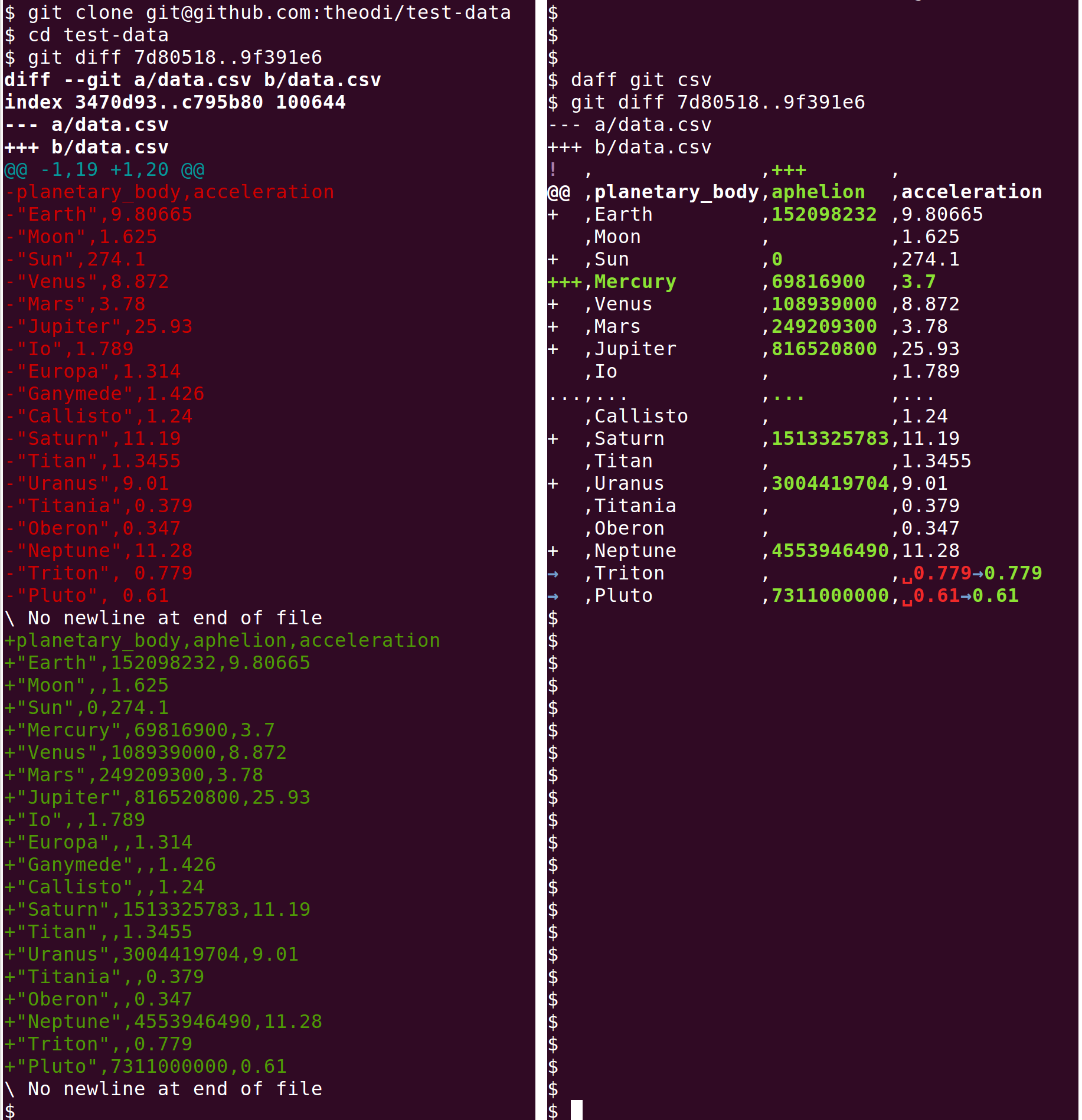
Run `daff git csv` to install daff as a diff and merge handler
for `*.csv` files in your repository. Run `daff git` for instructions
on doing this manually. Your CSV diffs and merges will get smarter,
since git will suddenly understand about rows and columns, not just lines:
The library
-----------
You can use `daff` as a library from any supported language. We take
here the example of Javascript. To use `daff` on a webpage,
first include `daff.js`:
```html
```
Or if using node outside the browser:
```js
var daff = require('daff');
```
For concreteness, assume we have two versions of a table,
`data1` and `data2`:
```js
var data1 = [
['Country','Capital'],
['Ireland','Dublin'],
['France','Paris'],
['Spain','Barcelona']
];
var data2 = [
['Country','Code','Capital'],
['Ireland','ie','Dublin'],
['France','fr','Paris'],
['Spain','es','Madrid'],
['Germany','de','Berlin']
];
```
To make those tables accessible to the library, we wrap them
in `daff.TableView`:
```js
var table1 = new daff.TableView(data1);
var table2 = new daff.TableView(data2);
```
We can now compute the alignment between the rows and columns
in the two tables:
```js
var alignment = daff.compareTables(table1,table2).align();
```
To produce a diff from the alignment, we first need a table
for the output:
```js
var data_diff = [];
var table_diff = new daff.TableView(data_diff);
```
Using default options for the diff:
```js
var flags = new daff.CompareFlags();
var highlighter = new daff.TableDiff(alignment,flags);
highlighter.hilite(table_diff);
```
The diff is now in `data_diff` in highlighter format, see
specification here:
> http://paulfitz.github.io/daff-doc/spec.html
```js
[ [ '!', '', '+++', '' ],
[ '@@', 'Country', 'Code', 'Capital' ],
[ '+', 'Ireland', 'ie', 'Dublin' ],
[ '+', 'France', 'fr', 'Paris' ],
[ '->', 'Spain', 'es', 'Barcelona->Madrid' ],
[ '+++', 'Germany', 'de', 'Berlin' ] ]
```
For visualization, you may want to convert this to a HTML table
with appropriate classes on cells so you can color-code inserts,
deletes, updates, etc. You can do this with:
```js
var diff2html = new daff.DiffRender();
diff2html.render(table_diff);
var table_diff_html = diff2html.html();
```
For 3-way differences (that is, comparing two tables given knowledge
of a common ancestor) use `daff.compareTables3` (give ancestor
table as the first argument).
Here is how to apply that difference as a patch:
```js
var patcher = new daff.HighlightPatch(table1,table_diff);
patcher.apply();
// table1 should now equal table2
```
For other languages, you should find sample code in
the packages on the [Releases](https://github.com/paulfitz/daff/releases) page.
Supported languages
-------------------
The `daff` library is written in [Haxe](http://haxe.org/), which
can be translated reasonably well into at least the following languages:
* Javascript
* Python
* Java
* C#
* C++
* Ruby (using an [unofficial haxe target](https://github.com/paulfitz/haxe) developed for `daff`)
* PHP
Some translations are done for you on the
[Releases](https://github.com/paulfitz/daff/releases) page.
To make another translation, or to compile from source
first follow the [Haxe language introduction](https://haxe.org/documentation/introduction/language-introduction.html) for the
language you care about. At the time of writing, if you are on OSX, you should
install haxe using `brew install haxe`. Then do one of:
```
make js
make php
make py
make java
make cs
make cpp
```
For each language, the `daff` library expects to be handed an interface to tables you create, rather than creating them
itself. This is to avoid inefficient copies from one format to another. You'll find a `SimpleTable` class you can use if
you find this awkward.
Other possibilities:
* There's a daff wrapper for R written by [Edwin de Jonge](https://github.com/edwindj), see https://github.com/edwindj/daff and http://cran.r-project.org/web/packages/daff
* There's a hand-written ruby port by [James Smith](https://github.com/Floppy), see https://github.com/theodi/coopy-ruby
API documentation
-----------------
* You can browse the `daff` classes at http://paulfitz.github.io/daff-doc/
Sponsors
--------
 The Data Commons Co-op, "perhaps the geekiest of all cooperative organizations on the planet," has given great moral support during the development of `daff`.
Donate a multiple of `42.42` in your currency to let them know you care: https://datacommons.coop/donate/.
Reading material
----------------
* https://specs.frictionlessdata.io/tabular-diff : a specification of the diff format we use.
* http://theodi.org/blog/csvhub-github-diffs-for-csv-files : using this library with github.
* https://github.com/ropensci/unconf/issues/19 : a thread about diffing data in which daff shows up in at least four guises (see if you can spot them all).
* http://theodi.org/blog/adapting-git-simple-data : using this library with gitlab.
* http://okfnlabs.org/blog/2013/08/08/diffing-and-patching-data.html : a summary of where the library came from.
* http://blog.okfn.org/2013/07/02/git-and-github-for-data/ : a post about storing small data in git/github.
* http://blog.ouseful.info/2013/08/27/diff-or-chop-github-csv-data-files-and-openrefine/ : counterpoint - a post discussing tracked-changes rather than diffs.
* http://blog.byronjsmith.com/makefile-shortcuts.html : a tutorial on using `make` for data, with daff in the mix. "Since git considers changes on a per-line basis,
looking at diffs of comma-delimited and tab-delimited files can get obnoxious. The program daff fixes this problem."
## License
daff is distributed under the MIT License.
The Data Commons Co-op, "perhaps the geekiest of all cooperative organizations on the planet," has given great moral support during the development of `daff`.
Donate a multiple of `42.42` in your currency to let them know you care: https://datacommons.coop/donate/.
Reading material
----------------
* https://specs.frictionlessdata.io/tabular-diff : a specification of the diff format we use.
* http://theodi.org/blog/csvhub-github-diffs-for-csv-files : using this library with github.
* https://github.com/ropensci/unconf/issues/19 : a thread about diffing data in which daff shows up in at least four guises (see if you can spot them all).
* http://theodi.org/blog/adapting-git-simple-data : using this library with gitlab.
* http://okfnlabs.org/blog/2013/08/08/diffing-and-patching-data.html : a summary of where the library came from.
* http://blog.okfn.org/2013/07/02/git-and-github-for-data/ : a post about storing small data in git/github.
* http://blog.ouseful.info/2013/08/27/diff-or-chop-github-csv-data-files-and-openrefine/ : counterpoint - a post discussing tracked-changes rather than diffs.
* http://blog.byronjsmith.com/makefile-shortcuts.html : a tutorial on using `make` for data, with daff in the mix. "Since git considers changes on a per-line basis,
looking at diffs of comma-delimited and tab-delimited files can get obnoxious. The program daff fixes this problem."
## License
daff is distributed under the MIT License.