STROMDAO developed an electricity tariff with a loyalty program allowing every electricity customer to do micro investments into renewable energy generation facilities (REGF). Primary purpose of Corrently Invest Token (CORI) is a profit distribution coming out of those micro investments. CORI shareholders get their energy bills deducted by the shared profit automatically. Shareholders without an electricity tariff could request a fiat currency payout monthly by filing an invoice to STROMDAO not later than 60 days after end of month (disagio, tax and handling apply).
Each Corrently represents one kilowatt-hour of consumed electricity. As consumption behaviors differ the amount of Corrently´s collected during a month is different as well. A single-family household with 3 persons for example might consume around 200 kWh of electricity and therefore collect 200 corrently´s per month. These Corrently´s can then be spent to purchase CORI Invest Tokens which in turn grants a shared profit of the REGF´s profit. The micro investment mechanism works directly off the customers electricity bill. The CORI Tokens are native assets backed tokens which are based on the ERC 20 Token Standard. That means that they are compatible with the Ethereum Blockchain. However, as the public Ethereum Blockchain is not yet suited to handle small scale and high-volume energy transactions STROMDAO developed the Fury Network – an open-source, Ethereum based blockchain specially designed for energy market needs.
In contrast to platform approaches (e.g. putting a wind-mill on a platform and granting the members of the platform a share of the wind-mills profits) STROMDAO does not act as a man in the middle. Yes, the REGF´s are selected by us and yes we decide the amount of CORI tokens which are equivalent to the REGF´s value. But once you buy CORI´s you are the owner. So, we cannot revoke your access, your ownership and therefore your profit claim. We are no middle man because blockchain technology enables you to create your own energy generation portfolio.
And that is the reason why we established Corrently. We believe in the potential of micro-investments for renewable energy, and that through its application, customers may find an easy and efficient way of to contribute into a sustainable power supply.
Our vision at STROMDAO is to allow asset owners to fund their activities as simply and securely as possible by utilizing digital currencies for project development. While at the same time enable electricity customers to gradually become energy prosumers simply by paying their bill and returning their Corrently´s into CORI Tokens.
Overall Corrently is way more than just a new electricity tariff with a fancy bonus system.
The aim of Corrently is non less than:
Corrently is an entirely new product in the electricity market. Our approach is to accelerate the expansion of renewable energy generation by giving each electricity customer the possibility to do micro-investments. Instead depending on governmental funds each owner of renewable energy generation facilities can offer their wind-mill, PV-panel or water turbine to be tokenized by STROMDAO. The working mechanism is displayed in the following figure.
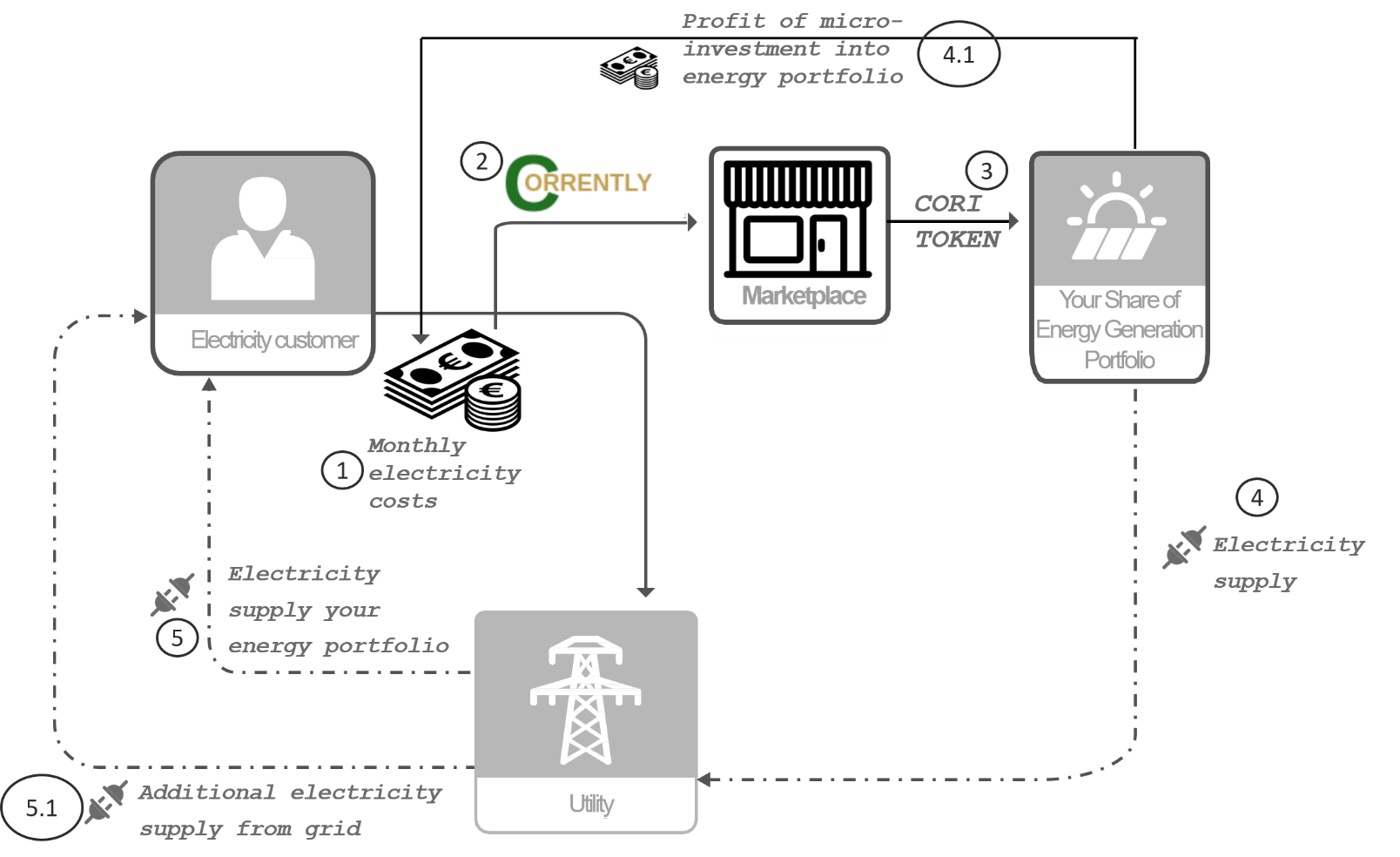
In a first step electricity customers pay their monthly electricity bills as usual. For each Kilowatt hour of electricity one Corrently will be issued to their account. Each customer can now decided what to do with his or her amount of Corrently´s. One option is to exchange Corrently´s for CORI Tokens by using the STROMDAO Marketplace (step 2). Within the online-marketplace customers can select renewable energy generation facilities they would like to invest their Corrently´s into. In addition to exchanging Corrently´s for CORI´s one might also chose to support one of a variety of social projects .
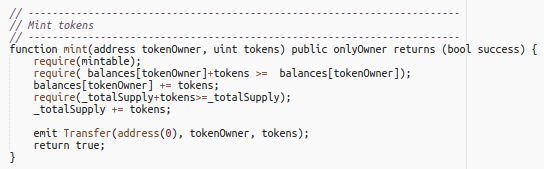
CORI Tokens represent a share of an energy generation portfolio (step 3). Each renewable energy generation facility has a defined amount of CORI´s that are eligible to be sold. The amount is put into the balance sheet of a smart contract which in deployed on the Ethereum based Blockchain designed by STROMDAO (Fury Network).
So what each customer is actually doing when purchasing CORI´s Tokens in exchange for Corrently Bonus points is to trigger this smart contract (address is public) and make a transfer of CORI Tokens from the smart contract address to one’s own electricity account. This electricity account in turn is represented by an address within the Fury Network.
The purchase of CORI`s therefore is an actual transfer of ownership of an asset which is the digital twin of the renewable energy generation facility! Each customer can now precisely track.
Over time the degree of energy self-sufficiency will raise as a higher share of electricity will directly be generated by ones energy portfolio. Therefore electricity needed from the utilities will drop. In the long term electricity will not only get cheaper but also more sustainable. Each customer and CORI owner can decide which energy portfolio fits his/ her needs best. The mix of wind-mills, pv-panel, storage and water-mill shares is completely up to the customer!
In addition to an increased energy self-sufficiency the induvial energy portfolio is generating profit which is paid to CORI Token holders according to their amount (step 4.1 in figure 1).
Since its beginning as an open-source project for building an Ethereum based Blockchain for energy market transactions back in 2015 it has been the mission of STROMDAO to enable people to actively shape the future of renewable energies in Germany. As every success story starts with the team building it our core team will be introduced in this chapter.
“If everyone is moving forward, then success takes care of itself” (Henry Ford)
In 2015 the Federal Ministry of Economics and Energy was in search for a new energy market design. As decentralization of energy production and digitization of communication between energy market actors became widespread new concepts were demanded. . The aim of the legislative process was to develop an electricity market design for the energy transition, as the existing model became inefficient as the share of electricity generated from renewable sources increased.
Thorsten Zoerner (founder and creator of STROMDAO) developed the model of the hybrid electricity market and submitted it to the Ministry. At the same time, a white paper was published and made known to the industry.
The 2015 amendment partially complied with the proposed market model and its rules, paving the way for the commercial implementation of the mechanisms described.
It quickly became apparent that the processes for billing and business processing established in the energy industry were standardized, but were not able to ensure a small-scale implementation. What was needed was a technology that made it possible to express ownership of small shares and to document the transfer without gaps.
In 2016, Stefan Thon and Thorsten Zoerner met in a project to develop a standard for the settlement of so-called "residential electricity". It turned out that the task contained the same problems that were solved with the hybrid power market model. An additional difficulty, however, was that a solution was sought that was able to represent the market rules automatically on a decentralized basis (in the object). The blockchain technology was used, which solved the problem of consensus building of all parties (=tenant, plant operator, owner) also in the absence of a central control.
Energy economist Manuel Utz joined the team in spring 2017. The first electricity customers were supplied with it and the first prototype of a hybrid electricity tariff was developed.
Corrently is the logical and consistent further development of the first hybrid electricity tariff developed back in 2017.
The founding team of STROMDAO consists of Thorsten, Stefan and Manuel. Due to family reasons Stefan decided to leave STROMDAO by the middle of 2018.
Since 2007 I have been working on the electricity grid and the electricity market. At the same time, a blog was created to provide information on the respective topics. It can be found at blog.stromhaltig.de.
So far I have published three books on the energy industry. In my book on the hybrid electricity market, published in 2014, I describe a market design that was included in the Electricity Market 2.0 legislative package in Germany. This combines two technologies of electricity procurement: the house connection with purchase from a classic electricity supplier and an alternative purchase of renewable energies. The economic advantages of such a market design have been proven.
Digitalization will also influence tomorrow's energy industry. Therefore I have intensively dealt with the topic of blockchain technology. Blockchain is a technology that can simplify the exchange and documentation of data. Therefore, this technology can revolutionize today's energy system with the help of digital possibilities. This enables automatic balancing of energy generation and energy consumption.
Professional stationsThe topic of industrial energy management has been my hobbyhorse since I studied industrial engineering. In the course of my employment as energy manager at the medical technology company Fresenius after my studies, the core questions revolved around increasing energy efficiency by creating data transparency. And here established software tools quickly reached their limits. In contrast to production processes which are carried out and monitored with a high degree of automation, the precise monitoring of energy quantities is still a great challenge. The fact that the topic of energy management goes far beyond efficiency increases and often completely new business models become possible is hardly lived in the industrial environment.
Against this background - to make energy flows more transparent and to develop new business models for energy-intensive companies - I became a shareholder of StromDAO UG in spring 2017. Here we have already implemented numerous projects as described above - and with the hybrid power product a real bang in the energy industry is imminent.
The technical implementation of the product is decisively connected with the blockchain technology. A technology which is already in practical use and on the basis of which many business models, especially in the energy industry, are possible. This is one reason why I am working on this topic in my parallel doctorate.
Professional stations:The system framework on which Corrently is based is defined by two components:
The Ethereum Blockchain is used to publicly display the current ownership of CORI Asset Tokens. So at any given point in time everyone within the Blockchain Network can precisely tell who is owning what part of a renewable energy generation facility (REGF). Each of our customres will create their own Ethereum Account by which they can purchase and transfer CORI Asset Tokens. For neither of the transactions any form of approval from STROMDAO is needed. Moreover STROMDAO is never the owner of CORI Tokens but the owner of the REGF and esentially the electricity customers exchanging Corrently´s for CORI´s are. Therefore even if STROMDAO would cease to exist as a company each CORI Token owner would still be an owner of his amount of CORI´s. As the transactions of ownership are made within the public ethereum blockchain transaction fees (in Ethereum those fees are called "gas") do apply for each transaction. However it is the only way to ensure that ownership can be guaranteed regardless of a companies success.
Any transaction that is not linked to the ownership or transfer of ownership of CORI Token is handled within the Fury Network. This Network is based upon is a coinless Proof-of-Authority (PoA) implementation of the Ethereum blockchain protocol (github.com/energychain). Since its establishment in 2017, a transaction volume of already 347 MWh was recorded in the Fury Network. It has been established to maintain irrevocable consensus on complex flows of energy and therefore acts as a single, decentralized market communication bus for settling and clearing transactions between energy market participants.
Since the network is unrestricted, anyone can deploy their own node. However, the PoA consensus mechanism allows transactions to only be verified by authorities. This form of internal governance does not only significantly reduce the energy consumption per transaction verification but also decreases the verification time. To become an authority node, one has to be voted in by another authority node. The energy sector market logic is encapsulated in smart contracts as entities on the blockchain.
Smart contracts are based on the ERC-20 Ethereum Token Standard. Business Objects have been created to handle entire business procedures such as billing processes. With over 56,000 downloads to date, the business object is the world's most successful project for the use of blockchain technology in the energy industry. Smart software components which have also been developed by STROMDAO are bridging the gap between digital infrastructure and the renewable energy generation facilities (REGF). Each of the REGF that first go through a due diligence process by STROMDAO (see chapter “CORI Token”) will be equipped with a smart meter infrastructure connected to the Fury Network. Therefore each Kilowatt hour feed into the grid can be precisely tracked. This tracking as well as the described management of energy flows in real time and the smart meter operation are domain specific tasks carried out in the Fury Network instead of the Public Ethereum Network due to performance reasons.
In contrast to a lot of Initial Coin Offerings (ICO´s) the CORI Token is backed by real assets and therefore be considered an “asset-backed Token” or short “Asset Token”. Its main characteristics are listed in table below:
| Total Supply | |
|---|---|
| GIT Repository | energychain/Corrently |
| WWW | https://corrently.de/token |
| Chat/Info | Gitter.im |
| Token Standard | ERC20 with 2 decimals |
| Ticker/Symbol | CORI |
| Trading/Exchange |
|
| Compliance |
|
| Accounting currency | Euro (EUR, €) |
At the moment this Whitepaper is written the total supply of CORI Token is 5000 which means that renewable energy generation facilities have already been run through the due diligence process by STROMDAO and CORI´s have been emitted by the "CORI Contract". It also means that electricity customers are already eligible to get their profit share of the REGF´s. As the customer base increases the amount of total supply will also increase. As each of the newly emitted CORI Tokens is backed by an asset there is no inflation in quantity and therefore deflation in price to be expected.
We established Corrently and CORI because we believe in the potential of micro-investments for renewable energy, and that through its application, customers may find an easy and efficient way of to contribute into a sustainable power supply. This will be achieved by utilizing what is known as an Asset Token. Our vision at STROMDAO is to allow asset owners to fund their activities as simply and securely as possible by utilizing digital currencies for project development.
To understand the Due Dilligence process defined in the following chapter the different smart contracts deployed on the Ethereum Mainnet will be explained. There are two different smart contracts
0x725b190bc077ffde17cf549aa8ba25e298550b18)0xa050b90B0C60900E304774Eb39220dFB2C5fFf0F)As the content and work mechanism of those smart contracts is rather difficult to grasp for non-developers an anlogie to FIAT currency will be used. Much like central banks define the framework of what is understand by the term "money" (e.g. by defining what bills are to be printed and the way of how FIAT money is created) the CORI Smart Contract defines who the total
As already described in chapter 3 above new tokens get issued to legal contract owner as soon as a profit sharing contract exists. By publishing those contracts STROMDAO ensures that issued tokens are backed with existing profit sharing agreements (=proof of existence of legal contracts). As the customer base growns and new assets are to be bought a due diligence process is performed by STROMDAO to ensure that its delivery obligations (profit sharing) can be fulfilled on a stable base.
New tokens get issued to legal contract owner as soon as a profit sharing contract exists. By publishing those contracts STROMDAO ensures that issued tokens are backed with existing profit sharing agreements (=proof of existence of legal contracts).
If asset is accepted STROMDAO issues new tokens to asset owner.
Shareholders within a valid STROMDAO tariff receive shared profit automatically (aprox. 2000 Tokens required for a monthly reduction of 1€, based on actually generation in payment cycle).
All token holders have the freedom to share, trade, sell and buy Corrently Invest Tokens (CORI) at any time.
Clearing is done monthly within the consens of a single block in Ethereum public blockchain (aka: Homestead). STROMDAO is entitled by its customers (electricity consumers) to collect debits from property owners and deduct customer electricity bills.
(note: Corrently invest token has 2 decimals!)
Our Proof of Concept was done mainly in the previously mentioned domain blockchain. However, we ported all the money, ownership and asset related contracts to Ethereum Main Blockchain. The following transaction flow provides public proof of our concept and business model.
STROMDAO confirms profit share agreement of a provider
| Asset Info | Operator/Issuer | Tokens Issued | Last Benchmark |
|---|---|---|---|
| 0480269a2b... | 0x445c1e284c15a... | 2000 | % () |
| 0c56adc82... | 0x445c1e284c15a... | 3000 | % () |
*) 100% Performance = Estimated and actual earnings are equal.
If you operate / owen a renewable energy asset in Germany you might get in contact with STROMDAO to evaluate options to become part CORI assets.
| Investment | 150.000€ |
| Revenue | 55.000 kWh / year |
| Feed-In Tariff | 12.000€ / year |
| ./. | 8,0% |
|---|
| Feed-In Tariff | 12.000€ / year |
| Corrently Revenue (CORI asset) | 1.000€ |
| ./. | +8,3% |
|---|
STROMDAO itself does not sell CORI. There are three options to become a shareholder.
Profit from assets is shared with token holders. While STROMDAO services need to have certain centralized elements for its energy market services, we strive towards decentralization and the minimization of trust related issues.
All asset income for the CORI token is publicly reported and visible on its payout smart contract. To verify the integrity of data, users will be able to check entitled dividends on this website.
Based on these monthly results, STROMDAO loads the ETH (Ethereum) amount of dividend payouts onto a smart contract. The smart contract will contain a table of dividend distributions. Think of it as a snapshot taken when dividends have been declared. Token holders will then proceed to query the smart contract dividend distribution function to move dividends from the wallet in which the tokens were stored at the time the “snapshot” was taken. The smart contract will proceed to pay out dividends to the wallet that made the request after validating all provided information. If the “snapshots” do not match the dividend payout amounts at 100% validity, the smart contract will refuse the payout request. This means that either all dividends will be paid out fairly and accurately or no dividends will be released at all.
The team of STROMDAO monitors real-time dividend payouts as micro transactions. However, the Ethereum network’s capabilities do not currently extend to high-volume transactions of such small size. For optimization tariff customers receive payouts from within a single, aggregated transaction.
per CORI
transaction - ETH to 0x61bdd888b3bd3f8466a4fb2e16435e917cd458a0
As CORI is based on public Ethereum BlockChain, you might use any tool to access, trade or manage our token.
We always include MetaMask, MyEtherWallet, and EtherScan in our tests.
In order to work with a SmartContract in Ethereums main blockchain, published address ( 0x725b190bc077ffde17cf549aa8ba25e298550b18 )
and an ABI definition is required.
Intend of this page is not to replace high-level tools. Instead, it should provide you with a quick access and validation capabilities.