compact-adviser




**compact-adviser** is an agent plugin that answers a single question: should I /compact now?

It uses [Jev](https://typesafe.ai) to instantly judge whether the current session is likely at a boundary that's safe to compact.
It can give you a hint to run `/compact` - or, on Pi and Claude Code, if you opt in, it can run it for you at the right time automatically. Codex CLI and Grok are hint-only: nothing outside their sessions can trigger `/compact`.
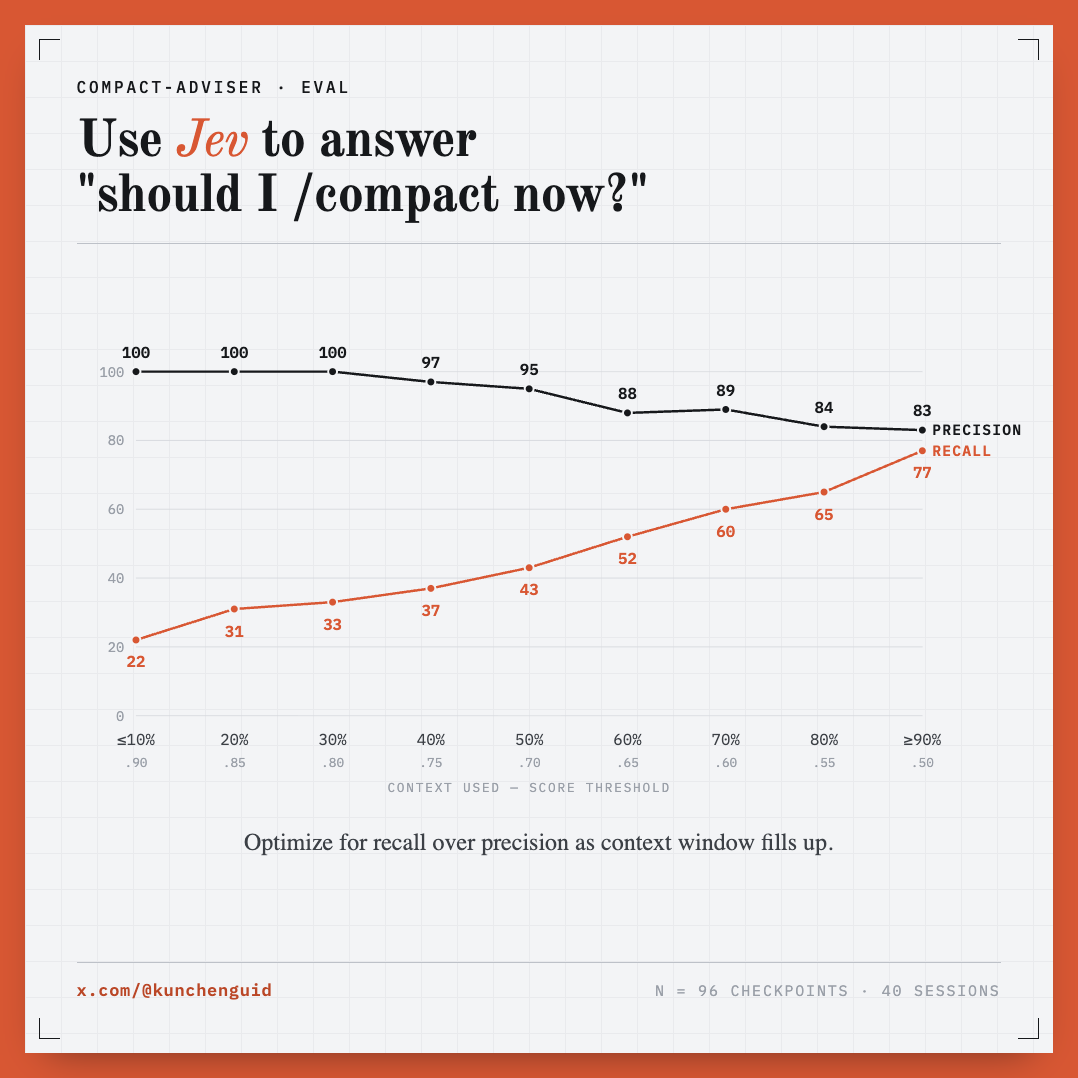
Judgment is two one-sentence Jev questions in one request (is the unit finished; is this hands-on work or coordination), composed in code into one score. The hint floor is 0.90 while the context is mostly empty (through about 10%) and relaxes toward 0.50 by about 90% full - a wrong hint costs most when there is still room. "Full" means the point where the host compacts: on Claude Code that is its auto-compact threshold when enabled, elsewhere the model's window. If you would rather compact well before that (long contexts cost more every turn), set a context budget: the floor then relaxes as the context approaches the smaller of your budget and that point. Automatic mode is the same gate, plus a first-use confirmation.
## Quick Start
Prerequisites: Node 22+ (22.18+ for Codex and Grok), and one of [Pi](https://pi.dev) 0.82.0 or newer (verified on **0.85.1**), Claude Code 2.1.274 or newer (verified on **2.1.275**), Codex CLI 0.153.0 or newer (verified on **0.153.4**), or [Grok Build](https://docs.x.ai/build/overview) 1.0.34 or newer (verified on **1.0.34**), plus a [TypeSafe API key](https://console.typesafe.ai/settings/keys). Supply it as `TYPESAFE_API_KEY` in the launch environment or put it in the session cwd's `./.env`; Pi and Claude Code can also save it through their settings, while Codex and Grok provide an external compact-adviser CLI. Jev is TypeSafe's structured decision model; this package asks it two one-sentence classification questions and never asks it to write a summary.
Installing the package is consent to send eligible checkpoint context to TypeSafe when a key is available and the other product gates pass. With `TYPESAFE_BASE` set, that context and the key go to that base instead.
### Pi
```sh
pi install npm:compact-adviser
```
Restart Pi or run `/reload`, then `/compact-adviser`.
`/compact-adviser status` should say `Key: env`, `Key: saved`, or `Key: .env`.
To install from git: `pi install git:github.com/kunchenguid/compact-adviser` (add `-l` for project-local).
### Claude Code
This plugin uses Claude Mod which is an experimental feature that requires `CLAUDE_CODE_ENABLE_FUNCTION_HOOKS=1` in your environment.
```sh
claude plugin marketplace add kunchenguid/compact-adviser
claude plugin install compact-adviser@compact-adviser
CLAUDE_CODE_ENABLE_FUNCTION_HOOKS=1 claude
```
Then `/compact-adviser`.
### Codex CLI
Codex support is **macOS and Linux only**. The plugin's hooks run through POSIX `sh`, matching
this repository's platform badge; Windows is not supported this ship.
```sh
codex plugin marketplace add kunchenguid/compact-adviser
codex plugin add compact-adviser@compact-adviser
```
Restart Codex and review the hook in `/hooks` once, so it is trusted. After a completed
checkpoint the advice appears as a `↳ Hook · Compact adviser: ...` line under the answer.
Codex is **hint-only**: it has no surface that lets another process run `/compact`, so there is
no automatic mode there. Settings live in a small CLI instead of a slash command; ask Codex for
"compact-adviser status" and the bundled skill runs it, or run it yourself:
```sh
node "$(ls -d "${CODEX_HOME:-$HOME/.codex}"/plugins/cache/*/compact-adviser/*/ | tail -1)src/cli.ts" status
```
### Grok Build
Grok is **hint-only**: nothing outside a running session can trigger `/compact`, so there is no automatic mode here. The hint is painted on the status row and never enters the model's context.
```sh
grok plugin install kunchenguid/compact-adviser#packages/grok-plugin --trust
```
(Install from the subdirectory, not the repository root: Grok also reads the Claude marketplace index in this repo, so a plain `grok plugin marketplace add` offers two plugins of the same name and refuses an unqualified install.)
Then two one-time steps, because Grok does not let a plugin do either of them for you. Start Grok and run:
```
/compact-adviser-install
```
That writes `${GROK_HOME:-~/.grok}/hooks/compact-adviser.json`, because **Grok 1.0.34 lists a plugin's own `hooks/hooks.json` but never loads it into a session**. Hooks in your own Grok home are always trusted, so nothing else is needed; delete that file to remove them. From a shell it is `node "$(node -e 'const l=JSON.parse(require("child_process").execFileSync("grok",["plugin","list","--json"],{encoding:"utf8"})); const p=(Array.isArray(l)?l:[]).find(x=>x&&x.name==="compact-adviser"); if(!p||typeof p.path!=="string") throw new Error("compact-adviser is not installed"); process.stdout.write(p.path)')/bin/adviser.ts" install`. After `install`, `${GROK_HOME:-~/.grok}/compact-adviser/adviser.sh` resolves the currently installed plugin the same way.
Then paste the `[ui.status_line]` block `install` printed into the config.toml path it named and restart Grok. The status row is off by default and only your own config can turn it on - a plugin cannot, and neither can a repository. Grok has one status row, so this script paints the built-in segments (`cwd`, `model`, `context`) too. Minimal render mode has no status row at all.
On Grok, save the TypeSafe key as `TYPESAFE_API_KEY` or a cwd `.env`, or with the CLI `key` command from a shell outside Grok. Do not type secrets after a Grok slash command; Grok appends those words to the model.
## If it does nothing
| Symptom | Cause |
| --- | --- |
| `Key: missing` in `/compact-adviser status` (Pi, Claude Code) or `/compact-adviser` (Grok) | No `TYPESAFE_API_KEY` in the launch environment, saved settings, or the session cwd's `./.env` |
| No `/compact-adviser` command in Claude Code | `CLAUDE_CODE_ENABLE_FUNCTION_HOOKS` is not exactly `1` |
| Command exists, no hint | Context is below the constant 40,000-token minimum, the session is not idle, or the last turn was not a settled final answer |
| Claude Code: "nonessential traffic" | `CLAUDE_CODE_DISABLE_NONESSENTIAL_TRAFFIC` blocks plugin network requests |
| No hint in Codex | The hook is untrusted (review it in `/hooks`), Node is older than 22.18, or the hook cannot find Node at all - Codex rebuilds its PATH, so set `COMPACT_ADVISER_NODE` to an absolute `node` path |
| Grok: no hint row at all | `[ui.status_line]` is not set in the `config.toml` `install` named, or Grok is in minimal render mode |
| Grok: no hint after a completed turn | `/compact-adviser-install` has not run, so no Stop hook is judging |
| Pi print / RPC / JSON, Claude `-p`, or `codex exec` | The adviser stays inert in reliably detected non-interactive sessions |
| Nothing at all, in any host | `COMPACT_ADVISER_DISABLE` is set to a truthy value |
## Environment variables
| Variable | Effect |
| --- | --- |
| `TYPESAFE_API_KEY` | The Jev key; a saved key or the session cwd's `./.env` is used when this is unset |
| `TYPESAFE_BASE` | Replaces the TypeSafe API base URL, `https://api.typesafe.ai` by default; the request goes to `/v1/systemone` with a trailing slash dropped. Read from the launch environment only, never a saved setting or `./.env`. It must be an `https` URL; plain `http` is accepted only for a loopback host (`127.0.0.1`, `[::1]`, `localhost`). Any other value, or one that carries credentials, a query or a fragment, is a configuration error: no request and no advice |
| `COMPACT_ADVISER_DISABLE` | `1`, `true`, `yes` or `on` (any case) makes the session inert: no TypeSafe request, no hint, no automatic compaction, no command. It wins over a saved `hint` or `auto` mode |
| `CLAUDE_CODE_ENABLE_FUNCTION_HOOKS` | Claude Code only; must be exactly `1` for the mod to load |
| `COMPACT_ADVISER_NODE` | Codex only; absolute path to a Node 22.18 or newer executable when the hook cannot find one on its rebuilt PATH |
Export `COMPACT_ADVISER_DISABLE=1` for unattended agent sessions, where advice has nobody to read it.
## What is sent to TypeSafe
| Included | Not sent |
| --- | --- |
| Bounded user constraints, up to the last 64 visible replies and tool results (clipped), short tool-result excerpts, an existing summary, saved-artifact names, omission markers | System prompts, hidden reasoning, images, environment variables, the API key in the model context and request body, complete transcripts |
| Best-effort redaction of known key patterns and obvious sensitive-file results | A guarantee. Uninstall or set mode Off for material that must not leave the machine |
Requests go to `https://api.typesafe.ai/v1/systemone`, or `/v1/systemone` when that is set, are capped at 32,000 serialized UTF-8 bytes, and never treat an error as an affirmative judgment.
The TypeSafe API key never enters the model context or the request body; it is sent as the Authorization header to authenticate the call.
Details: [SECURITY.md](https://github.com/kunchenguid/compact-adviser/blob/main/SECURITY.md).
## How It Works
```
settled turn
│
▼
┌───────────────────┐
│ cheap local gates │ mode, 40k minimum, idle session, key, cooldowns
└─────────┬─────────┘
▼
┌───────────────────┐
│ TypeSafe Jev │ done × shape score, floor slides 0.90→0.50 with usage
└─────────┬─────────┘
▼
hint: run /compact or, with explicit auto, native compaction
```
Automatic compaction is available on Pi and Claude Code. On Codex the same judgment only ever
produces the hint, as a `↳ Hook ·` line in the scrollback. On Grok the two halves are separate
processes: a `Stop` hook judges and records a verdict, and the `[ui.status_line]` script reads
that verdict and paints the hint. The Grok hook always allows the stop and prints nothing, so a
hint can never be fed back to the model.
On Claude Code, an optional `beforeCompactPrompt` setting (empty by default; set it in `/config`)
runs one turn before that automatic compaction, and only after auto mode is confirmed. Set it to
`/stow` to run the `stow` command first. Claude Code does not expand slash commands or `@file`
mentions in a prompt a plugin submits, and it rejects a plugin prompt that starts with `/`, so a
value that starts with `/` is run as a command instead of being sent to the model as text. If you
send your own prompt or run a command in between, or that turn is interrupted, errors, or does not
finish within 5 minutes, nothing is compacted. Hint mode, off, and an empty setting are unchanged. Pi, Codex, and
Grok do not have this setting.
## Usage
| Command | Effect |
| --- | --- |
| `/compact-adviser` (Pi and Claude Code) | Settings (mode, minimum, request log, TypeSafe API key) |
| `/compact-adviser auto` / `hint` / `off` (Pi and Claude Code) | Save that mode; auto asks for first-use confirmation |
| `/compact-adviser status` (Pi and Claude Code) | Mode, minimum, budget, context, key source (`env` / `saved` / `.env` / `missing`), cooldown |
| `/compact-adviser threshold 60000` (Pi and Claude Code) | Save an absolute token minimum |
| `/compact-adviser budget 450000` / `budget off` (Pi and Claude Code) | Save a context budget: the hint floor is fully relaxed at this many tokens, or at the host's own compaction point if that is smaller (off by default) |
| `/compact-adviser snooze` / `dismiss` (Pi and Claude Code) | Suppress the next three exchanges, or clear the current hint |
| `beforeCompactPrompt` in `/config` (Claude Code) | Optional text run before automatic compaction. Empty by default. `/stow` runs that command |
| `/compact-adviser` (Grok) | Show status; do not add arguments because Grok sends them to the model |
| `/compact-adviser-hint` / `/compact-adviser-off` (Grok) | Save hint-only mode, or disable the adviser |
| `/compact-adviser-snooze` / `/compact-adviser-dismiss` (Grok) | Suppress the next three exchanges, or clear the current hint |
| `/compact-adviser-install` (Grok) | Register the hooks and print the status-line block to paste into the named `config.toml` |
| `${GROK_HOME:-$HOME/.grok}/compact-adviser/adviser.sh threshold 60000` (Grok shell) | Save an absolute token minimum; `budget ` saves a context budget; `help` lists the other shell-only settings |
On Codex the same commands are arguments to the plugin's `src/cli.ts` (`status`, `hint`, `off`,
`threshold`, `budget `, `log on|off`, `key set|clear|status`) rather than a slash
command, because Codex plugins cannot register a command with code behind it. Codex has no
snooze or dismiss: the CLI cannot tell which session is current.
## Judge profiles
An optional [judge profile](https://github.com/kunchenguid/compact-adviser/blob/main/docs/judge-profiles.md) changes the two questions, score weight, or floor schedule without changing shipped defaults. All four hosts accept the same bounded JSON string in the `profile` setting. Keep hint mode while evaluating a profile. Invalid profiles disable advice, and loading a profile never grants automatic-mode consent.
## Eval
Local judgment eval uses real session checkpoints to score when the adviser should suggest `/compact`. The curve below is from a follow-up-aware gold set (96 checkpoints, 40 sessions): as the context window fills, the score threshold loosens from **0.90** (≤10% used) to **0.50** (≥90% used) so **recall rises** while precision stays high - favoring token savings when compaction is about to be forced anyway.
The judgment-eval harness lives in [packages/pi-extension/eval/](https://github.com/kunchenguid/compact-adviser/blob/main/packages/pi-extension/eval/README.md). It is not a published dataset: point it at your own sessions and keep transcripts local.