import { BaseClient, ClientConfig, Response } from "@commerce-apps/core";
import type { CommonParameters } from "@commerce-apps/core";
import type { OperationOptions } from "retry";
import type { RequestInit } from "node-fetch";
import type { CompositeParameters, QueryParameters, RequireParametersUnlessAllAreOptional } from "../../types";
import type { Category, CategoryResult, LocaleCode, PricesResult, Product, ProductImages, ProductResult, PromotionsResult } from '../models/index';
export type GetCategoriesLevelsEnum = 0 | 1 | 2;
export type GetCategoriesSfdcDwDntEnum = '0' | '1';
export type GetCategoriesPersonalizedEnum = 'none';
export type GetCategoryLevelsEnum = 0 | 1 | 2;
export type GetCategorySfdcDwDntEnum = '0' | '1';
export type GetCategoryPersonalizedEnum = 'none';
export type GetProductExpandEnum = 'none' | 'availability' | 'bundled_products' | 'links' | 'promotions' | 'options' | 'images' | 'prices' | 'variations' | 'set_products' | 'recommendations' | 'shipping_methods' | 'page_meta_tags' | 'primary_category';
export type GetProductSfdcDwDntEnum = '0' | '1';
export type GetProductPersonalizedEnum = 'none';
export type GetProductImagesSfdcDwDntEnum = '0' | '1';
export type GetProductImagesPersonalizedEnum = 'none';
export type GetProductPricesSfdcDwDntEnum = '0' | '1';
export type GetProductPricesPersonalizedEnum = 'none';
export type GetProductPromotionsSfdcDwDntEnum = '0' | '1';
export type GetProductPromotionsPersonalizedEnum = 'none';
export type GetProductsExpandEnum = 'none' | 'availability' | 'bundled_products' | 'links' | 'promotions' | 'options' | 'images' | 'prices' | 'variations' | 'set_products' | 'recommendations' | 'shipping_methods' | 'page_meta_tags' | 'primary_category';
export type GetProductsSfdcDwDntEnum = '0' | '1';
export type GetProductsPersonalizedEnum = 'none';
/**
* [Shopper Products](https://developer.salesforce.com/docs/commerce/commerce-api/references?meta=shopper-products:Summary)
* ==================================
*
* *[Download API specification](https://developer.salesforce.com/static/commercecloud/commerce-api/shopper-products/shopper-products-oas-v1-public.yaml)
# API Overview
The Shopper Products API enables you to access product details for products that are online, merchandised to a particular site catalog, and ready to be sold. You can use these product details to merchandise the product on other ecommerce channels. To set up category navigation paths on other commerce apps or storefronts, you can use the Categories API.
## Authentication & Authorization
The client requesting the product information must have access to the Products resource. The Shopper Products API requires a shopper access token from the Shopper Login and API Access Service (SLAS).
You must include the relevant scopes in the client ID used to generate the SLAS token. For a full list of required permissions, see the [Authorization Scopes Catalog.](https://developer.salesforce.com/docs/commerce/commerce-api/guide/auth-z-scope-catalog.html)
For details on how to request a shopper access token from SLAS, see the guest user flows for [public clients](https://developer.salesforce.com/docs/commerce/commerce-api/guide/slas-public-client.html#guest-user) and [private clients](https://developer.salesforce.com/docs/commerce/commerce-api/guide/slas-private-client.html#guest-user) in the SLAS guides.
## Customization
### Custom Properties
This API supports custom properties (prefixed with `c_`). For details, see [Custom Properties.](https://developer.salesforce.com/docs/commerce/commerce-api/guide/custom-properties.html)
### Hooks
For details on working with hooks, see [Extensibility with Hooks.](https://developer.salesforce.com/docs/commerce/commerce-api/guide/extensibility_via_hooks.html)
## Request Details
### Property Selection
This API supports the `select` query parameter for filtering response properties. For details, see [Property Selection.](https://developer.salesforce.com/docs/commerce/commerce-api/guide/scapi-property-selection.html)
### URL Encoding
If resource identifiers in request parameters contain commas (`,`) or percent signs (`%`), they must be URL encoded. For details, see [Encode URL Special Characters.](https://developer.salesforce.com/docs/commerce/commerce-api/guide/url-encode.html)
## Response Details
### Personalization
Responses from this API can be personalized using the [Shopper Context API.](https://developer.salesforce.com/docs/commerce/commerce-api/guide/shopper-context-api.html) By setting context attributes such as customer group, source code, or store ID, you can retrieve personalized promotions, pricing, and shipping methods. For details on how personalization interacts with caching, see [Personalized Caching.](https://developer.salesforce.com/docs/commerce/commerce-api/guide/server-side-web-tier-caching.html#personalized-caching)
### Caching
Caching is provided for this API. For details, see [Server-Side Web-Tier Caching.](https://developer.salesforce.com/docs/commerce/commerce-api/guide/server-side-web-tier-caching.html)
### Timeouts
Shopper API requests must respond within 10 seconds, including any hook execution. If a response exceeds this threshold, an HTTP 504 status code is returned. For details, see [Timeouts and Limits.](https://developer.salesforce.com/docs/commerce/commerce-api/guide/timeouts-limits.html)
### Error Handling
Error responses follow the [RFC 7807](https://datatracker.ietf.org/doc/html/rfc7807) problem detail format. To trace errors, include a `correlation-id` header in your request — the response returns it as `x-correlation-id`. For details, see [HTTP Status Codes and Errors.](https://developer.salesforce.com/docs/commerce/commerce-api/guide/error-response-codes.html)
## Use Cases
### Get a Single Product
Retrieve product details by ID. Replace `{access_token}` with a valid SLAS token.
```sh
curl "https://{shortCode}.api.commercecloud.salesforce.com/product/shopper-products/v1/organizations/{organizationId}/products/25695327M?siteId=RefArch" \
-H "Authorization: Bearer {access_token}"
```
### Get Multiple Products
Retrieve up to 24 products in a single request:
```sh
curl "https://{shortCode}.api.commercecloud.salesforce.com/product/shopper-products/v1/organizations/{organizationId}/products?ids=25695327M,25519318M&siteId=RefArch" \
-H "Authorization: Bearer {access_token}"
```
### Populate Product Listing Pages
Use the Shopper Product API so that a customer, browsing on a commerce shopping app built using Commerce Cloud APIs, can see a list of products. For example, hydrate a list of products (max 24). The API returns product details including images, prices, promotions, and product availability.

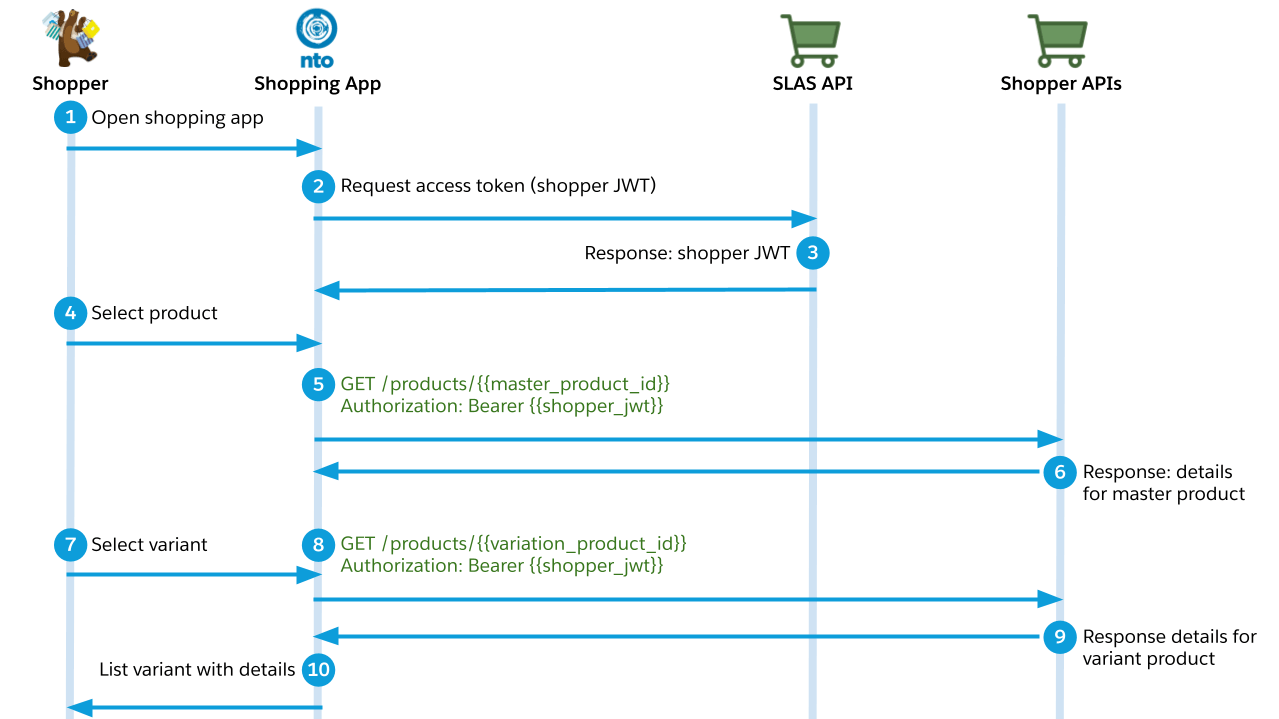
### Get Variation Product Details on an Ecommerce Channel
Use the API so that a customer, browsing on a commerce shopping app built using Commerce Cloud APIs, can switch between different variation products. The API returns product details including images, prices, promotions, and available to sell inventory.
### Retrieve Promotion Information
Promotions provide discounts to shoppers when they meet certain purchase requirements.
Promotion information is described in detail in [Promotion Details](https://developer.salesforce.com/docs/commerce/commerce-api/guide/promotion-details.html), but the following list provides several key points:
- Pricing discounts for basket and shipping promotions are NEVER returned by the 'getProduct' or 'getProducts' endpoint.
- Promotional pricing is ONLY returned for products that are included with non-conditional promotions.
- Callout messages are ALWAYS returned by the 'getProduct' and 'getProducts' endpoints.
By default, 'getProduct' and 'getProducts' return promotion information for a queried product. Promotion information includes both pricing and callout message information. However, the specific pricing and callout information that is fetched is determined by:
- Promotion Type
- Product Type
- Product Purchase Requirements
Some promotions can be displayed on a Product Data Page (PDP) or Product Listing page (PLP), while other promotions are displayed in the context of a basket, such as an order level promotion: "add the product to your basket to view price information". It is important to understand what is included in the response when designing a PDP or PLP on top of SCAPI to ensure your design aligns with implementable features.
#### Shopper Personalization
The SCAPI response can be personalized using the Shopper Context API or hooks. By setting specific values in the Shopper Context API, you can modify the response of the 'getProduct' or 'getProducts' endpoint based on the shopper's context. For instance, you can offer a 5% discount or free shipping to shoppers using mobile devices.
#### JWA Caching
The response is cached in JWA, which means promotion data contained in the response is also cached based on the TTL (Time to Live) specified in the Business Manager [Feature Switches](https://help.salesforce.com/s/articleView?id=cc.b2c_feature_switches.htm&type=5) configuration.
When the shopper context value is updated, a check is conducted to see if the updated shopper context affects the retrieval of product-promotion data. If it does, then the response is fetched from the source and cached in the JWA.
For details, see [Server-Side Web-Tier Caching.](https://developer.salesforce.com/docs/commerce/commerce-api/guide/server-side-web-tier-caching.html)
## Resources
### Product
A full representation of a product or service that is to merchandise. A ready to merchandise product is one that is online, categorized, and published to a channel. The information associated with a product includes, the product name, description, custom and system attributes, variations, price, availability, and images.
### Category
Categories and subcategories are the structure by which products are organized and grouped in a catalog and on a storefront. Categories can have relationships to other categories. Further, each category can provide context that is inherited by subcategories. For example, a category can have an assigned attribute. A product assigned to that category or any subcategory inherits the categories’s attribute value. Once the product is removed from the category, the attribute value is no longer inherited by the product. You can also use category linking for site hierarchical navigation. For example, inside the Clothing category you may have Men’s, and inside the Men’s category you may have Pants.
Categories are not tags.
## Related APIs
- [Products (Admin)](https://developer.salesforce.com/docs/commerce/commerce-api/references/products?meta=Summary) — Manage product catalogs, variations, and options.*
*
* For instructions on how to retrieve access token for admin APIs: https://developer.salesforce.com/docs/commerce/commerce-api/guide/authorization-for-admin-apis.html
* Example with admin auth
*
* ```typescript
* import { ShopperProducts, ClientConfig } from "commerce-sdk";
* // or
* const { ShopperProducts, ClientConfig } = require("commerce-sdk");
*
* const clientConfig: ClientConfig = {
* parameters: {
* clientId: "XXXXXX",
* organizationId: "XXXX",
* shortCode: "XXX",
* siteId: "XX"
* }
* };
*
* token = { access_token: 'INSERT_ACCESS_TOKEN_HERE' };
*
* clientConfig.headers['authorization'] = `Bearer ${token.access_token}`;
* const shopperProductsClient = new ShopperProducts(clientConfig);
* ```
*
*
* API Version: 1.4.4
* Last Updated:
*
*
*/
export declare class ShopperProducts extends BaseClient {
constructor(config: ClientConfig);
/**
* When you use the URL template, the server returns multiple categories (a result object of category documents). You can use this template to obtain up to 50 categories in a single request. You must enclose the list of IDs in parentheses. If a category identifier contains parenthesis or the separator sign, you must URL encode the character.
*
* If you would like to get a raw Response object use the other getCategories function.
*
* @param options - An object containing the options for this method.
* @param options.parameters - An object containing the parameters for this method.
* @param options.parameters.organizationId - An identifier for the Salesforce Commerce Cloud organization the request is being made by. It consists of a prefix 'f_ecom_' followed by a 4-character [realm identifier](https://developer.salesforce.com/docs/commerce/commerce-api/guide/base-url.html#realm-id) and a 3-character [instance type identifier](https://developer.salesforce.com/docs/commerce/commerce-api/guide/base-url.html#instance-id).
* @param options.parameters.ids - The comma separated list of category IDs (max 50).
* @param options.parameters.siteId - The identifier of the site that a request is being made in the context of. Attributes might have site specific values, and some objects may only be assigned to specific sites.
* @param options.parameters.levels - Specifies how many levels of nested subcategories you want the server to return. The default value is 1. Valid values are 0, 1, or 2. Only online subcategories are returned.
* @param options.parameters.locale - A descriptor for a geographical region by both a language and country code. By combining these two, regional differences in a language can be addressed, such as with the request header parameter `Accept-Language` following [RFC 2616](https://tools.ietf.org/html/rfc2616) & [RFC 1766](https://tools.ietf.org/html/rfc1766). This can also just refer to a language code, also RFC 2616/1766 compliant, as a default if there is no specific match for a country. Finally, can also be used to define default behavior if there is no locale specified.
* @param options.parameters.personalized - Controls whether personalization is applied to the response. Set to `none` to opt out of personalized response handling so the response is safe to cache at the CDN layer.
When set to `none`, the server skips applying personalization to the response.
Setting `personalized=none` is necessary but not sufficient for CDN caching: a response is only cached when the endpoint is also cacheable in the [server-side web-tier cache](https://developer.salesforce.com/docs/commerce/commerce-api/guide/server-side-web-tier-caching.html), subject to its TTLs and invalidation. A call that is uncacheable in the web tier is not cached at the CDN either. See [CDN caching](https://developer.salesforce.com/docs/commerce/commerce-api/guide/cdn-caching.html).
* @param options.retrySettings - Retry options for the `node-retry` package
* @param options.fetchOptions - Fetch options for the `make-fetch-happen` package
* @param options.headers - An object literal of key value pairs of the headers to be sent with this request.
*
* @returns A promise of type CategoryResult.
*/
getCategories(options?: RequireParametersUnlessAllAreOptional<{
parameters?: CompositeParameters<{
organizationId: string;
ids: Array;
siteId: string;
levels?: GetCategoriesLevelsEnum;
locale?: LocaleCode;
personalized?: GetCategoriesPersonalizedEnum;
} & QueryParameters, CommonParameters>;
retrySettings?: OperationOptions;
fetchOptions?: RequestInit;
headers?: {
[key: string]: string;
};
}>): Promise;
/**
* When you use the URL template, the server returns multiple categories (a result object of category documents). You can use this template to obtain up to 50 categories in a single request. You must enclose the list of IDs in parentheses. If a category identifier contains parenthesis or the separator sign, you must URL encode the character.
*
* @param options - An object containing the options for this method.
* @param options.parameters - An object containing the parameters for this method.
* @param options.parameters.organizationId - An identifier for the Salesforce Commerce Cloud organization the request is being made by. It consists of a prefix 'f_ecom_' followed by a 4-character [realm identifier](https://developer.salesforce.com/docs/commerce/commerce-api/guide/base-url.html#realm-id) and a 3-character [instance type identifier](https://developer.salesforce.com/docs/commerce/commerce-api/guide/base-url.html#instance-id).
* @param options.parameters.ids - The comma separated list of category IDs (max 50).
* @param options.parameters.siteId - The identifier of the site that a request is being made in the context of. Attributes might have site specific values, and some objects may only be assigned to specific sites.
* @param options.parameters.levels - Specifies how many levels of nested subcategories you want the server to return. The default value is 1. Valid values are 0, 1, or 2. Only online subcategories are returned.
* @param options.parameters.locale - A descriptor for a geographical region by both a language and country code. By combining these two, regional differences in a language can be addressed, such as with the request header parameter `Accept-Language` following [RFC 2616](https://tools.ietf.org/html/rfc2616) & [RFC 1766](https://tools.ietf.org/html/rfc1766). This can also just refer to a language code, also RFC 2616/1766 compliant, as a default if there is no specific match for a country. Finally, can also be used to define default behavior if there is no locale specified.
* @param options.parameters.personalized - Controls whether personalization is applied to the response. Set to `none` to opt out of personalized response handling so the response is safe to cache at the CDN layer.
When set to `none`, the server skips applying personalization to the response.
Setting `personalized=none` is necessary but not sufficient for CDN caching: a response is only cached when the endpoint is also cacheable in the [server-side web-tier cache](https://developer.salesforce.com/docs/commerce/commerce-api/guide/server-side-web-tier-caching.html), subject to its TTLs and invalidation. A call that is uncacheable in the web tier is not cached at the CDN either. See [CDN caching](https://developer.salesforce.com/docs/commerce/commerce-api/guide/cdn-caching.html).
* @param options.retrySettings - Retry options for the `node-retry` package
* @param options.fetchOptions - Fetch options for the `make-fetch-happen` package
* @param options.headers - An object literal of key value pairs of the headers to be sent with this request.
* @param rawResponse - Set to true to return entire Response object instead of DTO.
*
* @returns A promise of type Response if rawResponse is true, a promise of type CategoryResult otherwise.
*/
getCategories(options?: RequireParametersUnlessAllAreOptional<{
parameters?: CompositeParameters<{
organizationId: string;
ids: Array;
siteId: string;
levels?: GetCategoriesLevelsEnum;
locale?: LocaleCode;
personalized?: GetCategoriesPersonalizedEnum;
} & QueryParameters, CommonParameters>;
retrySettings?: OperationOptions;
fetchOptions?: RequestInit;
headers?: {
[key: string]: string;
};
}>, rawResponse?: T): Promise;
/**
* When you use the URL template, the server returns a category identified by the ID. By default, the server
also returns the first level of subcategories, but you can specify an additional level using the levels
parameter.
This endpoint fetches both online and offline categories. For offline categories, only the top-level
category is returned, not offline subcategories.
Using a large value for levels can cause performance issues when there is a large and deep category tree.
*
* If you would like to get a raw Response object use the other getCategory function.
*
* @param options - An object containing the options for this method.
* @param options.parameters - An object containing the parameters for this method.
* @param options.parameters.id - The ID of the requested category.
* @param options.parameters.organizationId - An identifier for the Salesforce Commerce Cloud organization the request is being made by. It consists of a prefix 'f_ecom_' followed by a 4-character [realm identifier](https://developer.salesforce.com/docs/commerce/commerce-api/guide/base-url.html#realm-id) and a 3-character [instance type identifier](https://developer.salesforce.com/docs/commerce/commerce-api/guide/base-url.html#instance-id).
* @param options.parameters.siteId - The identifier of the site that a request is being made in the context of. Attributes might have site specific values, and some objects may only be assigned to specific sites.
* @param options.parameters.levels - Specifies how many levels of nested subcategories you want the server to return. The default value is 1. Valid values are 0, 1, or 2. Only online subcategories are returned.
* @param options.parameters.locale - A descriptor for a geographical region by both a language and country code. By combining these two, regional differences in a language can be addressed, such as with the request header parameter `Accept-Language` following [RFC 2616](https://tools.ietf.org/html/rfc2616) & [RFC 1766](https://tools.ietf.org/html/rfc1766). This can also just refer to a language code, also RFC 2616/1766 compliant, as a default if there is no specific match for a country. Finally, can also be used to define default behavior if there is no locale specified.
* @param options.parameters.personalized - Controls whether personalization is applied to the response. Set to `none` to opt out of personalized response handling so the response is safe to cache at the CDN layer.
When set to `none`, the server skips applying personalization to the response.
Setting `personalized=none` is necessary but not sufficient for CDN caching: a response is only cached when the endpoint is also cacheable in the [server-side web-tier cache](https://developer.salesforce.com/docs/commerce/commerce-api/guide/server-side-web-tier-caching.html), subject to its TTLs and invalidation. A call that is uncacheable in the web tier is not cached at the CDN either. See [CDN caching](https://developer.salesforce.com/docs/commerce/commerce-api/guide/cdn-caching.html).
* @param options.retrySettings - Retry options for the `node-retry` package
* @param options.fetchOptions - Fetch options for the `make-fetch-happen` package
* @param options.headers - An object literal of key value pairs of the headers to be sent with this request.
*
* @returns A promise of type Category.
*/
getCategory(options?: RequireParametersUnlessAllAreOptional<{
parameters?: CompositeParameters<{
id: string;
organizationId: string;
siteId: string;
levels?: GetCategoryLevelsEnum;
locale?: LocaleCode;
personalized?: GetCategoryPersonalizedEnum;
} & QueryParameters, CommonParameters>;
retrySettings?: OperationOptions;
fetchOptions?: RequestInit;
headers?: {
[key: string]: string;
};
}>): Promise;
/**
* When you use the URL template, the server returns a category identified by the ID. By default, the server
also returns the first level of subcategories, but you can specify an additional level using the levels
parameter.
This endpoint fetches both online and offline categories. For offline categories, only the top-level
category is returned, not offline subcategories.
Using a large value for levels can cause performance issues when there is a large and deep category tree.
*
* @param options - An object containing the options for this method.
* @param options.parameters - An object containing the parameters for this method.
* @param options.parameters.id - The ID of the requested category.
* @param options.parameters.organizationId - An identifier for the Salesforce Commerce Cloud organization the request is being made by. It consists of a prefix 'f_ecom_' followed by a 4-character [realm identifier](https://developer.salesforce.com/docs/commerce/commerce-api/guide/base-url.html#realm-id) and a 3-character [instance type identifier](https://developer.salesforce.com/docs/commerce/commerce-api/guide/base-url.html#instance-id).
* @param options.parameters.siteId - The identifier of the site that a request is being made in the context of. Attributes might have site specific values, and some objects may only be assigned to specific sites.
* @param options.parameters.levels - Specifies how many levels of nested subcategories you want the server to return. The default value is 1. Valid values are 0, 1, or 2. Only online subcategories are returned.
* @param options.parameters.locale - A descriptor for a geographical region by both a language and country code. By combining these two, regional differences in a language can be addressed, such as with the request header parameter `Accept-Language` following [RFC 2616](https://tools.ietf.org/html/rfc2616) & [RFC 1766](https://tools.ietf.org/html/rfc1766). This can also just refer to a language code, also RFC 2616/1766 compliant, as a default if there is no specific match for a country. Finally, can also be used to define default behavior if there is no locale specified.
* @param options.parameters.personalized - Controls whether personalization is applied to the response. Set to `none` to opt out of personalized response handling so the response is safe to cache at the CDN layer.
When set to `none`, the server skips applying personalization to the response.
Setting `personalized=none` is necessary but not sufficient for CDN caching: a response is only cached when the endpoint is also cacheable in the [server-side web-tier cache](https://developer.salesforce.com/docs/commerce/commerce-api/guide/server-side-web-tier-caching.html), subject to its TTLs and invalidation. A call that is uncacheable in the web tier is not cached at the CDN either. See [CDN caching](https://developer.salesforce.com/docs/commerce/commerce-api/guide/cdn-caching.html).
* @param options.retrySettings - Retry options for the `node-retry` package
* @param options.fetchOptions - Fetch options for the `make-fetch-happen` package
* @param options.headers - An object literal of key value pairs of the headers to be sent with this request.
* @param rawResponse - Set to true to return entire Response object instead of DTO.
*
* @returns A promise of type Response if rawResponse is true, a promise of type Category otherwise.
*/
getCategory(options?: RequireParametersUnlessAllAreOptional<{
parameters?: CompositeParameters<{
id: string;
organizationId: string;
siteId: string;
levels?: GetCategoryLevelsEnum;
locale?: LocaleCode;
personalized?: GetCategoryPersonalizedEnum;
} & QueryParameters, CommonParameters>;
retrySettings?: OperationOptions;
fetchOptions?: RequestInit;
headers?: {
[key: string]: string;
};
}>, rawResponse?: T): Promise;
/**
* Allows access to product details for a single product ID. Only products that are online and assigned to a site catalog are returned. In addition to product details, the availability, images, price, bundled_products, set_products, recommendations, product options, variations, shipping_methods, and promotions for the products are included, as applicable.
*
* If you would like to get a raw Response object use the other getProduct function.
*
* @param options - An object containing the options for this method.
* @param options.parameters - An object containing the parameters for this method.
* @param options.parameters.organizationId - An identifier for the Salesforce Commerce Cloud organization the request is being made by. It consists of a prefix 'f_ecom_' followed by a 4-character [realm identifier](https://developer.salesforce.com/docs/commerce/commerce-api/guide/base-url.html#realm-id) and a 3-character [instance type identifier](https://developer.salesforce.com/docs/commerce/commerce-api/guide/base-url.html#instance-id).
* @param options.parameters.id - The ID of the requested product.
* @param options.parameters.siteId - The identifier of the site that a request is being made in the context of. Attributes might have site specific values, and some objects may only be assigned to specific sites.
* @param options.parameters.inventoryIds - The optional inventory list IDs, for which the availability should be shown (comma-separated, max 5 inventoryListIDs).
* @param options.parameters.expand - All expand parameters except page_meta_tags are used for the request when no expand parameter is provided.
The value "none" may be used to turn off all expand options.
The page_meta_tags expand value is optional and available starting from B2C Commerce version 25.2.
The availability expand is deprecated. Use the Shopper Availability API instead for better caching performance.
The primary_category expand returns the full breadcrumb path (root to leaf) for the product's primary category.
* @param options.parameters.allImages - The flag that indicates whether to retrieve the whole image model for the requested product.
* @param options.parameters.imgTypes - Filters product images by viewType with optional count limits per type. This parameter requires the images expand parameter.
When used, the response includes the imageGroups property filtered by the specified image types.
The format is a comma-separated list of image types with optional counts: :,:.
If the count is omitted, all images of that type are returned. If specified, the count limits the number of images returned for that type.
For example, imgTypes=large:2,small:1 returns up to 2 large images and 1 small image per product in the imageGroups.
If imgTypes is used without expand=images, it is ignored and imageGroups aren't included in the response.
* @param options.parameters.perPricebook - The flag that indicates whether to retrieve the per PriceBook prices and tiered prices (if available) for requested Products. Available end of June, 2021.
* @param options.parameters.select -
* @param options.parameters.currency - A three letter uppercase currency code conforming to the [ISO 4217](https://www.iso.org/iso-4217-currency-codes.html) standard, or the string `N/A` indicating that a currency is not applicable.
* @param options.parameters.locale - A descriptor for a geographical region by both a language and country code. By combining these two, regional differences in a language can be addressed, such as with the request header parameter `Accept-Language` following [RFC 2616](https://tools.ietf.org/html/rfc2616) & [RFC 1766](https://tools.ietf.org/html/rfc1766). This can also just refer to a language code, also RFC 2616/1766 compliant, as a default if there is no specific match for a country. Finally, can also be used to define default behavior if there is no locale specified.
* @param options.parameters.personalized - Controls whether personalization is applied to the response. Set to `none` to opt out of personalized response handling so the response is safe to cache at the CDN layer.
When set to `none`, the server skips applying personalization to the response.
Setting `personalized=none` is necessary but not sufficient for CDN caching: a response is only cached when the endpoint is also cacheable in the [server-side web-tier cache](https://developer.salesforce.com/docs/commerce/commerce-api/guide/server-side-web-tier-caching.html), subject to its TTLs and invalidation. A call that is uncacheable in the web tier is not cached at the CDN either. See [CDN caching](https://developer.salesforce.com/docs/commerce/commerce-api/guide/cdn-caching.html).
* @param options.retrySettings - Retry options for the `node-retry` package
* @param options.fetchOptions - Fetch options for the `make-fetch-happen` package
* @param options.headers - An object literal of key value pairs of the headers to be sent with this request.
*
* @returns A promise of type Product.
*/
getProduct(options?: RequireParametersUnlessAllAreOptional<{
parameters?: CompositeParameters<{
organizationId: string;
id: string;
siteId: string;
inventoryIds?: Array;
expand?: Array;
allImages?: boolean;
imgTypes?: string;
perPricebook?: boolean;
select?: string;
currency?: string;
locale?: LocaleCode;
personalized?: GetProductPersonalizedEnum;
} & QueryParameters, CommonParameters>;
retrySettings?: OperationOptions;
fetchOptions?: RequestInit;
headers?: {
[key: string]: string;
};
}>): Promise;
/**
* Allows access to product details for a single product ID. Only products that are online and assigned to a site catalog are returned. In addition to product details, the availability, images, price, bundled_products, set_products, recommendations, product options, variations, shipping_methods, and promotions for the products are included, as applicable.
*
* @param options - An object containing the options for this method.
* @param options.parameters - An object containing the parameters for this method.
* @param options.parameters.organizationId - An identifier for the Salesforce Commerce Cloud organization the request is being made by. It consists of a prefix 'f_ecom_' followed by a 4-character [realm identifier](https://developer.salesforce.com/docs/commerce/commerce-api/guide/base-url.html#realm-id) and a 3-character [instance type identifier](https://developer.salesforce.com/docs/commerce/commerce-api/guide/base-url.html#instance-id).
* @param options.parameters.id - The ID of the requested product.
* @param options.parameters.siteId - The identifier of the site that a request is being made in the context of. Attributes might have site specific values, and some objects may only be assigned to specific sites.
* @param options.parameters.inventoryIds - The optional inventory list IDs, for which the availability should be shown (comma-separated, max 5 inventoryListIDs).
* @param options.parameters.expand - All expand parameters except page_meta_tags are used for the request when no expand parameter is provided.
The value "none" may be used to turn off all expand options.
The page_meta_tags expand value is optional and available starting from B2C Commerce version 25.2.
The availability expand is deprecated. Use the Shopper Availability API instead for better caching performance.
The primary_category expand returns the full breadcrumb path (root to leaf) for the product's primary category.
* @param options.parameters.allImages - The flag that indicates whether to retrieve the whole image model for the requested product.
* @param options.parameters.imgTypes - Filters product images by viewType with optional count limits per type. This parameter requires the images expand parameter.
When used, the response includes the imageGroups property filtered by the specified image types.
The format is a comma-separated list of image types with optional counts: :,:.
If the count is omitted, all images of that type are returned. If specified, the count limits the number of images returned for that type.
For example, imgTypes=large:2,small:1 returns up to 2 large images and 1 small image per product in the imageGroups.
If imgTypes is used without expand=images, it is ignored and imageGroups aren't included in the response.
* @param options.parameters.perPricebook - The flag that indicates whether to retrieve the per PriceBook prices and tiered prices (if available) for requested Products. Available end of June, 2021.
* @param options.parameters.select -
* @param options.parameters.currency - A three letter uppercase currency code conforming to the [ISO 4217](https://www.iso.org/iso-4217-currency-codes.html) standard, or the string `N/A` indicating that a currency is not applicable.
* @param options.parameters.locale - A descriptor for a geographical region by both a language and country code. By combining these two, regional differences in a language can be addressed, such as with the request header parameter `Accept-Language` following [RFC 2616](https://tools.ietf.org/html/rfc2616) & [RFC 1766](https://tools.ietf.org/html/rfc1766). This can also just refer to a language code, also RFC 2616/1766 compliant, as a default if there is no specific match for a country. Finally, can also be used to define default behavior if there is no locale specified.
* @param options.parameters.personalized - Controls whether personalization is applied to the response. Set to `none` to opt out of personalized response handling so the response is safe to cache at the CDN layer.
When set to `none`, the server skips applying personalization to the response.
Setting `personalized=none` is necessary but not sufficient for CDN caching: a response is only cached when the endpoint is also cacheable in the [server-side web-tier cache](https://developer.salesforce.com/docs/commerce/commerce-api/guide/server-side-web-tier-caching.html), subject to its TTLs and invalidation. A call that is uncacheable in the web tier is not cached at the CDN either. See [CDN caching](https://developer.salesforce.com/docs/commerce/commerce-api/guide/cdn-caching.html).
* @param options.retrySettings - Retry options for the `node-retry` package
* @param options.fetchOptions - Fetch options for the `make-fetch-happen` package
* @param options.headers - An object literal of key value pairs of the headers to be sent with this request.
* @param rawResponse - Set to true to return entire Response object instead of DTO.
*
* @returns A promise of type Response if rawResponse is true, a promise of type Product otherwise.
*/
getProduct(options?: RequireParametersUnlessAllAreOptional<{
parameters?: CompositeParameters<{
organizationId: string;
id: string;
siteId: string;
inventoryIds?: Array;
expand?: Array;
allImages?: boolean;
imgTypes?: string;
perPricebook?: boolean;
select?: string;
currency?: string;
locale?: LocaleCode;
personalized?: GetProductPersonalizedEnum;
} & QueryParameters, CommonParameters>;
retrySettings?: OperationOptions;
fetchOptions?: RequestInit;
headers?: {
[key: string]: string;
};
}>, rawResponse?: T): Promise;
/**
* Returns a Product document for the specified product ID, focused on imageGroups and related image fields. Only
online products assigned to a site catalog are returned.
Use the following parameters to control image output:
imgTypes — Filters which catalog view types to include, with optional per-type image limits. Defaults to all
view types with a 200-image cap per type.
allImages — Controls whether the full image model is returned.
variationAttribute — Narrows image selection by variation context. Applies only when allImages is true.
*
* If you would like to get a raw Response object use the other getProductImages function.
*
* @param options - An object containing the options for this method.
* @param options.parameters - An object containing the parameters for this method.
* @param options.parameters.organizationId - An identifier for the Salesforce Commerce Cloud organization the request is being made by. It consists of a prefix 'f_ecom_' followed by a 4-character [realm identifier](https://developer.salesforce.com/docs/commerce/commerce-api/guide/base-url.html#realm-id) and a 3-character [instance type identifier](https://developer.salesforce.com/docs/commerce/commerce-api/guide/base-url.html#instance-id).
* @param options.parameters.productId - The ID of the product whose images to retrieve.
* @param options.parameters.siteId - The identifier of the site that a request is being made in the context of. Attributes might have site specific values, and some objects may only be assigned to specific sites.
* @param options.parameters.imgTypes - Comma-separated list of view types to include in the response, with optional per-type image limits. Each item is
either viewType or viewType:count. If omitted, all catalog view types are returned, up to 200 images per view
type. If present, only the listed view types are included. The image count defaults to 200 per view type when
no limit is specified.
* @param options.parameters.allImages - When true, returns all variation-specific image groups rather than only the best-matching group
for the product's variation attribute values. Default: false.
* @param options.parameters.variationAttribute - Variation attribute values used to filter image groups when allImages=true.
Format: =. This parameter can be repeated for multiple attributes.
Example: color=red&variationAttribute=size=L
* @param options.parameters.locale - A descriptor for a geographical region by both a language and country code. By combining these two, regional differences in a language can be addressed, such as with the request header parameter `Accept-Language` following [RFC 2616](https://tools.ietf.org/html/rfc2616) & [RFC 1766](https://tools.ietf.org/html/rfc1766). This can also just refer to a language code, also RFC 2616/1766 compliant, as a default if there is no specific match for a country. Finally, can also be used to define default behavior if there is no locale specified.
* @param options.parameters.personalized - Controls whether personalization is applied to the response. Set to `none` to opt out of personalized response handling so the response is safe to cache at the CDN layer.
When set to `none`, the server skips applying personalization to the response.
Setting `personalized=none` is necessary but not sufficient for CDN caching: a response is only cached when the endpoint is also cacheable in the [server-side web-tier cache](https://developer.salesforce.com/docs/commerce/commerce-api/guide/server-side-web-tier-caching.html), subject to its TTLs and invalidation. A call that is uncacheable in the web tier is not cached at the CDN either. See [CDN caching](https://developer.salesforce.com/docs/commerce/commerce-api/guide/cdn-caching.html).
* @param options.retrySettings - Retry options for the `node-retry` package
* @param options.fetchOptions - Fetch options for the `make-fetch-happen` package
* @param options.headers - An object literal of key value pairs of the headers to be sent with this request.
*
* @returns A promise of type ProductImages.
*/
getProductImages(options?: RequireParametersUnlessAllAreOptional<{
parameters?: CompositeParameters<{
organizationId: string;
productId: string;
siteId: string;
imgTypes?: string;
allImages?: boolean;
variationAttribute?: Array;
locale?: LocaleCode;
personalized?: GetProductImagesPersonalizedEnum;
} & QueryParameters, CommonParameters>;
retrySettings?: OperationOptions;
fetchOptions?: RequestInit;
headers?: {
[key: string]: string;
};
}>): Promise;
/**
* Returns a Product document for the specified product ID, focused on imageGroups and related image fields. Only
online products assigned to a site catalog are returned.
Use the following parameters to control image output:
imgTypes — Filters which catalog view types to include, with optional per-type image limits. Defaults to all
view types with a 200-image cap per type.
allImages — Controls whether the full image model is returned.
variationAttribute — Narrows image selection by variation context. Applies only when allImages is true.
*
* @param options - An object containing the options for this method.
* @param options.parameters - An object containing the parameters for this method.
* @param options.parameters.organizationId - An identifier for the Salesforce Commerce Cloud organization the request is being made by. It consists of a prefix 'f_ecom_' followed by a 4-character [realm identifier](https://developer.salesforce.com/docs/commerce/commerce-api/guide/base-url.html#realm-id) and a 3-character [instance type identifier](https://developer.salesforce.com/docs/commerce/commerce-api/guide/base-url.html#instance-id).
* @param options.parameters.productId - The ID of the product whose images to retrieve.
* @param options.parameters.siteId - The identifier of the site that a request is being made in the context of. Attributes might have site specific values, and some objects may only be assigned to specific sites.
* @param options.parameters.imgTypes - Comma-separated list of view types to include in the response, with optional per-type image limits. Each item is
either viewType or viewType:count. If omitted, all catalog view types are returned, up to 200 images per view
type. If present, only the listed view types are included. The image count defaults to 200 per view type when
no limit is specified.
* @param options.parameters.allImages - When true, returns all variation-specific image groups rather than only the best-matching group
for the product's variation attribute values. Default: false.
* @param options.parameters.variationAttribute - Variation attribute values used to filter image groups when allImages=true.
Format: =. This parameter can be repeated for multiple attributes.
Example: color=red&variationAttribute=size=L
* @param options.parameters.locale - A descriptor for a geographical region by both a language and country code. By combining these two, regional differences in a language can be addressed, such as with the request header parameter `Accept-Language` following [RFC 2616](https://tools.ietf.org/html/rfc2616) & [RFC 1766](https://tools.ietf.org/html/rfc1766). This can also just refer to a language code, also RFC 2616/1766 compliant, as a default if there is no specific match for a country. Finally, can also be used to define default behavior if there is no locale specified.
* @param options.parameters.personalized - Controls whether personalization is applied to the response. Set to `none` to opt out of personalized response handling so the response is safe to cache at the CDN layer.
When set to `none`, the server skips applying personalization to the response.
Setting `personalized=none` is necessary but not sufficient for CDN caching: a response is only cached when the endpoint is also cacheable in the [server-side web-tier cache](https://developer.salesforce.com/docs/commerce/commerce-api/guide/server-side-web-tier-caching.html), subject to its TTLs and invalidation. A call that is uncacheable in the web tier is not cached at the CDN either. See [CDN caching](https://developer.salesforce.com/docs/commerce/commerce-api/guide/cdn-caching.html).
* @param options.retrySettings - Retry options for the `node-retry` package
* @param options.fetchOptions - Fetch options for the `make-fetch-happen` package
* @param options.headers - An object literal of key value pairs of the headers to be sent with this request.
* @param rawResponse - Set to true to return entire Response object instead of DTO.
*
* @returns A promise of type Response if rawResponse is true, a promise of type ProductImages otherwise.
*/
getProductImages(options?: RequireParametersUnlessAllAreOptional<{
parameters?: CompositeParameters<{
organizationId: string;
productId: string;
siteId: string;
imgTypes?: string;
allImages?: boolean;
variationAttribute?: Array;
locale?: LocaleCode;
personalized?: GetProductImagesPersonalizedEnum;
} & QueryParameters, CommonParameters>;
retrySettings?: OperationOptions;
fetchOptions?: RequestInit;
headers?: {
[key: string]: string;
};
}>, rawResponse?: T): Promise;
/**
* Returns price details for a single product that is online and assigned to a site catalog. Returns the effective sales price, tiered prices, and per-pricebook prices. Prices are personalized by customer group and pricebook. Responses are not CDN-cached but are eligible for JWA caching with a 15-minute TTL.
*
* If you would like to get a raw Response object use the other getProductPrices function.
*
* @param options - An object containing the options for this method.
* @param options.parameters - An object containing the parameters for this method.
* @param options.parameters.organizationId - An identifier for the Salesforce Commerce Cloud organization the request is being made by. It consists of a prefix 'f_ecom_' followed by a 4-character [realm identifier](https://developer.salesforce.com/docs/commerce/commerce-api/guide/base-url.html#realm-id) and a 3-character [instance type identifier](https://developer.salesforce.com/docs/commerce/commerce-api/guide/base-url.html#instance-id).
* @param options.parameters.productId - The ID of the product whose prices to retrieve.
* @param options.parameters.siteId - The identifier of the site that a request is being made in the context of. Attributes might have site specific values, and some objects may only be assigned to specific sites.
* @param options.parameters.locale - A descriptor for a geographical region by both a language and country code. By combining these two, regional differences in a language can be addressed, such as with the request header parameter `Accept-Language` following [RFC 2616](https://tools.ietf.org/html/rfc2616) & [RFC 1766](https://tools.ietf.org/html/rfc1766). This can also just refer to a language code, also RFC 2616/1766 compliant, as a default if there is no specific match for a country. Finally, can also be used to define default behavior if there is no locale specified.
* @param options.parameters.currency - A three letter uppercase currency code conforming to the [ISO 4217](https://www.iso.org/iso-4217-currency-codes.html) standard, or the string `N/A` indicating that a currency is not applicable.
* @param options.parameters.personalized - Controls whether personalization is applied to the response. Set to `none` to opt out of personalized response handling so the response is safe to cache at the CDN layer.
When set to `none`, the server skips applying personalization to the response.
Setting `personalized=none` is necessary but not sufficient for CDN caching: a response is only cached when the endpoint is also cacheable in the [server-side web-tier cache](https://developer.salesforce.com/docs/commerce/commerce-api/guide/server-side-web-tier-caching.html), subject to its TTLs and invalidation. A call that is uncacheable in the web tier is not cached at the CDN either. See [CDN caching](https://developer.salesforce.com/docs/commerce/commerce-api/guide/cdn-caching.html).
* @param options.retrySettings - Retry options for the `node-retry` package
* @param options.fetchOptions - Fetch options for the `make-fetch-happen` package
* @param options.headers - An object literal of key value pairs of the headers to be sent with this request.
*
* @returns A promise of type PricesResult.
*/
getProductPrices(options?: RequireParametersUnlessAllAreOptional<{
parameters?: CompositeParameters<{
organizationId: string;
productId: string;
siteId: string;
locale?: LocaleCode;
currency?: string;
personalized?: GetProductPricesPersonalizedEnum;
} & QueryParameters, CommonParameters>;
retrySettings?: OperationOptions;
fetchOptions?: RequestInit;
headers?: {
[key: string]: string;
};
}>): Promise;
/**
* Returns price details for a single product that is online and assigned to a site catalog. Returns the effective sales price, tiered prices, and per-pricebook prices. Prices are personalized by customer group and pricebook. Responses are not CDN-cached but are eligible for JWA caching with a 15-minute TTL.
*
* @param options - An object containing the options for this method.
* @param options.parameters - An object containing the parameters for this method.
* @param options.parameters.organizationId - An identifier for the Salesforce Commerce Cloud organization the request is being made by. It consists of a prefix 'f_ecom_' followed by a 4-character [realm identifier](https://developer.salesforce.com/docs/commerce/commerce-api/guide/base-url.html#realm-id) and a 3-character [instance type identifier](https://developer.salesforce.com/docs/commerce/commerce-api/guide/base-url.html#instance-id).
* @param options.parameters.productId - The ID of the product whose prices to retrieve.
* @param options.parameters.siteId - The identifier of the site that a request is being made in the context of. Attributes might have site specific values, and some objects may only be assigned to specific sites.
* @param options.parameters.locale - A descriptor for a geographical region by both a language and country code. By combining these two, regional differences in a language can be addressed, such as with the request header parameter `Accept-Language` following [RFC 2616](https://tools.ietf.org/html/rfc2616) & [RFC 1766](https://tools.ietf.org/html/rfc1766). This can also just refer to a language code, also RFC 2616/1766 compliant, as a default if there is no specific match for a country. Finally, can also be used to define default behavior if there is no locale specified.
* @param options.parameters.currency - A three letter uppercase currency code conforming to the [ISO 4217](https://www.iso.org/iso-4217-currency-codes.html) standard, or the string `N/A` indicating that a currency is not applicable.
* @param options.parameters.personalized - Controls whether personalization is applied to the response. Set to `none` to opt out of personalized response handling so the response is safe to cache at the CDN layer.
When set to `none`, the server skips applying personalization to the response.
Setting `personalized=none` is necessary but not sufficient for CDN caching: a response is only cached when the endpoint is also cacheable in the [server-side web-tier cache](https://developer.salesforce.com/docs/commerce/commerce-api/guide/server-side-web-tier-caching.html), subject to its TTLs and invalidation. A call that is uncacheable in the web tier is not cached at the CDN either. See [CDN caching](https://developer.salesforce.com/docs/commerce/commerce-api/guide/cdn-caching.html).
* @param options.retrySettings - Retry options for the `node-retry` package
* @param options.fetchOptions - Fetch options for the `make-fetch-happen` package
* @param options.headers - An object literal of key value pairs of the headers to be sent with this request.
* @param rawResponse - Set to true to return entire Response object instead of DTO.
*
* @returns A promise of type Response if rawResponse is true, a promise of type PricesResult otherwise.
*/
getProductPrices(options?: RequireParametersUnlessAllAreOptional<{
parameters?: CompositeParameters<{
organizationId: string;
productId: string;
siteId: string;
locale?: LocaleCode;
currency?: string;
personalized?: GetProductPricesPersonalizedEnum;
} & QueryParameters, CommonParameters>;
retrySettings?: OperationOptions;
fetchOptions?: RequestInit;
headers?: {
[key: string]: string;
};
}>, rawResponse?: T): Promise;
/**
* Returns active promotion details for a single product that is online and assigned to a site catalog. Active promotions are filtered by customer group, campaign date range, and time slot. Promotions are personalized. Responses are not CDN-cached but are eligible for JWA caching with a 15-minute TTL.
*
* If you would like to get a raw Response object use the other getProductPromotions function.
*
* @param options - An object containing the options for this method.
* @param options.parameters - An object containing the parameters for this method.
* @param options.parameters.organizationId - An identifier for the Salesforce Commerce Cloud organization the request is being made by. It consists of a prefix 'f_ecom_' followed by a 4-character [realm identifier](https://developer.salesforce.com/docs/commerce/commerce-api/guide/base-url.html#realm-id) and a 3-character [instance type identifier](https://developer.salesforce.com/docs/commerce/commerce-api/guide/base-url.html#instance-id).
* @param options.parameters.productId - The ID of the product whose promotions to retrieve.
* @param options.parameters.siteId - The identifier of the site that a request is being made in the context of. Attributes might have site specific values, and some objects may only be assigned to specific sites.
* @param options.parameters.locale - A descriptor for a geographical region by both a language and country code. By combining these two, regional differences in a language can be addressed, such as with the request header parameter `Accept-Language` following [RFC 2616](https://tools.ietf.org/html/rfc2616) & [RFC 1766](https://tools.ietf.org/html/rfc1766). This can also just refer to a language code, also RFC 2616/1766 compliant, as a default if there is no specific match for a country. Finally, can also be used to define default behavior if there is no locale specified.
* @param options.parameters.currency - A three letter uppercase currency code conforming to the [ISO 4217](https://www.iso.org/iso-4217-currency-codes.html) standard, or the string `N/A` indicating that a currency is not applicable.
* @param options.parameters.personalized - Controls whether personalization is applied to the response. Set to `none` to opt out of personalized response handling so the response is safe to cache at the CDN layer.
When set to `none`, the server skips applying personalization to the response.
Setting `personalized=none` is necessary but not sufficient for CDN caching: a response is only cached when the endpoint is also cacheable in the [server-side web-tier cache](https://developer.salesforce.com/docs/commerce/commerce-api/guide/server-side-web-tier-caching.html), subject to its TTLs and invalidation. A call that is uncacheable in the web tier is not cached at the CDN either. See [CDN caching](https://developer.salesforce.com/docs/commerce/commerce-api/guide/cdn-caching.html).
* @param options.retrySettings - Retry options for the `node-retry` package
* @param options.fetchOptions - Fetch options for the `make-fetch-happen` package
* @param options.headers - An object literal of key value pairs of the headers to be sent with this request.
*
* @returns A promise of type PromotionsResult.
*/
getProductPromotions(options?: RequireParametersUnlessAllAreOptional<{
parameters?: CompositeParameters<{
organizationId: string;
productId: string;
siteId: string;
locale?: LocaleCode;
currency?: string;
personalized?: GetProductPromotionsPersonalizedEnum;
} & QueryParameters, CommonParameters>;
retrySettings?: OperationOptions;
fetchOptions?: RequestInit;
headers?: {
[key: string]: string;
};
}>): Promise;
/**
* Returns active promotion details for a single product that is online and assigned to a site catalog. Active promotions are filtered by customer group, campaign date range, and time slot. Promotions are personalized. Responses are not CDN-cached but are eligible for JWA caching with a 15-minute TTL.
*
* @param options - An object containing the options for this method.
* @param options.parameters - An object containing the parameters for this method.
* @param options.parameters.organizationId - An identifier for the Salesforce Commerce Cloud organization the request is being made by. It consists of a prefix 'f_ecom_' followed by a 4-character [realm identifier](https://developer.salesforce.com/docs/commerce/commerce-api/guide/base-url.html#realm-id) and a 3-character [instance type identifier](https://developer.salesforce.com/docs/commerce/commerce-api/guide/base-url.html#instance-id).
* @param options.parameters.productId - The ID of the product whose promotions to retrieve.
* @param options.parameters.siteId - The identifier of the site that a request is being made in the context of. Attributes might have site specific values, and some objects may only be assigned to specific sites.
* @param options.parameters.locale - A descriptor for a geographical region by both a language and country code. By combining these two, regional differences in a language can be addressed, such as with the request header parameter `Accept-Language` following [RFC 2616](https://tools.ietf.org/html/rfc2616) & [RFC 1766](https://tools.ietf.org/html/rfc1766). This can also just refer to a language code, also RFC 2616/1766 compliant, as a default if there is no specific match for a country. Finally, can also be used to define default behavior if there is no locale specified.
* @param options.parameters.currency - A three letter uppercase currency code conforming to the [ISO 4217](https://www.iso.org/iso-4217-currency-codes.html) standard, or the string `N/A` indicating that a currency is not applicable.
* @param options.parameters.personalized - Controls whether personalization is applied to the response. Set to `none` to opt out of personalized response handling so the response is safe to cache at the CDN layer.
When set to `none`, the server skips applying personalization to the response.
Setting `personalized=none` is necessary but not sufficient for CDN caching: a response is only cached when the endpoint is also cacheable in the [server-side web-tier cache](https://developer.salesforce.com/docs/commerce/commerce-api/guide/server-side-web-tier-caching.html), subject to its TTLs and invalidation. A call that is uncacheable in the web tier is not cached at the CDN either. See [CDN caching](https://developer.salesforce.com/docs/commerce/commerce-api/guide/cdn-caching.html).
* @param options.retrySettings - Retry options for the `node-retry` package
* @param options.fetchOptions - Fetch options for the `make-fetch-happen` package
* @param options.headers - An object literal of key value pairs of the headers to be sent with this request.
* @param rawResponse - Set to true to return entire Response object instead of DTO.
*
* @returns A promise of type Response if rawResponse is true, a promise of type PromotionsResult otherwise.
*/
getProductPromotions(options?: RequireParametersUnlessAllAreOptional<{
parameters?: CompositeParameters<{
organizationId: string;
productId: string;
siteId: string;
locale?: LocaleCode;
currency?: string;
personalized?: GetProductPromotionsPersonalizedEnum;
} & QueryParameters, CommonParameters>;
retrySettings?: OperationOptions;
fetchOptions?: RequestInit;
headers?: {
[key: string]: string;
};
}>, rawResponse?: T): Promise;
/**
* Allows access to multiple product details with a single request. Only products that are online and assigned to a site catalog are returned. The maximum number of product IDs that you can request is 24. In addition to product details, the availability, images, price, bundled_products, set_products, recommendations, product options, variations, shipping_methods, and promotions for the products are included, as applicable.
*
* If you would like to get a raw Response object use the other getProducts function.
*
* @param options - An object containing the options for this method.
* @param options.parameters - An object containing the parameters for this method.
* @param options.parameters.organizationId - An identifier for the Salesforce Commerce Cloud organization the request is being made by. It consists of a prefix 'f_ecom_' followed by a 4-character [realm identifier](https://developer.salesforce.com/docs/commerce/commerce-api/guide/base-url.html#realm-id) and a 3-character [instance type identifier](https://developer.salesforce.com/docs/commerce/commerce-api/guide/base-url.html#instance-id).
* @param options.parameters.ids - The IDs of the requested products (comma-separated, max 24 IDs).
* @param options.parameters.siteId - The identifier of the site that a request is being made in the context of. Attributes might have site specific values, and some objects may only be assigned to specific sites.
* @param options.parameters.inventoryIds - The optional inventory list IDs, for which the availability should be shown (comma-separated, max 5 inventoryListIDs).
* @param options.parameters.expand - All expand parameters except page_meta_tags are used for the request when no expand parameter is provided.
The value "none" may be used to turn off all expand options.
The page_meta_tags expand value is optional and available starting from B2C Commerce version 25.2.
The availability expand is deprecated. Use the Shopper Availability API instead for better caching performance.
The primary_category expand returns the full breadcrumb path (root to leaf) for each product's primary category.
* @param options.parameters.allImages - The flag that indicates whether to retrieve the whole image model for the requested product.
* @param options.parameters.imgTypes - Filters product images by viewType with optional count limits per type. This parameter requires the images expand parameter.
When used, the response includes the imageGroups property filtered by the specified image types.
The format is a comma-separated list of image types with optional counts: :,:.
If the count is omitted, all images of that type are returned. If specified, the count limits the number of images returned for that type.
For example, imgTypes=large:2,small:1 returns up to 2 large images and 1 small image per product in the imageGroups.
If imgTypes is used without expand=images, it is ignored and imageGroups aren't included in the response.
* @param options.parameters.perPricebook - The flag that indicates whether to retrieve the per PriceBook prices and tiered prices (if available) for requested Products. Available end of June, 2021.
* @param options.parameters.select -
* @param options.parameters.locale - A descriptor for a geographical region by both a language and country code. By combining these two, regional differences in a language can be addressed, such as with the request header parameter `Accept-Language` following [RFC 2616](https://tools.ietf.org/html/rfc2616) & [RFC 1766](https://tools.ietf.org/html/rfc1766). This can also just refer to a language code, also RFC 2616/1766 compliant, as a default if there is no specific match for a country. Finally, can also be used to define default behavior if there is no locale specified.
* @param options.parameters.currency - A three letter uppercase currency code conforming to the [ISO 4217](https://www.iso.org/iso-4217-currency-codes.html) standard, or the string `N/A` indicating that a currency is not applicable.
* @param options.parameters.personalized - Controls whether personalization is applied to the response. Set to `none` to opt out of personalized response handling so the response is safe to cache at the CDN layer.
When set to `none`, the server skips applying personalization to the response.
Setting `personalized=none` is necessary but not sufficient for CDN caching: a response is only cached when the endpoint is also cacheable in the [server-side web-tier cache](https://developer.salesforce.com/docs/commerce/commerce-api/guide/server-side-web-tier-caching.html), subject to its TTLs and invalidation. A call that is uncacheable in the web tier is not cached at the CDN either. See [CDN caching](https://developer.salesforce.com/docs/commerce/commerce-api/guide/cdn-caching.html).
* @param options.retrySettings - Retry options for the `node-retry` package
* @param options.fetchOptions - Fetch options for the `make-fetch-happen` package
* @param options.headers - An object literal of key value pairs of the headers to be sent with this request.
*
* @returns A promise of type ProductResult.
*/
getProducts(options?: RequireParametersUnlessAllAreOptional<{
parameters?: CompositeParameters<{
organizationId: string;
ids: Array;
siteId: string;
inventoryIds?: Array;
expand?: Array;
allImages?: boolean;
imgTypes?: string;
perPricebook?: boolean;
select?: string;
locale?: LocaleCode;
currency?: string;
personalized?: GetProductsPersonalizedEnum;
} & QueryParameters, CommonParameters>;
retrySettings?: OperationOptions;
fetchOptions?: RequestInit;
headers?: {
[key: string]: string;
};
}>): Promise;
/**
* Allows access to multiple product details with a single request. Only products that are online and assigned to a site catalog are returned. The maximum number of product IDs that you can request is 24. In addition to product details, the availability, images, price, bundled_products, set_products, recommendations, product options, variations, shipping_methods, and promotions for the products are included, as applicable.
*
* @param options - An object containing the options for this method.
* @param options.parameters - An object containing the parameters for this method.
* @param options.parameters.organizationId - An identifier for the Salesforce Commerce Cloud organization the request is being made by. It consists of a prefix 'f_ecom_' followed by a 4-character [realm identifier](https://developer.salesforce.com/docs/commerce/commerce-api/guide/base-url.html#realm-id) and a 3-character [instance type identifier](https://developer.salesforce.com/docs/commerce/commerce-api/guide/base-url.html#instance-id).
* @param options.parameters.ids - The IDs of the requested products (comma-separated, max 24 IDs).
* @param options.parameters.siteId - The identifier of the site that a request is being made in the context of. Attributes might have site specific values, and some objects may only be assigned to specific sites.
* @param options.parameters.inventoryIds - The optional inventory list IDs, for which the availability should be shown (comma-separated, max 5 inventoryListIDs).
* @param options.parameters.expand - All expand parameters except page_meta_tags are used for the request when no expand parameter is provided.
The value "none" may be used to turn off all expand options.
The page_meta_tags expand value is optional and available starting from B2C Commerce version 25.2.
The availability expand is deprecated. Use the Shopper Availability API instead for better caching performance.
The primary_category expand returns the full breadcrumb path (root to leaf) for each product's primary category.
* @param options.parameters.allImages - The flag that indicates whether to retrieve the whole image model for the requested product.
* @param options.parameters.imgTypes - Filters product images by viewType with optional count limits per type. This parameter requires the images expand parameter.
When used, the response includes the imageGroups property filtered by the specified image types.
The format is a comma-separated list of image types with optional counts: :,:.
If the count is omitted, all images of that type are returned. If specified, the count limits the number of images returned for that type.
For example, imgTypes=large:2,small:1 returns up to 2 large images and 1 small image per product in the imageGroups.
If imgTypes is used without expand=images, it is ignored and imageGroups aren't included in the response.
* @param options.parameters.perPricebook - The flag that indicates whether to retrieve the per PriceBook prices and tiered prices (if available) for requested Products. Available end of June, 2021.
* @param options.parameters.select -
* @param options.parameters.locale - A descriptor for a geographical region by both a language and country code. By combining these two, regional differences in a language can be addressed, such as with the request header parameter `Accept-Language` following [RFC 2616](https://tools.ietf.org/html/rfc2616) & [RFC 1766](https://tools.ietf.org/html/rfc1766). This can also just refer to a language code, also RFC 2616/1766 compliant, as a default if there is no specific match for a country. Finally, can also be used to define default behavior if there is no locale specified.
* @param options.parameters.currency - A three letter uppercase currency code conforming to the [ISO 4217](https://www.iso.org/iso-4217-currency-codes.html) standard, or the string `N/A` indicating that a currency is not applicable.
* @param options.parameters.personalized - Controls whether personalization is applied to the response. Set to `none` to opt out of personalized response handling so the response is safe to cache at the CDN layer.
When set to `none`, the server skips applying personalization to the response.
Setting `personalized=none` is necessary but not sufficient for CDN caching: a response is only cached when the endpoint is also cacheable in the [server-side web-tier cache](https://developer.salesforce.com/docs/commerce/commerce-api/guide/server-side-web-tier-caching.html), subject to its TTLs and invalidation. A call that is uncacheable in the web tier is not cached at the CDN either. See [CDN caching](https://developer.salesforce.com/docs/commerce/commerce-api/guide/cdn-caching.html).
* @param options.retrySettings - Retry options for the `node-retry` package
* @param options.fetchOptions - Fetch options for the `make-fetch-happen` package
* @param options.headers - An object literal of key value pairs of the headers to be sent with this request.
* @param rawResponse - Set to true to return entire Response object instead of DTO.
*
* @returns A promise of type Response if rawResponse is true, a promise of type ProductResult otherwise.
*/
getProducts(options?: RequireParametersUnlessAllAreOptional<{
parameters?: CompositeParameters<{
organizationId: string;
ids: Array;
siteId: string;
inventoryIds?: Array;
expand?: Array;
allImages?: boolean;
imgTypes?: string;
perPricebook?: boolean;
select?: string;
locale?: LocaleCode;
currency?: string;
personalized?: GetProductsPersonalizedEnum;
} & QueryParameters, CommonParameters>;
retrySettings?: OperationOptions;
fetchOptions?: RequestInit;
headers?: {
[key: string]: string;
};
}>, rawResponse?: T): Promise;
}