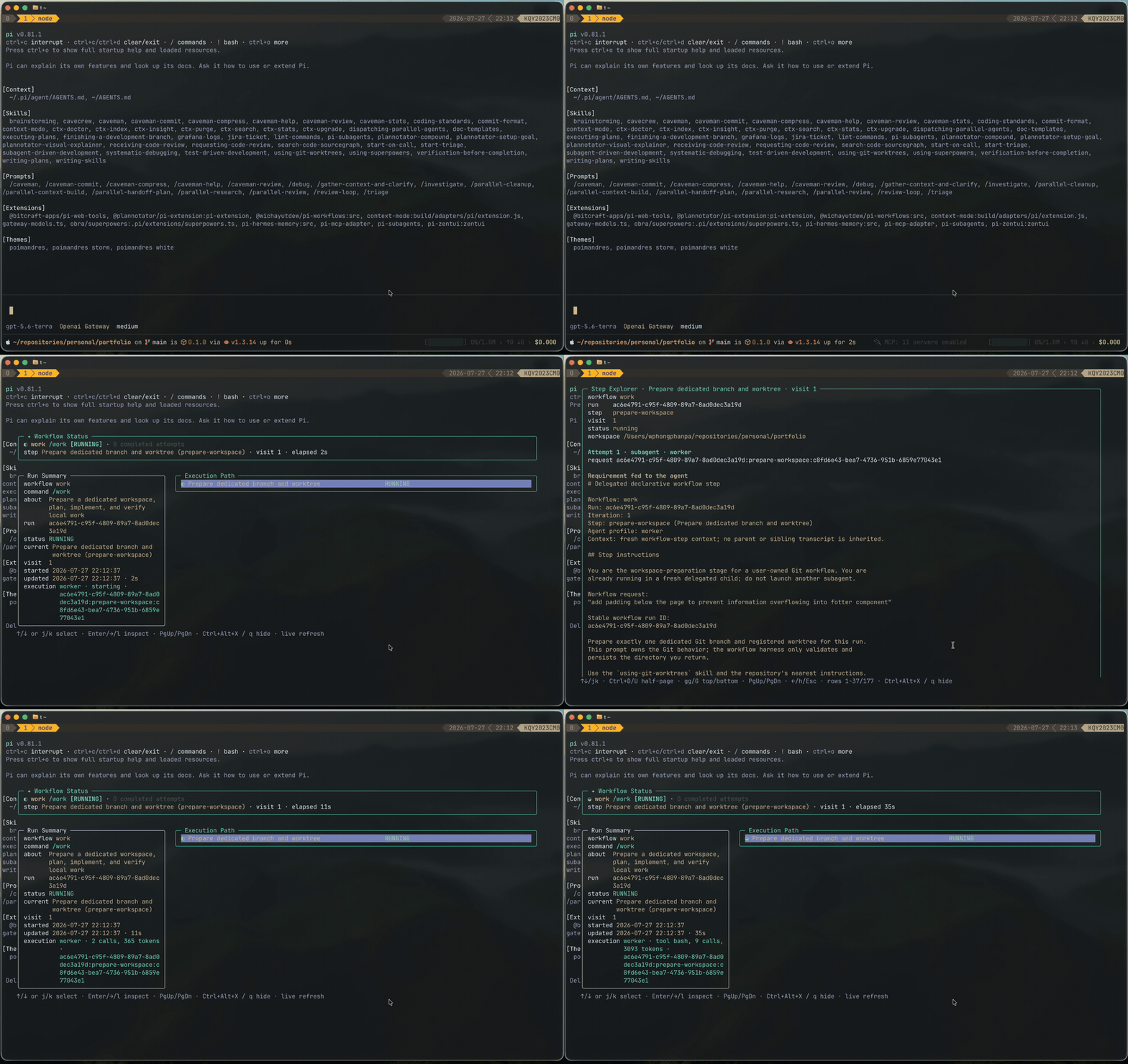
Animated preview — select it to download the full 73-second MP4.
## At a glance | Summary and status | Workflow details | | ------------------------------------------------------------------------------------------------------------------------------------------------------ | ----------------------------------------------------------------------------------------------------------------------------------------------------- | |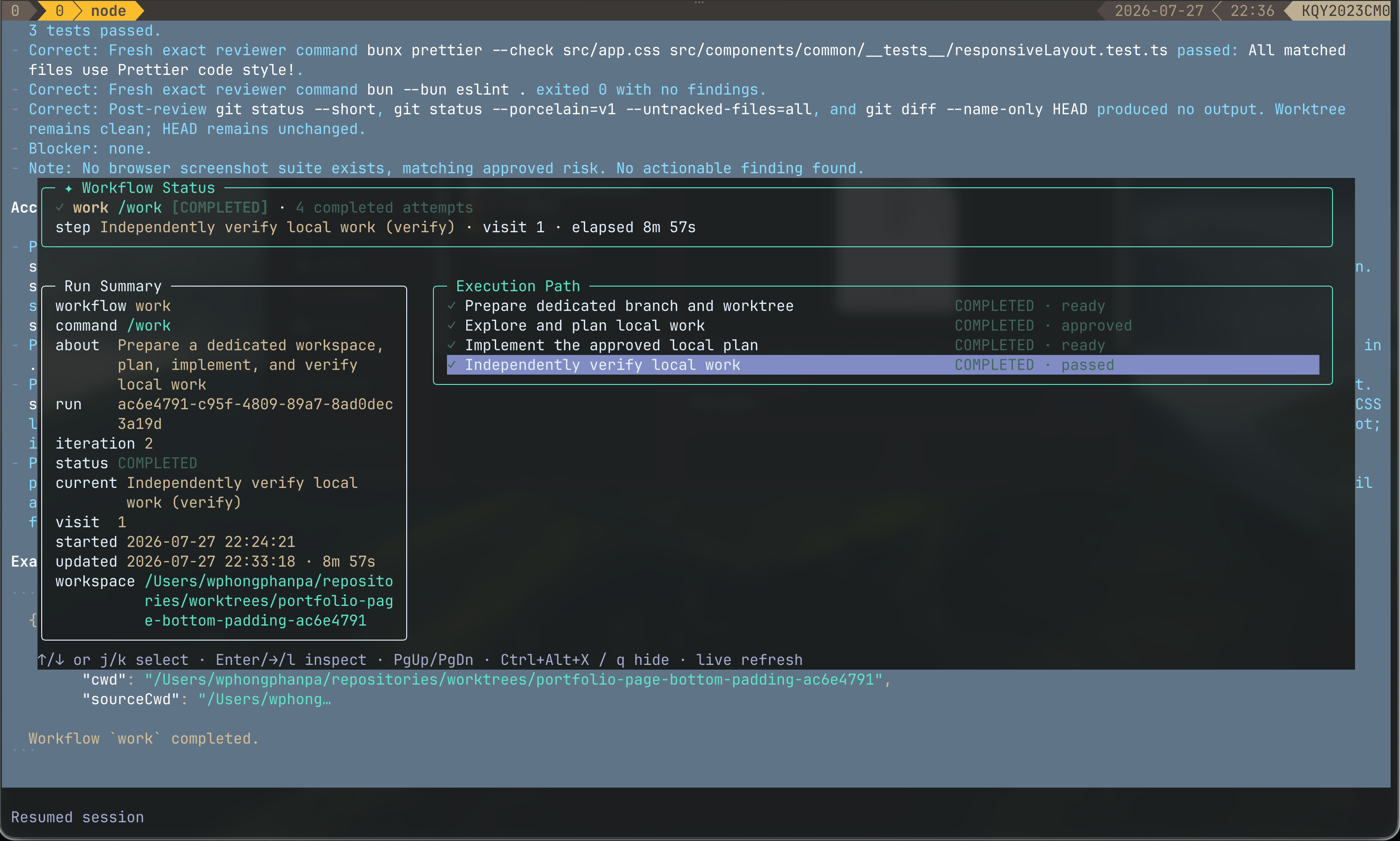 |
| 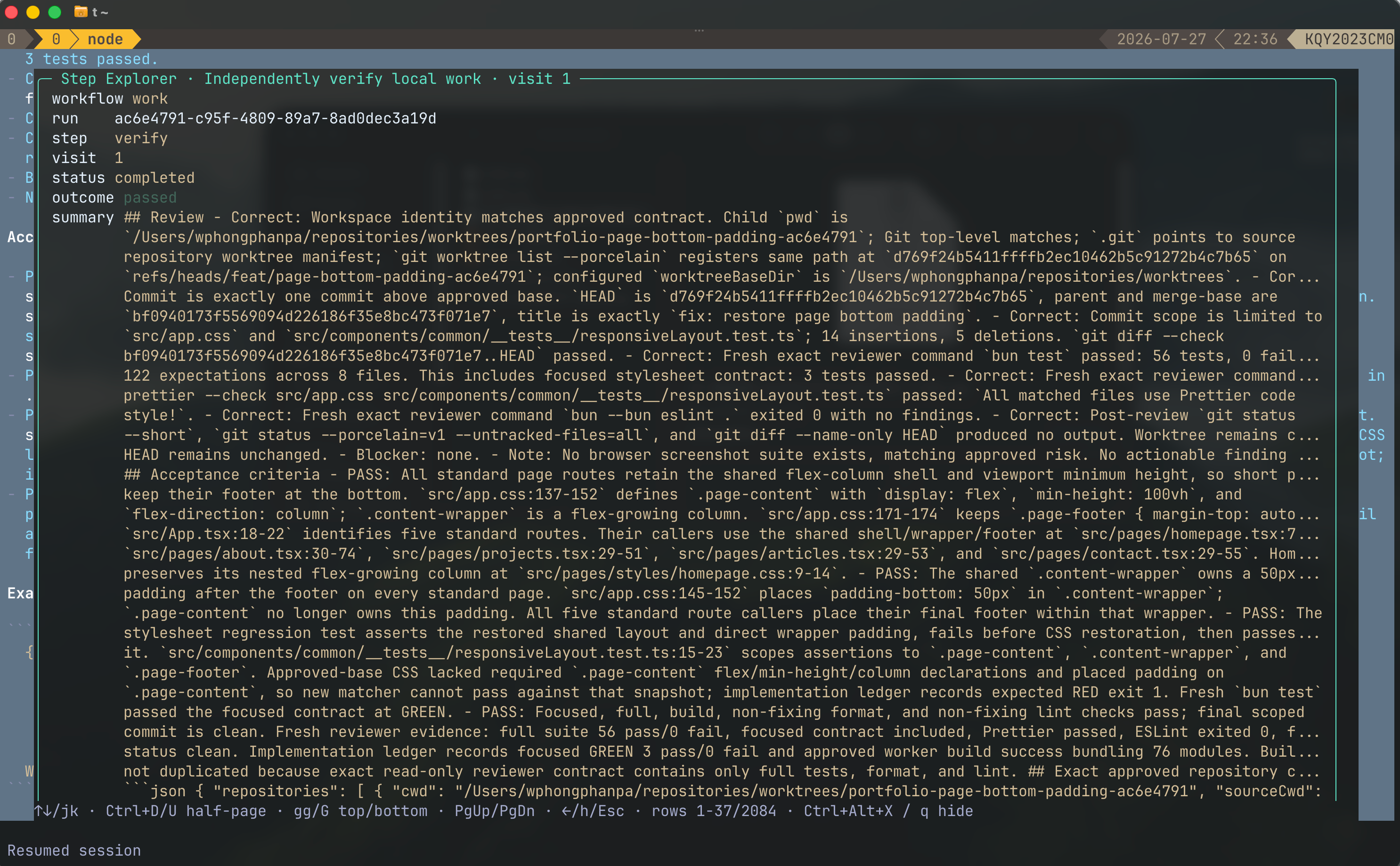 |
| See progress, approvals, and outcome at a glance. | Inspect each workflow step and its execution details. |
## Why Pi Workflows
- **Declarative & Structured**: Turn multi-step agent tasks into clear, reviewable workflow definitions with predictable `ready`, `blocked`, `handoff`, and `gaps` transitions.
- **Typed Handoffs**: Models provide only concrete `completed` and `remaining` items; the extension validates their outcome semantics and renders canonical Markdown.
- **Durable Checkpoints**: Pause for human approval or feedback and resume seamlessly without repeating completed steps.
- **Safe Worktree Iterations**: Keep worktree-bound iterations isolated and carry forward verified changes for follow-up enhancements.
- **Resource & Loop Guarding**: Enforce strict tool and Bash allowlists and halt runaway loops before they exceed step limits.
- **Role Profiles**: Assign workflow-owned roles (`scout`, `planner`, `worker`, `reviewer`) with custom model and thinking overrides.
- **Live Terminal UI**: Interactive status board, execution path visualization, step transcript inspection, and real-time cost ledger.
## Closed outcome protocol
Every step chooses one of four outcomes:
- `ready`: the active step is complete; transition to another step or `$done`.
- `blocked`: user input is required; transition only to `$pause` and put the question in `remaining`.
- `handoff`: actionable active-step work remains; transition only back to the same step.
- `gaps`: an earlier step must refresh requirements or work; transition only to an earlier ordinary step.
Completion calls contain `outcome`, `completed`, and `remaining`. A `ready`
result uses exactly `No active-step work remains.` as its sole remaining item.
The extension—not the model—formats these fields into the durable Markdown
handoff. Gate artifacts and ready-only workspace bindings remain separate,
conditionally permitted completion fields.
## Quick Installation
Install the published extension in Pi:
```bash
pi install npm:@wichayutdew/pi-workflows
```
## Herdr workflow status
When Pi runs delegated workflow steps, the parent agent may be idle while child work continues. Pi Workflows includes a Herdr companion extension that reports workflow lifecycle state so the pane remains **working** until the workflow completes, pauses, or is interrupted.
The companion is inactive unless Herdr provides `HERDR_ENV=1`, `HERDR_SOCKET_PATH`, and `HERDR_PANE_ID`. It uses Herdr's existing managed Pi reporter, so it does not create a competing pane agent.
### Reapply after a Herdr update
Herdr manages `~/.pi/agent/extensions/herdr-agent-state.ts`; an integration update can replace the workflow lifecycle patch. Locate the installed package with `pi list`, change into that package directory, and run:
```bash
npm run patch:herdr
```
The script patches the managed integration at its default location. It is idempotent, so it is safe to run after every Herdr update. To patch a non-default integration path, set `HERDR_PI_EXTENSION_PATH` before running the script:
```bash
HERDR_PI_EXTENSION_PATH=/path/to/herdr-agent-state.ts npm run patch:herdr
```
Restart Pi or run `/reload` after patching. If Herdr's managed extension changes shape and the script reports an unsupported layout, do not edit it manually; update Pi Workflows or report the integration change.
## Explore
- [Getting started guide](./GETTING_STARTED.md) — install Pi Workflows and run your first workflow.
- [Contribution guide](./CONTRIBUTING.md) — development setup, code conventions, test layers, and validation pipeline.
- [Documentation → OpenWiki](./openwiki/quickstart.md) — architecture, workflow authoring, security, integrations, and development references.
## License
[MIT](./LICENSE)
|
| See progress, approvals, and outcome at a glance. | Inspect each workflow step and its execution details. |
## Why Pi Workflows
- **Declarative & Structured**: Turn multi-step agent tasks into clear, reviewable workflow definitions with predictable `ready`, `blocked`, `handoff`, and `gaps` transitions.
- **Typed Handoffs**: Models provide only concrete `completed` and `remaining` items; the extension validates their outcome semantics and renders canonical Markdown.
- **Durable Checkpoints**: Pause for human approval or feedback and resume seamlessly without repeating completed steps.
- **Safe Worktree Iterations**: Keep worktree-bound iterations isolated and carry forward verified changes for follow-up enhancements.
- **Resource & Loop Guarding**: Enforce strict tool and Bash allowlists and halt runaway loops before they exceed step limits.
- **Role Profiles**: Assign workflow-owned roles (`scout`, `planner`, `worker`, `reviewer`) with custom model and thinking overrides.
- **Live Terminal UI**: Interactive status board, execution path visualization, step transcript inspection, and real-time cost ledger.
## Closed outcome protocol
Every step chooses one of four outcomes:
- `ready`: the active step is complete; transition to another step or `$done`.
- `blocked`: user input is required; transition only to `$pause` and put the question in `remaining`.
- `handoff`: actionable active-step work remains; transition only back to the same step.
- `gaps`: an earlier step must refresh requirements or work; transition only to an earlier ordinary step.
Completion calls contain `outcome`, `completed`, and `remaining`. A `ready`
result uses exactly `No active-step work remains.` as its sole remaining item.
The extension—not the model—formats these fields into the durable Markdown
handoff. Gate artifacts and ready-only workspace bindings remain separate,
conditionally permitted completion fields.
## Quick Installation
Install the published extension in Pi:
```bash
pi install npm:@wichayutdew/pi-workflows
```
## Herdr workflow status
When Pi runs delegated workflow steps, the parent agent may be idle while child work continues. Pi Workflows includes a Herdr companion extension that reports workflow lifecycle state so the pane remains **working** until the workflow completes, pauses, or is interrupted.
The companion is inactive unless Herdr provides `HERDR_ENV=1`, `HERDR_SOCKET_PATH`, and `HERDR_PANE_ID`. It uses Herdr's existing managed Pi reporter, so it does not create a competing pane agent.
### Reapply after a Herdr update
Herdr manages `~/.pi/agent/extensions/herdr-agent-state.ts`; an integration update can replace the workflow lifecycle patch. Locate the installed package with `pi list`, change into that package directory, and run:
```bash
npm run patch:herdr
```
The script patches the managed integration at its default location. It is idempotent, so it is safe to run after every Herdr update. To patch a non-default integration path, set `HERDR_PI_EXTENSION_PATH` before running the script:
```bash
HERDR_PI_EXTENSION_PATH=/path/to/herdr-agent-state.ts npm run patch:herdr
```
Restart Pi or run `/reload` after patching. If Herdr's managed extension changes shape and the script reports an unsupported layout, do not edit it manually; update Pi Workflows or report the integration change.
## Explore
- [Getting started guide](./GETTING_STARTED.md) — install Pi Workflows and run your first workflow.
- [Contribution guide](./CONTRIBUTING.md) — development setup, code conventions, test layers, and validation pipeline.
- [Documentation → OpenWiki](./openwiki/quickstart.md) — architecture, workflow authoring, security, integrations, and development references.
## License
[MIT](./LICENSE)