# Toa Exposition
Converter from [ROA](https://en.wikipedia.org/wiki/Resource-oriented_architecture)
to [SOA](https://en.wikipedia.org/wiki/Service-oriented_architecture).
## TL;DR
```yaml
# manifest.toa.yaml
name: dummy
namespace: dummies
exposition:
/:
GET: observe
```
```yaml
# context.toa.yaml
exposition:
host: api.example.com
```
```http
GET /dummies/dummy/
Host: api.example.com
```
See [features](features) for more examples.
## Overview
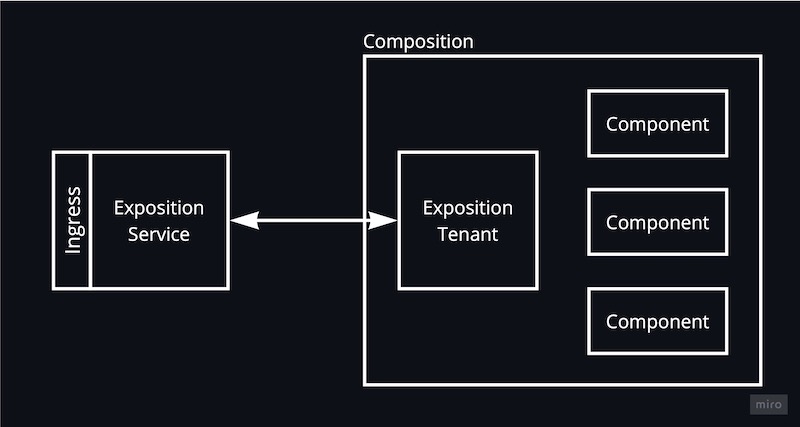
The Exposition extension includes a Service, which is an HTTP server with ingress and a Tenant.
The Service communicates with Tenants to discover their resource declarations and exposes them as
HTTP resources.
An instance of the Tenant is running within each Composition that has at least one Component with a
resource
declaration.
## Resource tree discovery
During the startup of the Tenant instance, it broadcasts an `expose` message
containing [Resource branches](#resource-branch)
of the Components within the Composition. Upon receiving the `expose` message, instances of the
Service (re-)configures
corresponding routes for its HTTP server.
During the startup of the Service instance, it broadcasts a `ping` message. Once an instance of the
Tenant receives
a `ping` message, it broadcasts an `expose` message.
## Resource branch
A Component can specify how to expose its Operations as HTTP resources by declaring a Resource
branch using the manifest extension.
```yaml
# manifest.toa.yaml
extensions:
'@toa.io/extensions.exposition': ...
```
Alternatively, a shortcut `exposition` is available:
```yaml
# manifest.toa.yaml
exposition: ...
```
Resource branches are attached to a Tree with a prefix `/{namespace}/{name}` or `/{name}` for
components within the default namespace.
```yaml
# manifest.toa.yaml
name: rooms
namespace: messaging
exposition:
/: ...
/:user-id: ...
/:user-id/:room-id: ...
```
The declaration above will result in exposing the following resources:
```
/messaging/rooms/
/messaging/rooms/:user-id/
/messaging/rooms/:user-id/:room-id/
```
> Trailing slash is required.
## Context annotation
The Exposition annotation declares options for its deployment.
```yaml
annotations:
'@toa.io/extensions.exposition':
host: the.exmaple.com
```
A shortcut is also available.
```yaml
exposition:
host: the.example.com
```
| Option | Type | Description |
|---------------|-----------|------------------------------------------------------------------|
| `host` | `string` | Domain name to be used for the corresponding Kubernetes Ingress. |
| `class` | `string` | Ingress class |
| `annotations` | `object` | Ingress annotations |
| `debug` | `boolean` | Output server errors. Default `false`. |
### Context resources
Exposition annotaion can contain [resource declaration](documentation/tree.md) under the `/` key.
```yaml
# context.toa.yaml
exposition:
host: the.example.com
/:
/code:
GET:
endpoint: development.code.checkout
type: observation
```
In the example above, a request `GET /code` will be mapped to the `development.code.checkout`
operation call.
Unlike a component resource branch declaration, properties `namespace`, `component`, and `type` are
required.
If component resource branch conflicts with an annotation, the annotation takes precedence.
### Example
```yaml
exposition:
host: the.example.com
host@staging: the.example.dev
class: alb
debug@staging: true
annotations:
alb.ingress.kubernetes.io/scheme: internet-facing
alb.ingress.kubernetes.io/target-type: ip
alb.ingress.kubernetes.io/listen-ports: '[{"HTTPS": 443}]'
/:
/foo:
GET: foo.bar.observe
```
## See Also
- [Protocol support](documentation/protocol.md)
- [Resource Tree Definition](documentation/tree.md)
- [Identity authentication](documentation/identity.md)
- [Access authorization](documentation/access.md)
- [BLOBs](documentation/octets.md)
- [Components and resources](documentation/components.md)
- [Caching](documentation/cache.md)
- [Features](features)