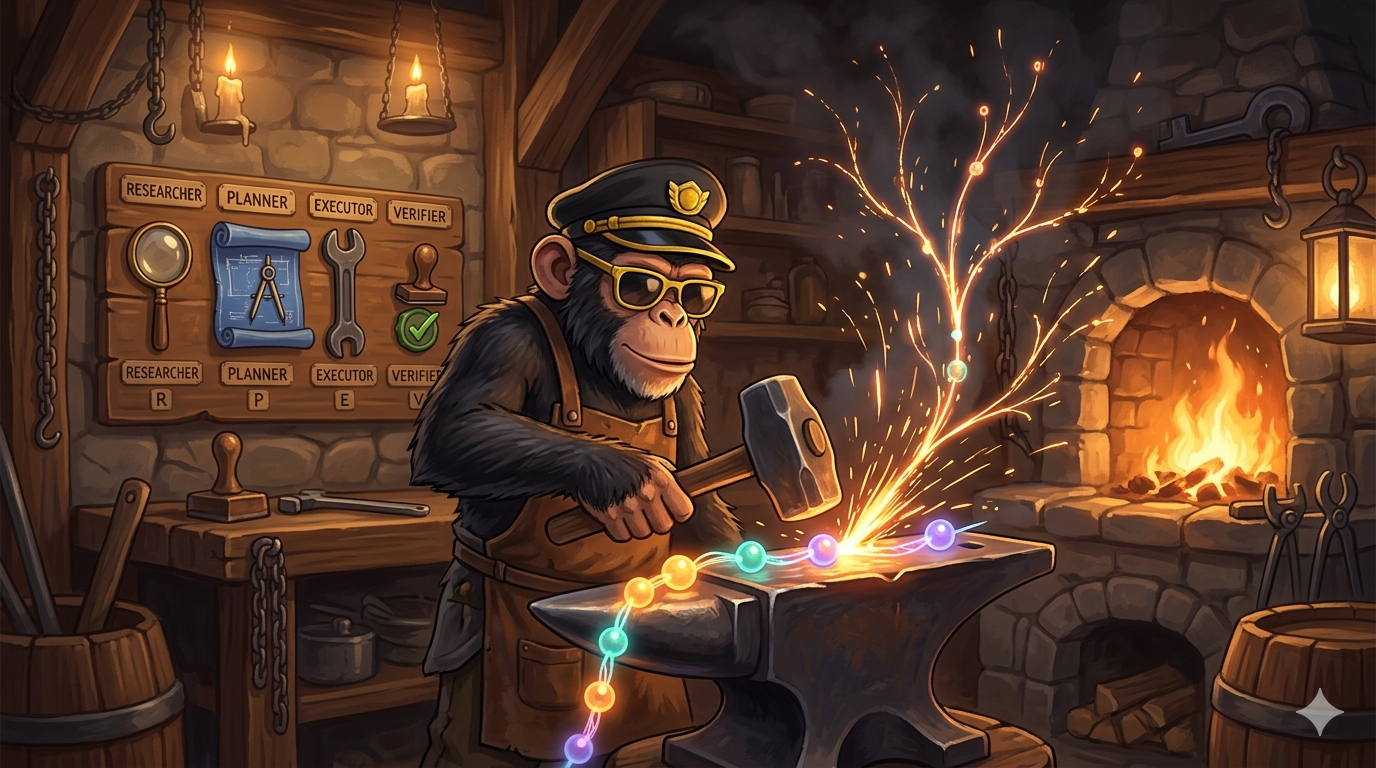
The Forge Flow
Autonomous coding agent orchestrator for Claude Code.
SQLite-backed state. Plannotator reviews. Wave-based parallel execution.
Setup |
Workflow |
Commands |
Architecture |
Agents
---
## What is The Forge Flow?
The Forge Flow (`tff-cc`) is a Claude Code plugin that orchestrates AI agents through a structured software development lifecycle. It coordinates 4 lean agents and 18 skills from project initialization to shipped code.
**Key features:**
- **SQLite state** — zero-dependency local state management with automatic persistence
- **Wave-based execution** -- tasks are topologically sorted into waves, independent tasks run in parallel
- **Fresh reviewer enforcement** -- code reviewers are never the same agent that wrote the code
- **Plannotator integration** -- all plan reviews, verification, and code reviews go through plannotator's interactive UI
- **Complexity tiers** -- S (quick fix), SS (feature), SSS (complex) determine which phases are required
- **Checkpoint/resumability** -- pause and resume execution across sessions
- **Skill library** -- 18 reusable methodology skills that agents load for consistent practices
- **Autonomous flow** -- `plan-to-pr` mode auto-runs from plan approval through PR creation, with escalation on failure
- **Auto-learn pipeline** -- observes tool-use patterns, ranks candidates, drafts skills with bounded guardrails
- **Lean agents** -- 4 identity-only agents for fresh-reviewer enforcement; all methodology lives in skills
---
## Setup Guide
The Forge Flow requires **Node.js 20+** and **Git**. Optionally install **plannotator** for interactive review UI.
### Step 1: Install plannotator
Plannotator is a Claude Code plugin that provides an interactive browser UI for reviewing plans and code.
```bash
# Add the plannotator marketplace
claude /plugin marketplace add backnotprop/plannotator
# Install the plugin
claude /plugin install plannotator@plannotator
```
Verify: Run `/plannotator-annotate README.md` in Claude Code -- it should open a browser window.
You can also verify from the command line:
```bash
tff-tools plannotator:check
```
### Step 2: Install The Forge Flow
```bash
# Add the marketplace
claude /plugin marketplace add MonsieurBarti/tff-mono
# Install the plugin
claude /plugin install tff-cc@the-forge-flow
```
Verify: Run `/tff:help` in Claude Code to see the command reference.
The plugin is pulled from the repo's `release` branch, which ships a pre-built `dist/` and resolved plugin tree — no manual `bun install` or `bun run build` is required on the consumer side. Contributors cloning `main` for development still need `bun install && bun run build` to produce `dist/` locally.
### Verification
Run `/tff:health` to check state consistency and plannotator availability (uses `tff-tools plannotator:check` internally).
---
## Full Workflow Example
Here's a complete walkthrough from empty project to shipped milestone: building an authentication system.
### 1. Initialize the project
```
/tff:new
```
Claude asks for your project name and vision. You provide:
- **Name:** my-saas-app
- **Vision:** A multi-tenant SaaS platform with team management
This creates `.tff/PROJECT.md` and asks you to define requirements.
**Next step suggested:** `/tff:new-milestone`
### 2. Create a milestone
```
/tff:new-milestone
```
- **Name:** MVP
- **Goal:** Basic auth + team CRUD
This creates the `milestone/M01` branch and prompts you to break the milestone into slices.
You define 3 slices:
1. **Auth flow** -- signup, login, JWT tokens
2. **Team CRUD** -- create/read/update/delete teams
3. **Permissions** -- role-based access control
**Next step suggested:** `/tff:discuss`
### 3. Discuss the first slice
```
/tff:discuss
```
The **brainstormer** agent (opus) challenges your assumptions:
- "What OAuth providers do you need? Just email/password?"
- "How do JWT tokens refresh? What's the expiry strategy?"
- "Is email verification required for MVP?"
The **product-lead** agent validates requirements and defines acceptance criteria.
Complexity is auto-classified as **SS** (5 tasks, 2 modules, no external integrations).
**Next step suggested:** `/tff:research M01-S01`
### 4. Research (optional for SS)
```
/tff:research M01-S01
```
The agent investigates the technical approach: reads the existing codebase, checks what auth libraries are available, documents findings in `.tff/milestones/M01/slices/M01-S01/RESEARCH.md`.
**Next step suggested:** `/tff:plan M01-S01`
### 5. Plan the slice
```
/tff:plan M01-S01
```
The agent creates a task decomposition with dependencies:
- T01: User entity + migration (no deps)
- T02: Password hashing service (no deps)
- T03: Signup endpoint (depends on T01, T02)
- T04: Login endpoint (depends on T01, T02)
- T05: JWT middleware (depends on T04)
Waves detected:
- Wave 0: [T01, T02] -- parallel
- Wave 1: [T03, T04] -- parallel
- Wave 2: [T05] -- sequential
**Plannotator opens** in your browser. You annotate the plan, suggest changes, approve.
A worktree is created at `.tff/worktrees/M01-S01/` on branch `slice/M01-S01`.
**Next step suggested:** `/tff:execute M01-S01`
### 6. Execute with wave parallelism
```
/tff:execute M01-S01
```
For each wave:
**Wave 0:** The **tester** agent writes failing specs for T01 and T02. Then **backend-dev** agents are spawned in parallel -- one for T01 (user entity), one for T02 (password hashing). Each implements until tests pass, then commits atomically.
**Wave 1:** Same pattern for T03 and T04. Tests written first, then implementation.
**Wave 2:** T05 (JWT middleware) -- sequential, single agent.
Checkpoints are saved after each wave. If the session crashes, `/tff:resume` picks up where it left off.
**Next step suggested:** `/tff:verify M01-S01`
### 7. Verify acceptance criteria
```
/tff:verify M01-S01
```
The **product-lead** agent checks each acceptance criterion against the implementation. Results are written to `VERIFICATION.md`.
**Plannotator opens** for you to review the findings. You mark any issues.
If all pass: **Next step suggested:** `/tff:ship M01-S01`
If failures: suggests `/tff:execute M01-S01` to fix and re-run.
### 8. Ship the slice (two-stage review)
```
/tff:ship M01-S01
```
**Stage 1 -- Spec compliance:** The **spec-reviewer** agent (fresh, never wrote this code) verifies every acceptance criterion is met in the actual code.
**Stage 2 -- Code quality:** The **code-reviewer** agent checks quality, patterns, tests, YAGNI. Only runs after spec passes.
**Security audit:** The **security-auditor** agent checks for OWASP top 10 issues.
**Plannotator opens** for your final code review.
If approved: slice PR is created (`slice/M01-S01` -> `milestone/M01`), merged, worktree cleaned up.
**Next step suggested:** `/tff:discuss` (for the next slice) or `/tff:progress`
### 9. Repeat for remaining slices
Run the same cycle for M01-S02 (Team CRUD) and M01-S03 (Permissions).
### 10. Complete the milestone
```
/tff:audit-milestone
```
Checks all slices are closed, requirements are covered. Then:
```
/tff:complete-milestone
```
Creates the milestone PR (`milestone/M01` -> `main`), runs a final security audit, opens plannotator for review. After approval, merges to main.
**Next step suggested:** `/tff:new-milestone` for the next milestone.
### Quick fixes and debugging
Found a bug while working on a later slice? Two options:
**If you know the fix:**
```
/tff:quick "Fix null pointer in user validation"
```
Skips brainstorming and research, goes straight to plan -> execute -> ship.
**If you need to investigate:**
```
/tff:debug "Users getting 500 on login after password reset"
```
Systematically diagnoses the issue first (no slice created), then fixes via S-tier slice once root cause is confirmed.
---
## Commands
### Project Lifecycle
| Command | Description |
| -------------------- | --------------------------------- |
| `/tff:new` | Initialize a new tff project |
| `/tff:new-milestone` | Start a new milestone |
| `/tff:progress` | Show status dashboard |
| `/tff:status` | Lightweight status with next step |
### Slice Lifecycle
| Command | Description |
| ------------------------------- | ------------------------------------- |
| `/tff:discuss` | Brainstorm and scope a slice |
| `/tff:research [slice-id]` | Research phase |
| `/tff:plan [slice-id]` | Plan and create tasks |
| `/tff:execute [slice-id]` | Execute with wave parallelism |
| `/tff:verify [slice-id]` | Verify acceptance criteria |
| `/tff:ship [slice-id]` | PR review and merge slice |
| `/tff:quick ` | Fast-track S-tier changes |
| `/tff:debug ` | Diagnose and fix a bug systematically |
### Milestone Lifecycle
| Command | Description |
| ------------------------- | ----------------------------- |
| `/tff:audit-milestone` | Audit against original intent |
| `/tff:complete-milestone` | PR review and merge to main |
### Management
| Command | Description |
| -------------------------- | ------------------------------------ |
| `/tff:add-slice` | Add slice to milestone |
| `/tff:insert-slice` | Insert between slices |
| `/tff:remove-slice` | Remove future slice |
| `/tff:rollback [slice-id]` | Revert slice commits |
| `/tff:pause` | Save checkpoint |
| `/tff:resume` | Restore from checkpoint |
| `/tff:sync` | Regenerate STATE.md |
| `/tff:health` | Diagnose state consistency |
| `/tff:settings` | View and modify all project settings |
| `/tff:map-codebase` | Analyze codebase and generate docs |
| `/tff:help` | Show command reference |
### Skill Auto-Learn
| Command | Description |
| ---------------------- | ------------------------------------------------ |
| `/tff:detect-patterns` | Run pattern detection pipeline |
| `/tff:suggest-skills` | Show ranked skill candidates |
| `/tff:create-skill` | Draft skill from pattern or description |
| `/tff:learn` | Detect skill divergences and propose refinements |
| `/tff:compose` | Detect and bundle skill clusters |
## Architecture
```
the-forge-flow/
.claude-plugin/ # CC marketplace manifest
commands/tff/ # 30 slash commands (.md)
agents/ # 4 lean identity-only agents (.md)
skills/ # 18 reusable methodology skills (folder convention)
workflows/ # 23 orchestration workflows (.md)
references/ # 8 reference documents (.md)
hooks/ # PostToolUse observation hook (.sh)
src/
application/ # Use cases (orchestrate via local ports)
infrastructure/ # Adapters (SQLite, git CLI, filesystem)
cli/ # CLI entry point
dist/ # Compiled CLI and native bindings
tests/ # Unit and integration tests
packages/core/
src/
domain/ # Shared domain layer (state machine, schema, contracts)
shared/ # Content, migrations, and shared assets
```
### Core / App Split
- `packages/core` owns domain models, state machine, schema, migrations, and shared content.
- `apps/tff-cc` owns the CLI entry point, Claude-Code-specific adapters, and local port wiring.
- `@tff/core` is bundled into the CLI at build time via esbuild (`external: []`); no runtime `node_modules` resolution is needed.
- Local port definitions remain in `apps/tff-cc/src/domain/ports/` for app-specific contracts not provided by `@tff/core`.
- **Tests** are organized as `.spec.ts`. Unit tests use in-memory adapters.
## Agents
After v0.7.0's skills architecture reform, methodology moved from agents to skills. Only 4 identity-only agents remain -- they exist for fresh-reviewer enforcement (ensuring the reviewer is never the same agent that wrote the code).
| Agent | Role | Profile |
| ---------------- | ------------------------------------ | --------------- |
| code-reviewer | Code quality review (fresh reviewer) | quality (opus) |
| spec-reviewer | Spec compliance verification | quality (opus) |
| security-auditor | Security review on every PR | quality (opus) |
| fixer | Apply accepted review findings | budget (sonnet) |
## Skills
Skills are reusable knowledge fragments loaded via `@skills//SKILL.md`. They teach HOW to do something -- agents define WHO does it. After v0.7.0, all methodology lives in skills (decoupled from TFF-specific terminology).
| Skill | Purpose |
| ------------------------------ | ------------------------------------------------- |
| hexagonal-architecture | DDD + CQRS + hexagonal boundary patterns |
| test-driven-development | TDD methodology with HARD-GATE enforcement |
| code-review-protocol | Two-stage review (spec compliance + code quality) |
| commit-conventions | Conventional commit format and rules |
| plannotator-usage | Interactive plan/review UI integration |
| brainstorming | Structured discovery and design exploration |
| systematic-debugging | 4-phase investigation (Track A/B diagnosis) |
| writing-plans | Break specs into bite-sized tasks (2-5 min each) |
| executing-plans | Wave-based execution with fresh subagent per task |
| finishing-work | Pre-PR checklist, structured merge/PR decision |
| stress-testing-specs | Devil's advocate for assumptions and scope |
| architecture-review | C4 model, dependency inversion review |
| acceptance-criteria-validation | Binary verdict per criterion, evidence-based |
| codebase-documentation | Divio framework documentation generation |
| skill-authoring | Evidence-driven pattern analysis for new skills |
| agent-authoring | Standardized agent template (identity-only) |
| receiving-code-review | Technical rigor when processing review feedback |
| verification-before-completion | Evidence before claims, always |
## Work Hierarchy
```
Project (one per repo)
Milestone (M01, M02, ...)
Slice (M01-S01, M01-S02, ...)
Task (T01, T02, ...)
```
### Git Branch Model
Branches use UUID-based names for uniqueness and merge safety. Human-readable labels (`M01`, `M01-S01`) are used for directories and PR titles.
```
main
milestone/a1b2c3d4 # M01 in PR title
slice/e5f6g7h8 # M01-S01 in PR title (worktree)
slice/i9j0k1l2 # M01-S02 in PR title (worktree)
```
### Complexity Tiers
| Tier | Brainstormer | Research | TDD | Fresh Reviewer |
| ------------- | ------------ | -------- | ---- | -------------- |
| S (quick fix) | Skip | Skip | Skip | Always |
| SS (feature) | Yes | Optional | Yes | Always |
| SSS (complex) | Yes | Required | Yes | Always |
## Branch Isolation
tff-cc writer commands refuse to run on the repository's **default branch** (usually `main` or `master`) to prevent accidental commits to shared branches during slice execution.
### How it works
On every writer command, `tff-tools` compares `git rev-parse --abbrev-ref HEAD` against `git symbolic-ref refs/remotes/origin/HEAD` (fallback: `main`). If they match, the command exits with:
```json
{
"ok": false,
"error": {
"code": "REFUSED_ON_DEFAULT_BRANCH",
"message": "Refusing to run \"\" on default branch \"\". Create a worktree before proceeding.",
"context": { "command": "", "branch": "" }
}
}
```
### Remediation
Create a worktree for your slice:
```bash
tff-tools worktree:create --slice-id M01-S01
cd .worktrees/M01-S01
# now run writer commands from here
```
### Exempt commands
Only `project:init` is exempt — it bootstraps the first project on `main` before any feature branch exists.
### Unaffected commands
Read-only and advisory commands (listers, getters, guards, workflows, patterns, skills, classifiers, session reminders, schema) are unaffected.
## Configuration
Project settings live in `.tff/settings.yaml`. Generated automatically by `/tff:new` with inline comments. Manage interactively with `/tff:settings`.
```yaml
model-profiles:
quality:
model: opus # brainstormer, architect, code-reviewer, security-auditor
balanced:
model: sonnet # product-lead, tester
budget:
model: sonnet # frontend-dev, backend-dev, devops, fixer, doc-writer
autonomy:
mode: guided # "guided" (pause at every step) | "plan-to-pr" (auto-transition)
auto-learn:
weights:
frequency: 0.25
breadth: 0.30
recency: 0.25
consistency: 0.20
guardrails:
min-corrections: 3
cooldown-days: 7
max-drift-pct: 20
clustering:
min-sessions: 3
min-patterns: 2
```
Settings are resilient: corrupted or partial files fall back to defaults per field. Run `/tff:settings` to detect and add missing fields.
## Routing
tff-cc classifies every routing decision through a layered pipeline (signals → tier → confidence) that was built in phases.
### Phase D — feedback loop (advisory calibration)
Phase D closes the routing loop by measuring outcomes and recommending threshold adjustments.
- `tff-tools routing:event --kind debug --slice ` — emit a `/tff:debug` observability event (invoked automatically from `/tff:debug`).
- `tff-tools routing:outcome --decision --dimension {agent|tier|unknown} --verdict {ok|wrong|too-low|too-high} [--reason "..."]` — hand-label a past decision.
- `tff-tools routing:calibrate [--n-min 5] [--implicit-weight 0.5]` — generate an advisory markdown report at `.tff/logs/routing-calibration.md` with per-agent and per-tag accuracy cells and rule-based recommendations.
Phase D is read-only over `settings.yaml` — it never auto-applies. Rules fire only on cells with `effective_total ≥ n_min` (default 5). Auto-apply is Phase E.
## Releasing (maintainers)
The `release` branch is a built-artifact channel. The intended flow after a PR merges to `main`:
1. PR merges to `main`.
2. release-please opens a version-bump PR; a maintainer merges it.
3. `.github/workflows/release.yml` runs: publishes to npm, then executes `scripts/sync-release-branch.sh` which force-pushes a fresh snapshot (plugin manifest + resolved content dirs + built `dist/` + native SQLite binaries + top-level docs) to `release`.
4. `.github/workflows/release-branch-validation.yml` fires on the push to `release` (and daily at 05:00 UTC), asserting `dist/cli/index.js` exists, the CLI runs, and no legacy `.tff/` directory has leaked in.
5. If validation is green, the new version is live for `claude /plugin install tff-cc@the-forge-flow`.
Before trusting the sync script in production, maintainers should smoke-test it against a throwaway fork — see the comment block at the top of `scripts/sync-release-branch.sh`.
For the full operator guide (failure modes, verification checklist, prerequisites), see [`references/release-checklist.md`](references/release-checklist.md).
## License
MIT
---
**Install via npm:** `npm install -g @the-forge-flow/tff-cc`