# dnanasum
> Calculate the sum of absolute values ([_L1_ norm][l1norm]) of double-precision floating-point strided array elements, ignoring `NaN` values.
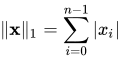
The [_L1_ norm][l1norm] is defined as
## Usage
```javascript
var dnanasum = require( '@stdlib/blas/ext/base/dnanasum' );
```
#### dnanasum( N, x, strideX )
Computes the sum of absolute values ([_L1_ norm][l1norm]) of double-precision floating-point strided array elements, ignoring `NaN` values.
```javascript
var Float64Array = require( '@stdlib/array/float64' );
var x = new Float64Array( [ 1.0, -2.0, NaN, 2.0 ] );
var N = x.length;
var v = dnanasum( N, x, 1 );
// returns 5.0
```
The function has the following parameters:
- **N**: number of indexed elements.
- **x**: input [`Float64Array`][@stdlib/array/float64].
- **strideX**: index increment for `x`.
The `N` and stride parameters determine which elements in the strided array are accessed at runtime. For example, to compute the sum of absolute values ([_L1_ norm][l1norm]) for every other element in the strided array,
```javascript
var Float64Array = require( '@stdlib/array/float64' );
var x = new Float64Array( [ 1.0, 2.0, NaN, -7.0, NaN, 3.0, 4.0, 2.0 ] );
var v = dnanasum( 4, x, 2 );
// returns 5.0
```
Note that indexing is relative to the first index. To introduce an offset, use [`typed array`][mdn-typed-array] views.
```javascript
var Float64Array = require( '@stdlib/array/float64' );
var x0 = new Float64Array( [ 2.0, 1.0, NaN, -2.0, -2.0, 2.0, 3.0, 4.0 ] );
var x1 = new Float64Array( x0.buffer, x0.BYTES_PER_ELEMENT*1 ); // start at 2nd element
var v = dnanasum( 4, x1, 2 );
// returns 9.0
```
#### dnanasum.ndarray( N, x, strideX, offsetX )
Computes the sum of absolute values ([_L1_ norm][l1norm]) of double-precision floating-point strided array elements, ignoring `NaN` values and using alternative indexing semantics.
```javascript
var Float64Array = require( '@stdlib/array/float64' );
var x = new Float64Array( [ 1.0, -2.0, NaN, 2.0 ] );
var v = dnanasum.ndarray( 4, x, 1, 0 );
// returns 5.0
```
The function has the following additional parameters:
- **offsetX**: starting index for `x`.
While [`typed array`][mdn-typed-array] views mandate a view offset based on the underlying buffer, the offset parameter supports indexing semantics based on a starting index. For example, to calculate the sum of absolute values ([_L1_ norm][l1norm]) for every other value in the strided array starting from the second value
```javascript
var Float64Array = require( '@stdlib/array/float64' );
var x = new Float64Array( [ 2.0, 1.0, NaN, -2.0, -2.0, 2.0, 3.0, 4.0 ] );
var v = dnanasum.ndarray( 4, x, 2, 1 );
// returns 9.0
```
## Notes
- If `N <= 0`, both functions return `0.0`.
## Examples
```javascript
var bernoulli = require( '@stdlib/random/base/bernoulli' );
var discreteUniform = require( '@stdlib/random/base/discrete-uniform' );
var filledarrayBy = require( '@stdlib/array/filled-by' );
var Float64Array = require( '@stdlib/array/float64' );
var dnanasum = require( '@stdlib/blas/ext/base/dnanasum' );
function rand() {
if ( bernoulli( 0.8 ) > 0 ) {
return discreteUniform( 0, 100 );
}
return NaN;
}
var x = filledarrayBy( 10, 'float64', rand );
console.log( x );
var v = dnanasum( x.length, x, 1 );
console.log( v );
```
* * *
## C APIs
### Usage
```c
#include "stdlib/blas/ext/base/dnanasum.h"
```
#### stdlib_strided_dnanasum( N, \*X, strideX )
Computes the sum of absolute values ([_L1_ norm][l1norm]) of double-precision floating-point strided array elements, ignoring `NaN` values.
```c
const double x[] = { 1.0, 2.0, 0.0/0.0, 4.0 };
double v = stdlib_strided_dnanasum( 4, x, 1 );
// returns 7.0
```
The function accepts the following arguments:
- **N**: `[in] CBLAS_INT` number of indexed elements.
- **X**: `[in] double*` input array.
- **strideX**: `[in] CBLAS_INT` index increment for `X`.
```c
double stdlib_strided_dnanasum( const CBLAS_INT N, const double *X, const CBLAS_INT strideX );
```
#### stdlib_strided_dnanasum_ndarray( N, \*X, strideX, offsetX )
Computes the sum of absolute values ([_L1_ norm][l1norm]) of double-precision floating-point strided array elements, ignoring `NaN` values and using alternative indexing semantics.
```c
const double x[] = { 1.0, 2.0, 0.0/0.0, 4.0 };
double v = stdlib_strided_dnanasum_ndarray( 4, x, 1, 0 );
// returns 7.0
```
The function accepts the following arguments:
- **N**: `[in] CBLAS_INT` number of indexed elements.
- **X**: `[in] double*` input array.
- **strideX**: `[in] CBLAS_INT` index increment for `X`.
- **offsetX**: `[in] CBLAS_INT` starting index for `X`.
```c
double stdlib_strided_dnanasum_ndarray( const CBLAS_INT N, const double *X, const CBLAS_INT strideX, const CBLAS_INT offsetX );
```
### Examples
```c
#include "stdlib/blas/ext/base/dnanasum.h"
#include
int main( void ) {
// Create a strided array:
const double x[] = { 1.0, 2.0, -3.0, -4.0, 5.0, -6.0, -7.0, 8.0, 0.0/0.0, 0.0/0.0 };
// Specify the number of elements:
const int N = 5;
// Specify the stride length:
const int strideX = 2;
// Compute the sum:
double v = stdlib_strided_dnanasum( N, x, strideX );
// Print the result:
printf( "sumabs: %lf\n", v );
}
```
[@stdlib/array/float64]: https://www.npmjs.com/package/@stdlib/array-float64
[mdn-typed-array]: https://developer.mozilla.org/en-US/docs/Web/JavaScript/Reference/Global_Objects/TypedArray
[l1norm]: https://en.wikipedia.org/wiki/Norm_%28mathematics%29
[@stdlib/blas/base/dasum]: https://github.com/stdlib-js/blas/tree/main/base/dasum
[@stdlib/blas/ext/base/dasumpw]: https://github.com/stdlib-js/blas/tree/main/ext/base/dasumpw