# dasumpw
> Calculate the sum of absolute values ([_L1_ norm][l1norm]) of double-precision floating-point strided array elements using pairwise summation.
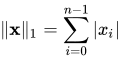
The [_L1_ norm][l1norm] is defined as
## Usage
```javascript
var dasumpw = require( '@stdlib/blas/ext/base/dasumpw' );
```
#### dasumpw( N, x, strideX )
Computes the sum of absolute values ([_L1_ norm][l1norm]) of double-precision floating-point strided array elements using pairwise summation.
```javascript
var Float64Array = require( '@stdlib/array/float64' );
var x = new Float64Array( [ 1.0, -2.0, 2.0 ] );
var N = x.length;
var v = dasumpw( N, x, 1 );
// returns 5.0
```
The function has the following parameters:
- **N**: number of indexed elements.
- **x**: input [`Float64Array`][@stdlib/array/float64].
- **strideX**: index increment for `x`.
The `N` and stride parameters determine which elements in the strided array are accessed at runtime. For example, to compute the sum of absolute values of every other element in `x`,
```javascript
var Float64Array = require( '@stdlib/array/float64' );
var x = new Float64Array( [ 1.0, 2.0, 2.0, -7.0, -2.0, 3.0, 4.0, 2.0 ] );
var v = dasumpw( 4, x, 2 );
// returns 9.0
```
Note that indexing is relative to the first index. To introduce an offset, use [`typed array`][mdn-typed-array] views.
```javascript
var Float64Array = require( '@stdlib/array/float64' );
var x0 = new Float64Array( [ 2.0, 1.0, 2.0, -2.0, -2.0, 2.0, 3.0, 4.0 ] );
var x1 = new Float64Array( x0.buffer, x0.BYTES_PER_ELEMENT*1 ); // start at 2nd element
var v = dasumpw( 4, x1, 2 );
// returns 9.0
```
#### dasumpw.ndarray( N, x, strideX, offsetX )
Computes the sum of absolute values ([_L1_ norm][l1norm]) of double-precision floating-point strided array elements using pairwise summation and alternative indexing semantics.
```javascript
var Float64Array = require( '@stdlib/array/float64' );
var x = new Float64Array( [ 1.0, -2.0, 2.0 ] );
var N = x.length;
var v = dasumpw.ndarray( N, x, 1, 0 );
// returns 5.0
```
The function has the following additional parameters:
- **offsetX**: starting index for `x`.
While [`typed array`][mdn-typed-array] views mandate a view offset based on the underlying buffer, the offset parameter supports indexing semantics based on a starting index. For example, to calculate the sum of absolute values of every other value in `x` starting from the second value
```javascript
var Float64Array = require( '@stdlib/array/float64' );
var x = new Float64Array( [ 2.0, 1.0, 2.0, -2.0, -2.0, 2.0, 3.0, 4.0 ] );
var v = dasumpw.ndarray( 4, x, 2, 1 );
// returns 9.0
```
## Notes
- If `N <= 0`, both functions return `0.0`.
- In general, pairwise summation is more numerically stable than ordinary recursive summation (i.e., "simple" summation), with slightly worse performance. While not the most numerically stable summation technique (e.g., compensated summation techniques such as the Kahan–Babuška-Neumaier algorithm are generally more numerically stable), pairwise summation strikes a reasonable balance between numerical stability and performance. If either numerical stability or performance is more desirable for your use case, consider alternative summation techniques.
## Examples
```javascript
var discreteUniform = require( '@stdlib/random/array/discrete-uniform' );
var dasumpw = require( '@stdlib/blas/ext/base/dasumpw' );
var x = discreteUniform( 10, -100, 100, {
'dtype': 'float64'
});
console.log( x );
var v = dasumpw( x.length, x, 1 );
console.log( v );
```
* * *
## C APIs
### Usage
```c
#include "stdlib/blas/ext/base/dasumpw.h"
```
#### stdlib_strided_dasumpw( N, \*X, strideX )
Computes the sum of absolute values ([_L1_ norm][l1norm]) of double-precision floating-point strided array elements using pairwise summation.
```c
const double x[] = { 1.0, 2.0, 3.0, 4.0 }
double v = stdlib_strided_dasumpw( 4, x, 1 );
// returns 10.0
```
The function accepts the following arguments:
- **N**: `[in] CBLAS_INT` number of indexed elements.
- **X**: `[in] double*` input array.
- **strideX**: `[in] CBLAS_INT` index increment for `X`.
```c
double stdlib_strided_dasumpw( const CBLAS_INT N, const double *X, const CBLAS_INT strideX );
```
#### stdlib_strided_dasumpw_ndarray( N, \*X, strideX, offsetX )
Computes the sum of absolute values ([_L1_ norm][l1norm]) of double-precision floating-point strided array elements using pairwise summation and alternative indexing semantics.
```c
const double x[] = { 1.0, 2.0, 3.0, 4.0 }
double v = stdlib_strided_dasumpw_ndarray( 4, x, 1, 0 );
// returns 10.0
```
The function accepts the following arguments:
- **N**: `[in] CBLAS_INT` number of indexed elements.
- **X**: `[in] double*` input array.
- **strideX**: `[in] CBLAS_INT` index increment for `X`.
- **offsetX**: `[in] CBLAS_INT` starting index for `X`.
```c
double stdlib_strided_dasumpw_ndarray( const CBLAS_INT N, const double *X, const CBLAS_INT strideX, const CBLAS_INT offsetX );
```
### Examples
```c
#include "stdlib/blas/ext/base/dasumpw.h"
#include
int main( void ) {
// Create a strided array:
const double x[] = { 1.0, -2.0, 3.0, -4.0, 5.0, -6.0, 7.0, -8.0 };
// Specify the number of indexed elements:
const int N = 8;
// Specify a stride:
const int strideX = 1;
// Compute the sum:
double v = stdlib_strided_dasumpw( N, x, strideX );
// Print the result:
printf( "sumabs: %lf\n", sum );
}
```
## References
- Higham, Nicholas J. 1993. "The Accuracy of Floating Point Summation." _SIAM Journal on Scientific Computing_ 14 (4): 783–99. doi:[10.1137/0914050][@higham:1993a].
[@stdlib/array/float64]: https://www.npmjs.com/package/@stdlib/array-float64
[mdn-typed-array]: https://developer.mozilla.org/en-US/docs/Web/JavaScript/Reference/Global_Objects/TypedArray
[l1norm]: https://en.wikipedia.org/wiki/Norm_%28mathematics%29
[@higham:1993a]: https://doi.org/10.1137/0914050
[@stdlib/blas/base/dasum]: https://github.com/stdlib-js/blas/tree/main/base/dasum
[@stdlib/blas/ext/base/dsumpw]: https://github.com/stdlib-js/blas/tree/main/ext/base/dsumpw
[@stdlib/blas/ext/base/gasumpw]: https://github.com/stdlib-js/blas/tree/main/ext/base/gasumpw
[@stdlib/blas/ext/base/sasumpw]: https://github.com/stdlib-js/blas/tree/main/ext/base/sasumpw