# pi-session-deck
**The full Pi session lifecycle in one place.**
Create and organize Pi sessions across repos and worktrees, see what each agent is doing or waiting on, and reopen or end them from a TUI or iTerm2 Toolbelt.
> The unsupported Session Deck desktop app has been retired. The `/session-deck desktop ...` commands are no longer available. If you still have the app installed, remove `~/Applications/Session Deck Desktop.app` and, if present, `~/.pi/session-deck/desktop/` manually. The TUI and iTerm2 Toolbelt integrations remain supported.
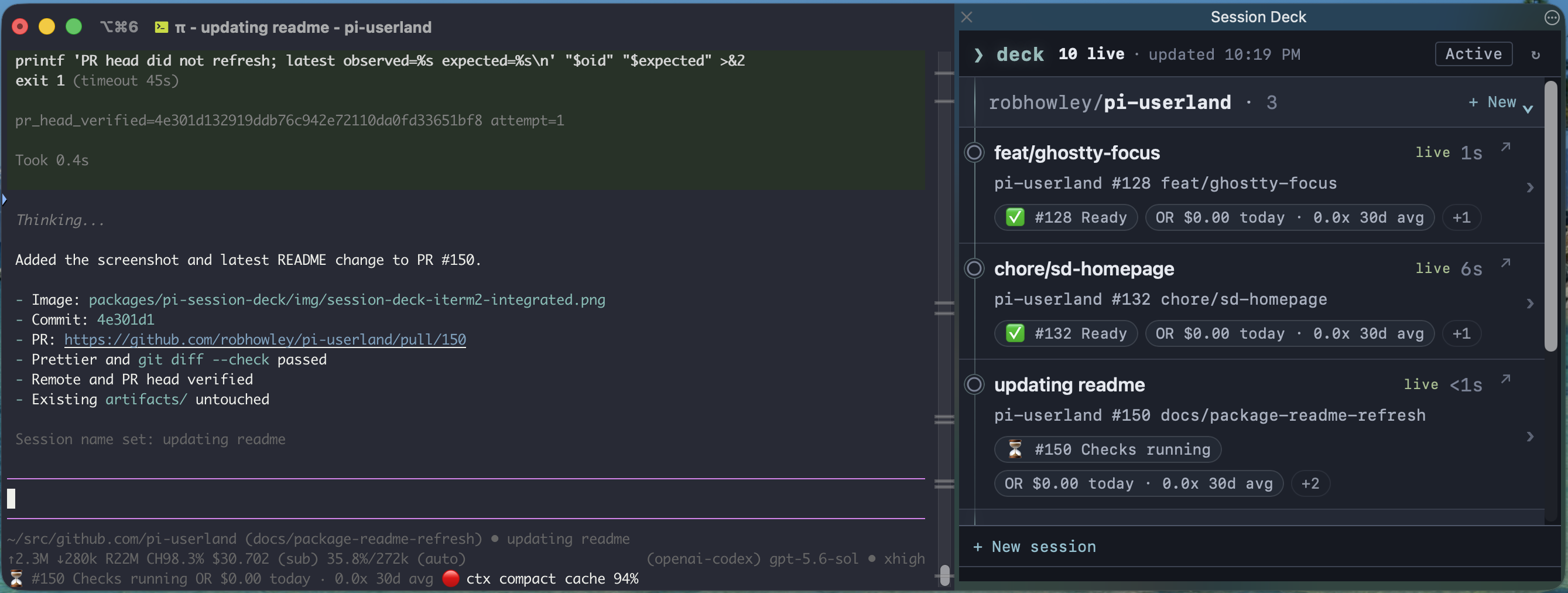 Session Deck turns agents scattered across terminals, repos, worktrees, and background tmux sessions into one operational view.
## The session lifecycle
- **Launch isolated agents.** Create a branch, Git worktree, and detached tmux session in one flow. The agent can keep working without occupying a terminal tab.
- **Know what every agent is doing at a glance.** See which agents are working, waiting, or need attention.
- **Keep work in context.** Sessions stay grouped by repo with their branch, worktree, pull request, status chips, and current activity close at hand.
- **Return without hunting.** Focus an existing terminal or reattach to the agent's tmux session directly from the deck.
- **End sessions cleanly.** Stop an agent when its work is done without deleting its session history.
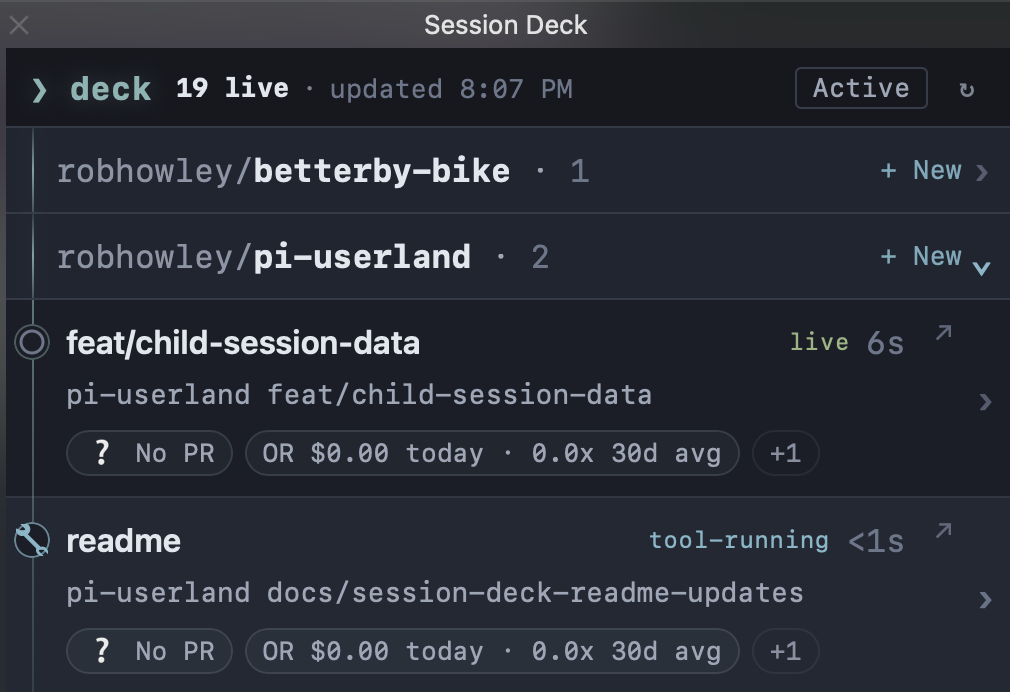
Session Deck gives each activity state its own icon, so the deck remains scannable without relying on color alone.
Session Deck turns agents scattered across terminals, repos, worktrees, and background tmux sessions into one operational view.
## The session lifecycle
- **Launch isolated agents.** Create a branch, Git worktree, and detached tmux session in one flow. The agent can keep working without occupying a terminal tab.
- **Know what every agent is doing at a glance.** See which agents are working, waiting, or need attention.
- **Keep work in context.** Sessions stay grouped by repo with their branch, worktree, pull request, status chips, and current activity close at hand.
- **Return without hunting.** Focus an existing terminal or reattach to the agent's tmux session directly from the deck.
- **End sessions cleanly.** Stop an agent when its work is done without deleting its session history.
Session Deck gives each activity state its own icon, so the deck remains scannable without relying on color alone.
 Temporary child runtimes stay folded into their parent session, keeping the deck readable while still showing how many spawned agents are active.
 ## One deck, two surfaces
Use Session Deck wherever it fits your workflow:
- **Native Pi TUI** for a fast, keyboard-driven view inside Pi.
- **iTerm2 Toolbelt** for an operational sidebar beside your terminals.
Both surfaces show the same underlying sessions and give you the same path through their lifecycle: launch, monitor, reopen, restart, and end.
## Launch, reopen, restart, and end
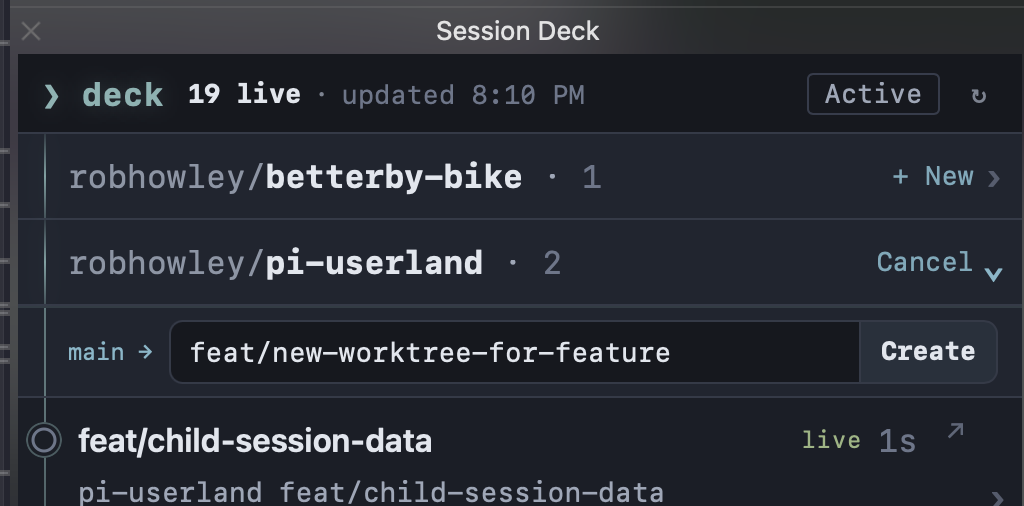
Use `w` in the Pi TUI or **+ New** in the Toolbelt to launch Pi on a new branch. Session Deck creates an isolated Git worktree and detached tmux session, allowing the agent to continue headlessly.
## One deck, two surfaces
Use Session Deck wherever it fits your workflow:
- **Native Pi TUI** for a fast, keyboard-driven view inside Pi.
- **iTerm2 Toolbelt** for an operational sidebar beside your terminals.
Both surfaces show the same underlying sessions and give you the same path through their lifecycle: launch, monitor, reopen, restart, and end.
## Launch, reopen, restart, and end
Use `w` in the Pi TUI or **+ New** in the Toolbelt to launch Pi on a new branch. Session Deck creates an isolated Git worktree and detached tmux session, allowing the agent to continue headlessly.
 Use `o` or **↗ Open** to return to an agent. Session Deck focuses its existing iTerm2 session when possible or reattaches to its tmux session. It never launches a duplicate.
Use uppercase `R` or **Restart Session** when a Session Deck-managed tmux Pi is unresponsive. Restart resumes the exact session file in the same pane and keeps its Session Deck runtime ID. It may force-kill Pi after two seconds and can lose in-flight work. Legacy, manual, direct-terminal, self-hosting TUI, and sessions with live child processes are not restartable.
Use `k` or **End session** when the agent is done. Its runtime stops, but its session history remains available to Pi. End Session keeps its existing SIGTERM-only behavior.
## Installation
```shell
pi install npm:@robhowley/pi-session-deck
```
### Native Pi TUI
Run inside Pi:
```text
/session-deck
```
### iTerm2 Toolbelt
Install Session Deck as an iTerm2 Toolbelt:
```text
/session-deck iterm2 install
```
Enable the iTerm2 Python API if prompted, fully quit and reopen iTerm2, then open **Toolbelt → Session Deck**.
## Command reference
| Command | Purpose |
| ---------------------------------------- | ------------------------------------------- |
| `/session-deck` | Browse current sessions. |
| `/session-deck --all` | Include stale, dead, and unknown sessions. |
| `/session-deck --reap` | Clear expired sessions from the deck. |
| `/session-deck --identity` | Show full session identity details. |
| `/session-deck --json --session-id ` | Print one visible session record as JSON. |
| `/session-deck iterm2 install` | Install the iTerm2 Toolbelt integration. |
| `/session-deck iterm2 doctor` | Diagnose Toolbelt setup and runtime issues. |
| `/session-deck iterm2 uninstall` | Remove the iTerm2 Toolbelt integration. |
Flags can be combined.
## TUI controls
| Key | Action |
| --------- | --------------------------------------------------- |
| `↑` / `↓` | Move between sessions. |
| `←` / `→` | Switch repo filters. |
| `enter` | Toggle session details. |
| `w` | Launch Pi on a generated worktree in detached tmux. |
| `o` | Open or focus the selected agent's terminal. |
| `R` | Restart an eligible managed tmux session. |
| `k` | End the selected session. |
| `r` | Refresh the deck. |
| `q` | Close Session Deck. |
| `esc` | Cancel an open prompt or close Session Deck. |
## Privacy
Session Deck observes operational state, not conversation history.
- It does not persist prompts, transcript content, tool arguments, or tool output.
- Status chips contain sanitized visible text only.
- Tool and assistant errors are reduced to compact, safe summaries.
- Managed restart recipes are private user-only files. They contain only the fixed executable/PATH, agent/session directory intent, cwd, exact tmux target, session binding, and process generation needed to restart safely.
- JSON output, restart results, and the Toolbelt omit recipes, session-file paths, commands, PATH, raw terminal metadata, and tmux attachment details.
Use `o` or **↗ Open** to return to an agent. Session Deck focuses its existing iTerm2 session when possible or reattaches to its tmux session. It never launches a duplicate.
Use uppercase `R` or **Restart Session** when a Session Deck-managed tmux Pi is unresponsive. Restart resumes the exact session file in the same pane and keeps its Session Deck runtime ID. It may force-kill Pi after two seconds and can lose in-flight work. Legacy, manual, direct-terminal, self-hosting TUI, and sessions with live child processes are not restartable.
Use `k` or **End session** when the agent is done. Its runtime stops, but its session history remains available to Pi. End Session keeps its existing SIGTERM-only behavior.
## Installation
```shell
pi install npm:@robhowley/pi-session-deck
```
### Native Pi TUI
Run inside Pi:
```text
/session-deck
```
### iTerm2 Toolbelt
Install Session Deck as an iTerm2 Toolbelt:
```text
/session-deck iterm2 install
```
Enable the iTerm2 Python API if prompted, fully quit and reopen iTerm2, then open **Toolbelt → Session Deck**.
## Command reference
| Command | Purpose |
| ---------------------------------------- | ------------------------------------------- |
| `/session-deck` | Browse current sessions. |
| `/session-deck --all` | Include stale, dead, and unknown sessions. |
| `/session-deck --reap` | Clear expired sessions from the deck. |
| `/session-deck --identity` | Show full session identity details. |
| `/session-deck --json --session-id ` | Print one visible session record as JSON. |
| `/session-deck iterm2 install` | Install the iTerm2 Toolbelt integration. |
| `/session-deck iterm2 doctor` | Diagnose Toolbelt setup and runtime issues. |
| `/session-deck iterm2 uninstall` | Remove the iTerm2 Toolbelt integration. |
Flags can be combined.
## TUI controls
| Key | Action |
| --------- | --------------------------------------------------- |
| `↑` / `↓` | Move between sessions. |
| `←` / `→` | Switch repo filters. |
| `enter` | Toggle session details. |
| `w` | Launch Pi on a generated worktree in detached tmux. |
| `o` | Open or focus the selected agent's terminal. |
| `R` | Restart an eligible managed tmux session. |
| `k` | End the selected session. |
| `r` | Refresh the deck. |
| `q` | Close Session Deck. |
| `esc` | Cancel an open prompt or close Session Deck. |
## Privacy
Session Deck observes operational state, not conversation history.
- It does not persist prompts, transcript content, tool arguments, or tool output.
- Status chips contain sanitized visible text only.
- Tool and assistant errors are reduced to compact, safe summaries.
- Managed restart recipes are private user-only files. They contain only the fixed executable/PATH, agent/session directory intent, cwd, exact tmux target, session binding, and process generation needed to restart safely.
- JSON output, restart results, and the Toolbelt omit recipes, session-file paths, commands, PATH, raw terminal metadata, and tmux attachment details.