# FornaContainer
In many situations, the user interaction is superfluous and the desired goal is
to simply display a secondary structure on a web page. This is a common
scenario in, for example, servers that predict a secondary structure. The
output, a dot-bracket string can simply be added to a `FornaContainer` object
to display.
## Trivial Example
Below is an example of a simple web page which uses a `FornaContainer` to show
a simple RNA molecule:

The code for creating this web page is rather straightforward. After importing
some necessary javascript files, we create a container using `new
FornaContainer("#rna_ss", {'applyForce': false})`, passing in `#rna_ss` as the
id of the `div` which will hold the container and then populate it with a
structure and sequence using `container.addRNA`:
```html
This is an RNA container.
This after the RNA container.
```
### Cofolded sequences
Display two cofolded sequences using the format of [RNAcofold](http://rna.tbi.univie.ac.at/cgi-bin/RNAcofold.cgi):
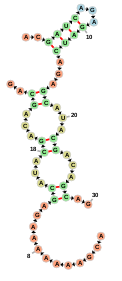
```javascript
var container = new fornac.FornaContainer("#cofold_ss",
{'applyForce': false, 'allowPanningAndZooming': true, 'initialSize':[500,300]});
var options = {'structure': '..((((...))))...((...((...((..&............))...))...))..',
'sequence': 'ACGAUCAGAGAUCAGAGCAUACGACAGCAG&ACGAAAAAAAGAGCAUACGACAGCAG'
};
container.addRNA(options.structure, options);
container.setSize();
```
## Options
The `FornaContainer` supports a number of options to allow users to customize how the RNA will be presented.
### applyForce
Indicate whether the force-directed layout will be applied to the displayed
molecule. Enabling this option allows users to change the layout of the
molecule by selecting and dragging the individual nucleotide nodes
### allowPanningAndZooming [default=true]
Allow users to zoom in and pan the display. If this is enabled then pressing
the 'c' key on the keyboard will center the view.
### circularizeExternal [default=true]
This only makes sense in connection with the `applyForce` argument. If it's
true, the external loops will be arranged in a nice circle. If false, they will
be allowed to flop around as the force layout dictates:
### labelInterval [default=10]
Change how often nucleotide numbers are labelled with their number.
## Implementation
Each RNA molecule is represented as a JSON file which encodes all of the
information necessary to display it. The example shows a trivial and slightly
modified example. `nodeType` can be either `nucleotide` or `label` or `middle`,
the latter of which is used only as a placeholder for maintaining an aesthetically
pleasing layout.
The links can be any of `basepair` (representing a basepair between two
nucleotides), `backbone` (backbone bond between adjacent nodes), `pseudoknot`
(pseudoknot, extracted from the specified structure using maximum matching
algorithm), `extra` (extra links specified by the user), `label_link` (links
between nucleotides and their nucleotide number labels), `fake` (invisible
links for maintaining the layout), and `fake_fake` (invisible links for
maintaining the layout).
This structure is initially created in `rnagraph.js` starting from a sequence
and dotbracket string.
```
{
"nodes":
[ {
"name": "A",
"num": 1,
"radius": 5,
"rna": null,
"nodeType": "nucleotide",
"structName": "empty",
"elemType": "e",
"uid": "44edb966-aca9-4058-a6bc-784a34959329",
"linked": false,
"prevNode": null,
"nextNode": null,
"x": 100,
"px": 100,
"y": 100,
"py": 100
},
...
],
"links":
[ {
"source": null,
"target": null,
"linkType": "basepair",
"value": 1,
"uid": "6664a569-5af1-4d86-8ada-d1c00da72a899f87a224-52a0-4ede-a29c-04fddc09e4c4"
},
...
]
}
```
## Development
First:
```
npm install
bower install
```
To debug:
```
gulp serve
```
To build:
```
gulp build
```
The output will be placed in the `dist` directory. To use `fornac` in a web page, simply include `dist/scripts/fornac.js` in your web page.
## Acknowledgements
Thanks to [Benedikt Rauscher](https://github.com/bene200) for the Javascript
version of the NAView layout and to the creators of
[VARNA](http://varna.lri.fr/) for the java implementation that it's based on.
 ### labelInterval [default=10]
Change how often nucleotide numbers are labelled with their number.
## Implementation
Each RNA molecule is represented as a JSON file which encodes all of the
information necessary to display it. The example shows a trivial and slightly
modified example. `nodeType` can be either `nucleotide` or `label` or `middle`,
the latter of which is used only as a placeholder for maintaining an aesthetically
pleasing layout.
The links can be any of `basepair` (representing a basepair between two
nucleotides), `backbone` (backbone bond between adjacent nodes), `pseudoknot`
(pseudoknot, extracted from the specified structure using maximum matching
algorithm), `extra` (extra links specified by the user), `label_link` (links
between nucleotides and their nucleotide number labels), `fake` (invisible
links for maintaining the layout), and `fake_fake` (invisible links for
maintaining the layout).
This structure is initially created in `rnagraph.js` starting from a sequence
and dotbracket string.
```
{
"nodes":
[ {
"name": "A",
"num": 1,
"radius": 5,
"rna": null,
"nodeType": "nucleotide",
"structName": "empty",
"elemType": "e",
"uid": "44edb966-aca9-4058-a6bc-784a34959329",
"linked": false,
"prevNode": null,
"nextNode": null,
"x": 100,
"px": 100,
"y": 100,
"py": 100
},
...
],
"links":
[ {
"source": null,
"target": null,
"linkType": "basepair",
"value": 1,
"uid": "6664a569-5af1-4d86-8ada-d1c00da72a899f87a224-52a0-4ede-a29c-04fddc09e4c4"
},
...
]
}
```
## Development
First:
```
npm install
bower install
```
To debug:
```
gulp serve
```
To build:
```
gulp build
```
The output will be placed in the `dist` directory. To use `fornac` in a web page, simply include `dist/scripts/fornac.js` in your web page.
## Acknowledgements
Thanks to [Benedikt Rauscher](https://github.com/bene200) for the Javascript
version of the NAView layout and to the creators of
[VARNA](http://varna.lri.fr/) for the java implementation that it's based on.