# @opentf/obj-diff
> ## The Fast, Accurate, and Modern JavaScript Objects Diffing & Patching Library.
### [Documentation & Playground](https://obj-diff.opentechf.org/)
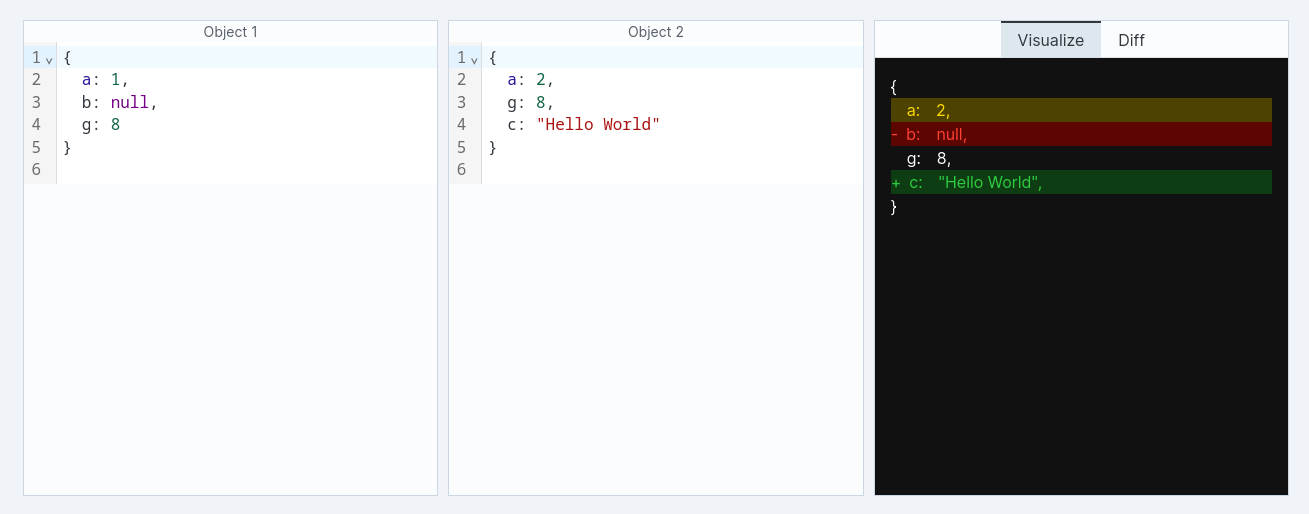
---
## 🚀 Features
- 🔍 **Deep Objects Diffing**: Detects changes at any depth.
- ✂️ **Compact Array Diffs**: Shortest edit scripts (Myers LCS) — inserting one element into a 10k array yields 1 op, not 10,001.
- 🩹 **Efficient Patching**: Apply diffs to recreate target objects.
- 🧬 **Type-Safe Serialization**: Round-trip diffs across network/process boundaries with `serialize` and `deserialize` preserving all JS native types.
- 🛠️ **Extensible**: Support for custom object types via `diffWith()`.
- 📦 **Modern Ecosystem**: Built for Bun, Node.js, Deno, and Browser.
- 🟦 **TypeScript Native**: Full type safety and autocompletion.
- ⚡ **High Performance**: Optimized for speed and minimal memory footprint.
## 📦 Installation
Install `@opentf/obj-diff` using your preferred package manager:
```sh
# Bun
bun add @opentf/obj-diff
# pnpm
pnpm add @opentf/obj-diff
# npm
npm install @opentf/obj-diff
# Deno
deno add @opentf/obj-diff
```
## 🛠 Supported Types
The library natively supports the following types:
- **Primitives**: `Undefined`, `Null`, `Number`, `String`, `Boolean`, `BigInt`.
- **Built-in Objects**: `Plain Objects {}`, `Array`, `Date`, `Map`, `Set`, `TypedArray` (`Uint8Array`, `Float32Array`, etc.), `ArrayBuffer`, `DataView`.
- **Temporal**: all `Temporal` types (`Instant`, `PlainDate`, `PlainTime`, `PlainDateTime`, `PlainYearMonth`, `PlainMonthDay`, `ZonedDateTime`, `Duration`) — compared as immutable values (`Duration` structurally by its canonical string, since it has no `.equals()`).
- **Class Instances**: instances sharing the same prototype are diffed by their own enumerable properties; instances of different classes are reported as replaced.
## 📖 Usage
### `diff(obj1, obj2)`
Performs a deep comparison between two objects.
```ts
import { diff } from '@opentf/obj-diff';
const result = diff(obj1, obj2);
```
#### `DiffResult` Structure
```ts
type DiffResult = {
type: 0 | 1 | 2 | 3 | 4; // 0: Deleted, 1: Added, 2: Changed,
// 3: Inserted (array splice-in), 4: Removed (array splice-out)
path: Array; // path to the property; Map entries use the Map key itself
value?: unknown; // the new value (for types 1, 2 and 3)
};
```
Types `3` (`INSERTED`) and `4` (`REMOVED`) are array-only splice operations with application-time indexes — they are what make array diffs compact:
```js
diff([1, 2, 3], [0, 1, 2, 3]);
//=> [{ type: 3, path: [0], value: 0 }] // 1 op, not 4
```
The constants (`DELETED`, `ADDED`, `CHANGED`, `INSERTED`, `REMOVED`) are exported from the package root.
### `patch(obj, patches)`
Applies an array of diff results to an object.
```ts
import { patch } from "@opentf/obj-diff";
const updatedObj = patch(originalObj, diffResults);
```
### `serialize(diff)` / `deserialize(wire)`
A diff holds **live** values by reference, so `JSON.stringify` loses their types (`Date`→string, `Map`/`Set`→`{}`, `BigInt`→throws). Use `serialize`/`deserialize` to send a diff across a process or network boundary and patch it back into the **correct types** on the other side:
```ts
import { diff, patch, serialize, deserialize } from "@opentf/obj-diff";
// client
const wire = serialize(diff(a, b)); // a JSON string, type-safe
// server
const patched = patch(a, deserialize(wire)); // Date/Map/Set/… restored exactly
```
`value` stays readable — each special value becomes a reference token `"@n"`, with the real types collected in a per-op `$refs` table:
```json
{
"type": 1,
"path": ["user"],
"value": { "id": 1, "lastSeen": "@1", "roles": "@2" },
"$refs": {
"1": { "_t": "Date", "_v": "2026-07-15T00:00:00.000Z" },
"2": { "_t": "Set", "_v": ["admin", "editor"] }
}
}
```
Every supported type is preserved (`Date`, `RegExp`, `Map`, `Set`, `TypedArray`, `ArrayBuffer`, `DataView`, `Error`, `URL`, `BigInt`, `Temporal`, …), nested to any depth. **Circular references** and objects **shared by identity** are rebuilt with the same identity on the far side (plain objects and arrays are hoisted into `$refs` when referenced more than once; single-use containers stay inline). Symbols, functions, class instances, and cycles that run through a `Map`/`Set`/`Error` throw. Deserializing a `Temporal` value requires a `Temporal` implementation on `globalThis`.
### `stringify(value)` / `parse(wire)`
Need the same type-safe codec for **any** value, not just a diff? `stringify`/`parse` are the general-purpose counterpart — a drop-in, richer `JSON.stringify`/`JSON.parse` that keeps native types intact:
```ts
import { stringify, parse } from "@opentf/obj-diff";
const wire = stringify({
when: new Date(),
tags: new Set(["a", "b"]),
prefs: new Map([["theme", "dark"]]),
big: 42n,
});
const value = parse(wire); // Date / Set / Map / BigInt all restored
```
Same coverage as above — every native type, plus circular references and shared identity. Symbols, functions, and class instances throw.
---
## 💡 Examples
### 1. Basic Objects
```js
const a = { a: 1, b: 2 };
const b = { a: 2, c: 3 };
diff(a, b);
/*
[
{ type: 2, path: ["a"], value: 2 },
{ type: 0, path: ["b"] },
{ type: 1, path: ["c"], value: 3 }
]
*/
```
### 2. Nested Structures
```js
const a = { foo: { bar: [1, 2] } };
const b = { foo: { bar: [1] } };
const d = diff(a, b);
const res = patch(a, d); // res is deep equal to b
```
### 3. ES6 Map & Set Support
Natively diff and patch modern collections.
```js
const a = new Set([1, 2]);
const b = new Set([2, 3]);
diff(a, b);
/*
[
{ type: 2, path: [0], value: 2 },
{ type: 2, path: [1], value: 3 }
]
*/
```
### 4. Circular Reference Safety
Safe comparison of recursive objects without infinite loops.
```js
const a = { id: 1 };
a.self = a;
const b = { id: 2 };
b.self = b;
diff(a, b);
// Output: [{ type: 2, path: ["id"], value: 2 }]
```
### 5. Custom Types via `diffWith()`
Extend the diffing logic for specialized types like MongoDB `ObjectId`.
```js
import { diffWith } from "@opentf/obj-diff";
import { ObjectId } from "bson";
const result = diffWith(record1, record2, (a, b) => {
if (a instanceof ObjectId && b instanceof ObjectId) {
return a.toString() !== b.toString();
}
});
```
---
## ⚠️ Caveats
### Internal Object Sharing (Aliasing)
For maximum performance, `@opentf/obj-diff` preserves internal object identity (sharing) during the `patch()` operation.
If your original object contains multiple paths pointing to the **same object instance**, patching one of those paths will affect all its aliases.
```js
const shared = { x: 1 };
const a = { first: shared, second: shared };
const b = { first: { x: 1 }, second: { x: 2 } };
const d = diff(a, b);
const res = patch(a, d);
// res.first.x will be 2 because it shares the same instance as res.second
console.log(res.first.x); // 2
```
> [!TIP]
> If you require independent branches after patching, ensure your input objects do not share internal references that are expected to diverge.
---
## 📊 Comprehensive Benchmarks
We have rebuilt our benchmark suite using `mitata` and split it into distinct categories to provide a clear, fair, and comprehensive comparison against the libraries developers actually use.
### 1. Diff Generation (Speed)
*Testing how quickly libraries can detect differences between two structures.*
| Scenario | `@opentf/obj-diff` | `microdiff` | `deep-diff` | `just-diff` | `deep-object-diff` |
| :--- | :--- | :--- | :--- | :--- | :--- |
| **No changes** | `1.89 µs` | `1.85 µs` | **`1.66 µs`** | `2.83 µs` | `4.37 µs` |
| **One property** | `1.93 µs` | **`1.46 µs`** | `1.24 µs` | `2.48 µs` | `3.86 µs` |
| **Deep nested** (9 lvls) | **`1.81 µs`** | `1.93 µs` | `3.18 µs` | `4.51 µs` | `3.47 µs` |
| **Mixed types** (JS native)| **`1.81 µs`** | `2.21 µs` | `2.30 µs` | `2.96 µs` | `3.70 µs` |
### 2. Diff + Patch (Complete Solution)
*Testing the full lifecycle: Generating a diff and applying it to reconstruct the target.*
| Scenario | `@opentf/obj-diff` | `fast-json-patch` | `jsondiffpatch` | `rfc6902` | `just-diff` + apply |
| :--- | :--- | :--- | :--- | :--- | :--- |
| **One property** | `4.03 µs` | **`2.16 µs`** | `3.82 µs` | `3.78 µs` | `4.21 µs` |
| **Mixed changes** | `2.90 µs` | **`2.24 µs`** | `8.46 µs` | `9.49 µs` | `4.33 µs` |
*(Note: `fast-json-patch` is highly optimized for strict JSON, but fails on JS-native structures like Maps/Sets/Dates. Among full-featured libraries, `@opentf/obj-diff` is significantly faster at patching).*
### 3. Large Scale Payloads (Algorithmic Scalability)
*Testing performance on a generated 1 Megabyte JSON payload with one deep change and one insertion.*
| Metric (1MB JSON) | `@opentf/obj-diff` | `microdiff` | `jsondiffpatch` |
| :--- | :--- | :--- | :--- |
| **Execution Time** | `33.08 ms` | **`27.36 ms`** | `768.29 ms` (Slow) |
| **Diff Size (Bytes)** | **`130 B`** | `198 B` | `131 B` |
| **Memory Allocation** | **`~0 MB`** | `6.45 MB` | **`~0 MB`** |
### 4. JS-Native Features & Accuracy
*Testing modern JavaScript support and complex edge case handling.*
| Feature | `@opentf/obj-diff` | `microdiff` | `jsondiffpatch` | `fast-json-patch` |
| :--- | :--- | :--- | :--- | :--- |
| **Date** | ✅ | ✅ | ✅ | JSON only |
| **Map** | ✅ | ❌ | ❌ | ❌ |
| **Set** | ✅ | ❌ | ❌ | ❌ |
| **TypedArray** | ✅ | ✅ | ✅ | ❌ |
| **Circular Refs** | ✅ | ✅ | ✅ | ❌ |
| **RegExp** | ✅ | ✅ | ✅ | ❌ |
| **Sparse Arrays** | ✅ | ✅ | ✅ | JSON only |
**Conclusion:** `@opentf/obj-diff` offers the exactness and JS-native feature set that JSON-patch libraries lack, while remaining orders of magnitude more scalable than older, heavy libraries like `jsondiffpatch`.
### 5. Type-Safe Serialization (`stringify`/`parse` vs `superjson`)
*Round-tripping real JavaScript values through a JSON boundary — the job `superjson` does.*
| Axis | `@opentf/obj-diff` | `superjson` |
| :--- | :--- | :--- |
| **Type fidelity** (22 native types) | **22 / 22** | 14 / 22 |
| **Speed** (stringify / round trip) | **~3× / ~2× faster** | baseline |
| **Wire size** | smaller for leaf & native-heavy values | smaller when many special values cluster |
`superjson` silently degrades `Float64Array` specials (`NaN`/`-0`/`∞` → `0`), turns `ArrayBuffer`/`DataView` into plain objects, unwraps boxed primitives, drops an `Error`'s own props, and throws on `BigInt64Array`. Full breakdown on the [comparison page](https://obj-diff.opentechf.org/docs/comparison#type-safe-serialization-vs-superjson).
### Running Benchmarks Locally
```sh
bun run benchmarks/category-a-diff.js
bun run benchmarks/category-b-patch.js
bun run benchmarks/category-c-large.js
bun run benchmarks/category-d-accuracy.js
bun benchmarks/serialization.mjs # obj-diff stringify/parse vs superjson
```
---
## ❓ FAQs
### 1. Why is JSON Patch (RFC 6902) not supported?
The JSON Patch protocol is quite heavy and complex. We've optimized `@opentf/obj-diff` for performance and simplicity, which covers the vast majority of real-world use cases.
### 2. What does an empty path `path: []` mean?
An empty path denotes the **Root** of the object. It typically means the entire source was replaced by the target value (e.g., comparing an object to `null`).
---
## 📄 License
This project is licensed under the [MIT License](./LICENSE).
---
⚡ Powered by Open Tech Foundation