# Using HooCode
This page collects day-to-day usage details that do not fit on the quickstart page.
## Interactive Mode
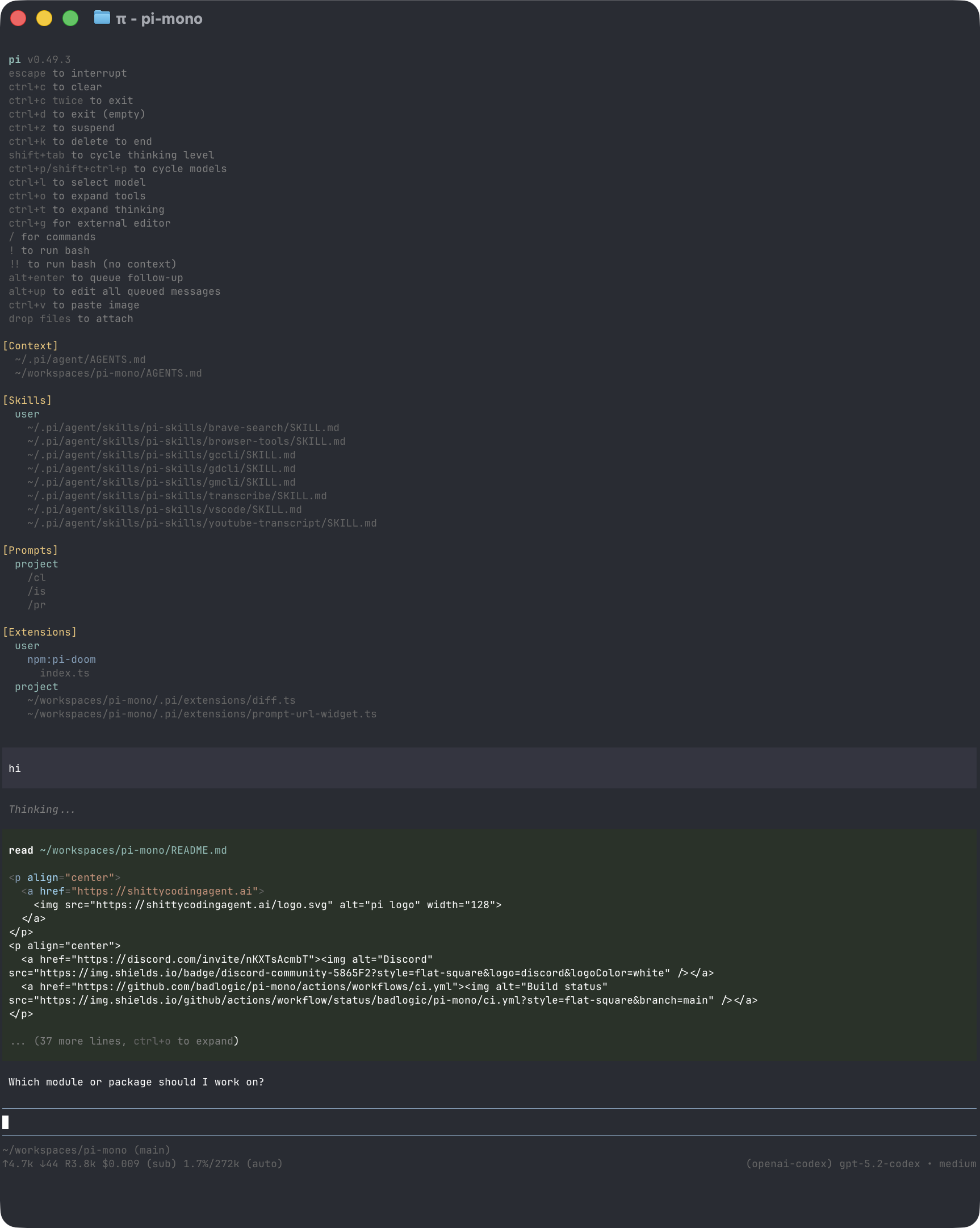
The interface has four main areas:
- **Startup header** - shortcuts, loaded context files, prompt templates, skills, and extensions
- **Messages** - user messages, assistant responses, tool calls, tool results, notifications, errors, and extension UI
- **Editor** - where you type; border color indicates the current thinking level
- **Footer** - working directory, session name, token/cache usage, cost, context usage, and current model
The editor can be replaced temporarily by built-in UI such as `/settings` or by custom extension UI.
### Editor Features
| Feature | How |
|---------|-----|
| File reference | Type `@` to fuzzy-search project files |
| Path completion | Press Tab to complete paths |
| Multi-line input | Shift+Enter, or Ctrl+Enter on Windows Terminal |
| Images | Paste with Ctrl+V, Alt+V on Windows, or drag into the terminal |
| Shell command | `!command` runs and sends output to the model |
| Hidden shell command | `!!command` runs without sending output to the model |
| External editor | Ctrl+G opens `$VISUAL` or `$EDITOR` |
See [Keybindings](keybindings.md) for all shortcuts and customization.
## Slash Commands
Type `/` in the editor to open command completion. Extensions can register custom commands, skills are available as `/skill:name`, and prompt templates expand via `/templatename`.
| Command | Description |
|---------|-------------|
| `/login`, `/logout` | Manage OAuth or API-key credentials |
| `/model` | Switch models |
| `/scoped-models` | Enable/disable models for Ctrl+P cycling |
| `/settings` | Thinking level, theme, message delivery, transport |
| `/resume` | Pick from previous sessions |
| `/new` | Start a new session |
| `/name ` | Set session display name |
| `/session` | Show session file, ID, messages, tokens, and cost |
| `/tree` | Jump to any point in the session and continue from there |
| `/fork` | Create a new session from a previous user message |
| `/clone` | Duplicate the current active branch into a new session |
| `/compact [prompt]` | Manually compact context, optionally with custom instructions |
| `/learn [all\|stats\|settings]` | Mine recent sessions for repeated directives, fixes, and workflows and promote them to `AGENTS.md` or a skill; `stats` reports what became of past proposals, `settings` shows where sessions are read from and the thresholds in force |
| `/copy` | Copy last assistant message to clipboard |
| `/export [file]` | Export session to HTML |
| `/share` | Upload as private GitHub gist with shareable HTML link |
| `/reload` | Reload keybindings, extensions, skills, prompts, and context files |
| `/hotkeys` | Show all keyboard shortcuts |
| `/changelog` | Display version history |
| `/import ` | Import and resume a session from a JSONL file |
| `/cost` | Session token and cost totals, broken down by model |
| `/quit` | Quit hoocode |
### Modes and planning
See [Modes](modes.md) for what each mode changes.
| Command | Description |
|---------|-------------|
| `/mode ` | Switch the active mode |
| `/plan` | Shorthand for `/mode plan` |
| `/approve` | Approve the current plan and switch to build mode to execute it |
| `/grill [me\|plan]` | Stress-test the current plan before committing to it |
| `/goal [--max-turns N] ` | Work autonomously toward a goal |
### Plugins and extensibility
See [Plugins](plugins.md) for the marketplace and trust model.
| Command | Description |
|---------|-------------|
| `/plugin marketplace add ` | Register a marketplace |
| `/plugin marketplace list\|refresh` | List registered marketplaces, or re-fetch their indices |
| `/plugin list` | List installed plugins |
| `/plugin install [--scope user\|project]` | Install a plugin |
| `/plugin remove ` | Uninstall a plugin |
| `/plugin trust [list]`, `/plugin untrust` | Inspect or revoke workspace trust |
| `/plugin publish [--to ]` | Package a plugin for distribution |
| `/new-skill ` | Scaffold a new skill |
| `/new-agent ` | Scaffold a new subagent |
| `/new-command ` | Scaffold a new slash command |
| `/new-canvas ` | Scaffold a canvas extension and build it; `/new-canvas ` scaffolds the template only |
### Canvas and scheduling
| Command | Description |
|---------|-------------|
| `/canvas list` | List canvases the loaded extensions provide |
| `/canvas open [:]` | Open a canvas |
| `/canvas reload [extension]` | Pick up code changes without restarting the session |
| `/canvas close ` | Close a running canvas |
| `/canvas rename ` | Rename a canvas everywhere its name appears |
| `/canvas remove ` | Delete a canvas, after confirming |
| `/loop "" ` | Schedule a prompt on a cron expression |
| `/loop <5m\|2h> ` | Schedule a prompt on an interval |
| `/loop once "" ` | Schedule a one-shot prompt |
| `/loop list`, `/loop delete `, `/loop stop` | Inspect and cancel schedules |
| `/loop auto [--max-turns N] ` | Run an autonomous loop on a task |
## Message Queue
You can submit messages while the agent is still working:
- **Enter** queues a steering message, delivered after the current assistant turn finishes executing its tool calls.
- **Alt+Enter** queues a follow-up message, delivered after the agent finishes all work.
- **Escape** aborts and restores queued messages to the editor.
- **Alt+Up** retrieves queued messages back to the editor.
On Windows Terminal, Alt+Enter is fullscreen by default. Remap it as described in [Terminal setup](terminal-setup.md) if you want hoocode to receive the shortcut.
Configure delivery in [Settings](settings.md) with `steeringMode` and `followUpMode`.
## Sessions
Sessions are saved automatically to `~/.hoocode/sessions/`, organized by working directory.
```bash
hoocode -c # Continue most recent session
hoocode -r # Browse and select a session
hoocode --no-session # Ephemeral mode; do not save
hoocode --session # Use a specific session file or session ID
hoocode --fork # Fork a session into a new session file
```
Useful session commands:
- `/session` shows the current session file and ID.
- `/tree` navigates the in-file session tree and can summarize abandoned branches.
- `/fork` creates a new session from an earlier user message.
- `/clone` duplicates the current active branch into a new session file.
- `/compact` summarizes older messages to free context.
See [Sessions](sessions.md) and [Compaction](compaction.md) for details.
## Context Files
HooCode loads `AGENTS.md` or `CLAUDE.md` at startup from, least specific first:
- `~/.agents/AGENTS.md` — the cross-vendor user scope, shared with other agent tools
- `~/.hoocode/AGENTS.md` — hoocode's own global instructions, which win on conflict
- parent directories, walking up from the current working directory
- the current directory
Both user scopes are read additively: neither shadows the other, so an existing
`~/.hoocode` file keeps working when you add a `~/.agents` one.
Use context files for project conventions, commands, safety rules, and preferences. Disable loading with `--no-context-files` or `-nc`.
Context files are re-sent on **every** request, so their size is a recurring
cost. HooCode warns when one file grows past ~2k tokens, truncates it past ~10k,
and warns again when the set as a whole passes ~6k — trimming the least specific
scope first past ~16k. The startup listing shows the running total.
Long or conditional guidance belongs in a [skill](skills.md) instead: skills load
on demand, context files load always.
### Learning rules from your sessions
`/learn` reads recent session transcripts for this directory, and reports what
repeated:
- **Directives you restated** across sessions — candidate rules, with the count
that justifies them. An item marked `restated` is already covered by a rule
that is not working and wants rewriting, not duplicating.
- **Failures you resolved** — a command that failed, then later succeeded
unchanged, with the work in between.
- **Repeated tool sequences** — candidate skills. Only procedures qualify: a
sequence has to chain at least two distinct doing-commands (test then commit,
build then publish). The edit/test rhythm is one command and every rotation of
itself, so it is not reported.
It then proposes edits to the repo `AGENTS.md`, to `~/.agents/AGENTS.md` for
habits that travel with you, or as a new skill. Nothing is written without the
usual edit approval. Because it reads transcripts from disk rather than the live
conversation, it still works after the session has been compacted.
`/learn stats` reports what became of past proposals: how many were shown, and
what share of the directive proposals you actually wrote down. It reads the
history file rather than re-mining sessions, so it is instant.
Read the number carefully. Adoption is a proxy for usefulness, not ground truth
— a proposal you correctly rejected as not durable counts against it exactly like
a junk one. Near zero means the extractor is proposing the wrong things; near
100% means the bar is too low and everything is getting through. The trend
matters more than the value, and it is the fastest way to tell whether a change
to `learnMinRepeats` helped.
`/learn` remembers what it has already shown you, per directory. An item comes
back only once it recurs *after* it was last put in front of you — so a rule you
accepted is not re-proposed, and one you passed on does not reappear every run
unchanged. Something you keep saying anyway will return, which is the point: that
is the case where the existing rule is not working. Run `/learn all` to ignore
that memory and re-propose everything in the window.
An item shown before that still is not written down anywhere is flagged as
previously declined, so it is proposed tentatively rather than pressed a second
time. That inference reads context files and skills alike, so a proposal you
routed to `~/.agents/AGENTS.md` or turned into a skill both count as adopted.
When a directive is already covered by a **skill** and you keep asking for it by
hand, it comes back marked `has-skill` rather than as a new rule. That is a
triggering problem, not a missing rule: the skill's `description` frontmatter
probably does not describe the situation you were in, so sharpening it is the fix
rather than writing a rule that duplicates the skill.
The five thresholds are editable from `/settings` under **Learning**. `/learn
settings` prints the same values as text, along with where sessions are read
from, how many were found, and the two files you can set them in by hand — the
user `~/.hoocode/settings.json` and the project `.hoocode/settings.json`. See
[settings](settings.md#learning-from-sessions) for what each one does.
Sessions are read from `~/.hoocode/sessions//`, the directory
hoocode writes this project's transcripts into. If a run reports nothing, it
names that directory, how many transcripts it holds, and why each was passed
over — out of the age window, over the session cap, or recorded under a
different working directory. Those are the three reasons a directory full of
history still mines to nothing, and each has a different fix: widen
`learnMaxAgeDays`, raise `learnMaxSessions`, or check that you are running from
the same path the sessions were recorded under.
### System Prompt Files
Replace the default system prompt with:
- `.hoocode/SYSTEM.md` for a project
- `~/.hoocode/SYSTEM.md` globally
Append to the default prompt without replacing it with `APPEND_SYSTEM.md` in either location.
## Exporting and Sharing Sessions
Use `/export [file]` to write a session to HTML.
Use `/share` to upload a private GitHub gist with a shareable HTML link.
If you use hoocode for open source work and want to publish sessions for model, prompt, tool, and evaluation research, see [`badlogic/pi-share-hf`](https://github.com/badlogic/pi-share-hf). It publishes sessions to Hugging Face datasets.
## CLI Reference
```bash
hoocode [options] [@files...] [messages...]
```
### Package Commands
```bash
hoocode install [-l] # Install package, -l for project-local
hoocode remove [-l] # Remove package
hoocode uninstall [-l] # Alias for remove
hoocode update [source|self|hoocode] # Update hoocode and packages; skips pinned packages
hoocode update --extensions # Update packages only
hoocode update --self # Update hoocode only
hoocode update --extension # Update one package
hoocode list # List installed packages
hoocode config # Enable/disable package resources
```
See [HooCode Packages](packages.md) for package sources and security notes.
### Modes
| Flag | Description |
|------|-------------|
| default | Interactive mode |
| `-p`, `--print` | Print response and exit |
| `--mode json` | Output all events as JSON lines; see [JSON mode](json.md) |
| `--mode rpc` | RPC mode over stdin/stdout; see [RPC mode](rpc.md) |
| `--export [out]` | Export a session to HTML |
In print mode, hoocode also reads piped stdin and merges it into the initial prompt:
```bash
cat README.md | hoocode -p "Summarize this text"
```
### Model Options
| Option | Description |
|--------|-------------|
| `--provider ` | Provider, such as `anthropic`, `openai`, or `google` |
| `--model ` | Model pattern or ID; supports `provider/id` and optional `:` |
| `--api-key ` | API key, overriding environment variables |
| `--thinking ` | `off`, `minimal`, `low`, `medium`, `high`, `xhigh` |
| `--models ` | Comma-separated patterns for Ctrl+P cycling |
| `--list-models [search]` | List available models |
### Session Options
| Option | Description |
|--------|-------------|
| `-c`, `--continue` | Continue the most recent session |
| `-r`, `--resume` | Browse and select a session |
| `--session ` | Use a specific session file or partial UUID |
| `--fork ` | Fork a session file or partial UUID into a new session |
| `--session-dir ` | Custom session storage directory |
| `--no-session` | Ephemeral mode; do not save |
### Tool Options
| Option | Description |
|--------|-------------|
| `--tools `, `-t ` | Allowlist specific built-in, extension, and custom tools |
| `--disallowed-tools ` | Comma-separated denylist, subtracted from the allowlist or default set |
| `--no-builtin-tools`, `-nbt` | Disable built-in tools but keep extension/custom tools enabled |
| `--no-tools`, `-nt` | Disable all tools |
Built-in tools: `read`, `bash`, `edit`, `write`, `SearchCodebase`.
#### Optional tool bundles
Off by default unless noted; each adds a capability rather than a single tool.
| Option | Enables |
|--------|---------|
| `--enable-todowrite` | The TodoWrite tool — a live todo list in the task panel |
| `--enable-webtools` | `webfetch` and `websearch` (network access) |
| `--enable-semantic-index` | The semantic index fused into `SearchCodebase` (on by default). The tool itself is always registered and cannot be disabled |
| `--enable-plugintools` | The autonomous plugin system — see [Plugins](plugins.md) |
#### Subagents
See [Subagent delegation](routing.md).
| Option | Description |
|--------|-------------|
| `--enable-subagents` | Enable the subagent tool (delegate to isolated agent loops) |
| `--no-subagents`, `--disable-subagents` | Disable it for this session, overriding the setting |
| `--max-subagent-depth ` | Tree-wide nesting cap (default 2 — one level of nesting) |
| `--warm-subagents` | Dispatch eligible subagents on reused warm RPC workers (experimental) |
### Resource Options
| Option | Description |
|--------|-------------|
| `-e`, `--extension ` | Load an extension from path, npm, or git; repeatable |
| `--no-extensions` | Disable extension discovery |
| `--skill ` | Load a skill; repeatable |
| `--no-skills` | Disable skill discovery |
| `--prompt-template ` | Load a prompt template; repeatable |
| `--no-prompt-templates` | Disable prompt template discovery |
| `--theme ` | Load a theme; repeatable |
| `--no-themes` | Disable theme discovery |
| `--no-context-files`, `-nc` | Disable `AGENTS.md` and `CLAUDE.md` discovery |
Combine `--no-*` with explicit flags to load exactly what you need, ignoring settings. Example:
```bash
hoocode --no-extensions -e ./my-extension.ts
```
### Other Options
| Option | Description |
|--------|-------------|
| `--system-prompt ` | Replace default prompt; context files and skills are still appended |
| `--append-system-prompt ` | Append to system prompt |
| `--light` | Minimal low-token preset for small/local models (see below) |
| `--print-token-surface` | Print the fixed per-turn surface (system prompt + serialized tool schemas) and exit |
| `--platform ` | Platform layout(s) to target when writing artifacts: `claude`, `copilot` (alias `github`, `gh`), `agents` (alias `native`). Comma-separated and/or repeated |
| `--team ` | Bridge a hooteams server into the task panel's teams view — focus roles, nudge, attach, answer approval gates. `auto` searches upward from cwd for `.agents/teams/default.json` or `hooteams.config.json` and spawns hooteams locally |
| `--verbose` | Force verbose startup |
| `-h`, `--help` | Show help |
| `-v`, `--version` | Show version |
#### Light mode
`--light` (or the `light` setting, editable in `/settings` under **Context**)
trims the session to the smallest useful fixed per-turn surface, for small or
local models that waste context on harness boilerplate:
- Only `read`, `write`, `edit`, and `bash`, with short descriptions and stripped
parameter schemas. `bash` subsumes `SearchCodebase` — discovery happens via the shell.
- A terse replacement system prompt.
- No subagents, TodoWrite, skills, context files, mode appendix, or the
self-documentation section.
`--print-token-surface` reports what that surface actually costs.
### File Arguments
Prefix files with `@` to include them in the message:
```bash
hoocode @prompt.md "Answer this"
hoocode -p @screenshot.png "What's in this image?"
hoocode @code.ts @test.ts "Review these files"
```
### Examples
```bash
# Interactive with initial prompt
hoocode "List all .ts files in src/"
# Non-interactive
hoocode -p "Summarize this codebase"
# Non-interactive with piped stdin
cat README.md | hoocode -p "Summarize this text"
# Different model
hoocode --provider openai --model gpt-4o "Help me refactor"
# Model with provider prefix
hoocode --model openai/gpt-4o "Help me refactor"
# Model with thinking level shorthand
hoocode --model sonnet:high "Solve this complex problem"
# Limit model cycling
hoocode --models "claude-*,gpt-4o"
# Read-only mode
hoocode --tools read,SearchCodebase -p "Review the code"
```
### Environment Variables
| Variable | Description |
|----------|-------------|
| `HOOCODE_AGENT_DIR` | Override config directory; default is `~/.hoocode` |
| `HOOCODE_AGENT_SESSION_DIR` | Override session storage directory; overridden by `--session-dir` |
| `HOOCODE_PACKAGE_DIR` | Override package directory, useful for Nix/Guix store paths |
| `HOOCODE_OFFLINE` | Disable startup network operations, including update checks, package update checks, and install/update telemetry |
| `HOOCODE_SKIP_VERSION_CHECK` | Skip the hoocode version update check at startup |
| `HOOCODE_TELEMETRY` | Override install/update telemetry: `1`/`true`/`yes` or `0`/`false`/`no`. This does not disable update checks |
| `HOOCODE_CACHE_RETENTION` | Set to `long` for extended prompt cache where supported |
| `VISUAL`, `EDITOR` | External editor for Ctrl+G |
## Design Principles
HooCode keeps the core small and pushes workflow-specific behavior into extensions, skills, prompt templates, and packages.
It intentionally does not include built-in MCP, sub-agents, permission popups, plan mode, to-dos, or background bash. You can build or install those workflows as extensions or packages, or use external tools such as containers and tmux.