# jeff
> A model-native quality control plane for agentic software work.
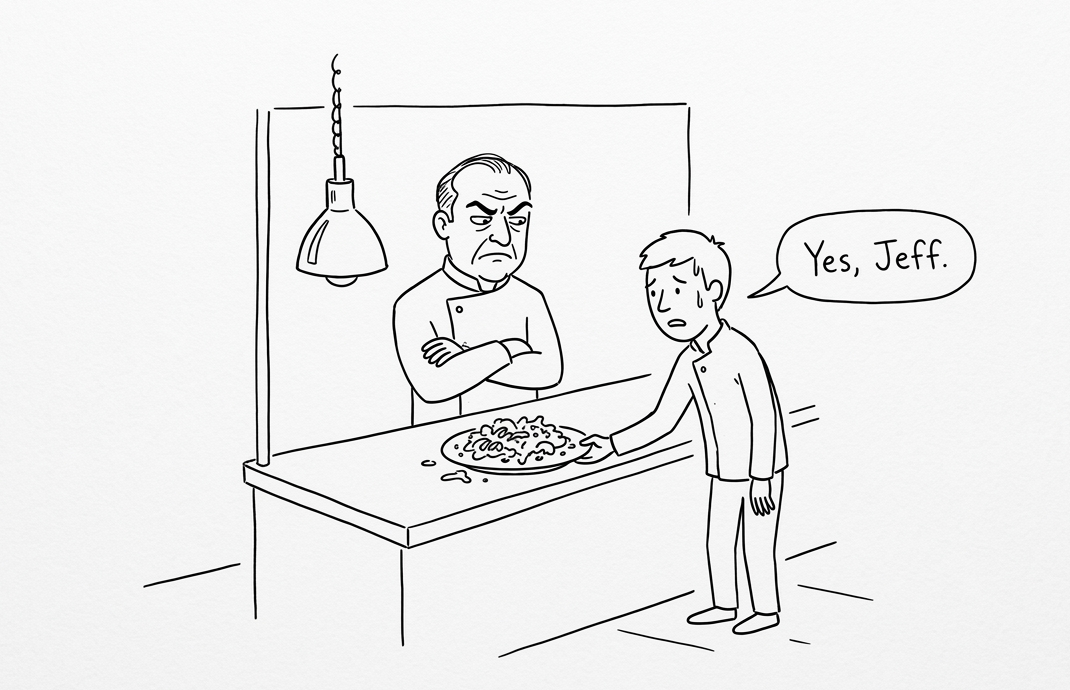
Jeff turns software work by frontier models into an inspectable engineering
process. A thin orchestrator routes atomic tasks through fresh specialist
contexts; builders never approve their own work; evidence survives outside the
chat; and a checked control plane decides whether each task is actually done.
The method is the product. Jeff supplies the quality lifecycle inside the
coding clients, model providers, and runtime systems you already use, while its
plain-file ledger keeps the process inspectable across sessions.
Five invariants carry the system:
1. **Fresh context per stage.** Planning, implementation, review, verification,
and audit do not inherit a long, degraded conversation.
2. **Builder is not judge.** Test author, implementer, reviewer, executor, and
verifier identities are mechanically separated where their roles conflict.
3. **Evidence is durable.** Task state, findings, approvals, test results, and
dispatch provenance live in an inspectable ledger, not only in a transcript.
4. **Gates are deterministic.** Checked JavaScript validates legal stage graphs,
identity separation, required evidence, convergence bounds, and completion.
5. **Disagreement is bounded.** Typed kickbacks, independent refutation, and one
task-wide council converge without letting the orchestrator waive a failure.
Jeff is a cooperative protocol for one trusted operator and friendly agents,
not a security sandbox or hostile-child containment system. It validates the
method's state and contracts; tool isolation remains a property of each host.
## Architecture
The kitchen is the interface, not the mechanism. You are the Chef. Jeff is the
sous chef that routes the order and holds the pass. The brigade consists of
fresh specialists, one station at a time.
The control plane is deliberately boring. `src/cli/cook.js` is the sole
operational entry point. The authoritative validator imports only Node's
standard library and `src/core/*`; there is no build step or runtime package
dependency inside the validation boundary. Models supply judgment. Checked
code supplies legality.
## Two closed completion graphs
Capture interviews one question at a time. It records the destination, then
locks only the confirmed now increment and the task's primary outcome.
Inspired by Matt Pocock (MIT; see `NOTICE`).
The bundled YAGNI ladder is adapted from ponytail (MIT; see `NOTICE`). Loading the [ponytail](https://github.com/DietrichGebert/ponytail) plugin beside Jeff is recommended; Jeff does not require it.
Code and operations then follow different graphs:
```text
code capture → plan + tests → implement → conditional refactor
→ review + conditional audit → done
operation capture → plan → execute → verify + conditional audit → done
```
Code planning owns the proof and starts RED when behavior changes. A separate
implementer makes it green. Jeff then binds one full-suite run to an immutable
checkpoint before independent judgment. Operation planning instead defines a
bounded runbook, recovery boundary, exact approval boundary when needed, and
deterministic postconditions. A separate verifier observes every postcondition
in order. Executor evidence never substitutes for verification.
No active specialist can declare the whole task done. The validator derives
that result from the ledger.
## Graph Engineering
Jeff 6.0 applied graph-engineering semantics to the work itself without
adopting a graph runtime or weakening a quality gate:
- **Expose real width.** Capture applies a fake-edge test and splits
independently shippable outcomes into atomic tasks. `deps` alone schedules;
`discoveredFrom` records provenance without inventing dependencies.
- **Drain the task DAG.** `cook ready`, `claim`, `claims`, and `release` provide
deterministic ready-set and atomic-claim primitives. Full-mode `cook all`
runs independent lanes in isolated worktrees, then serializes integration
against a gated checkpoint with an expected-old ref update.
- **Remove false serialization.** Independent judgments and source-bound
refutations fan out concurrently.
- **Carry facts, not conclusions.** An optional facts-only `context.md` gives
each cold specialist a verified repository map while keeping judgment
independent.
- **Make resume deterministic.** An append-only `journal.jsonl` writes intent
before specialist dispatches and external effects, so interruption does not
become ambiguous replay.
- **Repair the failed node.** Typed findings identify the exact file and stage
owed. A file-confined repair can retain an independently passing sibling
judgment, while the full-suite gate always reruns.
- **Scale escalation with evidence.** A shrinking, confined blocker set can
earn one bounded bonus cycle. Divergence still reaches a three-member
council, and the validator re-derives the bound.
- **Project state safely.** `cook snapshot --json` exposes an additive,
versioned, read-only machine projection for graph clients and other
observers, even when the underlying store is invalid.
### Bounded convergence
At the cap, Jeff dispatches three fresh, mutually blind inquiry specialists and deterministically derives each finding's vote result. A fourth fresh synthesis specialist selects one typed recovery route. The one bounded recovery episode preserves the original lineage, runs the applicable fresh gate and judgment round, then either completes the task or returns it to the Chef.
The detailed contracts and tradeoffs are recorded in the
[6.0 Graph Engineering slate](https://github.com/johanthoren/jeff/blob/main/docs/specs/graph-slate-6.0.md). The
[machine projection](skills/cook/reference/jeff-state-schema.md#snapshot-projection)
is also the boundary for the planned standalone `jeff graph` client.
## Position in the ecosystem
Jeff is designed to sit beside existing clients and orchestration systems. Each
keeps ownership of the layer it is built to solve.
| Adjacent system | Primary concern | Jeff's boundary |
|---|---|---|
| Claude Code, Codex, Cursor, Grok Build, Pi, and Oh My Pi | Interactive coding and native specialist execution | Jeff supplies one host-neutral method, ledger, and done-gate across their different dispatch mechanics. |
| Claude, GPT, and Grok model families | Reasoning and software-engineering judgment | Jeff inherits the orchestrator's active model by default and records actual provider, model, and effort as execution evidence. |
| LangGraph, Microsoft Agent Framework, Mastra, and Pydantic AI | Application-level agent graphs and runtime orchestration | These systems retain runtime ownership; Jeff controls the quality lifecycle of repository tasks. |
| Temporal, Restate, and DBOS | Durable execution and distributed workflow recovery | Jeff uses a local append-only journal and plain-file state for a narrower, single-operator engineering protocol. |
| Gas Town, beads, OpenHands, and fleet orchestrators | Task coordination, agent fleets, and throughput | Jeff borrows ready-set, claim, isolation, and projection semantics while retaining mechanical builder/judge separation and completion proof. |
The mid-2026 field survey positioned Jeff around one specific combination:
fresh-context judgment, mechanically enforced builder/judge separation, durable
task evidence, and a deterministic completion gate. Adjacent systems lead in
execution, durability, observability, and throughput. See the
[survey and design record](https://github.com/johanthoren/jeff/blob/main/docs/specs/graph-slate-6.0.md).
## Hosts and models
Claude Code, Codex, Cursor, Grok Build, and Pi are first-class Jeff hosts. Oh My Pi
installs the Pi package and uses its dispatch bridge. Grok Build consumes
Jeff's Claude Code-compatible plugin surface, including its agents, skills,
hooks, and marketplace metadata. A Grok Bot loads Jeff through the shipped
Cursor plugin. The adapters differ; the method, specialist contracts,
checked core, and evidence model remain shared.
Grok Build and Grok models occupy different layers. Grok Build is the coding
client; Grok 4.5 is a peer model-family design target alongside Claude Opus 5
and GPT-5.6 Sol. Jeff defaults specialist model selection to the orchestrator's
active provider and model and records the actual provider, model, and effort as
execution evidence.
Current dogfood is stamped GPT-5.6 Sol, July 2026. The stamp records operating
experience while compatibility remains host-neutral and model-open.
Host-native effort behavior remains explicit:
- Pi and Claude Code apply role-frontmatter effort where supported.
- Grok Build consumes the Claude Code-compatible agent definitions through its
native subagent runtime.
- Codex specialists inherit orchestrator effort.
## Install
Jeff is one versioned package with first-class install surfaces for each host.
Node.js `>=22.19.0` is required by the Pi dispatch SDK.
### Claude Code
```sh
claude plugin marketplace add johanthoren/jeff
claude plugin install jeff@jeff
```
Update the plugin, then restart Claude Code:
```sh
claude plugin update jeff@jeff
```
### Codex
```sh
codex plugin marketplace add johanthoren/jeff
codex plugin add jeff@jeff
```
Refresh the marketplace snapshot and reinstall to update:
```sh
codex plugin marketplace upgrade jeff
codex plugin add jeff@jeff
```
Restart Codex Desktop and begin a new task so it loads the updated skills.
### Cursor
Install from Customize, add the git marketplace, or load a local checkout
from `~/.cursor/plugins/local`:
```sh
agent plugin marketplace add https://github.com/johanthoren/jeff
```
Update the marketplace snapshot:
```sh
agent plugin marketplace update jeff
```
### Grok Build
Grok Build supports Claude Code-compatible plugins and can install Jeff
directly from GitHub. Git installs require an explicit trust decision. Review
the repository, then:
```sh
grok plugin install johanthoren/jeff --trust
```
Update Jeff:
```sh
grok plugin update jeff
```
An `already up to date` response means no change was needed.
### Grok Bot
A Grok Bot loads Jeff through the shipped Cursor plugin on the Cursor
account that owns the Bot. Install that plugin from Customize, or load a
local checkout from `~/.cursor/plugins/local`. Do not copy `skills/` onto
the Bot computer.
Native specialist dispatch on that Bot's computer is Grok Build plus cook,
using the existing `grok plugin` and `cook` commands. There is no Grok Bot
CLI.
Do not paste credentials into chat or ordinary files. Use the Grok Bot
secrets card.
### Pi
Install the stable npm release:
```sh
pi install npm:@johanthoren/jeff
```
Update or pin it:
```sh
pi update npm:@johanthoren/jeff
pi install npm:@johanthoren/jeff@X.Y.Z
```
For deliberate development installs from the live repository:
```sh
pi install git:github.com/johanthoren/jeff
```
### Oh My Pi
Install the stable npm release:
```sh
omp plugin install @johanthoren/jeff
```
Re-run the same command to update an npm-installed copy. `omp plugin upgrade`
is for `name@marketplace` installations.
OMP specialists do not inherit orchestration extensions, custom or MCP tools,
advisor behavior, memory/autolearn, or model fallback. Applicable user and
project `SYSTEM.md` instructions still tighten or specialize Jeff's bundled
standards floor.
### Verify installation
After an update, start a new host session, then inspect the loaded package with
the host's read-only inventory command:
| Host | Command |
|---|---|
| Claude Code | `claude plugin details jeff@jeff` |
| Codex | `codex plugin list` |
| Cursor | `agent plugin marketplace list` |
| Grok Build | `grok plugin details jeff` |
| Pi | `pi list` |
| Oh My Pi | `omp plugin list` |
Plain `npm install @johanthoren/jeff` downloads the package into
`node_modules`; it does not activate Jeff in any host.
## Set up
Activate Jeff once per repository:
- **Full mode:** for a repository whose task registry Jeff owns. Ask to set up
Jeff, or run `cook init`. The committed `.jeff/` store carries the registry
and full dependency graph.
- **Lite mode:** for a shared repository whose team already owns planning and
integration. Ask to set up Jeff Lite, or run `cook lite`. The local ledger is
git-excluded and the configured issue or plan store remains authoritative.
## Use
Describe the work normally. In an active project, the host first assesses it
without making a durable change.
- **Explore:** disposable experiments and local evidence stay ad hoc.
- **Remember:** an explicit Remember request is the consent to write durable memory without creating work.
Full mode uses `.jeff/memory/`; elsewhere Jeff
prefers a suitable tracked memory, decisions, learnings, or handoff file and
preserves its purpose and format, then falls back to local `.jeff/memory/`.
Without explicit Remember or another persistence request, ordinary work does not write durable memory.
`AGENTS.md`, READMEs, and product documentation are not memory stores.
- **Record:** create pending future work without starting it.
- **Start:** `cook ` and `cook on ` are equivalent forms to start or resume a recorded task through the quality pipeline.
Before the first durable write on consequential work, Jeff offers a clear
choice: ad-hoc local ship, record pending, or record and start capture. Risky
production, data, security, accessibility, release, and shared-state work
always restores that boundary.
Once tracked work starts, Jeff becomes the thin orchestrator. It routes and
records. Fresh specialists plan, build, simplify, judge, and audit. The
mechanical gate, not momentum in the conversation, decides done.
Re-fire until it's worthy.
## Read deeper
- [Design rationale](docs/specs/jeff-design.md): system boundaries, invariants,
pipeline graphs, and checked control plane.
- [6.0 Graph Engineering slate](docs/specs/graph-slate-6.0.md): field survey,
throughput mechanisms, targeted repair, DAG drain, and projection contracts.
- [Visual system atlas](docs/img/atlas-light.svg): Architecture, Graph
Engineering, and bounded convergence from three mutually blind inquiry specialists through a fourth fresh synthesis specialist in one sheet
([dark theme](docs/img/atlas-dark.svg)).
- [State schema](skills/cook/reference/jeff-state-schema.md): persisted records
and validator-derived invariants.
- [Operational method](skills/cook/SKILL.md): the complete orchestration loop.
- [Maintenance stance](docs/maintaining-jeff.md): pace layers, model drift, and
design for deletion.
- [Kitchen voice](docs/brand.md): the persona as a render layer over a fixed
technical substrate.
Prefer plain talk? Set `JEFF_FLAVOR=plain`. A per-repository `"flavor"` value
in `.jeff/config.json` overrides the environment, and a live conversation
choice overrides both. The work and evidence are identical.


