# @jmcombs/pi-steward
> **Steward — the llama.cpp control panel for [Pi](https://pi.dev).** *How may we serve your models?*
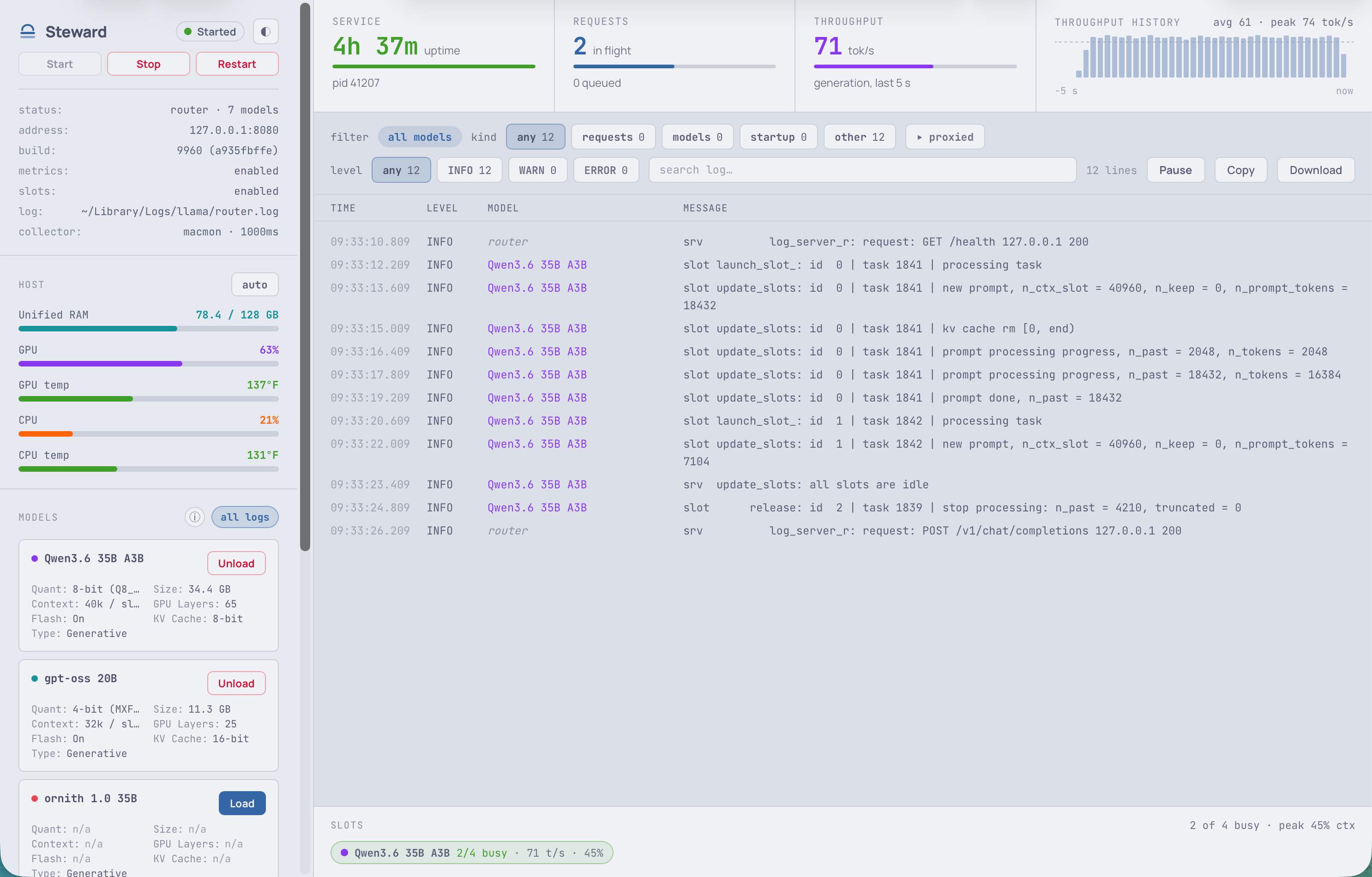
A single-page operator dashboard for the local `llama-server` behind Pi's llama.cpp provider, plus a
status bar inside Pi itself. It answers four questions at a glance, and lets you act on all of them
without leaving your editor:
1. **Is the service up**, and for how long?
2. **Which models are resident**, and what is each costing you in memory?
3. **Is the box healthy** — GPU, CPU, memory, temperature?
4. **What is the server doing right now** — slots, throughput, requests, and its live log?
Start, stop and restart the service; load and unload models; watch the log — all from the dashboard.
## Requirements
| | |
| --- | --- |
| **Node** | ≥ 22.13 |
| **[Pi](https://pi.dev)** | any recent version |
| **`llama-server`** | running in **router mode** — `--models-dir` and/or `--models-preset`, with no `-m`/`--model`/`-hf`. Pi's own llama.cpp provider requires this too. |
| **A [Nerd Font](https://www.nerdfonts.com)** | for the status bar's mark and separators. Set `STEWARD_GLYPH=""` to drop the mark if you would rather not install one. |
`/steward_initialize` checks everything else — metrics, slots, log capture, host sensors — and offers
to fix whatever is missing.
## Install
```bash
# Globally (recommended)
pi install npm:@jmcombs/pi-steward
# For a single session, without installing
pi -e ./packages/steward
```
See the [Pi packages documentation](https://pi.dev/docs/packages) for git, local path,
project-scoped install, and filtering options.
## Quick start
Start Pi, then:
```
/steward_initialize 1. connect this machine — review, approve, done
/steward_start 2. start the dashboard service
/steward_dashboard 3. open it in your browser
```
That is the whole path. Step 1 is once per machine; steps 2 and 3 are once per session — and
`/steward_dashboard` starts the service for you, so you can skip straight to it.
## Commands
| Command | What it does |
| --- | --- |
| `/steward_initialize` | Connects this machine to Steward. Works out how `llama-server` runs here, proposes the changes it needs, and writes `steward.json` — **asking before every change**. Run once per machine, or again whenever the setup moves. |
| `/steward_start` | Starts the dashboard service on `127.0.0.1:8788` for this session. Prints the URL and opens nothing — useful on a headless box, or when you only want the status bar. |
| `/steward_dashboard` | Opens the dashboard in your browser, starting the service first if it is not already running. |
| `/steward_stop` | Stops the dashboard service. It also stops on its own when the Pi session ends. |
## The status bar
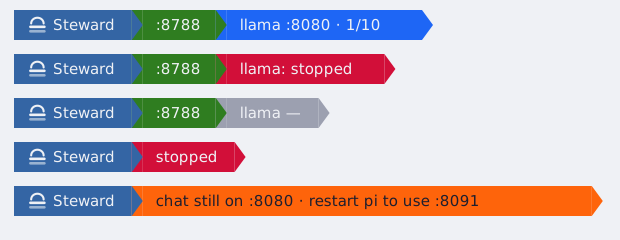
Steward draws a line above the editor whenever it has something to say. It reports **Steward's own
state** first, with `llama.cpp` as detail.
- **Everything up** — the dashboard is on `:8788`, `llama.cpp` answers on `:8080`, and 1 of its 10
models is resident. The count is models holding weights in memory, not models on disk.
- **llama.cpp down** — Steward is fine and says so in green; the server gets its own red block. The
dashboard still opens, and Start is there if you recorded one.
- **Not read yet** — Steward is up but has not completed a read. Deliberately its own colour: an
absent reading is not a healthy one.
- **Dashboard not running** — no `/steward_start` yet, or you stopped it. Nothing is said about
`llama.cpp`, because Steward is not watching it.
- **Pointed elsewhere** — Pi is dialling a different address than the server Steward watches, so
chat fails while everything else looks healthy. The bar names the fix.
Three colours, and only three: **green** started, **red** stopped, **orange** running but something
needs a person.
It refreshes while the dashboard is up, and reads the same data the dashboard does — no extra
connection to your server.
## Configuration
Run `/steward_initialize` and let your clanker set me up. It reviews the local environment, captures
how `llama.cpp` is currently configured, works out what is needed for Pi, Steward and `llama.cpp` to
run together, then hands you a plan to approve. Nothing is applied before you say so.
It writes `~/.config/steward/steward.json` at mode `0600` — the collector, the log path, the base
URL, the service commands, and a consent hash for every command Steward may run. Steward ignores
that file if it is not owned by you or is world-writable, because it is a code-execution surface.
### Environment variables
| Variable | Default | Purpose |
| --- | --- | --- |
| `STEWARD_CONFIG` | `~/.config/steward/steward.json` | Where the artifact lives. |
| `STEWARD_PORT` | `8788` | Dashboard port. `0` asks the OS for any free port; a port already taken costs an ephemeral one, not the dashboard. |
| `STEWARD_LOG_FILE` | — | Overrides the recorded `log.path` for the log console. |
| `STEWARD_GLYPH` | `` | The status bar's mark. `""` drops it; any other value replaces it. |
## Development
```bash
# From the repo root
npx vitest run packages/steward # tests
node scripts/typecheck.mjs # types
npx biome check packages/steward # lint and format
# Run the dashboard without Pi
npx tsx packages/steward/scripts/dev.ts
```
## License
MIT © [Jeremy Combs](https://github.com/jmcombs)