Developer Guide
Warning
This document refers to a version of the framework which is under development. Some things may change. You may also be interested in v1 of this framework.
Prerequisites
Usage of this smart contract system requires some proficiency in Solidity.
Additionally, this guide will assume a Truffle based setup. Client-side code samples will be written in JavaScript assuming the presence of a web3.js instance and various TruffleContract wrappers.
The current state of this smart contract system may be found on Github.
Installation
Via NPM
This developmental framework may be installed from Github through NPM by running the following:
npm i gnosis/pm-contracts
Preparing a Condition
Before predictive assets can exist in the system, a condition must be prepared. A condition is a question to be answered in the future by a specific oracle in a particular manner. The following function may be used to prepare a condition:
-
function
prepareCondition(address oracle, bytes32 questionId, uint outcomeSlotCount)
external
¶ This function prepares a condition by initializing a payout vector associated with the condition.
Parameters: - oracle – The account assigned to report the result for the prepared condition.
- questionId – An identifier for the question to be answered by the oracle.
- outcomeSlotCount – The number of outcome slots which should be used for this condition. Must not exceed 256.
Note
It is up to the consumer of the contract to interpret the question ID correctly. For example, a client may interpret the question ID as an IPFS hash which can be used to retrieve a document specifying the question more fully. The meaning of the question ID is left up to clients.
If the function succeeds, the following event will be emitted, signifying the preparation of a condition:
-
event
ConditionPreparation(bytes32 indexed conditionId, address indexed oracle, bytes32 indexed questionId, uint outcomeSlotCount)
¶ Emitted upon the successful preparation of a condition.
Parameters: - conditionId – The condition’s ID. This ID may be derived from the other three parameters via
keccak256(abi.encodePacked(oracle, questionId, outcomeSlotCount)). - oracle – The account assigned to report the result for the prepared condition.
- questionId – An identifier for the question to be answered by the oracle.
- outcomeSlotCount – The number of outcome slots which should be used for this condition. Must not exceed 256.
- conditionId – The condition’s ID. This ID may be derived from the other three parameters via
Note
The condition ID is different from the question ID, and their distinction is important.
The successful preparation of a condition also initializes the following state variable:
-
mapping (bytes32 => uint[]) public
payoutNumerators¶ Mapping key is an condition ID. Value represents numerators of the payout vector associated with the condition. This array is initialized with a length equal to the outcome slot count.
To determine if, given a condition’s ID, a condition has been prepared, or to find out a condition’s outcome slot count, use the following accessor:
-
function
getOutcomeSlotCount(bytes32 conditionId)
external
view
returns (uint)
¶ Gets the outcome slot count of a condition.
Parameters: - conditionId – ID of the condition.
Return: Number of outcome slots associated with a condition, or zero if condition has not been prepared yet.
The resultant payout vector of a condition contains a predetermined number of outcome slots. The entries of this vector are reported by the oracle, and their values sum up to one. This payout vector may be interpreted as the oracle’s answer to the question posed in the condition.
A Categorical Example
Let’s consider a question where only one out of multiple choices may be chosen:
Who out of the following will be chosen?
- Alice
- Bob
- Carol
Through some commonly agreed upon mechanism, the detailed description for this question becomes strongly associated with a 32 byte question ID: 0xabcabcabcabcabcabcabcabcabcabcabcabcabcabcabcabcabcabcabcabc1234
Let’s also suppose we trust the oracle with address 0x1337aBcdef1337abCdEf1337ABcDeF1337AbcDeF to deliver the answer for this question.
To prepare this condition, the following code gets run:
await predictionMarketSystem.prepareCondition(
    '0x1337aBcdef1337abCdEf1337ABcDeF1337AbcDeF',
    '0xabcabcabcabcabcabcabcabcabcabcabcabcabcabcabcabcabcabcabcabc1234',
    3
)
The condition ID may also be determined from the parameters via:
web3.utils.soliditySha3({
    t: 'address',
    v: '0x1337aBcdef1337abCdEf1337ABcDeF1337AbcDeF'
}, {
    t: 'bytes32',
    v: '0xabcabcabcabcabcabcabcabcabcabcabcabcabcabcabcabcabcabcabcabc1234'
}, {
    t: 'uint',
    v: 3
})
This yields a condition ID of 0x67eb23e8932765c1d7a094838c928476df8c50d1d3898f278ef1fb2a62afab63.
Later, if the oracle 0x1337aBcdef1337abCdEf1337ABcDeF1337AbcDeF makes a report that the payout vector for the condition is [0, 1, 0], the oracle essentially states that Bob was chosen, as the outcome slot associated with Bob would receive all of the payout.
A Scalar Example
Let us now consider a question where the answer may lie in a range:
What will the score be? [0, 1000]
Let’s say the question ID for this question is 0x777def777def777def777def777def777def777def777def777def777def7890, and that we trust the oracle 0xCafEBAbECAFEbAbEcaFEbabECAfebAbEcAFEBaBe to deliver the results for this question.
To prepare this condition, the following code gets run:
await predictionMarketSystem.prepareCondition(
    '0xCafEBAbECAFEbAbEcaFEbabECAfebAbEcAFEBaBe',
    '0x777def777def777def777def777def777def777def777def777def777def7890',
    2
)
The condition ID for this condition can be calculated as 0x3bdb7de3d0860745c0cac9c1dcc8e0d9cb7d33e6a899c2c298343ccedf1d66cf.
In this case, the condition was created with two slots: one which represents the low end of the range (0) and another which represents the high end (1000). The slots’ reported payout values should indicate how close the answer was to these endpoints. For example, if the oracle 0xCafEBAbECAFEbAbEcaFEbabECAfebAbEcAFEBaBe makes a report that the payout vector is [9/10, 1/10], then the oracle essentially states that the score was 100, as the slot corresponding to the low end is worth nine times what the slot corresponding with the high end is worth, meaning the score should be nine times closer to 0 than it is close to 1000. Likewise, if the payout vector is reported to be [0, 1], then the oracle is saying that the score was at least 1000.
Outcome Collections
The main concept for understanding the mechanics of this system is that of a position. We will build to this concept from conditions and outcome slots, and then demonstrate the use of this concept.
However, before we can talk about positions, we first have to talk about outcome collections, which may be defined like so:
A nonempty proper subset of a condition’s outcome slots which represents the sum total of all the contained slots’ payout values.
Categorical Example Featuring Alice, Bob, and Carol
We’ll denote the outcome slots for Alice, Bob, and Carol as A, B, and C respectively.
A valid outcome collection may be (A|B). In this example, this outcome collection represents the eventuality in which either Alice or Bob is chosen. Note that for a categorical condition, the payout vector which the oracle reports will eventually contain a one in exactly one of the three slots, so the sum of the values in Alice’s and Bob’s slots is one precisely when either Alice or Bob is chosen, and zero otherwise.
(C) by itself is also a valid outcome collection, and this simply represents the case where Carol is chosen.
() is an invalid outcome collection, as it is empty. Empty outcome collections do not make sense, as they would essentially represent no eventuality and have no value no matter what happens.
Conversely, (A|B|C) is also an invalid outcome collection, as it is not a proper subset. Outcome collections consisting of all the outcome slots for a condition also do not make sense, as they would simply represent any eventuality, and should be equivalent to whatever was used to collateralize these outcome collections.
Finally, outcome slots from different conditions (e.g. (A|X)) cannot be composed in a single outcome collection.
Index Set Representation and Identifier Derivation
A outcome collection may be represented by an a condition and an index set. This is a 256 bit array which denotes which outcome slots are present in a outcome collection. For example, the value 3 == 0b011 corresponds to the outcome collection (A|B), whereas the value 4 == 0b100 corresponds to (C). Note that the indices start at the lowest bit in a uint.
A outcome collection may be identified with a 32 byte value called a collection identifier. In order to calculate the collection ID for (A|B), simply hash the condition ID and the index set:
web3.utils.soliditySha3({
    // See section "A Categorical Example" for derivation of this condition ID
    t: 'bytes32',
    v: '0x67eb23e8932765c1d7a094838c928476df8c50d1d3898f278ef1fb2a62afab63'
}, {
    t: 'uint',
    v: 0b011 // Binary Number literals supported in newer versions of JavaScript
})
This results in a collection ID of 0x52ff54f0f5616e34a2d4f56fb68ab4cc636bf0d92111de74d1ec99040a8da118.
We may also combine collection IDs for outcome collections for different conditions by adding their values modulo 2^256 (equivalently, by adding their values and then taking the lowest 256 bits).
To illustrate, let’s denote the slots for range ends 0 and 1000 from our scalar condition example as LO and HI. We can find the collection ID for (LO) to be 0xd79c1d3f71f6c9d998353ba2a848e596f0c6c1a9f6fa633f2c9ec65aaa097cdc.
The combined collection ID for (A|B)&(LO) can be calculated via:
'0x' + BigInt.asUintN(256,
    0x52ff54f0f5616e34a2d4f56fb68ab4cc636bf0d92111de74d1ec99040a8da118n +
    0xd79c1d3f71f6c9d998353ba2a848e596f0c6c1a9f6fa633f2c9ec65aaa097cdcn
).toString(16)
Note
BigInt is used here for the calculation, though BN.js or BigNumber.js should both also suffice.
This calculation yields the value 0x2a9b72306758380e3b0a31125ed39a635432b283180c41b3fe8b5f5eb4971df4.
Defining Positions
In order to define a position, we first need to designate a collateral token. This token must be an ERC20 token which exists on the same chain as the PredictionMarketSystem instance.
Then we need at least one condition with a outcome collection, though a position may refer to multiple conditions each with an associated outcome collection. Positions become valuable precisely when all of its constituent outcome collections are valuable. More explicitly, the value of a position is a product of the values of those outcome collections composing the position.
With these ingredients, position identifiers can also be calculated by hashing the address of the collateral token and the combined collection ID of all the outcome collections in the position. We say positions are deeper if they contain more conditions and outcome collections, and shallower if they contain less.
As an example, let’s suppose that there is an ERC20 token called DollaCoin which exists at the address 0xD011ad011ad011AD011ad011Ad011Ad011Ad011A, and it is used as collateral for some positions. We will denote this token with $.
We may calculate the position ID for the position $:(A|B) via:
web3.utils.soliditySha3({
    t: 'address',
    v: '0xD011ad011ad011AD011ad011Ad011Ad011Ad011A'
}, {
    t: 'bytes32',
    v: '0x52ff54f0f5616e34a2d4f56fb68ab4cc636bf0d92111de74d1ec99040a8da118'
})
The ID for $:(A|B) turns out to be 0x6147e75d1048cea497aeee64d1a4777e286764ded497e545e88efc165c9fc4f0.
Similarly, the ID for $:(LO) can be found to be 0xfdad82d898904026ae6c01a5800c0a8ee9ada7e7862f9bb6428b6f81e06f53bb, and $:(A|B)&(LO) has an ID of 0xcc77e750b61d29e158aa3193faa3673b2686ba9f6a16f51b5cdbea2a4f694be0.
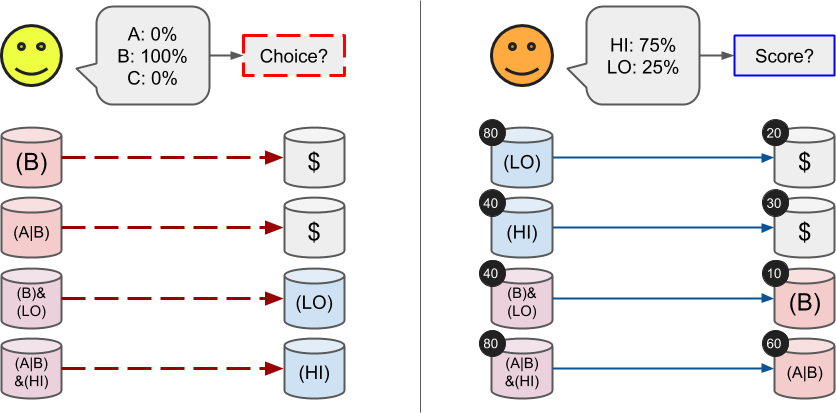
All the positions backed by DollaCoin which depend on the example categorical condition and the example scalar condition form a DAG (directed acyclic graph):

Graph of all positions backed by $ which are contingent on either or both of the example conditions.
Splitting and Merging Positions
Once conditions have been prepared, stake in positions contingent on these conditions may be obtained. Furthermore, this stake must be backed by collateral held by the system. In order to ensure this is the case, stake in shallow positions may only be created directly by sending collateral to the system for the system to hold, and stake in deeper positions may only be created by destroying stake in shallower positions. Any of these is referred to as splitting a position, and is done through the following function:
-
function
splitPosition(IERC20 collateralToken, bytes32 parentCollectionId, bytes32 conditionId, uint[] partition, uint amount)
external
¶ This function splits a position. If splitting from the collateral, this contract will attempt to transfer amount collateral from the message sender to itself. Otherwise, this contract will burn amount stake held by the message sender in the position being split. Regardless, if successful, amount stake will be minted in the split target positions. If any of the transfers, mints, or burns fail, the transaction will revert. The transaction will also revert if the given partition is trivial, invalid, or refers to more slots than the condition is prepared with.
Parameters: - collateralToken – The address of the positions’ backing collateral token.
- parentCollectionId – The ID of the outcome collections common to the position being split and the split target positions. May be null, in which only the collateral is shared.
- conditionId – The ID of the condition to split on.
- partition – An array of disjoint index sets representing a nontrivial partition of the outcome slots of the given condition.
- amount – The amount of collateral or stake to split.
If this transaction does not revert, the following event will be emitted:
-
event
PositionSplit(address indexed stakeholder, IERC20 collateralToken, bytes32 indexed parentCollectionId, bytes32 indexed conditionId, uint[] partition, uint amount)
¶ Emitted when a position is successfully split.
To decipher this function, let’s consider what would be considered a valid split, and what would be invalid:
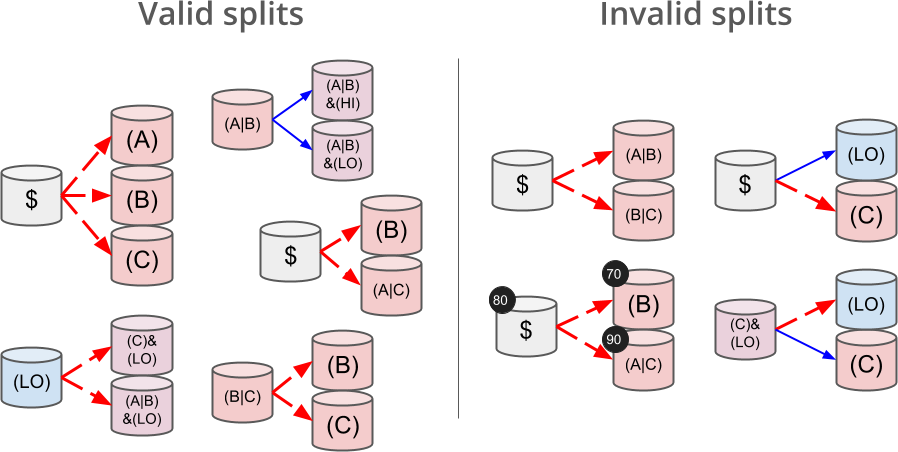
Details for some of these scenarios will follow
Basic Splits
Collateral $ can be split into outcome tokens in positions $:(A), $:(B), and $:(C). To do so, use the following code:
const amount = 1e18 // could be any amount

// user must allow predictionMarketSystem to
// spend amount of DollaCoin, e.g. through
// await dollaCoin.approve(predictionMarketSystem.address, amount)

await predictionMarketSystem.splitPosition(
    // This is just DollaCoin's address
    '0xD011ad011ad011AD011ad011Ad011Ad011Ad011A',
    // For splitting from collateral, pass bytes32(0)
    '0x00',
    // "Choice" condition ID:
    // see A Categorical Example for derivation
    '0x67eb23e8932765c1d7a094838c928476df8c50d1d3898f278ef1fb2a62afab63',
    // Each element of this partition is an index set:
    // see Outcome Collections for explanation
    [0b001, 0b010, 0b100],
    // Amount of collateral token to submit for holding
    // in exchange for minting the same amount of
    // outcome token in each of the target positions
    amount,
)
The effect of this transaction is to transfer amount DollaCoin from the message sender to the predictionMarketSystem to hold, and to mint amount of outcome token for the following positions:
| Symbol | Position ID |
|---|---|
$:(A) |
0x8c12fa3bb72c9c455acd4d6034989ec0ce9188afd7c89c8c42d064ed7fe5a9d8 |
$:(B) |
0x21aec03d8dfd8b5f0a2750718fe491e439f3625816e383b66a05cabd56624b4c |
$:(C) |
0x8085f7c500098412ff2fc701a74174527e7b39a2b923cd0bca6ad2d5f7fa348d |
Note
The previous example, where collateral was split into shallow positions containing collections with one slot each, is similar to Event.buyAllOutcomes from v1.
The set of (A), (B), and (C) is not the only nontrivial partition of outcome slots for the example categorical condition. For example, the set (B) (with index set 0b010) and (A|C) (with index set 0b101) also partitions these outcome slots, and consequently, splitting from $ to $:(B) and $:(A|C) is also valid and can be done with the following code:
await predictionMarketSystem.splitPosition(
    '0xD011ad011ad011AD011ad011Ad011Ad011Ad011A',
    '0x00',
    '0x67eb23e8932765c1d7a094838c928476df8c50d1d3898f278ef1fb2a62afab63',
    // This partition differs from the previous example
    [0b010, 0b101],
    amount,
)
This transaction also transfers amount DollaCoin from the message sender to the predictionMarketSystem to hold, but it mints amount of outcome token for the following positions instead:
| Symbol | Position ID |
|---|---|
$:(B) |
0x21aec03d8dfd8b5f0a2750718fe491e439f3625816e383b66a05cabd56624b4c |
$:(A|C) |
0xb33b3d0035913315b76e85842f682920f78b32c43c7175768c4c67e3f31e6413 |
Warning
If non-disjoint index sets are supplied to splitPosition, the transaction will revert.
Partitions must be valid partitions. For example, you can’t split $ to $:(A|B) and $:(B|C) because (A|B) (0b011) and (B|C) (0b110) share outcome slot B (0b010).
Splits to Deeper Positions
It’s also possible to split from a position, burning outcome tokens in that position in order to acquire outcome tokens in deeper positions. For example, you can split $:(A|B) to target $:(A|B)&(LO) and $:(A|B)&(HI):
await predictionMarketSystem.splitPosition(
    // Note that we're still supplying the same collateral token
    // even though we're going two levels deep.
    '0xD011ad011ad011AD011ad011Ad011Ad011Ad011A',
    // Here, instead of just supplying 32 zero bytes, we supply
    // the collection ID for (A|B).
    // This is NOT the position ID for $:(A|B)!
    '0x52ff54f0f5616e34a2d4f56fb68ab4cc636bf0d92111de74d1ec99040a8da118',
    // This is the condition ID for the example scalar condition
    '0x3bdb7de3d0860745c0cac9c1dcc8e0d9cb7d33e6a899c2c298343ccedf1d66cf',
    // This is the only partition that makes sense
    // for conditions with only two outcome slots
    [0b01, 0b10],
    amount,
)
This transaction burns amount of outcome token in position $:(A|B) (position ID 0x6147e75d1048cea497aeee64d1a4777e286764ded497e545e88efc165c9fc4f0) in order to mint amount of outcome token in the following positions:
| Symbol | Position ID |
|---|---|
$:(A|B)&(LO) |
0xcc77e750b61d29e158aa3193faa3673b2686ba9f6a16f51b5cdbea2a4f694be0 |
$:(A|B)&(HI) |
0xbacf3ddf0474d567cd254ea0674fe52ab20a3e2ebca00ec71a846f3c48c5de9d |
Splits on Partial Partitions
Supplying a partition which does not cover the set of all outcome slots for a condition, but instead some outcome collection, is also possible. For example, it is possible to split $:(B|C) (position ID 0x5d06cd85e2ff915efab0e7881432b1c93b3e543c5538d952591197b3893f5ce3) to $:(B) and $:(C):
await predictionMarketSystem.splitPosition(
    '0xD011ad011ad011AD011ad011Ad011Ad011Ad011A',
    // Note that we also supply zeroes here, as the only aspect shared
    // between $:(B|C), $:(B) and $:(C) is the collateral token
    '0x00',
    '0x67eb23e8932765c1d7a094838c928476df8c50d1d3898f278ef1fb2a62afab63',
    // This partition does not cover the first outcome slot
    [0b010, 0b100],
    amount,
)
Merging Positions
Merging positions does precisely the opposite of what splitting a position does. It burns outcome tokens in the deeper positions to either mint outcome tokens in a shallower position or send collateral to the message sender:
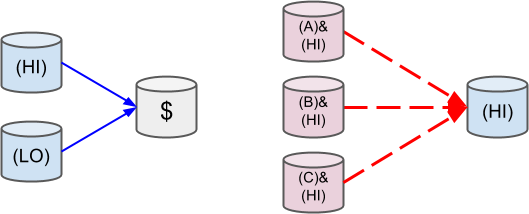
Splitting positions, except with the arrows turned around.
To merge positions, use the following function:
-
function
mergePositions(IERC20 collateralToken, bytes32 parentCollectionId, bytes32 conditionId, uint[] partition, uint amount)
external

If successful, the function will emit this event:
-
event
PositionsMerge(address indexed stakeholder, IERC20 collateralToken, bytes32 indexed parentCollectionId, bytes32 indexed conditionId, uint[] partition, uint amount)
¶ Emitted when positions are successfully merged.
Note
This generalizes sellAllOutcomes from v1 like splitPosition generalizes buyAllOutcomes.
Querying and Transferring Stake
Outcome tokens in positions are not ERC20 tokens, but rather part of an ERC1155 multitoken.
In addition to a holder address, each token is indexed by an ID in this standard. In particular, position IDs are used to index outcome tokens. This is reflected in the balance querying function:
To transfer outcome tokens, the following functions may be used, as per ERC1155:
-
function
safeTransferFrom(address from, address to, uint256 positionId, uint256 value, bytes data)
external
¶ -
function
safeBatchTransferFrom(address from, address to, uint256[] positionIds, uint256[] values, bytes data)
external
¶ -
function
safeMulticastTransferFrom(address[] from, address[] to, uint256[] positionIds, uint256[] values, bytes data)
external

Approving an operator account to transfer outcome tokens on your behalf may also be done via:
Querying the status of approval can be done with:
Redeeming Positions
Before this is possible, the payout vector must be set by the oracle:
-
function
receiveResult(bytes32 questionId, bytes result)
external
¶ Called by the oracle for reporting results of conditions. Will set the payout vector for the condition with the ID
keccak256(abi.encodePacked(oracle, questionId, outcomeSlotCount)), where oracle is the message sender, questionId is one of the parameters of this function, and outcomeSlotCount is derived from result, which is the result of serializing 32-byte EVM words representing payoutNumerators for each outcome slot of the condition.Parameters: - questionId – The question ID the oracle is answering for
- result – The oracle’s answer
This will emit the following event:
-
event
ConditionResolution(bytes32 indexed conditionId, address indexed oracle, bytes32 indexed questionId, uint outcomeSlotCount, uint[] payoutNumerators)

Then positions containing this condition can be redeemed via:
-
function
redeemPositions(IERC20 collateralToken, bytes32 parentCollectionId, bytes32 conditionId, uint[] indexSets)
external

This will trigger the following event:
-
event
PayoutRedemption(address indexed redeemer, IERC20 indexed collateralToken, bytes32 indexed parentCollectionId, uint payout)

Also look at this chart: