# team — the lead's round over the board
`board` owns the cards; `team` is how a lead moves them between sessions: hand one
to a peer that is already running, offer one to whoever is free, or ask a peer a
question. Nothing here starts a process — every action is a message, and a peer
listening with `wake` is woken for it ([`session-bus`](session-bus.md) owns that).
A card's own state — `claim`, `reclaim`, the moves, the contract, the two signs — is
[`board`](board.md)'s. What outlives the round is the project's [`memory`](memory.md) store.
The board's Team tab is the same round as a page: three columns that count themselves and scroll as
one. **AGENTS** gives each session a card, the lead pinned first — a monogram, its state and age at
the edge, `lead` and `you` chips with the mail and needs-you counts, and one mission line.
**NEEDS YOU** is the seat's queue over `blocked`, `execute`, `plan` and `backlog`, counting only what the
seat can finish: `approval`, `untold`, `gone`, `unwritten`; folded at five, with `The board · N open`
counting the lanes and a large pool reduced to one line and a door. **ACTIVITY** draws unread mail as a
block — a fill and an accent edge — above a flat recent history; reading consumes nothing, and
`WAITING` counts sends, one row each however many inboxes it reached, while a card's chip counts its
own inbox's files.
## What you can do
| What you want | What to do |
|---|---|
| Hand a card to a running session | `team assign 4 to billing-core` |
| Offer one to whoever is free | `team offer 5 note "whoever is free"` |
| Take a card back from a quiet owner | `board reclaim 4` |
| Take a card yourself | `board claim 5` |
| Ask a peer a question | `team ask to billing-core question "what is left on #4?"` |
| See the round | `/team` in the terminal, or the board's Team tab |
| See who is here, and what each holds | `/team who` — one row per session, `- none` for an empty group; `/team who billing-core` for one |
| Join the team | `/team join billing-core` names yourself, `/team join` for a `team.teammates` name, `/team help` for the words |
| Leave the team | `/team exit` — drops this session's bus record and its claims, refusing while a card or the page's seat is yours |
## Try it
Two sessions, one repository. In the first:
```text
/board
```
It joins as the lead; in the second, `board claim` joins it under its own name. From the lead:
```text
team assign 4 to billing-core
```
The peer is told at its next turn; the card's owner is `billing-core`, and the lead's round shows it held.
## Reference
**Actions.** Three, and every one of them reaches another session. `assign` (card, `to`, `note?`) joins, records
the owner, then sends the handoff — the owner from the one read of the team that also names the peers a message
could not reach, so the peer reads a card that already holds it — and says whether the bus took it: `told` means
written, not read, because mail is pruned after a day. That order is the point rather than a habit: a write no
rule allowed sends nobody a message at all, and a send that fails leaves the card owned with the handoff owed, so
running the same verb again is the retry rather than a second attempt at a first one. A handoff that loses the
race to a reclaim names the one condition that survives — if the board shows another owner, leave it alone and
ask the lead. A completed contract tells the lead, and `approve` tells the holder; `offer` (card, `note?`)
records only the moment it was offered, then broadcasts the card, so the first peer to claim it wins —
the same order `assign` keeps, so the two verbs agree on which half survives a failure; `ask` (`to`,
`question?`) sends one peer a question and writes nothing else: its own ask id, and the answering session by id,
so a reply sets `replyTo ""` and the bus prints it as `re: `.
`/team`'s stalled lines name the door: `board reclaim 1, 2 — api-core stopped`, folded at five like the
page's own queue, with `… N owners more — /board shows them` naming the surface that draws the rest —
so the round is one message whichever way a board grows. A field an action does
not read is refused, naming the verb that takes it — `offer` takes no `to`, and `assign` and `ask` refuse
`*`, which is `offer`'s broadcast.
**Who is who.** `/team` lists who is live, who is live but not listening, who is quiet (a heartbeat past ten
minutes), and who is absent from the bus — an owner a card names that no record answers. A label nobody
answers to cannot be handed a card, and a rename is one row: a card is named by the record its owner's **id**
names. A handoff the bus could not name records the owner `unresolved`: mail reaches the label, but only the
lead moves the card. A quiet owner's card is reclaimable; one held by a session with no record is not — a
live session that never joined looks the same. A message to a quiet or not-listening peer says so: written
is not heard. `/team who` prints that answer as rows — `live (n)`, `quiet (n)`, `not on the bus (n)`,
`gone (n)`, nothing elided — and `/team who
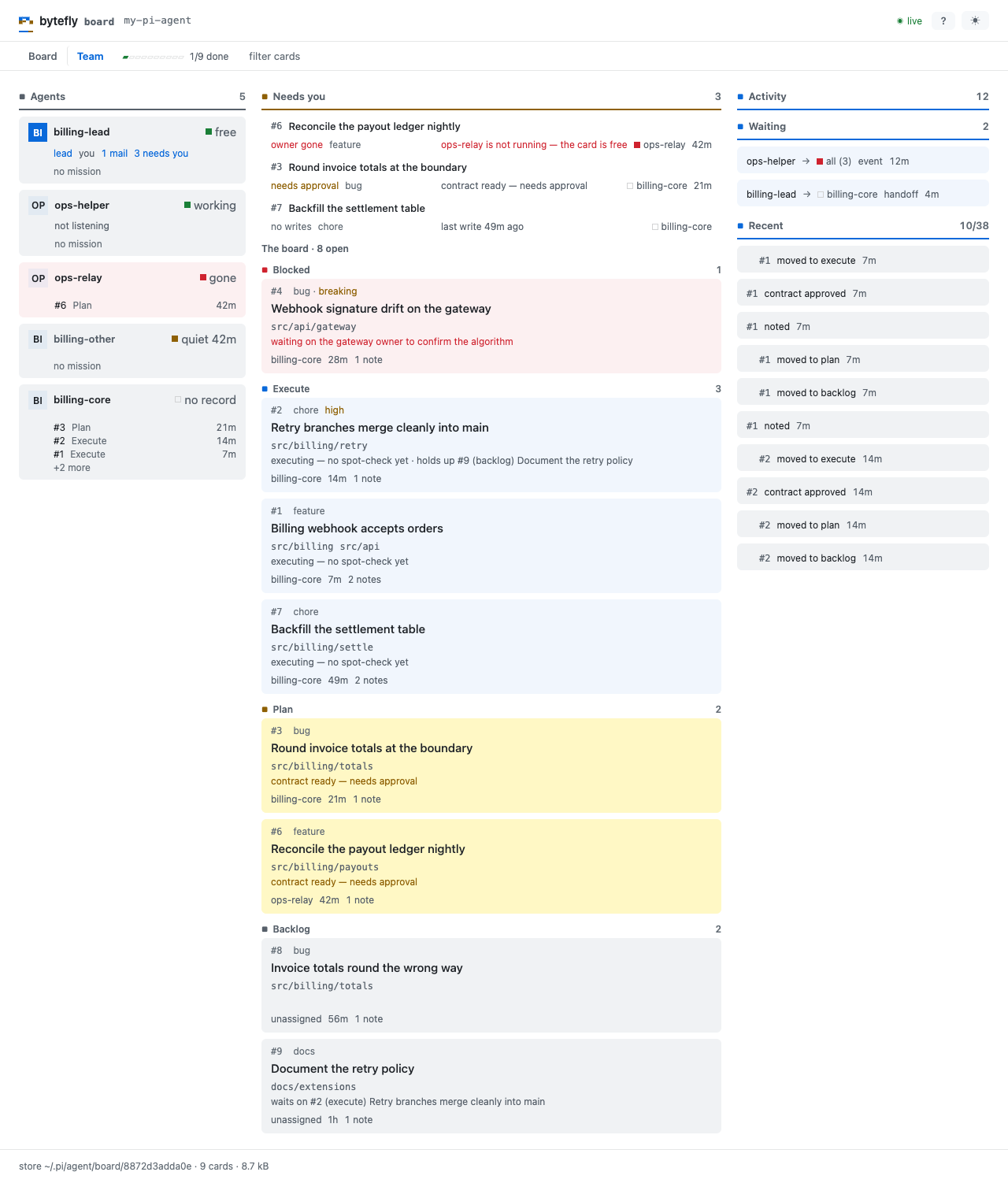 The board's Team tab is the same round as a page: three columns that count themselves and scroll as
one. **AGENTS** gives each session a card, the lead pinned first — a monogram, its state and age at
the edge, `lead` and `you` chips with the mail and needs-you counts, and one mission line.
**NEEDS YOU** is the seat's queue over `blocked`, `execute`, `plan` and `backlog`, counting only what the
seat can finish: `approval`, `untold`, `gone`, `unwritten`; folded at five, with `The board · N open`
counting the lanes and a large pool reduced to one line and a door. **ACTIVITY** draws unread mail as a
block — a fill and an accent edge — above a flat recent history; reading consumes nothing, and
`WAITING` counts sends, one row each however many inboxes it reached, while a card's chip counts its
own inbox's files.
## What you can do
| What you want | What to do |
|---|---|
| Hand a card to a running session | `team assign 4 to billing-core` |
| Offer one to whoever is free | `team offer 5 note "whoever is free"` |
| Take a card back from a quiet owner | `board reclaim 4` |
| Take a card yourself | `board claim 5` |
| Ask a peer a question | `team ask to billing-core question "what is left on #4?"` |
| See the round | `/team` in the terminal, or the board's Team tab |
| See who is here, and what each holds | `/team who` — one row per session, `- none` for an empty group; `/team who billing-core` for one |
| Join the team | `/team join billing-core` names yourself, `/team join` for a `team.teammates` name, `/team help` for the words |
| Leave the team | `/team exit` — drops this session's bus record and its claims, refusing while a card or the page's seat is yours |
## Try it
Two sessions, one repository. In the first:
```text
/board
```
It joins as the lead; in the second, `board claim` joins it under its own name. From the lead:
```text
team assign 4 to billing-core
```
The peer is told at its next turn; the card's owner is `billing-core`, and the lead's round shows it held.
## Reference
**Actions.** Three, and every one of them reaches another session. `assign` (card, `to`, `note?`) joins, records
the owner, then sends the handoff — the owner from the one read of the team that also names the peers a message
could not reach, so the peer reads a card that already holds it — and says whether the bus took it: `told` means
written, not read, because mail is pruned after a day. That order is the point rather than a habit: a write no
rule allowed sends nobody a message at all, and a send that fails leaves the card owned with the handoff owed, so
running the same verb again is the retry rather than a second attempt at a first one. A handoff that loses the
race to a reclaim names the one condition that survives — if the board shows another owner, leave it alone and
ask the lead. A completed contract tells the lead, and `approve` tells the holder; `offer` (card, `note?`)
records only the moment it was offered, then broadcasts the card, so the first peer to claim it wins —
the same order `assign` keeps, so the two verbs agree on which half survives a failure; `ask` (`to`,
`question?`) sends one peer a question and writes nothing else: its own ask id, and the answering session by id,
so a reply sets `replyTo "