# session-bus — coordinate sessions on one repository

Two sessions on one repository can block each other. The bus is the local channel
that prevents it: each discovers the other, exchanges messages, claims paths before
editing — and the board refuses a write outside the card's `paths` in `execute`.

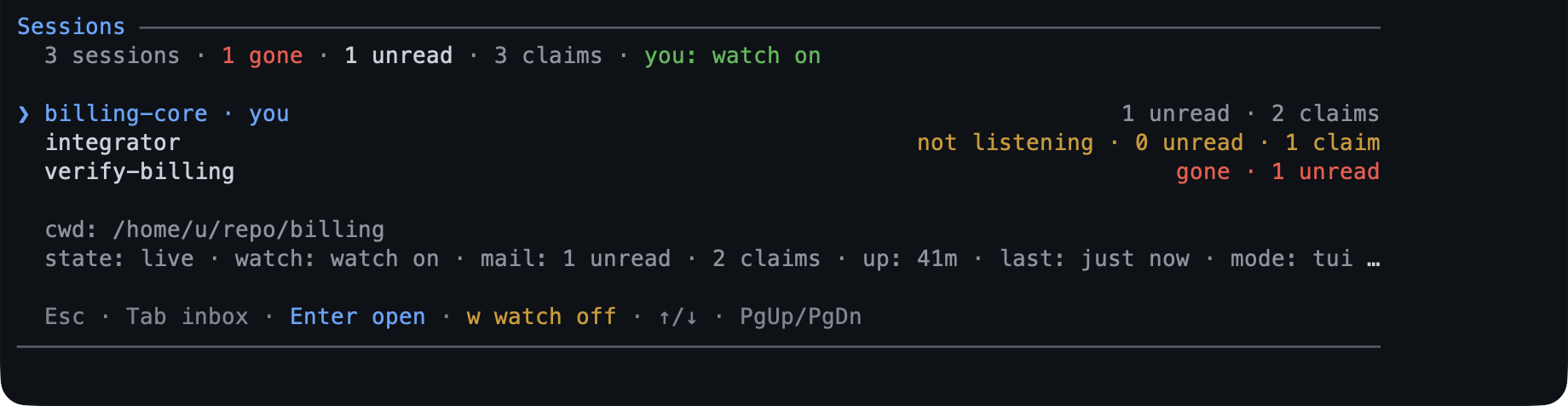
<img src="../../assets/screens/session.png" alt="The /sessions screen: a counts summary, session rows with unread and claim counts, and the focused session's working directory, claims, and identity" width="1840" height="476">

- **Local and pull-based.** Files under the agent directory — no service, no network.
- **Joining is explicit.** The board opens empty; a session appears only when it
  joins, which every `session` action except `status` does — `/board` and
  `/team join` join too.
- **Listening is a mode**: mail reported at the next turn, or — with `wake` — one raised turn when
  idle. A board or team join asks for `wake`, and `listen: false` is the one opt-out.
- **Waiting mail**: a listening session's turn starts with the count until `inbox` clears it.- **Claims are all-or-nothing**, on a file or a directory prefix, and they expire
  with the session.

## What you can do

| What you want | What to do |
|---|---|
| See who is working here | `/sessions` — the board, or the listing outside the TUI |
| Join under a name | `/team join billing-core`, or `session join` |
| Message one session | `session send to billing-web text "the API route is free"` |
| Broadcast an event | `session send to "*" kind "event" text "…"` |
| Read your mail | `session inbox`, or `session read` to show it and keep it (the waiting line counts files, so `read` leaves it) |
| Clear this session's own old mail | `/sessions clean [<age>]` — this inbox alone, older than the age or past the message TTL; it asks first |
| See mail no session holds, and clear one | the board's summary counts it; `/sessions drop` names each, and `<id>` clears one |
| Free a stopped session's name | `/sessions forget <label\|id>…` — its record and claims go now, and its unread mail becomes unaccounted for `drop` |
| Claim files before editing | `session claim paths ["src/api"]` |
| Release a claim, or take a peer's | `session release paths ["src/api"]`, or `x` on the board; with `holder tom`, from the seat |
| Be woken by mail | a board/team join asks for it; `session join wake: true` for a bare session |
| Stop listening | `w`, on the board |

## Try it

```text
/sessions
```

The board lists every session with its mark — `gone`, `not listening` — beside its unread count and claims, plus your own identity; the summary's unread is this session's own mail, the number the Inbox tab draws, and a pane prints the record's facts, claims included.
`Tab` cycles Sessions, Inbox, and Claims, `Enter` opens the focused row and is offered only while there is one, `w` toggles listening (the chip reads `you: watch …` on every scope), and `x` releases a claim you hold — offered only under your own — after a confirmation. It joins nothing by itself.

The three words past the board are the door's own, and each asks before it destroys: `/sessions
clean 2h` clears this session's mail older than two hours — no age means the message TTL, and it
never joins — `/sessions drop <id>` clears mail no record holds, and `/sessions forget <label>`
frees a stopped session's name. `Tab` completes the words and their arguments; a typo is named, and the board opens.

## Reference

**Actions.** `session status` reads without joining; `session send` writes one message per
recipient — `key` folds a resend into the waiting copy, `replyTo` names the message it answers, and
`about` is what it concerns (a card's `#673`); `session claim`/`release` hold and drop claims — with
`holder`, the seat moves a live peer's claims instead ([`multi-session`](../multi-session.md#a-stopped-owner));
`session join` puts this session on the bus, with `wake` and `listen`.

**Message kinds.** `message`, `event`, `ask`, and `handoff`. An `ask` does not
block the sender; a `handoff` names the work it assigns. A message may carry the
repository paths it concerns. A broadcast is one file per recipient sharing one
message id: `to "*"`, which is refused unless `kind` is `event`.

**Mail is read, not taken, by the page.** The Team tab removes nothing and marks nothing told — only
the session advances its count — and a row's state comes from its recipient's id, not its label.

**Records.** `session status` lists each session with its state — `live` while its heartbeat
holds, `quiet` once it has aged, `gone` once its process is not running — and whether its watch
is armed, so a peer that will not be woken reads as one. The record carries the turn too:
stamped on `agent_start`, dropped on `agent_settled`, counted only beside a fresh heartbeat.
A record that cannot be written says so: one `session-bus: heartbeat failed: …` line on stderr when
a streak starts, and one `… recovered` when a whole tick beats again — never one per tick, so a
failing write is visible without owning the terminal.
It names the machine that wrote it: another machine's record — a store can live where a sync client
replicates it — is judged by its heartbeat alone, so it reads `quiet`, never `gone`, once that ages.
The Team tab draws a row per machine saying when it was last seen, and names it on a session there.

It also carries what its session was told, and that is what unread counts: a notice marks its
burst told, so the number falls with nothing deleted, and both surfaces draw that one number.
A notice previews five messages, so `session read` is what shows the rest; a file this build
cannot parse is named rather than counted, and its TTL is the only thing that ends it. Mail whose
recipient's record was pruned has no row to hang a number on, and `session status` names it under
`Unaccounted (N)`, where `/sessions drop <id>` clears one. A heartbeat ends expired mail in its
own inbox and in the ones no record holds; a stopped inbox is swept once its record ages out, and
each file still ends at its own TTL. `/sessions clean [<age>]` is that sweep on a person's word:
this inbox alone, older than the age or the message TTL. Both are commands, not `session` actions: a message is evidence, and the store refuses an id a record's inbox holds.

**Labels.** Name a session for the outcome it owns (`billing-core`), not its layer. A duplicate
label gets a short id suffix, and a label is reserved while the bus keeps its owner's record —
ten minutes past the last heartbeat — so a crashed session has not freed its name. A person frees
it sooner with `/sessions forget <label>` — asked first, when there is a screen to ask on: the
record and its claims go, and its unread mail becomes unaccounted for `drop`.

**Claims.** A claim names the machine that made it and ends on that machine's heartbeat: another
machine's is judged by its row in `hosts/`, this machine's by the owner's record, never by a pid.
A claim that lapses that way is not lost silently: the session whose prune took it leaves its owner
one notice in its inbox, naming the paths, and the next claim says where a path went. A claim is
drawn under the label its owner's record holds now, so a rename moves its row and the conflict
sentence together; it keeps the name it captured only for a reader with no record of the id.
All-or-nothing: if one path conflicts, nothing is claimed. A directory claim conflicts
with claims below and above it. Two sessions claiming overlapping paths at once both pass the check —
`src` and `src/api` are two files — so each batch re-reads after publishing: the claim written first
keeps, the smaller session id decides a tie in one tick, and the loser gives its batch back and is
told who holds the path. Paths resolve against your working directory and are stored relative to the
repository root; the repository itself cannot be claimed, and there is no forced takeover. A claim
is visibility, never enforcement: nothing refuses a write to a path it holds. A card's `paths` bounds
that card's own file tools and shell, never a peer's write, and a merge is the only place an overlap
is refused — the board's [limits](board.md#limits) state all three.

**Where it lives.** `~/.pi/agent/repos/<repo-id>/session-bus/`, beside the board, so never committed —
`sessions/`, `hosts/<host>.json`, `claims/`, `inbox/`. This machine's name is `presence/host.json`,
outside the store, because a replicated identity would arrive as the other machine's.

## Limits

- Same machine and OS user only: any process with your file access can read or rewrite it, with no
authentication between sessions; the [agent directory](../security.md#the-agent-directory) is trusted input.
- A replicated store shows another machine's sessions and machines, and nothing more: mail reaches the sessions here.
- Pull-based for a bare `session join`: a message waits for a session that is not listening. A board
or team join asks for `wake`, so a handoff, an ask, or a sign starts a turn in an idle teammate.
- Reading is not joining: `/sessions` shows a board you are not on until you join or act.
- Membership belongs to the process, not the transcript: a `/new` and a `/reload` keep the record — its
name, its watch, its claims, its unread count — a `/new` names the transcript it begins, and a quit
frees the label later.
- The board acts on your own state only — it never consumes mail or touches a peer's claims.
- Two listening peers can wake each other in a loop; stop listening on one.
- A fan-out is one file per inbox, so it can be partial; the result names the delivered and the missed.

## Settings

The bus has no keys in this version: the heartbeat (10 s), watch poll (2 s), session TTL (10 min),
message TTL (24 h), text cap, and inbox limits are fixed. Off, in `/bytefly`, the team goes and the
cards stay workable ([what that costs](../minimal-install.md#what-switching-one-off-costs)).

## Learn more

- [Several sessions](../multi-session.md) — the bus, the cards, and the lead's round together.
- [`team`](../extensions/team.md) — the lead's round, over this bus.
- [`board`](../extensions/board.md) — the cards a handoff moves.
- [`subagent`](../extensions/subagent.md) — delegation inside one session.
