# board — one shared feature board per repository
The board is one list of features for a repository, worked by every session on it. A card
carries what kind of work it is, its owner, its priority, what it waits on, the contract it
promises, and the notes that explain it — and two signatures are needed before it can ship.
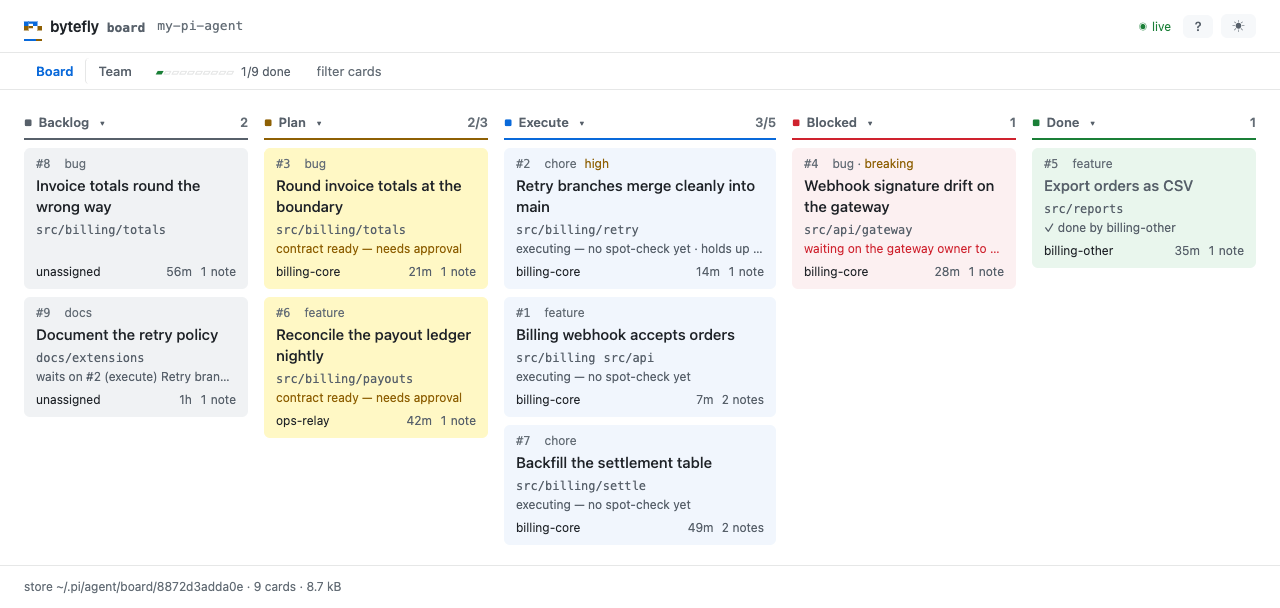 - **One board per repository**, one page: the first `/board` serves it, every other session opens it.
- **The page is a view**: it follows the files, and nothing is claimed, moved, or signed from a browser.
- **Two signatures**: the lead signs both gates — a contract before `execute`, the work before
`done` — with `board` or `/board`, and `/board` also takes the seat that refuses code (below).
- **The lane is the record**: told once which cards are its own and what each owes, and again after a `/tree` or a `/compact`.
- **Steps stay out of it** — they live in the owner's plan and `todo`.
## What you can do
| What you want | What to do |
|---|---|
| See the board | `/board` — Board and Team tabs, live |
| Take the seat | `/board` in the session that serves the page: code edits are refused until `/board exit`, which ends the page with the seat |
| Put a feature on it | `board({ action: "add", title, paths })` — a call, because `add` takes a title rather than a card id |
| Say what kind of work it is | `type` on `add` or `edit`: `feature`, `bug`, `refactor`, `docs`, `test`, or `chore` |
| Flag a breaking change | `breaking: true` on `add` or `edit`; `false` clears it |
| Take a card | `board claim 4` — into `plan`, owned by this session, and only while the bus holds a live record of it; `board reclaim 4` takes one back — the lead from anyone, a peer only once that owner's record says it stopped. The claims it took stay with the session that took them: only that session's `session release` frees them, or its stopping, and a release inside `execute` waits only for the next turn, so `paths: []` and the lane are the exits that last |
| Record what it promises | `board contract 4 path goal … acceptance … scopeOut … verify …` — all four lines, and the `verify` command is required |
| Approve the contract | `/board approve 4` in the lead's session, or the lead with the `board` action `approve` |
| Start the work | `board move 4 execute` |
| Block a card | `board move 4 blocked blocker decision blockedBy "waiting on the API owner"` |
| Set a card aside | `board shelve 4 note "waiting on the API owner" until 30d` — it stays in the pool, and `board unshelve 4`, or a claim, puts it back |
| Sign off finished work | `/board review 4` in the lead's session, then `board move 4 done`, and `/board next` starts the next session — once nothing of yours is in `plan` or `execute`; the page and its seat end with it, the record does not |
| Explain something | `board note 4 "why the retry is capped at three"` |
| Set finished work aside | `/board archive` in the lead's session, or the `board` action `archive` from any session |
| Read the round | `board list round: true`, or `/team` — owners, features, unassigned, shelved, unplanned, awaiting approval, awaiting review, untold, blocked, unwritten, done, and `, N archivable` when a sweep has something to take |
## Try it
```text
Put the billing webhook's order acceptance on the board, under src/billing.
```
The model calls `board({ action: "add", … })` and then, when you say so, `board({ action: "claim", card: "1" })`.
Those are tool actions, not commands: `Reference` lists every `/board` word and who may run one. The claim names
the next step, and `/board approve 1` refuses until the contract names a plan file in this repository's store.
A card is as tall as it draws: the line above its last one says what decides what happens next — a
dependency it waits on, one it has met, a gate it owes, or what a parked card waits on — and the row
prints that gate in one word, `untold` for a sign nobody heard, which a narrow terminal folds down.
A `round` read answers before the board: its collapsed line counts what needs a signature, the expanded block
names those cards by id above the board drawn once — each section counted, one past eight rows naming the rest.
## Reference
**Lanes.** `backlog` is the pool nobody holds, `plan` is where the card is designed and its
contract signed, `execute` is where the work happens, `blocked` waits on a person, and `done`
is closed. Each move follows the one transition from where the card is; no lane is skipped.
**The page.** A lane's width follows its work; five sit side by side (one below 1180px, via the picker) and a
lane of 24 folds. The pane is the one scroll box: a lane is as tall as the board, its head riding its edge. The
Team tab raises what needs the seat: one list of the moves only it can finish — sign a contract nobody read, send a notice that never landed, free a card whose owner is gone, chase one nobody has written to — each a two-line row that says its own reason, folded at five. Under it, `The board · N open` counts the four lanes it draws: `blocked`, `execute`, `plan`, and `backlog`, whose cards appear while the pool is small and become one line and a door past twelve. The terminal's rollup keeps its own counts (`9 unassigned · 5 unplanned`), because it answers what the board holds rather than what the seat owes — and its block's line carries the counts a card waits on somebody for, in the words that line prints. An owner's line counts the cards it holds — `mike (0 cards, 55 done)` — so `/team`'s `N of M sessions live` stays the only line in the round that speaks about liveness.
**Actions.** One tool, shaped by action: `list`, `add`, `claim`, `release`, `reclaim`, `move`, `note`, `contract`, `approve`,
`review`, `edit`, `shelve`, `unshelve`, `archive`, `drop`. `claim` and `move` are refused while a lane is full; `claim` is also refused while the bus
holds no live record of this session — the fact that decides whether the tool is offered at all — so it wrote nothing and names `/team join` or `/board`, while a run with no bus claims as it always has. `assign` is `team`'s verb under that rule, and one session holds one card in flight by default (`board.wip.perOwner`). `move` into `execute` or `done` re-reads the plan and refuses a
card whose plan is gone. An `execute` card claims the `paths` nobody else holds; `edit` claims added paths and releases removed
ones, claiming first so a conflict releases nothing. A contract names a `verify` command — the card's own suites, and then
the repository's gate, `bun run check`, [as the walkthrough writes one](../tutorials/first-board.md) — and `review` runs the module and suite size gates first, then the command, in the tree `root` names, refusing the sign when either gate is red; a tree that carries no commit past the base branch is refused before either gate starts, naming the tree and pointing at `root` for the card's worktree; a tree that keeps neither gate file skips them, and the sign records the skip so a reader can tell "they held" from "they were not there". The result then names the base branch when it has moved past that tree — `origin/main moved to 20fdf9c7: sync before the merge, or the sign names a tree the landing will not reproduce` — because the sign names a tree and the landing merges it into a base that may have moved since; it refuses nothing, since a lead may sign and land in one pass while the base is steady, which is the clean form.
`done` refuses a sign with no result or one older than the card's state, and resolves the landing: an older tree, a tip
declaring another card, or a squashed branch its subject names. A reviewed merge is its own landing
only while it is the tip; `done` records the merge, `landed: ` names it, and `override` reads "by instruction".
A folded card names that merge in `landed`; the argument is checked at or below its spot-check, never above it. A close
the caller resolved no landing for at all is refused as unchecked, while a spot-check that named no commit closes
with nothing to prove.
**Commands.** `/board` serves or opens the page (add `team` for the Team tab; `serve.autoOpen` off prints the URL);
`/board next` starts a new session at a boundary; `/board approve ` and `review [--root ]` sign,
`archive` sweeps, `status` prints the seat, repository, port, and tabs, and `exit` ends the page and the seat together,
which costs the live round. A word refuses a flag it does not declare or a word it does not take, naming the ones it has.
**Who signs.** The lead is `team.lead` in `bytefly.json` (default `gavin`), and the page serves as that name; an
empty lead lets only the person sign and serves no page. A session signs only while it is the lead, never while
it holds the card, and the `/board` words gate on that label. The sign says who heard it — quiet, not listening,
or not told — and an untold one is sent again.
**Lead mode.** Serving the page is the seat: `/board` turns the mode on in that session and the bar draws `⚑ lead`. While it holds the seat keeps a closed
allow-list — the readers `read`, `grep`, `find`, `ls`, `read_doc`, `run_doctor`; the board's verbs (`board`, `team`, `session`, `plan`, `todo`, `goal`,
`question`, `subagent`); `web_search`, `web_fetch`, `bash` for read-only git — a retargeting `-C` or `cd` is refused with the by-revision forms to use instead (`git show :`, `git log `) — and every other tool is refused by a sentence naming `/board exit`. A tool's
own `readOnlyHint` does not admit it, so an MCP reader is refused while the seat is held. `subagent` stays read-only, `plan` keeps `write` and `steps`
while `enter` refuses, and each turn carries one `[LEAD MODE]` line: the seat's unread mail, what is yours to sign, each parked card's decision,
the pool's three ids and a count, who is listening. A seated session lands a reviewed card with `board land`, which refuses anyone else, so the seat stays on. Its subject is derived, never supplied: the one extension its paths name, unless the paths naming another extension or an area other than `lib` outnumber it (a tie stays with the extension); then the title's `scope:` prefix; then the area of the first path that names one — any top-level directory but `extensions`, or a root documentation file, while `extensions/…`, `package.json` and `CHANGELOG.md` name none; then `board`. `lib` is the one area that is not a surface — it is every shared helper's address, not something a reader opens — so a card the area rung would settle there names nothing at all and the landing refuses it, saying to retitle it `: …`; `docs` and `test` are surfaces and stand. So a card whose paths name two extensions and whose title carries no scope lands `merge(board)`; the surface belongs in the title (`session-bus: …`), which lands as that scope. The merge that follows tells the holder it is theirs to close, naming the sha `done` resolves against. The bullet is the landing's too: the same subject's scope and title and the card's id, filed under the heading its `type` earns, so a branch never edits `CHANGELOG.md` — one that does is refused before the merge, and the landed tree is the signed one plus that line, a version cut's foot references being the one edit a branch may make. Its proof refuses a merge whose changelog is anything else; in `test/suite-manifest.ts` it refuses a declaration unless the merge no longer carries the suite it named — a suite's removal deletes its declaration, while a declaration whose suite survives is a rewritten record.
**Where it lives.** `~/.pi/agent/repos//board/` — a card per file under `cards/`, with `archive/` and `ended/` beside it. The archive holds more than one record shape: a file written before the lanes says `status` and no `lane`, and the reader maps that word (`todo` → `backlog`, `doing` → `execute`, `done` and `blocked` as themselves), so nothing is rewritten. A card records its plan by the **name** it holds in this repository's plan store, not this host's path, so two machines sharing a store resolve it on either — and a card holding an older absolute path still executes. A shared store is compared on every write, so it converges rather than serializing — [two machines, one store](../multi-session.md#two-machines-one-store). A plan file is one card's: a `contract` naming a name another card records is refused, naming that card, because the file is what a sign covers and a re-plan elsewhere would rewrite it.
## Limits
- `done` is terminal: a card finished by mistake is dropped and re-added at a new number. Nothing prunes itself: `archive` takes a card nothing waits on, and `--older-than 30d` bounds it, naming what it kept.
- The lead is a name, not an authority: any session can join it, and a lead holding a card can release it, sign it and
claim it again. A lead holding no card may still move it `plan` → `execute`, or close a signed card whose holder the
bus lost — a close, not a signature; every other verb is the holder's. A gate is a reading.
- Settle title, paths and contract before the sign: a write after the spot-check stops it speaking, and a branch is proved against `main` as cut — the spot-check's own result says so when the base has moved, so the sync is a step the holder takes before asking for the sign rather than a merge and a re-sign after it. `board land` keeps three copies of its own rule apart — the process's, the checkout's disk, and the tree the spot-check signed. It refuses a process older than the disk, naming `lib/workflow/land.ts` and the reader `lib/workflow/suite-declarations.ts`: `/new`, `/board next` and `/reload` all keep a `lib/` module another extension already loaded, so a restart is what fixes it. And it refuses a signed tree that carries a different verb, naming the exact changelog line to commit and the `###` section it belongs under — that commit is a new tip, so the same branch needs a second spot-check before it lands, and the restart is owed after rather than before.
- A contract's `verify` names the card's own suites, and then `bun run check` — the gate that proves the tree — because the spot-check
runs the command and nothing else, so format, `tsc`, the size gates and the sweeps are otherwise a claim the holder ran by hand.
A card that changes no code names `bun run check` alone, because it has no suite to lead with.
- The same failure appears when a card claims a sentence is tested: a green run that reddened nothing is not coverage, so the
detail line's `waits on: #1` says nothing about the listing's `waits on #2, #3`, and a case that never failed is a rule nobody
knows holds. Neither is a gate: a card lives outside this repository, so the sign is what reads them.
- Ownership is a session id, not a lock: a card in `execute` holds its `paths` as the bus's claims and as the tree's write boundary, and a lane change frees only the writer's. While the session's only card sits in `plan`, `blocked`, or the pool, `write`, `edit`, and every shell but a read-only git command are refused, naming `board move execute` — or `board release `, for work that is not the card's. The `paths` bound the two file tools, the shell is judged by lane and not by path, and a hint is a prefix for both readers: the gate refuses a write outside it, and the bus's claim covers what lies under it. So a card whose work grows widens them with `board edit paths [...]` up to twelve, and past twelve names the directory its files share (`lib/workflow/`), one hint where five files would have been; the refusal names that door, which is how the file list keeps up with the work. A session holding no card writes as it always did, and a card a page moves mid-turn is read again by the next `board` call rather than by the write it interrupts. A card whose owner's record reads `gone` is pooled by the next start's sweep, whatever the card calls that owner: the sweep reads the id `holds` compares, never the name, so nothing on the board is re-owned by a name — a pruned record waits for a person, because no record is not a session that stopped. A sweep also keeps the spot-check it finds: holding the seat is not withdrawing a judgement, so only the signer's own reclaim takes a sign back.
- Plan mode is a card's own step, so the model's `plan` `enter` is refused while this session holds no
card, naming `claim` (`board add` opens one) so the plan has a card to record it against; a session on
a bus is offered `/team exit` beside it, and one the board's tool is withheld from is not gated at all.
The person's `/plan` and Shift+Tab raise no tool call, so they stay their own doors.
- The two tools that run what they are told are judged by their action, the way the shell is judged by its
grammar: `job start`/`send` and `watch add` need the card in `execute`, while `job list`/`status`/`logs`/`wait`
and `watch list`/`status`/`matches`/`logs` are reads. `kill`, `stop` and `clear` are allowed in any lane too,
because they clean up a process the card does not own and write no tree.
- The `board` tool is also the seat's signing surface, so it goes with the team: `/team exit` refuses while the seat is served, and a record that goes without a leave takes the tool at the next turn — and that turn's seat line carries the door with it, so losing the tool is a fact with a way back rather than a silence.
- The page asks the bus for a stamp every second — mail waiting, a peer's state, a turn starting — and sweeps every five for what no file announces; a page with no watch scans every second. The reader is the stream, not the tab: while one is open the tick reads, and with none it reads nothing at all — no stamp, no frame — and no timer waits for a closed tab to come back, so the session outlives its page.
## Settings
| Key | Default | What it does |
|---|---|---|
| `wip.plan` | `3` | Cards a repository may hold in `plan` at once (1–20). |
| `wip.execute` | `5` | Cards a repository may hold in `execute` at once (1–20). |
| `team.lead` | `"gavin"` | The team name whose signature the two gates take. A stated empty lead is no lead: only the person signs, and `/board` will not serve. |
| `team.teammates` | `["gavin","tom","jack","mike","sam"]` | Who is on the team: labels, at most 20 of them. A session the bus has not recorded takes the first free one as the name it writes — `team-agent-` once every one is held — and the footer draws a name only when it is one of these, so a stated empty list draws no chip. |
The limits live in `board` and the names in `team`, both edited by `/bytefly settings`
([configuration](../configuration-reference.md#team--the-projects-own-team)); toggle `board` to switch it off.
## Learn more
- [Your first board](../tutorials/first-board.md) — one feature through both gates.
- [Several sessions](../multi-session.md) — the round the cards, the bus, and the lead make together.
- [`team`](../extensions/team.md) — handing a card to a peer.
- [`session-bus`](../extensions/session-bus.md) — the bus the signs travel on.
- [`plan`](../extensions/plan.md) — the plan a contract points at.
- [Troubleshooting](../troubleshooting.md) — when a gate refuses the session that holds the card.