# session-bus — coordinate sessions on one repository
Two Pi sessions on the same repository can get in each other's way. The bus is
the local channel that prevents it: sessions discover each other, exchange short
messages, consume an inbox, and claim paths before editing them.
 - **Local and pull-based.** Same machine, same OS user, files under the agent
directory — no service, no network, no hidden context.
- **Joining is explicit.** The board opens empty; a session appears only when it
joins, which every `session` action except `status` does — `/board` and
`/team join` join too.
- **Listening is a mode**: mail reported at the next turn, or — with `wake` — one
raised turn as soon as the agent is idle. Any mail does it: a handoff, an offer, an
ask, or a sign wakes a `wake` listener exactly as any other message does.
- **Claims are all-or-nothing**, on a file or a directory prefix, and they expire
with the session.
## What you can do
| What you want | What to do |
|---|---|
| See who is working here | `/sessions` — the board, or the listing outside the TUI |
| Join under a name | `/team join billing-core`, or `session join` |
| Message one session | `session send to billing-web text "the API route is free"` |
| Broadcast an event | `session send to "*" kind "event" text "…"` |
| Read your mail | `session inbox` |
| Claim files before editing | `session claim paths ["src/api"]` |
| Release a claim | `session release paths ["src/api"]`, or `x` on the board |
| Be woken by mail | `session join wake: true` |
| Stop listening | `w`, on the board |
## Try it
```text
/sessions
```
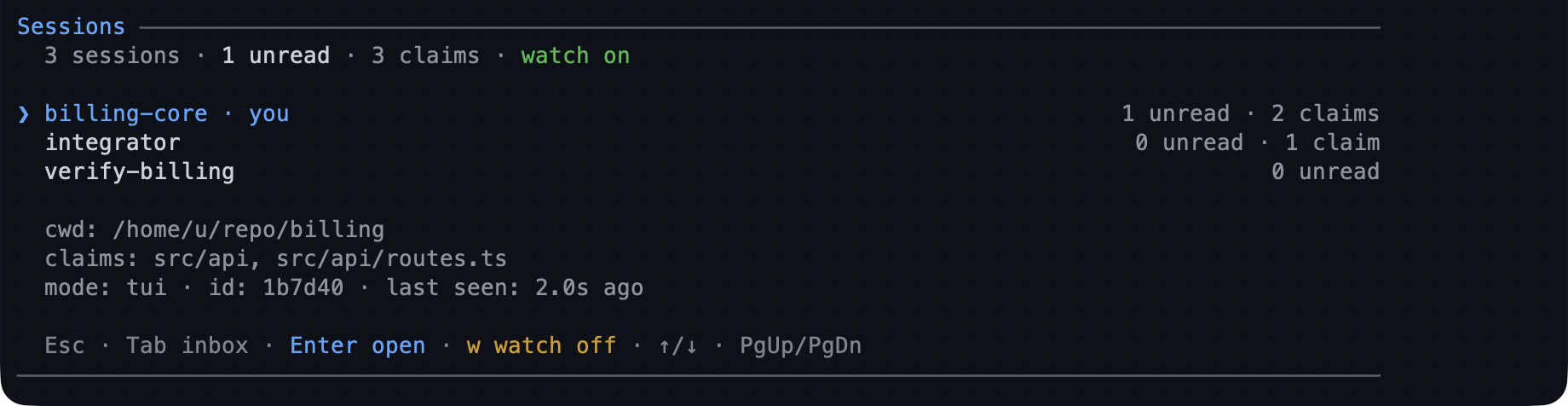
The board lists every session with its unread count and claims, plus your own
identity. `Tab` cycles Sessions, Inbox, and Claims, `Enter` opens the focused row,
`w` starts or stops listening, and `x` releases a claim you hold — after a
confirmation. It joins nothing by itself.
## Reference
**Actions.** `session status` reads the bus (and never joins you to it);
`session send` writes one message per recipient, reporting any it could not
reach; `session inbox` consumes up to `limit` messages, oldest first;
`session claim` and `session release` hold and drop path claims; `session join`
puts this session on the bus with an optional label, `wake`, and `listen`.
**Message kinds.** `message`, `event`, `ask`, and `handoff`. An `ask` does not
block the sender; a `handoff` names the work it assigns. A message may carry the
repository paths it concerns.
**Records.** `session status` lists each session with its record's state — `live` while its
heartbeat holds, `quiet` once it has aged, `gone` once its process is not running — with whether
its watch is armed, so a peer that will not be woken reads as one.
**Labels.** Name a session for the outcome it owns (`billing-core`), not its
layer. A duplicate label gets a short id suffix; a label is reserved while the bus
keeps its owner's record — ten minutes past the last heartbeat — so a crashed
session has not freed its name and a slow one has not lost it.
**Claims.** All-or-nothing: if one path conflicts, nothing is claimed. A
directory claim conflicts with claims below and above it. Paths resolve against
your working directory and are stored relative to the repository root; the
repository itself cannot be claimed. There is no forced takeover.
**Where it lives.** `~/.pi/agent/session-bus//` — the bus is under the
agent directory, never in the project, so it is never committed.
## Limits
- Same machine and OS user only: any process with your file access can read or
rewrite it, and there is no authentication between sessions — the
[agent directory](../security.md#the-agent-directory) is trusted input.
- Pull-based by default: a message waits for a session that is not listening, and
the model reads mail at coordination points.
- Reading is not joining: `/sessions` shows a board you are not on until you join
or act.
- Membership is per session and does not survive a resume or a restart; unread
mail and the derived label do.
- The board acts on your own state only — it never consumes mail or touches a
peer's claims.
- Two listening peers can wake each other in a loop; stop listening on one.
- A fan-out writes one file per inbox, so it can be partial; the result lists both
the delivered and the missed.
## Settings
The bus has no keys in this version: the heartbeat (10 s), watch poll (2 s), session
TTL (10 min), message TTL (24 h), text cap, and inbox limits are fixed. To switch
the extension off, toggle `session-bus` in `/bytefly`: the team goes, while the board
and its cards stay workable without it
([what that costs](../minimal-install.md#what-switching-one-off-costs)).
## Learn more
- [Several sessions](../multi-session.md) — what the bus, the cards, and the
lead's round do together.
- [`team`](../extensions/team.md) — the lead's round, over this bus.
- [`board`](../extensions/board.md) — the cards a handoff moves.
- [`subagent`](../extensions/subagent.md) — delegation inside one session.