# board — one shared feature board per repository
The board is one list of features for a repository, worked by every session on
it. A card carries what kind of work it is, its owner, its priority, what it waits
on, the contract it promises, and the notes that explain it — and two signatures
are needed before it can ship.
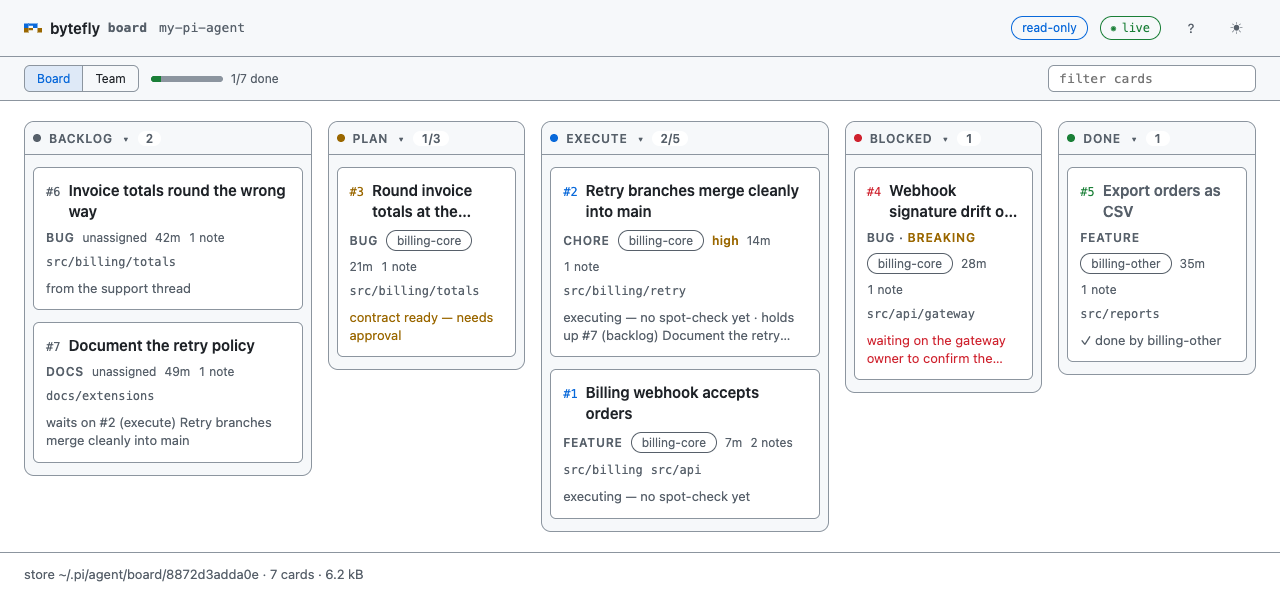 - **One board per repository**, and one page: the first `/board` serves it, every
other session opens that same page.
- **The page is a view.** Nothing is claimed, moved, or signed from a browser — assigning a
card means messaging its owner.
- **Two signatures**: the lead approves a contract before `execute`, and
spot-checks the work before `done`. The person at the keyboard can give either — how
a one-session repository finishes work — with `/board approve` and `/board review`.
- **The lane is the record, and a session is told which cards are its own** — once,
before its first turn, with what each owes next.
- **Steps stay out of it** — they live in the owner's plan and `todo`.
## What you can do
| What you want | What to do |
|---|---|
| See the board | `/board` — Board and Team tabs, live |
| Put a feature on it | `board add "" paths ["src/area"]` |
| Say what kind of work it is | `type` on `add` or `edit`: `feature`, `bug`, `refactor`, `docs`, `test`, or `chore` |
| Flag a breaking change | `breaking: true` on `add` or `edit`; `false` clears it |
| Take a card | `board claim 4` — into `plan`, owned by this session; `board reclaim 4` takes one back, from a peer only once that owner's record says it stopped |
| Record what it promises | `board contract 4 path <plan file> goal … acceptance … scopeOut …` |
| Approve the contract | `/board approve 4` as the person, or the lead with the `board` action `approve` |
| Start the work | `board move 4 execute` |
| Park a card | `board move 4 blocked blocker decision blockedBy "waiting on the API owner"` |
| Sign off finished work | `/board review 4`, then `board move 4 done` |
| Explain something | `board note 4 "why the retry is capped at three"` |
| Set finished work aside | `/board archive` |
| Read the round | `board list round: true`, or `/team` — owners, unassigned, unplanned, awaiting approval, awaiting review, blocked, done |
## Try it
```text
Put the billing webhook's order acceptance on the board, under src/billing.
```
The model calls `board({ action: "add", … })` and then, when you say so,
`board({ action: "claim", card: "1" })`. Those are tool actions, not commands:
you type only `/board archive|approve|review|status|stop|team`.
The claim's result names the next step, and `/board approve 1` refuses until the contract
names a plan file in this repository's store; a plan deleted later stops it at the next gate.
A claim also joins the team, and its result says when it could not ([`team`](team.md)).
Every card's last line says what it needs next, so a lane can be read without
opening a card: `contract ready — needs approval`, `executing — no spot-check
yet`, `offered 2h ago — nobody took it`.
## Reference
**Lanes.** `backlog` is the pool nobody holds, `plan` is where the card is
designed and its contract signed, `execute` is where the work happens, `blocked`
waits on a person, and `done` is closed. Each move follows the one transition the
board allows from where the card is; no lane can be skipped.
**Actions.** One tool, shaped by action: `list`, `add`, `claim`, `release`,
`reclaim`, `move`, `note`, `contract`, `approve`, `review`, `edit`, `archive`,
`drop`. `add` and `edit` record the kind of work (`type`) and the breaking marker
(`breaking`); both draw as one quiet label, and `list query` matches them. `claim`, `move`
and `assign` are refused while `plan` or `execute` is full, naming the ways out. `reclaim`
takes a card back to `backlog` from its holder, the person and the lead always, and from a
peer only while that owner's record says quiet or gone. `move` into `execute` or `done`
re-reads the plan where the write lands: a plan that is gone refuses the move, and the face
says `its plan is gone`. A sign nobody heard reads `· not told` on a live card; saying it
again sends the message. `review` takes an `override` — one line saying why — for a card
closed without the gate, which then reads `closed by instruction`.
**Commands.** `/board` serves or opens the page (add `team` for the Team tab);
`/board approve <id>` and `/board review <id>` sign as the person; `/board archive` runs the sweep;
`/board status` prints the seat, repository, port, and tabs; `/board stop` ends the page.
**Who signs.** The lead is `board.lead` in `bytefly.json` (`lead` by default), and the page serves
as that name. A session signs only while it is the lead and never while it holds the card;
`/board approve` and `/board review` sign as the person, marked `person: true`. The sign says who
heard it — quiet, not listening, or not told — and an untold one is sent again by its signer.
**Where it lives.** `~/.pi/agent/board/<repo-key>/` — one card per file under
`cards/`, with `archive/` and `ended/` beside it.
## Limits
- `done` is terminal: a card finished by mistake is dropped and re-added at a new number.
- Nothing prunes itself: `done` cards cost a read until `archive` takes them, which it only
does for a card nothing open waits on — and an archived record is closed but for `drop`.
- The lead is a name, not an authority: any session can join it, and a lead holding a card
can release it, sign it, and claim it again. A gate is a reading, not a permission.
- Ownership is a session id, not a lock: only `session-bus` path claims are. A card in `execute`
holds its `paths`, and a lane change releases only the writer's — so a `reclaim` from a peer
names what stays held; a card whose owner's session ended is released at the next start.
- A card keeps eight lane transitions; an unreadable card file is skipped, and named in the listing.
## Settings
| Key | Default | What it does |
|---|---|---|
| `lead` | `"lead"` | The team name whose signature the two gates take. |
| `wip.plan` | `3` | Cards a repository may hold in `plan` at once (1–20). |
| `wip.execute` | `5` | Cards a repository may hold in `execute` at once (1–20). |
They live in the `board` section of `bytefly.json`; `/bytefly settings` edits all
three ([configuration](../configuration-reference.md#board--the-shared-feature-board)). To
switch the extension off entirely, toggle `board` in `/bytefly`.
## Learn more
- [Your first board](../tutorials/first-board.md) — one feature through both gates.
- [Several sessions](../multi-session.md) — the round the cards, the bus, and the lead make together.
- [`team`](../extensions/team.md) — handing a card to a peer.
- [`session-bus`](../extensions/session-bus.md) — the bus the signs travel on.
- [`plan`](../extensions/plan.md) — the plan a contract points at.
- [Troubleshooting](../troubleshooting.md) — when a gate refuses the session that holds the card.