# job — background shell-command jobs for Pi
Run long-lived shell commands (builds, test suites, dev servers, watchers) in
the background and manage them without blocking the turn. A job starts
immediately and keeps running across tool calls; poll it, tail its output, wait
for it, or kill it.
 ```
pi --extension ./extensions/job # load just this extension
pi -e . # load the whole @gavin-hu/my-pi-agent package
pi install ./ # install the package
```
## Tool rendering
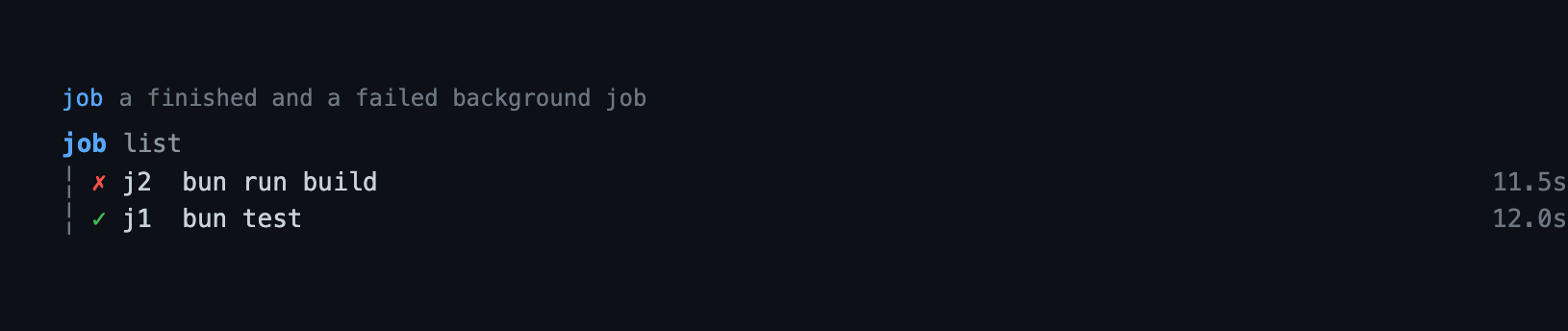
How the `job` call and its result look in the transcript — the call line as a headline and the body indented under it:
 ## What it does
- Registers one model-callable tool, `job`, with actions `start`, `list`,
`status`, `logs`, `send`, `kill`, `wait`, and `clear`.
- Shows this session's jobs, and — tagged `peer` — a live peer session's, so two
Pi sessions on one repo can see each other's builds; the peer's rows are
read-only on the screen.
- Runs each command in its own process group, streaming stdout and stderr to an
append-only log file under `~/.pi/agent/jobs//`. A segment rotates
to `.log.1` at `maxLogBytes` (8 MiB by default), so a chatty job cannot
fill the disk, and `logs` reads across the boundary.
- Feeds a running job input when it was started with `stdin: true`: `send`
writes a line (or a bare keystroke) to its stdin, and `eof: true` closes it, so
a REPL, a debugger prompt, or a `read` can be driven without a TTY.
- Shows a `▸ N` running status chip and a separate `✗ N` unreported-failure
chip for this session's jobs, plus a `/jobs` screen for selecting, tailing,
killing, and clearing.
- Reports finished jobs to the model at the start of the next turn, or — for
jobs started with `wake: true` — by triggering one turn.
- Kills session-owned jobs on shutdown so no process is left behind; start a
job with `detached: true` to keep it running and reattach next session. A
detached POSIX job points its own output straight at its log file, so it keeps
logging after this process ends.
## Tool
| Field | Value |
|---|---|
| `name` | `job` |
| `action` | `start` \| `list` \| `status` \| `logs` \| `send` \| `kill` \| `wait` \| `clear` |
| `command` | Shell command to run (`start`). |
| `cwd` | Working directory (`start`); defaults to the session cwd. |
| `label` | Short display label (`start`); defaults to the command. |
| `wake` | Wake the agent with one triggered turn when it finishes (`start`). |
| `detached` | Leave it running when the session ends (`start`). |
| `stdin` | Give the job a stdin pipe so `send` can write to it (`start`); not with `detached`. |
| `id` | Job id such as `j1` (`status`/`logs`/`send`/`kill`/`wait`/`clear`). |
| `lines` | Log lines to return (`logs`, 1–2000). |
| `input` | Text to write to a running job's stdin (`send`; max 8192 characters). |
| `newline` | Append a newline to `input` (`send`; default `true`). |
| `eof` | End the job's stdin after writing, so it sees EOF (`send`). |
| `signal` | `SIGTERM` \| `SIGKILL` \| `SIGINT` (`kill`; default `SIGTERM`). |
| `timeoutMs` | `start`: kill the job after this many ms. `wait`: how long to block (default 30s). |
| `all` | With `clear`, also remove running jobs. |
Example: start a test suite, then poll it.
```
job start { "command": "bun test", "label": "tests" } → j1
job status { "id": "j1" }
job logs { "id": "j1", "lines": 50 }
job wait { "id": "j1", "timeoutMs": 120000 }
job kill { "id": "j1" }
job clear
```
`wait` honours the tool's abort signal: pressing Escape cancels the wait but
leaves the job running. While it blocks, the transcript draws a railed
`Waiting on j1… 12s` line with a live elapsed count. Validation is pure and runs
before any side effect, so `codemode` callers that bypass the TypeBox schema
cannot start a process with missing arguments.
Example: drive an interactive program. Only a job started with `stdin: true`
accepts input, and `eof` closes it once you are done.
```
job start { "command": "python3 -q", "stdin": true, "label": "repl" } → j2
job send { "id": "j2", "input": "print(1 + 1)" }
job logs { "id": "j2" }
job send { "id": "j2", "eof": true }
```
`send` writes `input` plus a newline by default, so a line-oriented program
sees one line per call; pass `newline: false` to deliver a bare keystroke.
Writing to a finished job, a job without `stdin: true`, or a job this session
does not hold the pipe for is an error, and the call changes nothing.
Each result carries a `JobDetails` object in tool-result `details`:
```
JobDetails {
action: JobAction
job?: JobRecord // start/status/logs/send/kill/wait
jobs?: JobRecord[] // list/clear
logs?: string // sanitized tail for `logs`
truncated?: boolean
cleared?: number
signalled?: boolean // kill sent a signal to a running job
signal?: KillSignal // signal sent by kill (SIGTERM/SIGKILL/SIGINT)
sent?: number // characters of `input` written by send
stdinClosed?: boolean // send ended the job's stdin (EOF)
timedOut?: boolean // wait hit its timeout
cancelled?: boolean // wait was aborted; job still running
sessionId?: string // list/status: who made the call, for tagging peers
error?: string
}
```
### Transcript
The call line names the action and its target. The result is themed and reuses
the slot's component: `list` draws the same rows as `/jobs`, `logs` draws a
blank line and the sanitized tail, and a single-job action draws one outcome
line. A `kill` that sent a signal appends it (`· SIGTERM sent`) instead of
showing the job's pre-kill running state, a `start` badges `detached` and
`wake`, a `send` appends what it did (`· sent 5 · stdin closed`), and a `logs`
call on a job with no output yet renders `No output yet.`
```
job list
▸ j1 tests 3.2s
✗ j2 build 0.4s
```
```
job logs j1
… 412 earlier lines
compiled successfully
```
```
job status j1
✓ j1 tests · exit 0 · 12.0s
```
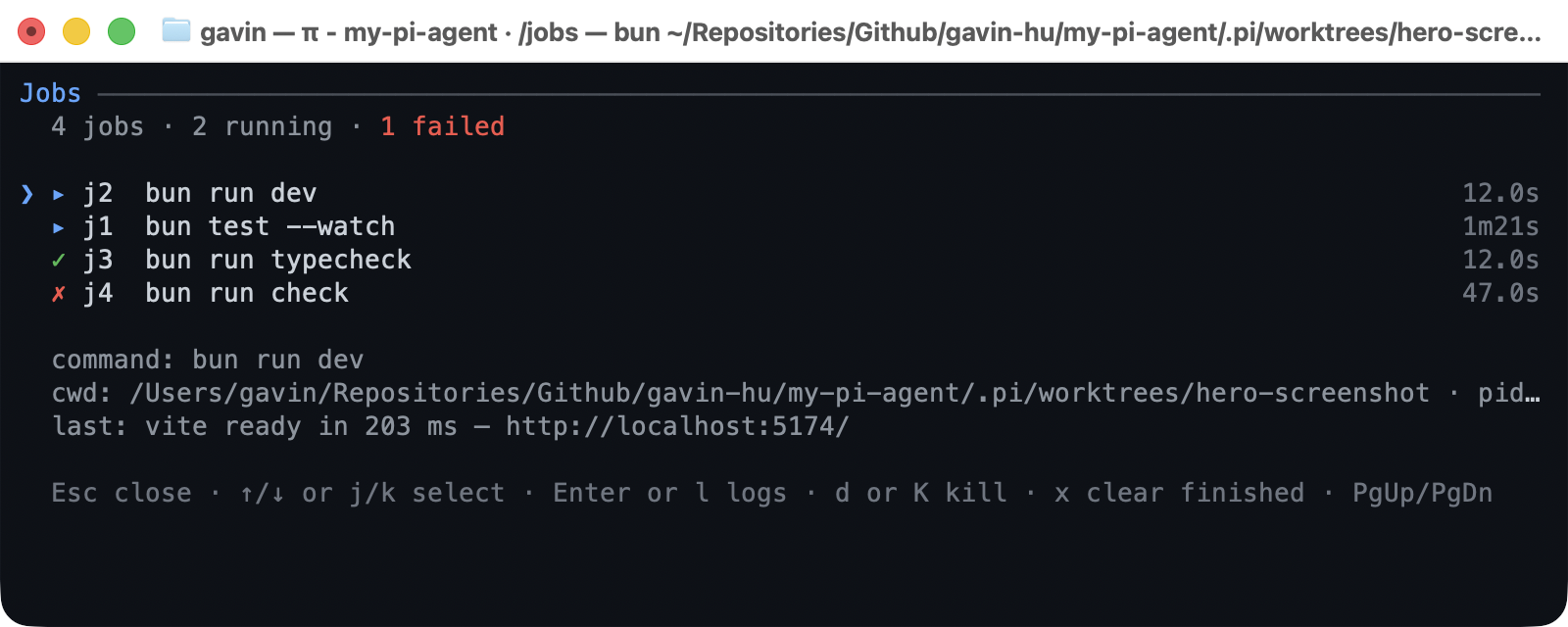
### Command: `/jobs`
`/jobs` opens an interactive list in the TUI, and prints a text summary
elsewhere. The list shows the jobs this session started, a dead session's
records adopted into it, and a live peer session's jobs tagged `peer`. On
the screen: `↑`/`↓` or `j`/`k` select, `PgUp`/`PgDn` page, `Home`/`End` jump,
`Enter`/`l` opens the log pane, `d` (or `K`) kills the selected running job,
`x` clears finished jobs, `Esc`/`q` closes. `d` and `x` ask for a `y`/`N`
confirmation before acting, so a stray key cannot kill a build; when `x` would
drop an unreported result, the prompt says how many. A `d` on a finished job (or
an `x` with nothing finished) says so instead of doing nothing. Another
session's row opens its log but is otherwise left alone: `d` answers
`j9 is another session's job; not killed.`, and `x` counts and clears only this
session's finished jobs. In the log pane,
`↑`/`↓`, `PgUp`/`PgDn`, `Home`/`End`, and `g`/`G` scroll; the view follows the
tail until you scroll up, and `Esc`/`Backspace`/`q` returns to the list. The
pane's subheader names the job's log file, notes when only a bounded tail is
loaded, and shows whether the view is `following` the tail or `paused`.
The screen shows a counts summary (`N jobs · R running · F failed · P peer`) over
the rows it shows, so it includes a peer's running job even though the footer
chips count only this session's. Running jobs come first, then recent finished
ones, and a focused detail pane follows (command, cwd, outcome, the owner when
it is another session, and the last output line). Selection is tracked by job
id, so the live re-sort cannot move the cursor or switch the open log out from
under the user.
Any dock screen (`/todos`, `/jobs`, `/rewind`, or the
`question` questionnaire) hides the above-editor goal/todo rails for its
lifetime and restores them on close.
## Behaviour by mode
The tool and `/jobs` work in every mode. The status chip and the interactive
`/jobs` screen need a UI; RPC and non-interactive runs receive tool results and
notifications instead.
## Configuration
The `job` section of the shared `bytefly.json` (global document, then project
document, project wins):
| Key | Default | Meaning |
|---|---|---|
| `enabled` | `true` | Track jobs at all. |
| `showStatus` | `true` | Show the `▸ N` / `✗ N` status chips. |
| `wakeOnFinish` | `false` | Wake the agent when any job finishes. |
| `detachedByDefault` | `false` | Leave jobs running when the session ends. |
| `maxJobs` | `20` | Finished jobs kept before the oldest are pruned. |
| `maxLogLines` | `100` | Log lines returned by `logs`. |
| `maxLogBytes` | `8388608` | Bytes a log segment may reach before it rotates to `.log.1`; `0` keeps logs unbounded. |
| `killGraceMs` | `5000` | Grace before SIGTERM escalates to SIGKILL. |
| `repaintMs` | `1000` | Status-chip refresh interval while jobs run. |
| `sessionTtlMs` | `60000` | How long a session heartbeat is trusted before its jobs may be reaped. |
| `registryDir` | — | Override the registry/log directory. |
## Security
Job output is arbitrary program output and is sanitized at every boundary
before it reaches a terminal or the model: ANSI/OSC escapes and control
characters are stripped, and carriage-return progress rewrites collapse to
their final state. This runs before text reaches the `/jobs` pane, the
model-facing `logs` result, and completion notes. The raw log file is never
rewritten.
## Limitations
- **`unknown` still has no exit code on some paths.** A POSIX job is wrapped in
an `EXIT` trap that writes `$?` to a per-job `.status` file, so a job
reattached after its session died reports its real exit code. `exec cmd`
replaces the shell and bypasses the trap, and Windows has no equivalent, so
those jobs settle as `unknown`.
- **Another session's jobs are shown, but not managed here.** Records are merged
from every session file so ids stay unique and a peer's job is not reaped, and
`list`/`/jobs` show them tagged `peer` (a dead session's records are adopted
into this one and lose the tag). The screen opens a peer's log but refuses to
kill or clear it, and the tool's `clear` refuses that record too; the tool can
still take one over by explicit id (`status`/`logs`/`kill`, where `kill`
adopts it). Chips, completion notices, and pruning stay this session's own, so
a peer's finished job waits for that session to clear it.
- **stdin is a pipe, not a TTY.** A job started with `stdin: true` can be fed
with `send`, but the child sees a pipe: line-oriented programs (a REPL, a
debugger prompt, `read`, `npm init`) work, while a full-screen program that
requires a terminal does not. Only the session holding the child's pipe can
write to it, so a reattached or peer job cannot be fed, and a `detached` job
cannot take stdin at all.
- **A detached job's log is not rotated.** A POSIX `detached` job points its
own stdout at the log file (`exec >> …`), so the file has a writer this
process does not own and cannot safely rename or truncate: the child would
keep appending to the moved inode, or lose everything. Its log therefore grows
without the `maxLogBytes` cap; `logs` still reads a bounded tail, and the file
can be emptied by hand.
- **Windows is best-effort.** Tree-kill uses `taskkill /T`; POSIX uses process
groups. A detached job only escapes the parent process on POSIX, where its
shell writes the log directly; on Windows it keeps the parent pipe and is
captured only until the session ends.
## Non-goals
- **No cron/scheduling.** Jobs run when started, not on a timer.
- **No durable task queue.** Persisted work items are `todo`'s domain; a job is
an OS process, and mixing the two would blur both.
- **No subagent-job wrapping.** Subagents already have a purpose-built result
pipeline; a job wrapper adds surface for little gain.
## Pi integration
| Integration point | Details |
|---|---|
| Tool | `pi.registerTool` name `job`; `exposure` defaults to `direct`. |
| Execution mode | `sequential` — actions share the in-memory job table. |
| Annotations | `readOnlyHint: false`, `destructiveHint: true`, `idempotentHint: false`, `openWorldHint: true` — plan mode blocks it. |
| `outputSchema` / `structuredContent` | None. Results return `JobDetails` in tool-result `details` only. |
| State storage | One durable registry file per session, `~/.pi/agent/jobs//registry-.json` (keyed by the session cwd, so entering a worktree does not move it), merged from every session file on load; a dead session's records are adopted and a legacy shared `registry.json` is migrated once. Ids are reserved with an atomic `O_EXCL` `.lock` before `start`, and a POSIX job's exit code is written to a per-job `.status` file. Tool results carry `JobDetails`; unreported completions arrive as a shared transcript notice (`my-pi-agent/notice`) at `before_agent_start`. |
| Lifecycle | `session_start` loads and reconciles the registry and arms `onFinish` and `onComplete`; `session_shutdown` kills session-owned jobs and clears both status chips. `session_tree` repaints; `agent_start`/`agent_settled` track busy; `context` prunes stale notices of its own source. |
| Event bus | Each job that reaches a terminal state is published on `my-pi-agent/job-finished` (`lib/events.ts`) with its id, label, status, exit code, and signal, from the one `settle` path every transition goes through. bytefly's notify capability subscribes there instead of importing this extension. |
## Design notes
- **Visibility is not ownership.** `list` shows every record in the merged
table, but each mutation keeps its own rule: the screen refuses a `peer` row,
`clear` refuses another session's record, `kill` adopts it deliberately, and
`send` has no pipe to reach it. The chips, completion notices, and pruning
stay own-only, so showing a peer never makes this session responsible for it.
- **Shell commands only, one action-based tool.** A single `job` tool with
eight actions mirrors `rewind` and keeps the model surface small. Validation
is pure and runs before any side effect.
- **The log rotates under the stream, not behind its back.** A parent-owned log
is a `WriteStream`; when the live segment reaches `maxLogBytes` the stream is
ended, the file renamed to `.log.1`, and a fresh stream opened, with
chunks that arrive during the swap queued (and bounded) rather than written
into the renamed inode. `logs` fills a request from the previous segment when
the live one is shorter, so the rotation is invisible to the model and to the
`/jobs` pane. A detached job writes its own log and is exempt.
- **Stdin is an opt-in pipe.** `start` keeps the child's stdin closed by
default, so it gets EOF immediately and a `read` exits instead of blocking;
`stdin: true` swaps in a pipe that `send` writes to and `eof` closes. The pipe
belongs to this process, so it never outlives the handle that owns it, and a
`detached` job is refused rather than handed EOF when the session ends.
- **`child_process.spawn`, not `pi.exec`.** `pi.exec` resolves on exit, the
opposite of a background job. Jobs are spawned with a shell in their own
process group, and signals go to the whole group so a shell and its
descendants die together; Windows uses `taskkill /pid /T`.
- **One registry file per session, merged on load.** A job outlives a tool
call and, when detached, a session, so each session writes only its own
`registry-.json` (atomic tmp + rename, best-effort) and every
file is merged on load. A dead session's records are adopted and rewritten
into this session's file before its file is deleted, while a live peer's are
kept for id reservation and reaping without being shown; a legacy shared
`registry.json` is migrated once.
- **Session-scoped surface, project-wide storage.** The registry merges every
session file for id reservation and adoption, but `list`, the chips, and the
`/jobs` screen show only this session's jobs. A job the session cannot clear
or report is never presented as its own.
- **Ids are reserved atomically.** Because ids are project-global but files are
per session, `start` claims the next `j` with an `O_EXCL` `.lock`
before spawning, so two sessions cannot pick the same id from a stale read;
the reservation is pruned once the id is committed to a registry file.
- **Sessions heartbeat; reconciliation is owner-aware.** Each session writes a
liveness marker, so a peer's live non-detached job is not reaped until its
owner's marker expires. `persist` merges onto a fresh read and drops ids this
session deleted.
- **Exit codes survive a session boundary.** A POSIX job is spawned behind an
`EXIT` trap that writes `$?` to a per-job `.status` file (path passed in the
environment); a later session reads it when it finds a dead pid and reports
`exited`/`failed` with the recovered code instead of `unknown`.
- **Reconcile on load; kill by default.** A dead pid becomes `unknown`, a live
detached job is reattached, and a live non-detached job whose owning session
is gone is killed. An abandoned build cannot keep running unnoticed, while a
`detached` dev server survives.
- **Pid reuse is guarded by a start-time token.** Before signalling an unowned
pid, its best-effort start token (`ps -o lstart=`) is re-checked; a mismatch
is treated as gone instead of as a signal. Where no token is available the
check degrades to liveness.
- **Reattached jobs are polled.** A reattached detached job has no child
handle, so its `close` event never fires; the repaint clock polls it and
settles it (recovering an exit code from the status file, else `unknown`)
when the pid disappears.
- **Notify by default, wake opt-in.** A failed job raises one `ctx.ui.notify`
(a clean exit is left to the list and chips). Finished jobs are also posted
as a shared transcript notice — model-facing text plus the notice block — at the
next `before_agent_start`. A `wake: true` job (or `wakeOnFinish`) additionally
triggers one turn when the agent is idle; auto-wake is not the default because
it easily loops and burns tokens.
- **Width-1 glyphs and cached latest line.** The running chip is `▸ N` and the
failure chip `✗ N`, each a two-token badge under its own status key, so the
status bar compacts each independently (`▸N` / `✗N`) and an unreported
failure is never hidden behind the running count. The latest output line is
cached from the stdout stream for `status`/`wait`/completion notes; only the
`/jobs` log pane reads the file.
- **Pure logic split from IO.** `format.ts` and the reconciliation in
`registry.ts` are pure; `process.ts` and the runtime take injectable
spawn/liveness/kill/clock functions, so the whole suite runs without
launching a process.
- **The transcript reuses the `/jobs` grammar.** `job list` renders the same
`jobRow` rows as the screen (running first, capped, `… N more`), minus the
selection-marker column (`listRow`'s `marker: false`), which only the
interactive screen needs; `job logs` draws a themed tail with a `… N earlier
lines` note, and single-job actions
draw one `formatJobOutcomeLine` (plus a signal note on `kill` and
`detached`/`wake` badges on `start`). A capped collapsed result ends with the
`app.tools.expand` hint, and an expanded list shows every job. The renderers
reuse `context.lastComponent`, and a `wait` in progress (`options.isPartial`)
renders as a `Waiting …`
warning.
## Files
| File | Responsibility |
|---|---|
| `index.ts` | Factory: registers the tool/command and wires events. |
| `schema.ts` | Parameter schema and pure validation (a `JobCall` union). |
| `config.ts` | The `job` section of `bytefly.json`: loading and clamping. |
| `format.ts` | Pure formatting, sanitization, duration, and transcript outcome-line helpers. |
| `process.ts` | Injectable spawn/liveness/kill-tree primitives. |
| `paths.ts` | Session/marker/registry/status file-name helpers. |
| `registry.ts` | Per-session registry load/merge, legacy migration, and pure reconciliation. |
| `reservations.ts` | Atomic `O_EXCL` job-id reservation and release. |
| `status.ts` | `EXIT`-trap exit-status file (write path via env, read on reattach). |
| `session.ts` | Per-session heartbeat markers and owner-liveness rules. |
| `store.ts` | Durable store: registry dir, this session's atomic merge-write, deletions. |
| `logs.ts` | Bounded, sanitized log-tail reading. |
| `ui.ts` | Footer status chips, over the shared `lib/tui/status-controller.ts`. |
| `waiters.ts` | `wait` resolver bookkeeping. |
| `runtime.ts` | Composition: job table, handles, process events, repaint clock. |
| `tui.ts` | The `/jobs` screen and the transcript `JobResult` rows, drawn from the `lib/tui/` kit (`titleRule`, `listRow`, `emptyState`, `IdCursor`, `LinePane`). |
| `tools.ts` | The `job` tool and its transcript rendering. |
| `commands.ts` | The `/jobs` command. |
| `types.ts` | Shared types. |
## Testing
`extensions/job/` covers schema validation (`schema`), pure formatting and
sanitization (`format`), the durable store (`store`), per-session reconciliation
(`registry`), id reservation (`reservations`), exit-status recovery (`status`),
session markers (`session`), bounded log reads and tail flags (`logs`), wait
bookkeeping (`waiters`), the `job` tool (`tools`), the `/jobs` screen (`tui`),
the runtime's session-scoped list and failure notification (`runtime`), `send`
to a job's stdin and the pipe's lifecycle (`runtime`), log rotation, its two
segments, and the cross-segment read (`runtime`), and the
install/resume/shutdown lifecycle (`extension`). Tests drive a scripted
`FakeChild` and a temp registry, so the suite runs without launching a process.